A One-Day Trip to Jingting Mountain
Have you ever had a mountain you especially wanted to visit, or a person you especially admired? Chinese characters are fascinating: a person and a mountain together form the character 'immortal' — no wonder Li Bai was called the 'Poetry Immortal'. Li Bai particularly loved climbing one mountain, which is Jingting Mountain in Anhui. He climbed it seven times and wrote a poem that generations of Chinese people know by heart. So we wanted to experience this somewhat special mountain.
Xuancheng, abbreviated as Xuan, was known in ancient times as Wanling or Xuanzhou. It is a prefecture-level city in Anhui Province. In January 1988, Jixi and Jingde counties were officially placed under the jurisdiction of Xuancheng Region. Since then, Xuancheng has governed 1 district, 4 counties, and 2 county-level cities: Xuanzhou District; Langxi County, Jing County, Jixi County, Jingde County; Ningguo City, Guangde City.
On the morning of October 5th, the young lady packed her bags ready to depart: the last stop of this National Day trip — the long-admired Jingting Mountain.
Hotel lobby: Jingting Mountain Scenic Area is located in the northern outskirts of Xuanzhou District, Xuancheng City, Anhui Province. Jingting Mountain is a branch of the Huangshan Mountains, with 60 peaks of various sizes, including three main peaks: Yifeng, Jingfeng, and Cuiyun Peak. The highest peak, Cuiyun Peak, is 324.1 meters above sea level.
Xuancheng was historically part of the Wu-Yue region, adjacent to Jiangsu and Zhejiang, and close to Shanghai and Hangzhou. It is known as the 'Home of the Four Treasures of the Study' in China. It has been honored as a National Historical and Cultural City, National Health City, National Garden City, National Forest City, and National Civilized City.
A corner of the underground parking lot: Xuancheng has 1 national 5A-level scenic spot, 21 4A-level scenic spots, 1 national-level historical and cultural city (Jixi County), and 1 provincial-level historical and cultural city (Xuancheng).
Somewhere in the city, preparing to eat breakfast: Xuancheng has 3 national-level historical and cultural towns/villages: Shuidong Town, Zhaji Village, and Jiang Village; 4 traditional Chinese villages: Zhaji Village, Huangtian Village, Jiang Village, and Longchuan Village.
Xuancheng also has 13 provincial-level historical and cultural towns/villages: Taohuatan Town in Jing County, Huangtian Village, Ganxi Village in Guangde City, Xiaohu Village in Xuanzhou District, Meizhu Town and Yao Village in Langxi County, Longchuan Village, Hu Village, Kantou Village, Shangzhuang Village, Feng Village, Shijia Village in Jixi County, and Hule Town in Ningguo City. All are worth a visit.
Plenty of snacks, but too many people — you have to queue. The pan-fried buns are good.
Arrived at the simple South Gate parking lot at 9 o'clock: We originally planned to enter through the East Gate (main gate), but we met a morning exerciser on the road. The Minister warmly asked for directions, and the person answered sincerely, saying that we could drive in through the South Gate, which was not far from there, and told us how to enter the main gate. After entering the main gate, there were two walking paths: one along the foot of the mountain, and the other going straight up the mountain first and then walking along the ridge. The answer was very detailed and clear. We thought we kind-hearted people had met another kind-hearted person, and we thanked him repeatedly. The place where we asked for directions should be the core scenic area where the Buddhist Pure Land sect's Hongyuan Temple and the Chan sect's Guangjiao Temple are located.
There is a reservoir at the South Gate: there are many winter swimming enthusiasts there. I felt very cold.
Jingting Mountain, located on Zhaoting North Road, Xuanzhou District, Xuancheng City, Anhui Province, by the Shuiyang River, is a famous historical and cultural mountain in China. Originally named Zhaoting Mountain, it was renamed Jingting Mountain in the early Jin Dynasty to avoid the taboo of Emperor Sima Zhao's name.
The security guard at the gate checked our travel code and immediately let us pass. Southerners are indeed gentler.
The signs were very clear: we decided to climb directly while we still had energy.
The four major scenic areas of Jingting Mountain: the Twin Pagodas Scenic Area, the Duzuo Tower Scenic Area, the Yifeng Scenic Area, and the Wanling Lake Scenic Area. Historical sites are mostly concentrated in the Twin Pagodas and Duzuo Tower areas, and there are mountain gate archways, the Ancient Zhaoting Teahouse, the Green Snow Teahouse, the Taibai Duzuo Tower, the Huaiying Pavilion, the Imperial Aunt Spring, and other waterside pavilions and terraces.
A pavilion for swallows to rest — nice.
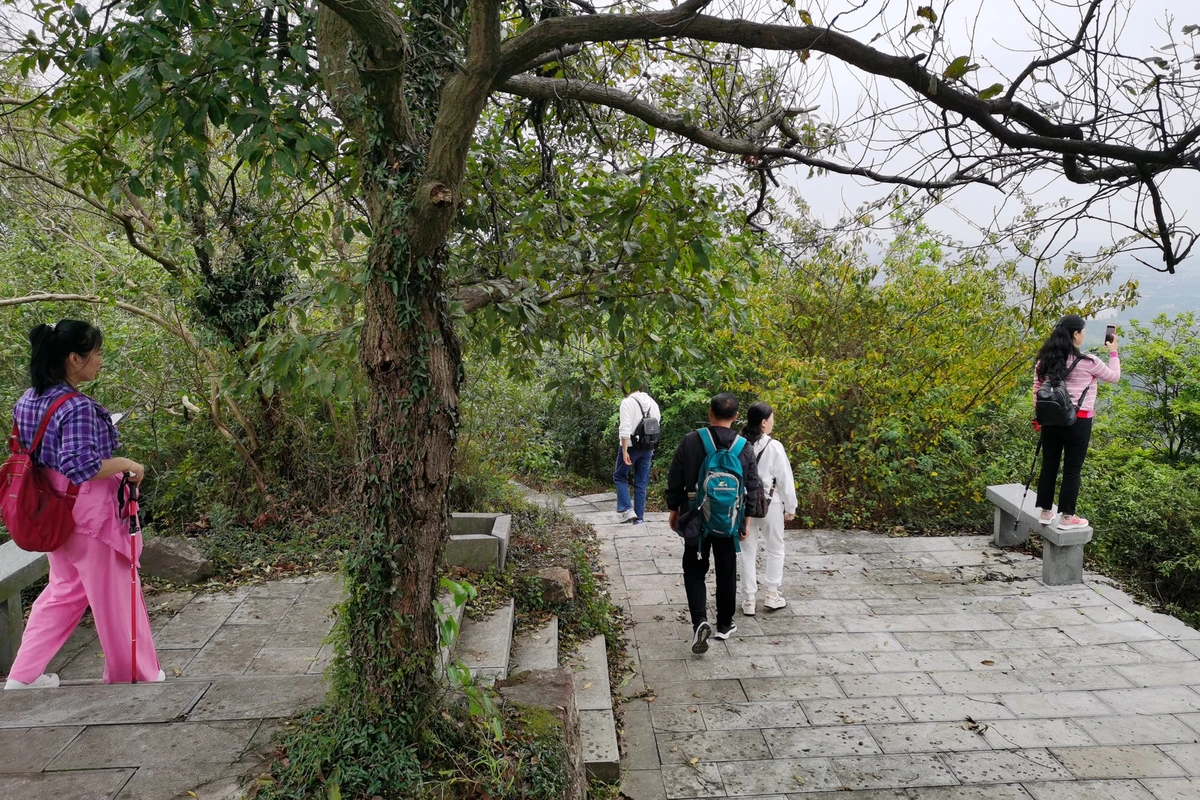
Starting the climb: Looking at the way everyone was walking, their legs were still a bit sore.
In 1996, Jingting Mountain was designated as one of the first batch of National Forest Parks by the Ministry of Forestry. In January 2012, it was approved as a national 4A-level scenic spot.
Looking back at these steps, the difficulty index: three stars.
Good stamina, Yanzi.
After reaching the top, we walked along the ridge, crossing one small peak after another.
Although Jingting Mountain is not among the five famous mountains, it has gained rich cultural heritage thanks to Li Bai's poem 'Sitting Alone in Face of Peak Jingting'.
Overlooking Xuancheng city area.
Among China's famous mountains and great rivers, Jingting Mountain is just a small hill, but it became famous because of Li Bai's poem. I humbly borrow a line from Feng Xiaogang's character in the movie 'Kung Fu Hustle': 'Who else...'
Tianji Pavilion is in sight from afar — keep going.
Reached Tianji Pavilion:
From Tianji Pavilion, overlooking the city. When Li Bai climbed Jingting Mountain, this pavilion probably didn't exist yet.
Falling behind, huh?
Arrived at Taibai Duzuo Tower. The side facing the mountain was locked; we had to walk down and go up from the opposite side to enter the tower.
Passed Huaiying Pavilion:
Tourist map: we entered from the South Gate. As you can see, it took 2 hours of walking to reach Tianji Pavilion. The scenery along the way was ordinary; we considered it as exercise.
Why is it called Huaiying Pavilion? This record is worth highlighting, but it's placed in an inconspicuous spot, and many tourists miss it. Our happy life today should make us especially grateful to these heroes who sacrificed their lives for the country...
Huaiying Pavilion, located at the top of the main peak 'Yifeng' of Jingting Mountain, was built by the Kuomintang's 108th Division stationed in Xuancheng to commemorate the anti-Japanese battle at Xinhe Village and the martyrs who died there. The monument in the pavilion was inscribed by the political director Sun Maiqiu, and the inscription describes this heroic battle and lists the names of some of the martyrs who fell in that battle. We must not forget those heroes who defended the dignity of the Chinese nation and protected our territory from invasion. Bow to them in tribute!
Otherwise, how could we enjoy our sweet and loving life?
The title 'Jiangnan Poetry Mountain' probably makes other mountains sigh with envy: For over a thousand years since the Southern Qi poet Xie Tiao served as the governor of Xuancheng, Li Bai was a frequent visitor here, which naturally increased its fame, attracting celebrities from all over to tour, especially poets, who came in an endless stream. After Bai Juyi, Du Mu, Liu Yuxi, and other literary figures arrived, they felt inspired to write poems and leave their calligraphy. Jingting Mountain in Anhui has truly become the 'Jiangnan Poetry Mountain'.
So high; I sighed at the foot of the tower and just wandered around the first floor. Taibai Tower, also known as Taibai Duzuo Tower, is located at the southern waist of Jingting Mountain. It was built in the 12th year of the Tianbao era (753 AD). Because Li Bai wrote the famous poem 'Sitting Alone in Face of Peak Jingting' here, later generations built the 'Yongcui Pavilion' here and erected a monument to record the event. This pavilion was also commonly called 'Taibai Pavilion'.
In the Qing Dynasty, this pavilion was converted into Taibai Tower, with the lower floor serving as a Taoist priest's residence. It was destroyed by fire in 1937. In November 2014, the Xuancheng municipal government built a new Taibai Duzuo Tower near Huaiying Pavilion on the mountainside of Jingting Mountain. 'The tower is 33 meters high, with 4 floors, and is built in the style of Tang architecture.'
In the third year of the Tianbao era of Emperor Xuanzong (744 AD), Li Bai was given gold and released to return home, not tolerated by the court. Disappointed, he began his life wandering the world, experiencing all the bitterness and sweetness of life.
In the 12th year of the Tianbao era, Li Bai came to Xuancheng, Anhui. Here he made friends with the farmer Wang Lun and wrote the timeless poem 'To Wang Lun'. At this time, Li Bai was actually lonely and disappointed inside, so he often climbed Jingting Mountain, watching the high-flying birds and drifting clouds, feeling deep melancholy, and thus wrote 'Sitting Alone in Face of Peak Jingting'.
Another important reason Li Bai loved Jingting Mountain so much was that it once bore the footprints of his idol, Xie Tiao.
Xie Tiao was a poet of the Southern Dynasties who served as the governor of Xuancheng. In his spare time, Xie Tiao often visited Jingting Mountain. When Li Bai sat alone on Jingting Mountain, he felt he could have a spiritual exchange with Xie Tiao.
Secondly, Li Bai had an unusual personal relationship with Princess Yuzhen. The princess had repeatedly recommended Li Bai to Emperor Xuanzong. Regardless of whether Li Bai ultimately succeeded or failed in his official career, this kindness was unforgettable to Li Bai. Moreover, Li Bai had entered the Daoist path early on, and the two shared common interests and were particularly compatible, even having feelings beyond friendship. Naturally, Li Bai would frequently come to Jingting Mountain.
After the An Lushan Rebellion, Li Bai and the princess went to Jingting Mountain together to avoid the turmoil. From then on, Li Bai climbed Jingting Mountain a total of seven times, and each time he stayed for a long time. Obviously, since the princess was there, he would naturally come. Later, the princess passed away peacefully on Jingting Mountain. To commemorate this down-to-earth princess, people called her burial place 'Imperial Aunt's Tomb', and nearby there is the 'Imperial Aunt Spring' and 'Imperial Aunt Bridge'. Coincidentally, in the same year, the Poetry Immortal Li Bai also passed away in Anhui.
Since there is no exact record, it's hard to judge whether the relationship between the two was real or not. Personally, I think the relationship between Li Bai and Princess Yuzhen was most likely real, because when too many coincidences appear at the same time, it indicates that the truth has emerged. So, while Li Bai made the Poetry Mountain famous, the Poetry Mountain also fulfilled the great poet and the princess's feelings.
When we travel with these stories in mind, what we see is no longer just a mountain or a tomb, but a touching romance between the Poetry Immortal and the princess. With this association, the mountain becomes more vivid and interesting.
Although Jingting Mountain is not high in altitude, its scenery is picturesque and full of ethereal beauty. Legend has it that when Li Bai first arrived in Xuancheng, the local literary world was stirred, and dignitaries flocked to welcome him. Fans entertained him lavishly, vying to treat him, considering it an honor to accompany Li Bai on mountain tours and enjoy poetry with him.
Along the Haohan Slope heading down, there is a viewing platform where you can look into the distance and enjoy the scenery. Here you can breathe fresh air and admire the beautiful tea plantations. Along the way, there are also pavilions for public rest, such as Chongyang Pavilion and Lansheng Pavilion.
When the An Lushan Rebellion broke out, Li Bai's best friend Du Fu was captured, another good friend Wang Changling lost his life, and he himself was chased around by the rebel army. Poverty and illness tormented him physically and mentally.
On the surface, this poem is about loneliness, but in fact it is full of unrestrained ease. We can see a rich and interesting person who, even alone, could enjoy himself thoroughly. What does this show? It shows his inner strength.
'All birds fly high away, / A lonely cloud drifts off at leisure.' In the past, when he visited Jingting Mountain, he was always surrounded by attendants, but now he was alone. Not only that, even the birds in the sky seemed to disdain him — as soon as they saw him, they flew far away until they disappeared; the clouds in the sky glanced at Li Bai and drifted away as well.
At this moment, Li Bai was like a child abandoned by the whole world. Who was still left by his side? Who would remain with Li Bai through thick and thin?
Lonely, Li Bai looked around; the only thing accompanying him was Jingting Mountain. Only Jingting Mountain opened its arms to welcome this aging wanderer.
Thus, Li Bai couldn't help but sigh, 'We never get tired of each other, / Only me and Jingting Mountain.'
Here, 'tired' does not mean 'annoyed' but 'satisfied'.
Whether 'birds' or 'clouds', they are all 'passing clouds' — let them go. It is enough that Jingting Mountain understands me.
Jingting Mountain gave Li Bai a kind of comfort. He saw through everything, let go of everything. The Great Way is simple; he cultivated his mind and nature in nature, meditated on Dao and Zen, merged with heaven and earth, achieving 'harmony between heaven, earth, and man'.
Li Bai left his leisurely figure on Jingting Mountain, and more importantly, he wrote Jingting Mountain into the hearts of the Chinese people.
Ticket price: 10 yuan. We took the sightseeing car down to the East Gate. But the gate was closed, and we were told to exit from another gate. Darn it, we had to walk again.
At this point we were very close to Jingting Square, which is also the entrance most tourists use to officially start climbing.
Across from Jingting Square, separated by Taibai Lake, is the newly built Hongyuan Temple, built in the style of Tang architecture, very imposing.
Self-driving tourists don't have to park at the distant East Gate Plaza. There is parking at Jingting Square, and there is also a parking lot in front of Hongyuan Temple. Next to Hongyuan Temple, there is a winding mountain road, but the road is not good. Motor vehicles are prohibited from driving up the mountain in the scenic area. We went the opposite way — entered from the South Gate near Guangjiao Temple. Hehe, you know.
There are many forks on Jingting Mountain, and signs are posted at each intersection. The section from Jingting Square to Taibai Duzuo Tower has the most concentrated scenic spots, and climbing up takes about 30-50 minutes. As you ascend the steps, you first see the Ancient Zhaoting Archway. Further up, green and lovely bamboo groves line the path. In order, you will see the Imperial Aunt Spring (Acacia Spring), the statue and epitaph of Princess Yuzhen. If interested, you can learn about the love legend of the princess and Li Bai online in advance.
After passing the Green Snow Teahouse, there is a fork: left to Cuiyun Nunnery, right to Taibai Duzuo Tower. The two paths will converge not far ahead. Most tourists turn back after reaching Taibai Duzuo Tower.
If you continue climbing northwest for about an hour, you can reach the main peak Yifeng. If you climb northeast from Taibai Duzuo Tower for about an hour, you can reach Jingfeng, which is second only to the main peak in height, where there is the Wangjiang Pavilion. You can refer to the tour map.
Yunqiao (Cloud Bridge) is near Wangjiang Pavilion. It is a boardwalk made of wooden planks. Walking on it, you can overlook Xuancheng, farmland, and the Shuiyang River. No matter where you have climbed, when descending, head towards the East Gate of Jingting Mountain to exit the scenic area. Of course, if you have plenty of energy, you can also go to Tianji Pavilion and then head southwest to the South Gate exit, but it is very strenuous, and you'll have to take a taxi from the South Gate to the East Gate.
Jingting Mountain is usually not crowded, but on holidays there are many tourists. To avoid the crowds and take a different route, I highly recommend visiting after a winter snowfall. The entire mountain is silent; if you shout into the empty mountain, the snow on the bamboo leaves will fall with a rustling sound — quite interesting.
We walked back to the research base, a place we had passed in the morning and remembered well. From there to the South Gate, we called a ride-hailing car. It only cost a few yuan to get to the South Gate Reservoir — hard to believe; we thought it would be 20-30 yuan. Thumbs up for the timely, convenient, and cheap ride-hailing service. Half an hour later, we got in the car, went directly onto the expressway, ate at the service station, and then sped home. The four-day National Day trip concluded successfully.
After visiting Jingting Mountain, it felt as if Valen Hsu's song 'Monologue' was playing in my ears. Let's step into Li Bai's quatrain and experience the loneliness of the poet's 'sitting alone'. His life's ups and downs, placed in the social context of his time — after all,
Who directed this play?
In this lonely role,
The dialogue is always soliloquy,
The counterpart is always memories, no ending in sight...
Postscript: After returning, I learned from the news that on October 12th, tourists found several wild boars near the Jingting Mountain scenic area. According to the Jingting Mountain scenic area management, wild boars have indeed been appearing in the area recently. Currently, staff have set up warning signs in the scenic area, reminding tourists of wild boar activity and to pay attention to safety. If you encounter a wild boar outdoors, don't panic; keep a certain distance and take a detour.
It's a pity we didn't see any during our visit — otherwise we would have caught a few to bring back.
Video footage taken by tourists shows several wild boars moving about in the bamboo groves or grassy areas within the scenic area. Most of them are small in size with black bristles. Some appear in groups, while others alone root through fallen leaves for food, paying no attention to the tourists filming them.
A staff member from the Municipal Forestry Bureau said that the wild boars might have entered the scenic area due to water or food sources. They will subsequently organize local hunting teams to hunt the wild boars.


