Traveling with Li Bai to “Peach Blossom Pool”
“Li Bai was about to set sail when he suddenly heard singing and stamping on the shore. The Peach Blossom Pool is a thousand feet deep, but not as deep as Wang Lun’s love for me.” I read this poem in a textbook long ago, but I never gave much thought to where this place was. In July 2021, I visited Zhaji Ancient Village in Jing County. To my surprise, Zhaji Ancient Village is located in Peach Blossom Pool Town. However, due to a tight schedule, I did not go to the Peach Blossom Pool scenic area. In early July this year, I made a special trip to Peach Blossom Pool. I felt it was truly a worthwhile visit. Actually, it is better to visit Zhaji and Peach Blossom Pool together.
Peach Blossom Pool Scenic Area is located in Peach Blossom Pool Town, Jing County, Anhui Province (upstream of the Qingyi River), 34 kilometers from the county seat. The scenic area integrates natural and cultural landscapes, featuring both the fresh and beautiful scenery of southern Anhui with layered green mountains, allowing one to appreciate the vitality of the landscape, and well-preserved ancient architecture with unique styles, evoking nostalgia for the past.
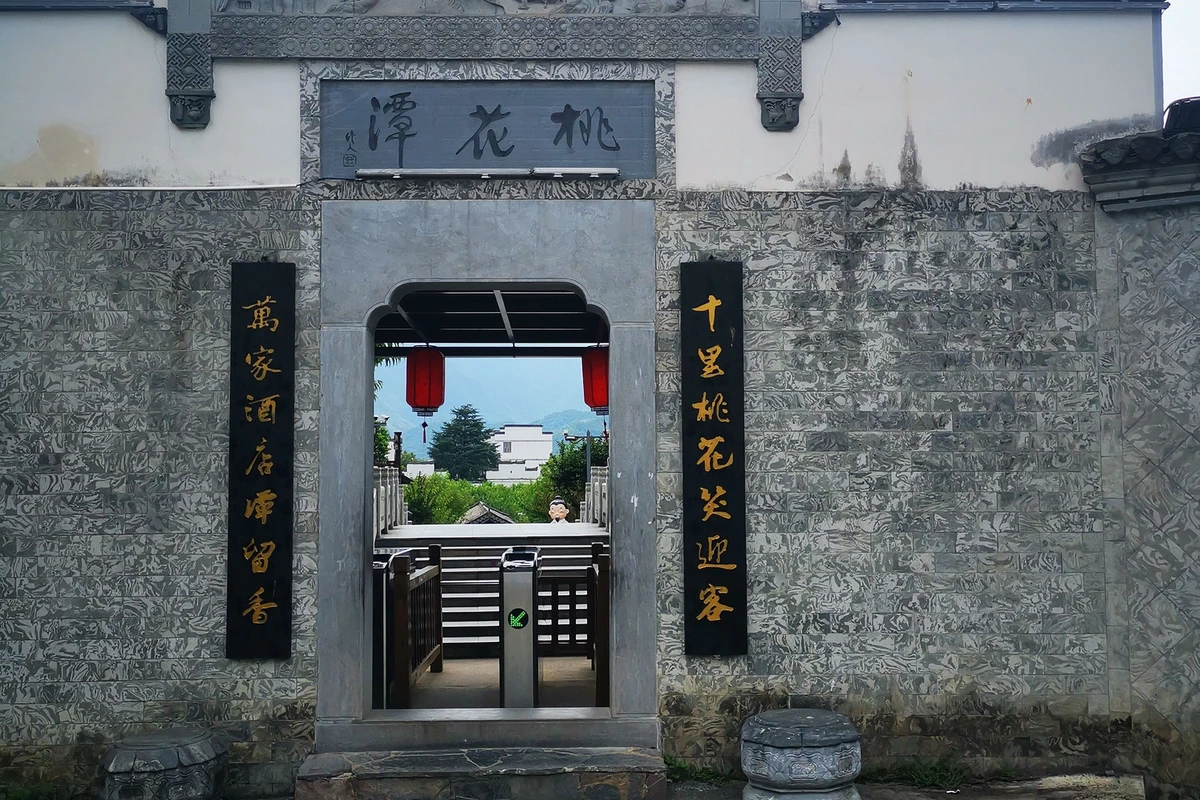
The reason why Peach Blossom Pool is famous has been explained differently over the years. Some say that ancient people found it as clear and misty as the Wulingyuan described in “Peach Blossom Spring,” hence the name. But the fame of Peach Blossom Pool actually stems from a beautiful legend. During the reign of Emperor Xuanzong of the Tang Dynasty, Wang Lun, a heroic man from Jingzhou (present-day Jing County, Anhui), heard that the great poet Li Bai was living at his uncle Li Bingyang’s home in Nanling. Overjoyed, Wang Lun wrote a letter to Li Bai: “Sir, you love to travel, right? There are ten miles of peach blossoms here. Sir, you love wine, right? There are ten thousand taverns here.” Li Bai gladly came. Wang Lun then told him the truth: “Peach blossom” was actually the name of the pool, and “ten thousand taverns” referred to a tavern owner named Wan. Li Bai laughed heartily and was not offended; instead, he was moved by Wang Lun’s warm hospitality. It happened to be the season when spring breeze and peach blossoms bloomed, with red flowers everywhere in the mountains. The pool water was deep, clear, and sparkling, reflecting the green hills. Li Bai and Wang Lun enjoyed poetry and wine together, lingering and forgetting to leave. When parting at the ancient shore where songs were sung, Li Bai wrote the timeless masterpiece “To Wang Lun,” which made Peach Blossom Pool famous for generations. To this day, there is a tombstone by the pool inscribed “Tomb of Wang Lun, Official Historian of Tang,” said to have been written by Li Bai, though its authenticity cannot be verified.
Peach Blossom Pool is located in Peach Blossom Pool Town, formerly known as Nanyang Town, which comprised Wan Village and Zhai Village. This area is rich in natural resources and outstanding people. The town preserves the most intact group of ancient dwellings in southern Anhui, with over 700 buildings from the Ming and Qing dynasties.
Chen Village lies behind Peach Blossom Pool, now called Chen Village, but the Zhai and Wan families are the dominant clans here. For centuries, the ownership of Peach Blossom Pool was a source of open and covert conflict between these two families. Peach Blossom Pool probably gained its name and widespread fame from Li Bai, but locally, people call it Wan Village Pool or Wan Cun Pool.
According to records, the Zhai clan produced 15 jinshi (successful candidates in the highest imperial examinations), hundreds of juren (provincial graduates), and thousands of xiucai (county-level scholars) during the Ming and Qing dynasties. During the Wanli reign of the Ming Dynasty, Zhai Guoru, the General of Jiangnan, died in suppressing a rebellion in Yunnan. His ancestral hall was granted the name “Loyalty and Filial Piety Hall” by the emperor. This hall, with three courtyards, covers an area of a thousand mu. The building materials are all nanmu and white marble, and its stone and wood carvings are extremely rare. Mr. Luo Zhewen, an ancient architecture expert from the National Cultural Heritage Administration, praised it as “the number one ancestral hall in China.”
The Wenchang Pavilion was built in the 32nd year of the Qianlong reign (1767) of the Qing Dynasty. It has three floors and an octagonal shape. From the first to the third floor, plaques hanging read “Prosperous Civilization,” “Literary Radiance Reaching the Dipper,” and “Ascending the Ladder Together.” It was a monument to the literary and martial achievements of the Zhai clan. With its elegant and exquisite design, it is also a famous scenic spot. In addition, other ancient buildings such as Huaixian Pavilion, Wanxing Yimen, Dazi Tower, Fufeng Guild Hall, and Sima Di also have significant historical importance and research value.
Tracing up the Peach Blossom Pool water, you reach the largest Chen Village Hydropower Station in the mountainous area of southern Anhui. Climbing onto the dam and looking far into the distance, you face the famous “Yellow Mountain Couple” Taiping Lake, which is adjacent to Yellow Mountain. You can take a cruise directly to the foot of Yellow Mountain. The lake surface stretches for miles with green waves and countless green peaks, presenting a different kind of scenery. Gold Island in the lake is like a pearl on Taiping Lake, standing gracefully. The island is densely forested, with birds singing and flowers fragrant—every step reveals a new view, poetic and picturesque.
Walking into the inner streets of the village, the ruins of the “Ten Thousand Taverns” that once “attracted” Li Bai still remain. The winding stone paths guide visitors to trace the marks of history. Compared with Zhaji, this place is more tranquil and secluded, with few locals living here. The ancient houses stand lonely, waiting for wanderers to return.


