Spring Festival Road Trip
This year, I happened to be going to Nanjing to visit relatives, so I planned a Spring Festival road trip.
On February 15, the sixth day of the lunar new year, it was overcast turning to light rain. It was the latter part of the holiday, and the return peak was approaching; heading out of the city, we happened to go against the flow. We set off at 7 a.m., the roads were smooth all the way, and we arrived in Nanjing around 10:30 a.m., having driven more than 290 kilometers with a stop at the Fangmaoshan Service Area in Changzhou. It was raining on the Changzhou–Zhenjiang section, so the speed was relatively slow; in other sections it was overcast, and we basically drove at over 100 km/h. After a short rest at the hotel, we went to visit relatives and chatted about family and friendship.
On February 16, the seventh day of the lunar new year, it was sunny. After breakfast, we left Nanjing, crossed the Jiangxinzhou Yangtze River Bridge, took the G40 Shanghai–Xi'an Expressway onto the G0321 Tianchang–Tongling Expressway, got off at the Chuzhou South exit, and followed the navigation to the north gate of Langya Mountain Scenic Area. The parking lot was quite large, but still almost full (when we left the scenic area, the police were blocking cars at the entrance to divert them to an alternate parking lot). Langya Mountain is famous for the Zuiweng Pavilion, and I had long wanted to visit it. This year it was newly promoted to 5A level, so I chose it as the first stop of the road trip. Langya Mountain Scenic Area waives the main entrance fee (thumbs up); there are four attractions inside (Zuiweng Pavilion, Langya Temple, South Heaven Gate, and Tongle Garden) that require separate tickets. Anhui Province offers free admission to people over 65 (thumbs up). From the mountain gate to Zuiweng Pavilion is about 1 km; you can walk or take an electric cart (round trip to Langya Temple 30 yuan, one way 20 yuan). The road is flat, so strolling along is also pleasant. Zuiweng Pavilion is a must-visit; the garden is not large but crowded with people. Besides the Zuiweng Pavilion, there are also Erxian Hall, Gumei Pavilion (with an ancient plum tree planted by Ouyang Xiu in front), Yingxiang Pavilion (with a lady in ancient costume playing the zither for entertainment), Yizai Pavilion, and Yi Pavilion. It is said that within the 1,000 square meter garden there are nine courtyards and seven pavilions, each different in style and each with its own story. On the small square in front of Zuiweng Pavilion, there were yangge and dragon dance performances, intangible cultural heritage displays, and local snacks. The festive atmosphere was strong.
Langya Mountain takes pavilions as its main theme, and the scenic area is dotted with various types of pavilions. After leaving Zuiweng Pavilion, there is a fork in the road: to Langya Temple is 1.3 km, and to Tongle Garden is only 250 meters. I chose to visit Tongle Garden, which is quite small; the highlights are a small cliff waterfall and the Ouyang Xiu Memorial Hall (in front of the hall, a graceful lady in Tang costume was dancing). Returning out the north gate, we drove away from the scenic area, had lunch in the city, then got back on the Tianchang–Tongling Expressway from Chuzhou South, transferred to G0321 via the Tongshang Expressway, then to G50 Shanghai–Chongqing Expressway and G3 Beijing–Taibei Expressway, and got off at Qingyang County in Chizhou to check into a hotel. The second leg was about 350 km in total, smooth all the way, with only one stop at the Qingxi Service Area, while the opposite direction was a heavy stream of returning cars.
On February 17, the eighth day of the lunar new year, it was sunny, the last day of the toll-free holiday. Staying in Qingyang County was specifically to go up Mount Jiuhua. The county is about half an hour's drive from Mount Jiuhua; we chose to take County Road 005 and Provincial Road 221, avoiding the G318 main road to reduce traffic jams. Although there were some mountain roads that were narrow and difficult to drive, luckily there were few cars and no congestion, so it was smooth all the way. The parking lot at the Mount Jiuhua Visitor Center is very large, with a multi-story parking garage (charged by time period, 30 yuan for 24 hours). For Mount Jiuhua Scenic Area, people over 65 are free of charge, and the shuttle bus costs 50 yuan (three round-trip segments). After about 40 minutes on the shuttle, we arrived at Yingxian Bridge Station on Jiuhua Street; as soon as we stepped out of the station, the atmosphere of the Buddhist kingdom hit us.
Zhiyuan Temple, the first large temple near Jiuhua Street, has vigorous incense offerings. Past Zhiyuan Temple is the Baisui Palace cable car station (round trip 100 yuan). Although today was not yet the peak, we still had to queue for about 45 minutes. The cable car ride took less than ten minutes to reach the top (if you don't take the cable car, you can walk up Baisui Road). After turning left past the Feilai Guanyin Peak, we arrived at Baisui Palace. Although the temple is on the mountain, the incense offerings were still vigorous. Returning to the upper cable car station, you could see in the distance the mountain contour resembling a sleeping Buddha.
After lunch on Jiuhua Street, we took the shuttle bus from Huxingshan Bus Station to the Tiantai Scenic Area. Tiantai is the main peak of Mount Jiuhua (elevation 1,306 meters), second only to Shiwang Peak and Qixian Peak. The shuttle stops in front of the Tiantai cable car station; you can take the cable car to Tiantai (round trip 160 yuan). After getting off the cable car, we passed through the Blessing Character Wall (with various fonts of the character "fu" on the right and famous calligraphers' handwritten "fu" on the left), descended about 200 steps, then walked along a flat path to the Ancient Worship Platform. Inside the temple, there is a large rock with two lifelike giant footprints of the Buddha. This is also the meeting point for those who walk up from the Fenghuang Pine shuttle bus terminal (3,800 meters), but you still need to climb 780 meters more to reach the very top of Tiantai. The Tiantai Scenic Area combines cultural and natural attractions, including Tortoise Climbing the Mountain, Miaobi Peak, Longhua Sanshi Stone Carvings, Yixian Tian (a line of sky), and Ping'an Locks. Behind Tiantai Temple there is a trail to the Huatai Scenic Area (a 2-hour walk).
We returned the same way; after getting off the cable car, we had to descend 200 meters to reach the Fenghuang Pine station. Climbing Tiantai was really tiring! That night we stayed in a guesthouse near the station, and for dinner we rewarded ourselves with the Anhui specialty stinky mandarin fish.
On February 18, the ninth day of the lunar new year, it was sunny. After breakfast, we took the shuttle from Fenghuang Pine Station, got off at the Flesh Body Pagoda stop, climbed the steps and entered through the west gate. The Flesh Body Pagoda, which enshrines the earthly remains of several eminent monks, is the most mysterious place on Mount Jiuhua, attracting the most devotees and tourists; it is a must-visit when climbing Mount Jiuhua. The pagoda is not open to entry; you can only walk around it in a circle and pray. After visiting, we exited through the south gate and, on the way to Jiuhua Street, could conveniently visit Jinsha Spring, Shangchan Hall, and many other temples and nunneries. The entire route was downhill, so it was not tiring. On Jiuhua Street there are also Huacheng Temple and Tonghui Temple. We took the shuttle from Yingxian Bridge Station back to the visitor center at the foot of the mountain.
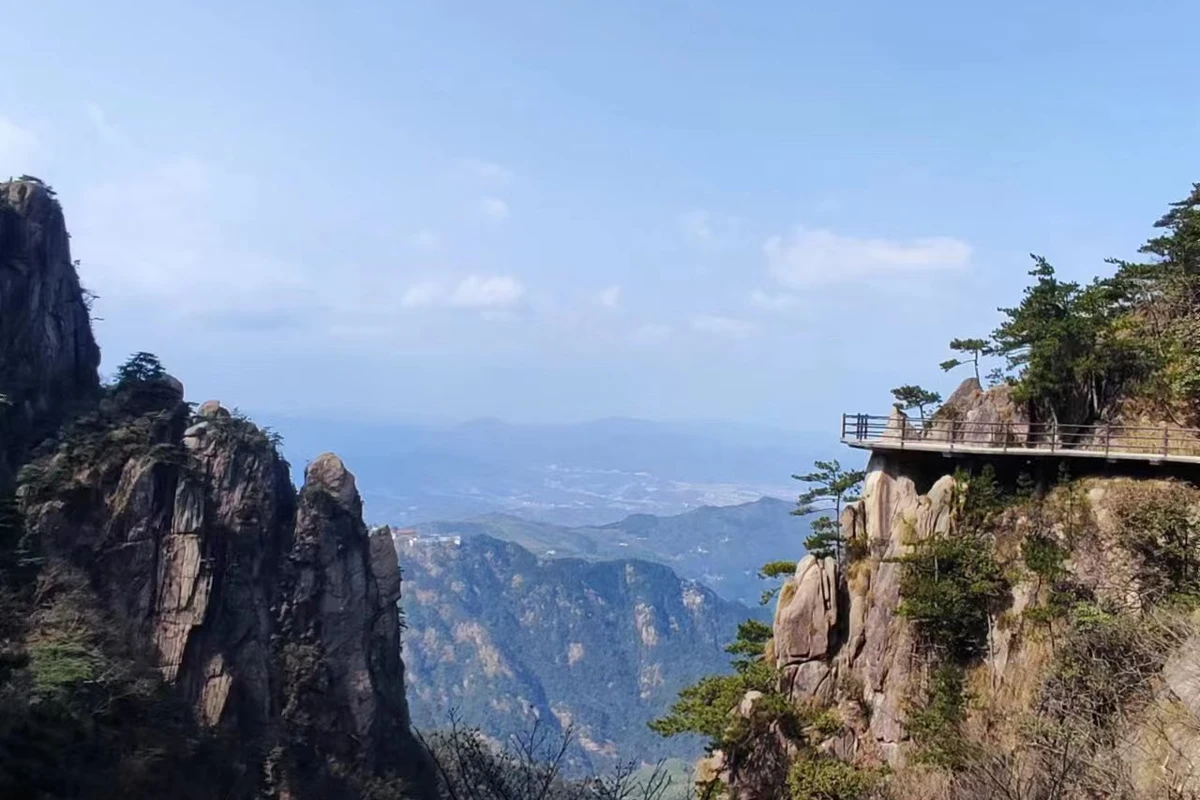
At the visitor center, we transferred to the shuttle heading to Huatai direction, arrived at the Huatai cable car station, and took the cable car (round trip 160 yuan) up to the Huatai Scenic Area. The Huatai Scenic Area is free; you can also walk there from the Tiantai Scenic Area. Conversely, going from Huatai to Tiantai requires checking your Mount Jiuhua ticket. After getting off the cable car, there are both hiking trails and a flat boardwalk (which can be done as a loop). A small speaker reminded the elderly, children, and the infirm to take the boardwalk both ways, suggesting the hiking trail is quite strenuous. I just took the boardwalk! The Huatai Scenic Area is known for its natural scenery. The weather was good today, perfect for high-altitude views with blue sky and white clouds, strange rocks and odd pines. Walking and looking around, we reached the end in about an hour. Turning left leads to the hiking trail back to the cable car station; turning right leads to the Tiantai Scenic Area (where there is a ticket inspection station). We took the cable car back to the visitor center, retrieved the car, and drove away.
Although the highway had resumed tolls today, because of the upcoming work and school start the next day, the highway still showed long sections of red congestion. Not taking the highway both avoided traffic jams and saved money (secretly happy). After returning to Qingyang County, we took national and provincial roads toward Xuancheng. On the way, there is Chaji Ancient Town, said to be a pristine, hidden gem. I had long wanted to explore it, so today we went along the way. National Road 330 was in decent condition, but turning onto Provincial Road 468 was quite rough! First, the junction was extremely narrow, looking like a small alley, so I dared not enter; the navigation kept telling me to turn around before I carefully drove in. Second, the road was very narrow, resembling a country lane; when oncoming cars appeared, we had to find a place to stop and yield. Third, at the border between Qingyang and Jingxian, there was a mountain section with narrow, steep roads and sharp switchbacks, requiring careful driving; going downhill, I shifted to manual mode and used engine braking to slow down. After entering Jingxian County, the road conditions improved. First, we went to the Chaji Ancient Town Visitor Center to inquire; it turned out that the visitor center is more than a kilometer from the ancient town's core area. Normally you would take an electric cart, but today the peak visiting hours had passed, so we could drive in ourselves.
The ancient town is located at the confluence of the Cenxi, Shixi, and Xuxi streams. Now developed for tourism, there is an art museum at the entrance of the village. Turning past the art museum and walking along the Xuxi stream, there are attractions such as the God of Wealth Bridge, Baogong Ancestral Hall, Tofu Workshop (handmade tofu workshop), Tianshen Bridge, and Honglou Bridge. Residents still live in the town, and we also encountered a dragon dance parade in front of an ancestral hall. There are guesthouses, cafés (with waitstaff in Tang-style costumes), restaurants, and shops, while the scene of townspeople washing clothes and vegetables by the stream under the bridge is especially charming. It can be called pristine and authentic, but it lacks planning. Although there are stone-paved roads and Huizhou-style architecture, the addition of glass doors and modern fittings makes it somewhat incongruous and inelegant.
Leaving Chaji Ancient Town, we drove along Provincial Road 206 for about two hours to reach the hotel in Xuancheng County. Today, the G50 Shanghai–Chongqing Expressway toward Shanghai still showed long sections of red congestion, so we simply stayed overnight and decided based on the situation the next day. Today we drove 150 kilometers on national and provincial roads, taking about three and a half hours. The road conditions were generally good; the key was no traffic jams!
On February 19, Monday. Last night it rained in Xuancheng; the rain stopped by morning, but the roads were wet and slippery. After breakfast at the hotel, we got on the G50 Expressway from Xuancheng East; there was a long construction section toward Shanghai, which explained why the congestion had been so bad the previous day! Fortunately, work and school had started today, and most people had already arrived at their posts or schools, so the flow of vehicles returning to Shanghai was greatly reduced. We basically passed through the construction section at 80 km/h. Only at the Guangde and Jiepai service area exits did congestion occur because many cars were entering and parking spaces were full. After entering Zhejiang and Jiangsu, the weather cleared up, and the entire route was smooth, allowing us to drive at full speed. We stopped to rest at the Changxing and Dianshan Lake service areas. We exited the expressway at Qingpu, got on the Songze Elevated Road, and then took the elevated road all the way (on Monday, outside-area license plates are restricted; on weekdays at noon, the entire route was green and smooth) back home. Today we drove about 300+ kilometers, taking about four and a half hours. We returned home safely at 12:30 p.m., in time to pick up my grandson from school.
The Spring Festival road trip concluded smoothly. When driving on a self-driving trip, what you fear most is, first, bad weather—bad for both safe driving and sightseeing; second, traffic congestion along the way—time-consuming, fuel-wasting, and tiring. On this trip, except for rain on the first day, the weather was sunny for the remaining four days, making the journey comfortable. On the way, we went against the flow and didn't get stuck; on the return, we also avoided the peak. Although there were quite a few visitors at the scenic spots, it was much better than the "people mountain people sea" mode of the previous days. Hotel and scenic area prices during the holiday were a bit higher, but having a car made it convenient to choose hotels a bit farther from the scenic areas or in non-tourist cities, which would be more economical.
Over five days, we drove more than 1,000 kilometers, spent about 700 yuan on fuel, and only 110.2 yuan on expressway tolls.


