Couple's Self-driving Tour of Anhui and Hunan (Part 2)
I had long wanted to travel alone by car, but my wife firmly disagreed, saying she would worry about me going alone. When I decided to go on a self-driving trip, she specifically took leave to accompany me.
Before departure, I planned an itinerary, mainly focusing on the Southern Anhui Sichuan-Tibet Highway and Mount Heng (Nanyue). Unexpectedly, after visiting Orange Island in Hunan, my wife proposed seeing Fenghuang Ancient Town. Since we were driving and had flexible plans, we immediately changed course to western Hunan, visiting Tianmen Mountain, Furong Ancient Town, and Fenghuang Ancient Town.
Originally considering a solo trip, I had purchased some daily necessities, including a small-capacity electric pressure cooker, a kettle, a car mattress, a car refrigerator, a large-capacity thermos, and a 700V battery, along with some nutritious porridge packets and self-heating rice dishes. Of course, in the end, we did use them, though only half the mattress was brought for naps.
Due to various social media promotions, the Southern Anhui Sichuan-Tibet Highway had a mysterious allure for me. I entered from the east entrance in Ningguo, passing through Chujiatan, Huiyun Zen Temple, Qinglong Lake, Bald Cypress Forest, Yulin Dam, then diverted to Shuimo Tingxi, before returning to Banqiao Village and continuing on S345 (Southern Anhui Sichuan-Tibet Highway).
Seventh Attraction: 72 Bends
Leaving Shuimo Tingxi and returning to Banqiao Village, we turned right and continued on the Southern Anhui Sichuan-Tibet Highway.
After passing the sign "After all the detours today, the rest of life will be smooth," we entered the 72 Bends section of the highway.
The mountain road twists and turns, making it somewhat difficult for cars to pass each other. Fortunately, it was not a holiday, so traffic was light and we could proceed normally.
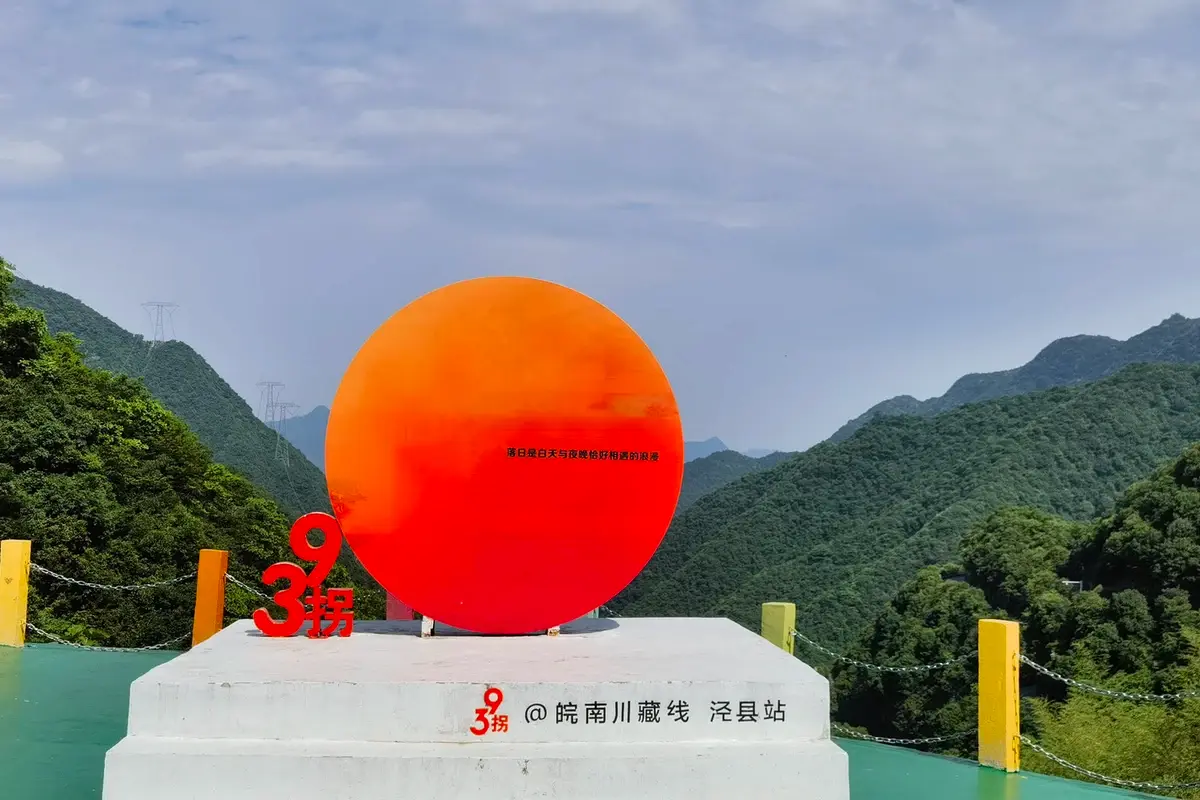
Along the way, we stopped at Six Bends, Twelve Bends, and 39 Bends. The photo shows the 39 Bends at the Jingxian Station of the Southern Anhui Sichuan-Tibet Highway.
Eighth Attraction: Mount Heng (Nanyue)
That day we drove 996 kilometers and arrived near the Mount Heng scenic area in the evening, checking into a budget hotel. Surprisingly, both sides of the street and the lobbies of many hotels were all selling incense, in various lengths, sizes, and styles.
That day, I developed a mouth ulcer. I ordered medicine online to be delivered to the hotel, and after one night, it healed.
Mount Heng, also known as Nanyue, Shouyue, or Nanshan, is one of China's Five Great Mountains, located in Hengyang City, Hunan Province. Its peaks are majestic and imposing, with 72 peaks stretching 800 li (400 km) across seven counties and cities. It is a famous Taoist and Buddhist sacred site in China, with over 200 temples, shrines, nunneries, and monasteries scattered around the mountain. In ancient times, emperors like Tang Yao and Yu Shun toured, hunted, and offered sacrifices here; it was also where Xia Yu killed a horse to pray to heaven and earth for flood control methods. The mountain god of Mount Heng is the fire god Zhurong, entrusted by the Yellow Emperor to guard the mountain, teaching people to use fire and nurture all things. After his death, he was buried at Chidi Peak on Mount Heng and is locally revered as the Holy Emperor of Nanyue.
According to the Ganshi Xingjing (a star chart) from the Warring States period, the mountain was named Heng because it lies in the wing of the constellation Zhen (one of the 28 mansions), and it is said to "respond to the celestial balance" and "measure virtue and matter," like a balance that can weigh heaven and earth, hence the name Heng (meaning "balance"). The main peak, Zhurong Peak, is 1,300.2 meters above sea level. Since ancient times, it has been renowned for its unique beauty among the Five Great Mountains, its long history and fame, the coexistence of Buddhism and Taoism with wide influence, and its status as China's sacred longevity mountain. In 1982, Mount Heng Scenic Area was listed among the first batch of national key scenic spots; in May 2007, it was rated as one of the first national 5A-level tourist attractions.
Our first stop was the Nanyue Grand Temple. We parked at the visitor center parking lot and walked along Jinsha Road to the temple. We didn't enter through the main south gate but instead went north to south, passing through Shenggong Shengmu Hall, Shengdi Hall, Yubei Pavilion, South Main Gate, Kuixing Pavilion, and finally to Lingxing Gate. I was struck by the strong incense-burning atmosphere, with smoke swirling around, yet it felt heavy and murky.
Shengdi Hall, also the main hall, is seven bays wide and five bays deep with a double-eaved hip-and-gable roof.
Couplets:
The holy grace is vast, benefiting the people;
The emperor's virtue is towering, blessing us boundlessly.
The temple's majestic appearance endures through generations, with endless legacies;
The divine grace is vast, and offerings continue for thousands of years.
The sun shines brightly in the sky, illuminating all ages;
Virtue is revered on Nanyue, nurturing all beings.
Beside the Yubei Pavilion, several people were walking in circles praying, seemingly in a ritual or spontaneous activity.
Kuixing Pavilion is also a stage.
Couplet:
Why does the coiled dragon not fly in the sky with thunder and lightning?
The mountain often gathers phoenixes; they all come here to listen to xiao and shao music.
Wanshou Palace, inside is the Wanshou Palace Lingguan Hall, serving as the mountain gate of the temple.
Couplet:
Colors shine at the Heavenly Gate, flying in five hues;
Auspiciousness is born in the emperor's hall, celebrating three enfeoffments.
The Nanyue Grand Temple is located at the foot of Zhuming Peak, one of the 72 peaks of Mount Heng. It is dedicated to the Holy Emperor of Nanyue and consists of nine sections and four courtyards, surrounded by red walls with corner towers rising high, and spring water from Shoujian Stream flowing around the walls, resembling the style of Beijing's Forbidden City. It was the main temple where emperors of successive dynasties offered sacrifices to mountains and rivers on behalf of the state, and along with Tai'an Dai Temple and Dengfeng Zhongyue Temple, it is renowned as the largest ancient architectural complex south of the Yangtze River, known as the "First Temple South of the Yangtze" and the "Southern Forbidden City." Its site dates back to the Qin and Han dynasties, was founded in the Sui Dynasty, first built in the Tang Dynasty, and after six major fires and sixteen renovations and expansions through the Tang, Song, Yuan, Ming, and Qing dynasties, it reached an area of 98,500 square meters in the eighth year of the Guangxu reign (1882). Every year on the 15th day of the 8th lunar month, a grand temple fair is held here, and incense never fades.
Leaving the Nanyue Grand Temple, we took the scenic area shuttle to Zushi Hall and then got off to hike up the mountain.
At the Southern Heavenly Gate, Zushi Hall has stone walls and black tiles, with a pair of mischievous stone lions flanking the front.
Couplet:
The ancestor's teachings of a thousand words spread Chinese morality through the ages;
The master is revered for ten thousand generations, and Nanyue's sacrificial vessels last forever.
The Southern Heavenly Gate Stone Archway, also known as the Gate to Heaven.
The stone archway is a three-arch structure with carvings of clouds on the pillars. On the side gates are inscribed "Xingyun" (dispelling clouds) and "Shiyu" (bestowing rain), and on the central pillars is a couplet:
The gate reaches heaven; looking up, the stars are near;
The path leads to the summit; looking down, the green peaks are low.
Continuing upward! In the distance, mountains undulate with dense vegetation, lush and green.
Chijian Shangfeng Temple, known as Guangtian Guan before the Sui Dynasty, was renamed Shangfeng Temple by Emperor Yang of Sui. It is revered by Taoism as the 22nd blessed land.
At Nanyue Mount Heng, inscribed by Zhao Puchu, below is Li Bai's poem: "Mount Heng towers into the purple sky, looking down at the Old Man Star in the south. The whirlwind scatters snow from the five peaks, often sending blossoms flying over Dongting Lake."
Zhurong Peak, at 1,300.2 meters above sea level, towers into the clouds and stands majestically in the southern sky. It is the highest and main peak among the 72 peaks of Mount Heng. At the summit is Zhurong Hall, originally called the Old Saint Emperor Hall, first built as a shrine in the Wanli reign (1573–1620) of the Ming Dynasty. Because of the strong winds at high altitude, the building is constructed with solid granite walls and iron tile roofs, standing proudly on the massive boulder at the summit, braving wind and snow.
Zhurong Peak is named after the fire god Zhurong. According to legend, Zhurong was a minister of the Yellow Emperor in ancient times and the god of fire. After humans invented drilling wood for fire, they didn't know how to preserve it or use it. Zhurong, being close to fire, became adept at managing and using it. The Yellow Emperor appointed him as the official in charge of fire. Because he was familiar with the southern region, the Yellow Emperor also made him a minister overseeing southern affairs. He lived on Mount Heng and was buried there after his death. To commemorate his great contributions, the highest peak of Mount Heng was named Zhurong Peak. In ancient language, "Zhu" means lasting, and "Rong" means brightness, wishing him eternal light.
The downhill walkway stretches for kilometers and is quite large in scale.
"Nanyue, spiritually beautiful; a journey of wishes."
Ninth Attraction: Hunan Normal University
Leaving Mount Heng, we drove to Changsha and checked in near the Yuegou Plaza in the Science City community on Lushan South Road. After dinner at the food court, we walked to the place where the great man once studied: Hunan Normal University.
Hunan Normal University Library
The emblem of Hunan Normal University hanging amidst the green shade.
The next day, it drizzled, and citizens and many students queued for the bus in the rain.
We passed by the School of Fine Arts of Hunan Normal University, which we had also passed at night but didn't notice due to the dark.
Tenth Attraction: Orange Island
Orange Island, located in the center of the Xiangjiang River in Yuelu District, Changsha City, Hunan Province. Originally covering about 17 hectares, the scenic area's developed land area reaches 91.64 hectares. It is the largest alluvial sandbar among many in the lower reaches of the Xiangjiang River, known as "China's First Island." Stretching from south to north across the river, it faces Yuelu Mountain to the west and Changsha city to the east, surrounded by water, extending over ten li (about 5 km). Its narrowest part is about 40 meters wide, and the widest about 140 meters, forming a long island. Orange Island features attractions such as the Mao Zedong Youth Art Sculpture and Wentian Terrace. According to historical records, the island formed in the second year of the Yongxing reign of Emperor Jin Hui (305 AD), created by turbulent currents and accumulated sand and stone.
We drove across the Orange Island Bridge spanning the Xiangjiang River to reach the island. The picture shows a small building south of the site of the former Standard Oil Company building, with red bricks and red tiles in a Republic of China style.
"Meet the best you in the most beautiful place." To the south, there is a fountain in the lake that can spray water up to a hundred meters high. In the drizzle, we walked back and forth, passing Guiyuan (Osmanthus Garden), Taoyuan (Peach Garden), Meiyuan (Plum Garden), Zhuyuan (Bamboo Garden), and Citrus Culture Garden.
Carved on a stone is Chairman Mao's poem "Qinyuanchun·Changsha."
Further south is the artistic sculpture of Mao Zedong in his youth, looking forward with great spirit and heroic vigor! It matches the great man's poem: "I ask the vast earth, who decides the rise and fall?"


