2025 Summer Vacation: Three-Day Tour of Southern Anhui (Wannan Sichuan-Tibet Route + Xu Village)
This summer, due to my child's summer class schedule and work leave reasons, I couldn't arrange a long-distance trip. Taking advantage of the brief rest period in early August, I planned a three-day nearby tour. For summer heat relief, playing in the water, the most suitable place nearby is Southern Anhui. The wildly popular Wannan Sichuan-Tibet Route in recent years, which I hadn't visited yet, seemed perfect for a relaxed trip, so I started with it. Two days before departure, my partner couldn't take leave due to work, so it was just my child and me going for a spin—getting out for some fresh air is always good.
At the end of July, typhoon "Zhujiecao" arrived; I was worried it might affect driving on the mountain roads. I consulted the homestay owner, who said the impact would be minimal. On August 1st, we set off early as planned. First stop: East Entrance of Wannan Sichuan-Tibet Route.
The Wannan Sichuan-Tibet Route is the Anhui Provincial Road S345 from Ningguo to Jing County. Along the way, natural landscapes showcase the essence of Southern Anhui's mountains and waters—rolling green hills and occasional vast reservoirs. After checking in at the east entrance, the first scenic spot was Chujiatan (Cloud Depth Unknown Coffee Shop).
You can drive along this small path; across the shore is the Cloud Depth Unknown Coffee Shop. It was quiet in the morning with few people.
Thrilling incident along the way: At the last service area before exiting the highway, I went to the restroom and accidentally dropped my phone into the toilet. Water got into the phone, and it immediately stopped recognizing the SIM card (no internet, no QR code payments). Fortunately, I had a backup navigation phone in the car. I used it to call my child's father for help. He transferred money via WeChat, solving the payment issue. At this parking spot, I found a sharp coil wire from a notebook coil, used it to remove the SIM card from the water-damaged phone, inserted it into the navigation phone, logged back into my main WeChat account, and finally managed to contact people normally, ending the state of being unreachable (I can take leave on workdays but cannot be out of contact).
Relieved, we continued the journey. Second stop: Huiyun Zen Temple.
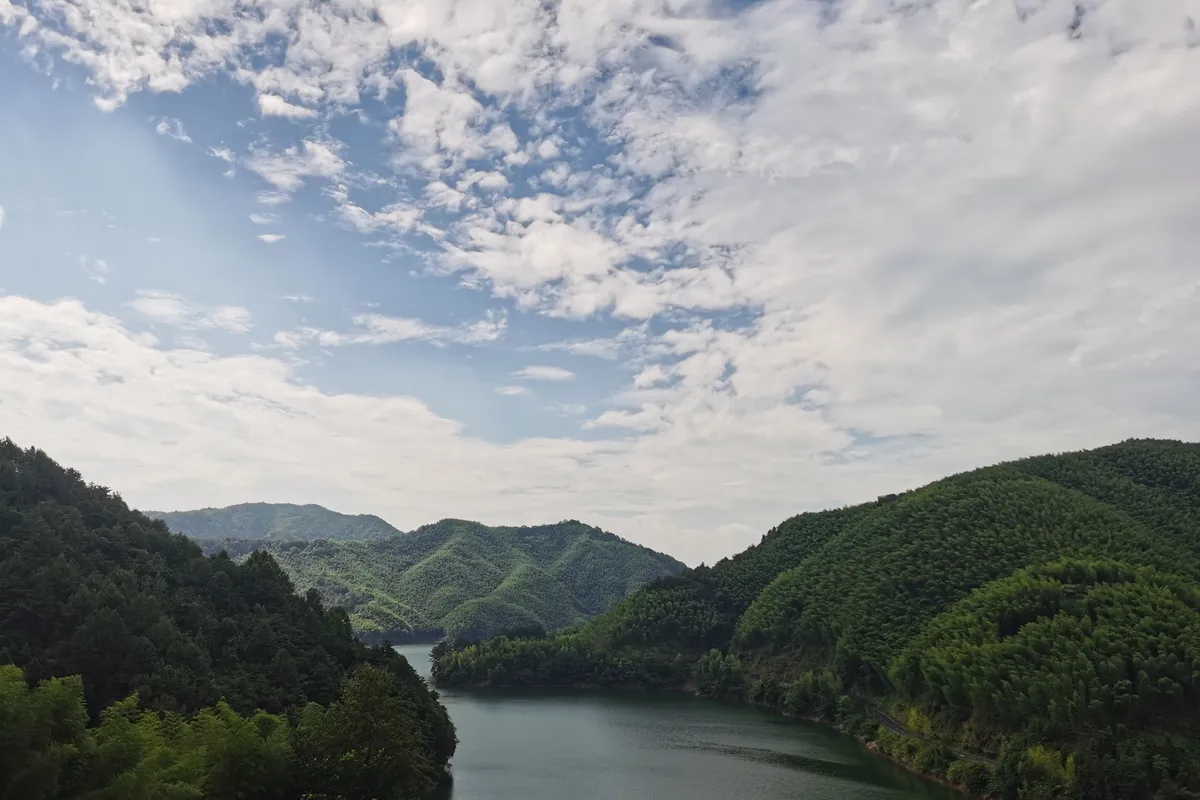
Huiyun Zen Temple, in my opinion, is the most worthwhile viewpoint along the Wannan Sichuan-Tibet Route. Located on a mountaintop, you can drive all the way up, and parking is easy. The view overlooking the reservoir is stunningly beautiful.
Opposite the temple gate, there is a plank road that descends to the lakeside. It has 758 steps, taking about half an hour round trip. If you have time, it's worth a walk. No other tourists took this path besides us. We did not enter the temple.
After visiting Huiyun Zen Temple, we returned to the main S345 road. Huiyun Zen Temple is on a branch road with only one way in and out. The entire visit took about 1 hour (including the lakeside plank road, excluding the temple).
We continued toward Taoling Liudaowan. Along the way, we encountered several spots suitable for playing in the water, but perhaps due to the typhoon, there were few people.
The Taoling Liudaowan section is the part of the Wannan Sichuan-Tibet Route with the sharpest turns. The road is narrow, but normal driving is not difficult; large vehicles may have trouble passing each other. There were many monkeys along the way, with signs reading: "Do not light cigarettes for monkeys, as it may cause fires."
Xingfulu Observation Deck is one of two parking spots in the Liudaowan area. Parking spaces are limited—only enough for a few cars—and the scenery is average.
This checkpoint does not allow parking; the parking spot is 100 meters ahead and is very small, accommodating only a few cars. On holidays with heavy traffic, it is sure to be congested.
Along the way, we saw many monkeys with shiny coats, completely unafraid of people, likely accustomed to being fed by tourists. I have a phobia of monkeys (having been scratched by one on Mount Emei years ago), so I advise against teasing them.
Leaving the Liudaowan area, we navigated directly to "The Universe is a Granary" coffee shop, skipping Shuimo Tingxi and Moon Bay.
This coffee shop is nestled in a valley, about 30 minutes' drive from Liudaowan. When we arrived, a light drizzle was falling. The scenery was nice, perfect for a short rest.
We had lunch and took a break.
After resting, we continued to tonight's accommodation: Lantian Town at the foot of Huangshan in Xiuning County, close to both Huangshan and Hongcun. This place is in San Keshu, surrounded by mountains and water, peaceful and not noisy, ideal for playing in the water. There is a riverbank right at the doorstep.
The water is very clear, with few people. You can catch small fish, making it especially suitable for families with children. Most areas are shallow, with one deeper section.
We booked a family room with a terrace. The facilities were complete, the room clean, and it was perfect for lying back and relaxing during the vacation.
According to the owner, there are two rafting spots within 3 kilometers. We weren't interested in rafting, so we just waded in the water and lounged in the room.
On the second day, we went out only in the morning and afternoon—playing in the creek, flying the drone on the terrace. When the sun got too strong, we returned to the room to lie down. It was a very comfortable and leisurely vacation mode.
This homestay's local Huizhou cuisine was delicious. I had stinky mandarin fish there (I've had it at other Huizhou restaurants, but none as good as here) and ate it for two consecutive days. None of the dishes disappointed, and breakfast was also good (breakfast included with accommodation).
We had three full meals and two breakfasts; every dish earned praise.
On Sunday for the return trip, we first visited Xu Village, an hour's drive from the homestay. Xu Village in She County is a lesser-known village of scholars (jinshi), more ancient than Hongcun. This thousand-year-old village, founded in the Eastern Han Dynasty, is 1,000 years older than Hongcun and 850 years older than Xidi, but few people know about it. It is currently under restoration and offers free admission.
At the entrance of Xu Village, you can hire a guide for 80 yuan per tour. There were few tourists in the village as we wandered around, encountering only a handful of visitors and mostly local residents.
This pristine, tranquil ancient Southern Anhui village has none of the typical tourist souvenirs or commercial atmosphere. We couldn't even find a place to eat lunch in Xu Village town. There is a small path in town leading to a hilltop observation deck (about 15 minutes on foot), offering a panoramic view of the entire village. Exploring Xu Village takes about 2–3 hours. If you are passing by or interested in ancient Southern Anhui villages, it's well worth a visit.
After visiting Xu Village, we returned to Nanjing. I'll complain again here: Xu Village requires exiting at the Chengkan exit. This exit is connected to the Chengkan service area and Chengkan scenic area, with a roundabout at the entrance and exit, making it easy to go wrong. On the way back, we took a wrong turn, ended up at the next highway exit (adding 20 kilometers round trip), got off the highway, turned around, and got back on to return to Nanjing.
1. Regarding the Wannan Sichuan-Tibet Route: My child's comment was "Not that great"; it's not worth a dedicated trip—just stop by if you're passing through. During holidays, traffic jams are 100% certain. During our visit, there was a typhoon, so many people canceled their trips, resulting in light traffic and an okay experience. The biggest issue with this road is that the scenic mountain road section (Liudaowan) has no parking spots (only two places with very limited space). The entire Wannan Sichuan-Tibet Route is 120 kilometers long (Ningguo to Jing County), with very few parking spots. Even if the scenery were beautiful, the lack of convenient parking makes it hard to enjoy—and random roadside parking causes congestion and is extremely unsafe, especially since the scenery is really just average.
2. San Keshu Scenic Area in Lantian Town, Xiuning: It's a good choice for summer family water fun—few people, quiet, and great value. On summer weekends, a family room with a terrace costs over 600 yuan, while a standard double room at Moon Bay would be 800–900 yuan. Meal prices are also reasonable. Compared to the crowded and noisy Moon Bay, this place wins completely except for the distance. There are many nearby attractions—close to Huangshan, Qiyun Mountain, Hongcun, Xidi, Chengkan, etc.
3. Xu Village: Worth a visit on a three-day trip. If you have young children, focus on water play and you can skip it.
4. The total round-trip distance for the three-day tour was 700 kilometers. For Jiangsu, Zhejiang, and Shanghai areas, there aren't many options within this distance range for summer weekend trips.


