Born in Jingzhou, Live in Jingzhou: Must-Visit Ancient Chu Capital and Three Kingdoms City Jingzhou, Four-Day Three-Night Guide Here
Jingzhou has a long history and splendid culture. It is the birthplace of Chu culture and the center of Three Kingdoms culture. Historically, well-known Three Kingdoms stories such as "Liu Bei Borrows Jingzhou" and "Guan Yu Loses Jingzhou Due to Carelessness" all took place here. It is rich in tourism resources, with both natural and cultural attractions, as well as a large number of historical and cultural relics. It is truly a famous historical and cultural city.
Find a time, born in Jingzhou, live in Jingzhou, you must visit the ancient Chu capital and Three Kingdoms city Jingzhou.
[Itinerary]
Day 1: Depart from Wuhan — Check in at Weishui Car Camping Base — Camp, barbecue, stay in treehouses, enjoy the lake, mountains, and idyllic scenery
Day 2: Weishui National Wetland Park, play water sports at Asia's No.1 Dam, take a boat to South Mountain View Island
Day 3: Jingzhou Chu-Han Intangible Cultural Heritage Skills Inheritance Center — Jingzhou Ocean World Xiaomeisha Aquarium — King Chu's Chariot Pit Scenic Area — Jingzhou Ancient City Binyang Tower — Night cruise on painted boats, enjoy light and shadow show
Day 4: Jingzhou Fantawild Oriental Heritage — Return
----------------------------------------------------------
The holiday is here, and if you want to find a good place to relax, where you can get close to nature, enjoy a paradise-like comfort, camp, barbecue, and have various fun outdoor activities with different accommodation experiences (RVs, tents, villas, treehouses), then the [Weishui Car Camping Base] is such a place that can almost meet all your needs. It is a one-stop high-quality leisure experience for family trips or group outings. It offers both speed and passion as well as a romantic fairy-tale world.
It is far from the hustle and bustle of the city, allowing you to temporarily leave behind the trivialities and fatigue of daily life and work. Drive to Jingzhou, go to the Weishui Car Camping Base, and enjoy the charm of "one building, one treehouse, one room, one tranquility." Go see the Weishui Scenic Area, where there are islands in the lake and lakes within the islands. The mountains come alive with water, and the water is charming with mountains. The vast lake merges with the sky into one color, offering infinite beautiful scenery!
China's first five-star quality car camping base! ✔️ On a clear night, turn off the lights, lie down in the Weishui Scenic Area, choose a starry sky tent, and enjoy the starry sky through the skylight late at night, experiencing the peace and tranquility of wilderness. It is the top choice for everyone to experience pastoral idyll and romantic travel.
[Location]: Weishui Town, Songzi, Hubei; Weishui Tourism Scenic Area, Jingzhou, Hubei; Weishui Car Camping Base
[Transportation] 🚙: From Jingzhou to Weishui, self-driving takes about 2 hours; from Wuhan, self-driving takes about 3.5 hours. Navigate to "Weishui Car Camping Base."
[About Entertainment Experiences] 💖: This is definitely a super cool entertainment area. Not only can you camp, have bonfires, and barbecue, but it is also a national standard leisure fishing competition venue and a carnival paradise for self-driving enthusiasts!
✳️ Inside the camp: High and low altitude exploration (tree obstacle course), jungle CS, attack and defense archery, competitive fishing pond, all-terrain vehicles, VR sports experiences, parent-child tribe, etc.
❇️ Outside the camp: You can also go to [Weishui National Wetland Park], check in at Asia's No.1 Dam, view the entire Weishui Car Camping Base from the dam closure site, play on the suspension bridge at the cruise terminal, and take an E-lv Tour sightseeing boat to two attractions: Ecological Island and South Mountain View Island. While on the boat, you can also watch the thrilling jet ski performances on the water. Super exciting! 😜
Our first stop was taking the E-lv Tour sightseeing boat to South Mountain View Island. During the boat ride, two handsome guys on jet skis circled us, speeding and surfing, creating wild splashes like a carnival of water droplets, churning up huge white waves on the lake. If you stand at the stern, be careful not to get wet and cool.
Climbing the stairs to South Mountain View Island, there is a great observation platform to enjoy the view of the wetland park. Those who like climbing mountains and looking into the distance should not miss it.
✳️ There are also water activities, don't miss them! They are very fun! At the [Water Sports Park], there are jet skis, water skateboards, flying fish, banana boats, water flyers, powered parachutes... So many fun options, one of them is surely your cup of tea. Look at our friends, they all had a blast and tried almost all the activities!
[Booking Accommodation]: Many room types have limited availability. For example, the parent-child castle 🏰 treehouse I stayed in this time has an area of 40 square meters, one bedroom, one bathroom, priced at 2588 yuan. I bought it at a discounted price of 1588 yuan/night, and it came with three tickets. Since only two are open to the public, it is really popular. If it's a holiday, remember to book at least a week in advance. You can also book on weekdays if you have time.
I absolutely love the Weishui Car Camping Base. I remember staying in a starry sky tent when I came two years ago. This time I stayed in the parent-child castle. The room has a large bed and two bunk beds for children. The decoration is very warm and comfortable. There is even a slide outside the treehouse. It's like a children's playground, especially suitable for family trips and parent-child choices!
[About Accommodation] 🏡: The available room types are all super atmospheric: characteristic wooden houses, romantic treehouses, private RV hotels, luxury safari tents, star-gazing tents, lakeside villas (with large terraces), as well as tent camping and tent camping areas (with air mattresses, sleeping bags, and chairs for rent), and RV parking spaces.
The interior of the RV is also different from ordinary RVs. This is a more spacious accommodation point than regular RVs, and the various functional areas inside are very comfortable.
The luxury safari tent accommodation is particularly luxurious, with a huge and luxurious living room and two separate bedrooms. The interior decoration is also according to the highest decoration standards.
Of course, the lakeside villa is very generous. It faces the lake and has a large terrace. It has three standard rooms and a common living room.
Each accommodation type has its own characteristics, some suitable for parent-child, some for parties, some for couples. In short, there are many options, and each one is surprising. There are 15 treehouses, 5 wooden houses, 4 luxury safari tents, 5 star-gazing tents, 5 RV garden hotels, and camping tents. Of course, there is also the nearby Weishui Holiday Hotel, which is also very good.
[About Camp Cuisine]: You must personally experience the fire pit barbecue, which is a major feature of the scenic area. In summer, you can barbecue and sing karaoke at the same time. It's so joyful!
Recommendation index: Five-star recommendation
As we all know: Intangible cultural heritage refers to various traditional cultural expressions handed down from generation to generation by various ethnic groups and closely related to people's lives, including folk activities, performing arts, traditional knowledge and skills, and related utensils, objects, and handicrafts. In our Hubei Jingzhou, as the birthplace of Chu culture and once the capital of the Chu state, there are not only a large number of historical and cultural relics but also many precious intangible cultural heritages.
To better inherit the various intangible cultural heritages of the Chu land, a special "Jingzhou Chu-Han Intangible Cultural Heritage Inheritance Center" has been established on Beijing East Road in Shashi District, Jingzhou City. It has become a place for everyone to experience intangible cultural heritage, folk crafts, and Chu-Han culture.
The Jingzhou Chu-Han Intangible Cultural Heritage Skills Inheritance Center (referred to as the Inheritance Center) is a non-heritage inheritance protection base established under the Changjiang Art Engineering Vocational College. It is the first privately-run comprehensive non-heritage museum in Hubei. With the concept of "seeing people, seeing things, seeing life," the museum's art pieces are amazing!
For example, in the Mill Eagle Kite Hall, we learned about the production process of the "Mill Eagle" kite, listening to the craftsman explain on-site: It integrates the traditional techniques of tying, pasting, painting, and flying. The eagle's head and body are prominently shaped, with hollowed-out eyes fitted with bright, rotating "live eyes" that cleverly use the wind to turn flexibly. In the kite's line structure, a unique technique of one fulcrum and one line is used. In the line installation, the line is installed at a position slightly to the left or right of the body's center, creating a temporarily asymmetrical state, which allows the "Mill Eagle" to spiral and achieve balance after takeoff. It is very ingenious.
Inheriting folk crafts, promoting Chu-Han culture. The Jingzhou Chu-Han Intangible Cultural Heritage Inheritance Center not only showcases a rich variety of Chu-Han intangible heritage techniques to everyone but also allows everyone to personally experience the unique charm of Chu-Han intangible culture.
The Inheritance Center also specially hires many national, provincial, and municipal intangible cultural heritage masters as base teachers, carrying out teaching of inheritance crafts, protective production, and technical innovation. If you come here, you will find many students studying Chu-Han intangible heritage techniques here. Seeing the young faces seriously studying truly reflects the word "inheritance."
Promoting Chinese culture, it is a characteristic tourist destination for youth study tours, cultural and creative incubation, interactive experiences, traditional Chinese culture lectures, and guqin training. People experience Chu-Han folk handicrafts, the spirit of craftsmanship, and feel the intangible cultural heritage.
[Twelve Exhibition Halls] The Inheritance Center has built "Lacquer Culture Exhibition Hall, Chu-style Lacquerware Skills Exhibition, Master Lacquerware Works Exhibition, Jingzhou Intangible Heritage Project Exhibition, Jinghe Theater, Jingzuo Chu Life Experience Museum" and other 12 venues.
[Eighteen Chu-Han Craftsmen Workshops] Includes "Chu-style lacquerware decoration skills, Chu-style zither making, Mill eagle kite, Yingcheng clay pottery, freshwater shell carving, Chu bamboo slip production skills, Chu-Han embroidery (Chu embroidery, Han embroidery), gourd ware production, delicate flower paper-cutting" and other intangible heritage projects.
[Six Skill Experiences] There are many experience venues in the Skills Inheritance Center: Gourd pyrography experience workshop, Chu embroidery experience workshop, carved paper-cutting experience workshop, Mill eagle kite experience workshop, freshwater shell carving experience workshop, clay pottery experience workshop.
[Detailed Address] No. 1 Beijing Road, Jingzhou City, Hubei Province
"Jingzhou Xiaomeisha Aquarium" is located in Shashi District, Jingzhou City, and is an important part of "Jingzhou Ocean World." When you enter "Jingzhou Xiaomeisha Aquarium," you feel as if you have traveled to a magical fairy tale world. Both the decoration style and various ornaments are full of strong ocean joy and fun.
Jingzhou Xiaomeisha Aquarium gathers many marine creatures for visitors to enjoy, such as dolphins, sharks, seals, beluga whales, penguins, sea lions, jellyfish, and various exotic creatures from the Amazon basin, vividly recreating the wonders of the underwater world.
The aquarium has various marine creatures, each exhibition hall is particularly beautiful, absolutely a great place for those with childlike innocence to check in, and also a paradise for children to get close to marine animals.
Among them, the most impressive to me is the "mermaid" performance. It is so beautiful! I have to give thumbs up to these two mermaids.
When visiting Jingzhou, don't miss the "most shocking" archaeological site park in Jingzhou City, evaluated by the archaeological association chairman as "Only in China, number one in the world" – the "King Chu's Chariot Pit" scenic area, known as the model of Chu king mausoleums. Address of "King Chu's Chariot Pit" scenic area: Zhangchang Village, Chuandian Town, Jingzhou District, Jingzhou City, Hubei Province. Also known as "Xiongjia Tomb National Archaeological Site Park," it is a national 4A-level tourist attraction.
As the largest, best-preserved, and most complete cemetery site of high-ranking Chu nobles currently found in China and even the world, the importance of "King Chu's Chariot Pit" is evident. "Xiongjia Tomb" is named after the burial of the Xiong ancestors. During the Spring and Autumn and Warring States periods, the monarch of the most powerful feudal state in southern China, the Chu state, was surnamed Xiong. Therefore, scholars speculate that "Xiongjia Tomb" is a burial complex of a certain Chu king.
The "Chariot Pit Exhibition Hall" in Jingzhou was built directly on the archaeological excavation site. It is currently the largest excavated chariot burial site in China. Among them, Chariot Pit No. 1 is the longest chariot pit found in the country. After recent years of archaeological excavation, two-thirds of this large chariot pit has been cleared. Chariot Pit No. 1, also known as the large chariot pit, is a rectangular earthen pit. The excavated part of the large chariot pit in the north is 79 meters long, covering an area of 950 square meters. A total of 43 chariots and 164 horses were unearthed. Although eroded by water and soil for nearly 2,000 years, the unearthed chariots and horses are still well preserved. The original paint and painted patterns on the chariots are still clearly visible.
Although only bone marks remain of the horse bones, the skulls, limb bones, vertebrae, and ribs are clearly discernible. From the analysis of the vehicle shapes, it appears that vehicles of the same type were placed in nearby positions. Among them, there are three chariots drawn by six horses, which according to Zhou rites, is the royal carriage system. Although one-third of this large chariot pit remains unexcavated, based on its central axis symmetry, experts speculate that the entire large chariot pit contains 66 chariots and 258 horses, impressive in scale!
Chariot Pit No. 2 is a command chariot for leading troops. It is located in the center between the main tomb and Chariot Pit No. 1, with the tomb passage on a central axis. This pit contains one chariot, but its preservation is very poor, with only the irregular bottom of two wheel grooves remaining. The west wheel groove bottom has traces of wheel teeth. This chariot is located at the center front of the chariot formation in Chariot Pit No. 1, indicating it is the command chariot of the entire formation, i.e., the "Pei Che."
Regarding the ancient Chinese chariot and horse burial system: Legend has it that the Yellow Emperor "subdued oxen and rode horses," and the Xia Dynasty's "Xi Zhong made the chariot." Archaeological findings show wheel ruts from the Erlitou Xia culture and chariot and horse burials from the late Shang Dynasty. The Zhou Dynasty ritual system stipulated strict differences in the structure and decoration of chariots, the number of horses, and the shape of chariot fittings according to ranks from the Zhou king to vassals and officials. The specifications of chariot burials were important markers of identity. Unearthed Eastern Zhou chariots are generally single-shaft (single pole) chariots with two or four horses, and many war chariots were used for burial.
A "state of chariots" or "state of ten thousand chariots" was a great power. In the late Warring States period, cavalry gradually replaced chariots as the main combat method. During the Qin and Han dynasties, chariot models changed from single-shaft to single-horse-drawn double-shaft chariots, mainly used for transportation and carrying loads. However, physical chariots could still be seen in burials, later gradually replaced by funerary models.
Today's Chariot Pit not only has the Chariot Pit Exhibition Hall, the Chu King Mausoleum, and site displays, but also a national school, pottery handicrafts, and archery experiences.
Since "King Chu's Chariot Pit" represents the highest level of Chu culture during the Spring and Autumn and Warring States periods, and is an important part of the national key cultural relic protection unit — the large ancient cultural site of Chu Jinan City, it is praised by many as "The Terracotta Warriors of the North, the Chariot Pit of the South." Nowadays, the Chariot Pit increasingly attracts tourists, many of whom come here to explore and experience a unique cultural destination.
"Impregnable Jingzhou"
Jingzhou Ancient City, also known as Jiangling City, is one of China's famous historical and cultural cities and a concentration of Three Kingdoms culture. The ancient city has six gates, each with a city tower. The Jingzhou ancient city wall was first built during the Spring and Autumn and Warring States periods. After more than 350 years of wind and rain, the existing city wall is mostly from the late Ming and early Qing dynasties. The entire city wall is divided into three layers: the outer layer is a water city, the middle is a brick city, and the inner layer is an earth city. These three layers rely on each other and are extremely strong, earning it the reputation of "Impregnable Jingzhou."
The majestic brick city standing before you is undulating, tall, complete, and solid. It is the best-preserved ancient city wall among Chinese prefectural cities. After climbing the city wall, you can walk about one kilometer until a large iron door blocks the way. The entire city wall of Jingzhou looks somewhat mottled, and walking on it is uneven. This is its charm. After hundreds of years of wind and rain and several wars, it adds a sense of historical vicissitude and weight. Touching the bricks of the ancient city wall and feeling its history, it's as if you are transported back to the Three Kingdoms period.
1: To tour the ancient city, you can take an electric sightseeing car in the scenic area, 40 yuan/person, circling the city wall for about an hour.
2: Stops at main attractions within the ancient city. Electric car operating hours: 7:30-17:00. Boarding and alighting location: East Gate Scenic Area.
3: Interested visitors can also rent bicycles from local private companies, cycling around the ancient city wall, priced between 60-100 yuan (1-2 hours).
Whether electric car or bicycle, they both travel under the city wall. Walking on the city wall requires purchasing a ticket for Binyang Tower to climb up. The open walking area is about 1 kilometer.
In Jingzhou city, take bus routes 1, 15, 19, 33, 34, 51, 101 to Sanjianyu Station, or routes 12, 14, 18, 20, 21, 22, 23 inner loop, 23 outer loop, 32, 104 to Beiyuan Station to arrive.
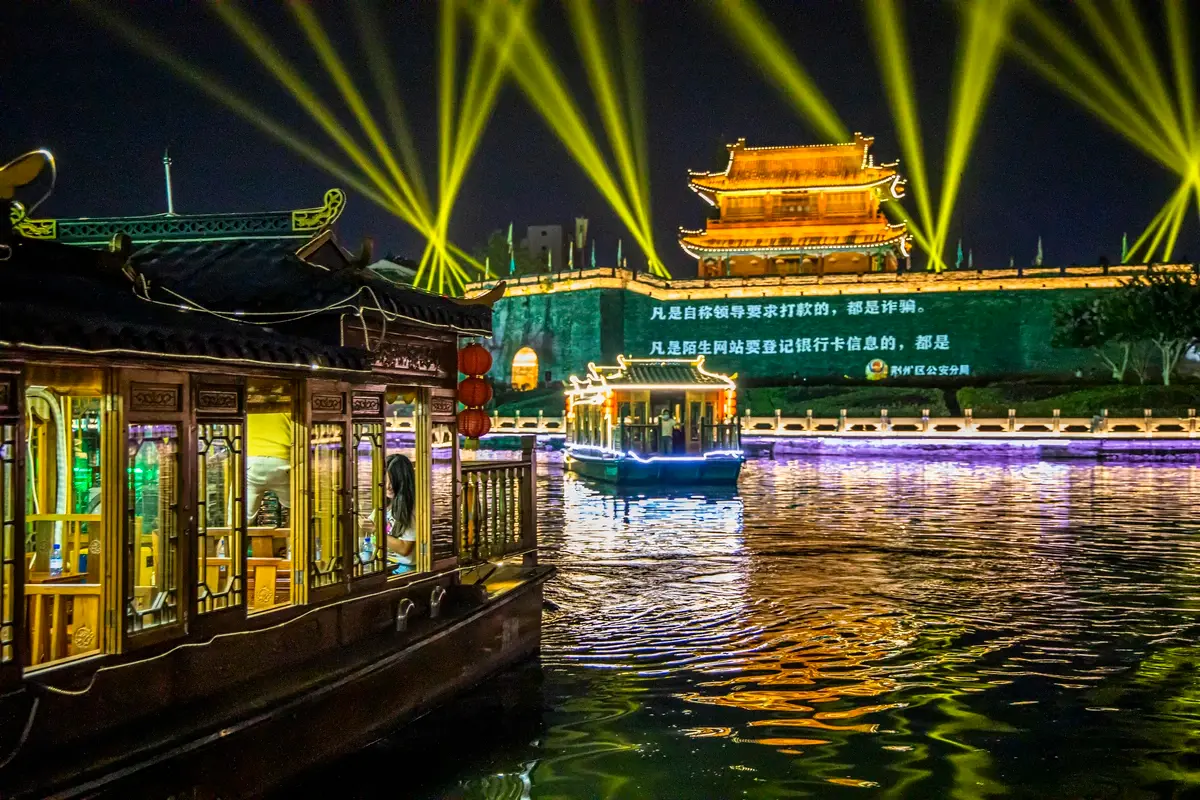
In ancient Jingzhou, as night falls, a bustle begins. A modern light and shadow show opens a new chapter of night tours in the ancient city.
At the east gate of Jingzhou Ancient City, the modern technological light and shadow show is stunning, with dazzling colors showcasing the charm of modern technology, brilliant lights and shadows displaying the brilliance of the times.
The lights on the city towers, the water spray from the Nine Dragons Bridge, the flowing colors along the moat, coupled with colorful light pillars, are simply magnificent and beautiful!
In the evening, take a boat at the east gate of Jingzhou, leisurely cruise on the moat, watch the unique beauty of Jingzhou Ancient City at night, feel the breeze on the water and the ancient atmosphere of the historic city.
Each scene tells a story, deeply captivating. Each show is divided into three chapters: Chu Charm, Three Kingdoms Culture, and Vibrant Jingzhou. The first chapter highlights figures, humanities, and history; the second presents Three Kingdoms culture; the third is Vibrant Jingzhou, showcasing the core humanistic history and cultural relics of Jingzhou, presenting a modern flavor of Chu style and a grand epic.
With the theme "Guan Yu's Holy Land, Charismatic Ancient Jingzhou," the light show at the east gate of Jingzhou Ancient City adorns the night with a "colorful dress." Every night's light show not only presents a vibrant picture of ancient Chu Jingzhou but also promotes Jingzhou's history and culture, showcasing the profound heritage of this famous historical and cultural city.
Utilizing modern high technology of "city·water·light·shadow," it presents the historical scroll and modern civilization of "the soul of Chu" — including Jingzhou's "Three Views," Gongan's "Three Yuans," Shashi's Wanshou Pagoda, Zhanghua Temple, Honghu Lotus, Shishou Elk, etc., to the audience, highlighting the characteristics of Chu culture. It is a splendid light and shadow feast that no tourist visiting Jingzhou should miss!
New highlights of the ancient city night tour: boat tour on the moat to watch the modern technological light and shadow show. Two shows every day, each lasting 8 minutes. By displaying Chu and Han cultural landscapes and promoting the heritage of Three Kingdoms culture, it publicizes and develops the ancient city of Jingzhou. The future is promising. Maybe soon, Jingzhou Ancient City will become a popular internet-famous check-in spot for people around the world!
Hubei's first Fantawild theme park, [Jingzhou Fantawild Oriental Heritage], combines Chinese historical culture with Chu culture to create a modern high-tech cultural theme park. I did my homework: the park has 41 indoor and outdoor rides, over 200 leisure and landscape projects, with an overall Chinese style. It's dazzling to see, and the experience is particularly amazing, full of surprises!
Although I've visited many amusement parks and checked in at quite a few foreign ones, I never expected that Hubei could produce such a culturally creative large amusement park. It's absolutely a five-star recommendation!
[Recommended Must-Visit Rides]:
"Fly with You": An 8-minute tour of China's beautiful scenery. Highly recommended to check in first. It feels like flying in an airplane with full naked-eye 3D effects. The scenes are truly realistic, offering a panoramic view of China's scenic spots and historical sites.
"Nüwa Mends the Sky": A combination of high tech and traditional culture. People ride in a sightseeing car for an adventure. One segment is full 4D and fully tunneled, so realistic that it feels like a collective escape. Similar to Disney's "Pirates of the Caribbean," but the 4D effect is really impressive.
"Cowherd and Weaver Girl": Lie on the seats and watch the starry sky and petals. Very romantic.
"Magic Tower": Similar to indoor drop towers at Disney, when it reaches the highest point, the tower windows suddenly open.
"Circus Carnival": A suspended roller coaster, super thrilling. The up-and-down motion is less obvious, but the hanging experience feels like flying. It's so fun to be airborne.
[Two Must-See Performances]:
Both major performances need to be booked through the Fantawild app. [Qu Yuan] and [Chu Music] require on-site queuing to find seats; first come, first served. The high-tech stage design is really excellent. Be sure to watch them; you won't regret it!
Of course, there are many outdoor large-scale rides, such as thrilling pirate ships, canyon rafting, and Yu the Great Flood Control... All are especially suitable for children and friends with a childlike heart. The park also has the kids' favorite "Boonie Bears" themed area, super cute and silly, built exactly like the cabin of Briar and Bramble, full of joy!
[Opening Hours]: Monday to Friday: 09:30-17:30; Holidays (including summer vacation): 09:00-18:00. (Opening hours may change; refer to the park's daily notice.)
[About Transportation]: Bus: Route 42 from downtown to Fantawild; Route 22. Self-driving: Follow navigation. Parking fee is a flat rate: 20 yuan for over 20 minutes and within 24 hours. Pay by scanning code when leaving.
[About Accommodation]: There is no accommodation inside Fantawild. You can stay in the city. Around Wanda Plaza, accommodation is about 300 yuan/night. Other places may be cheaper, with various price ranges. Book according to needs.
[About Security Check]: The first gate is security check, the second gate is ticket check. Security is not strict; small bags are generally exempt. Drones are not allowed. Everyone should actively follow the park rules.


