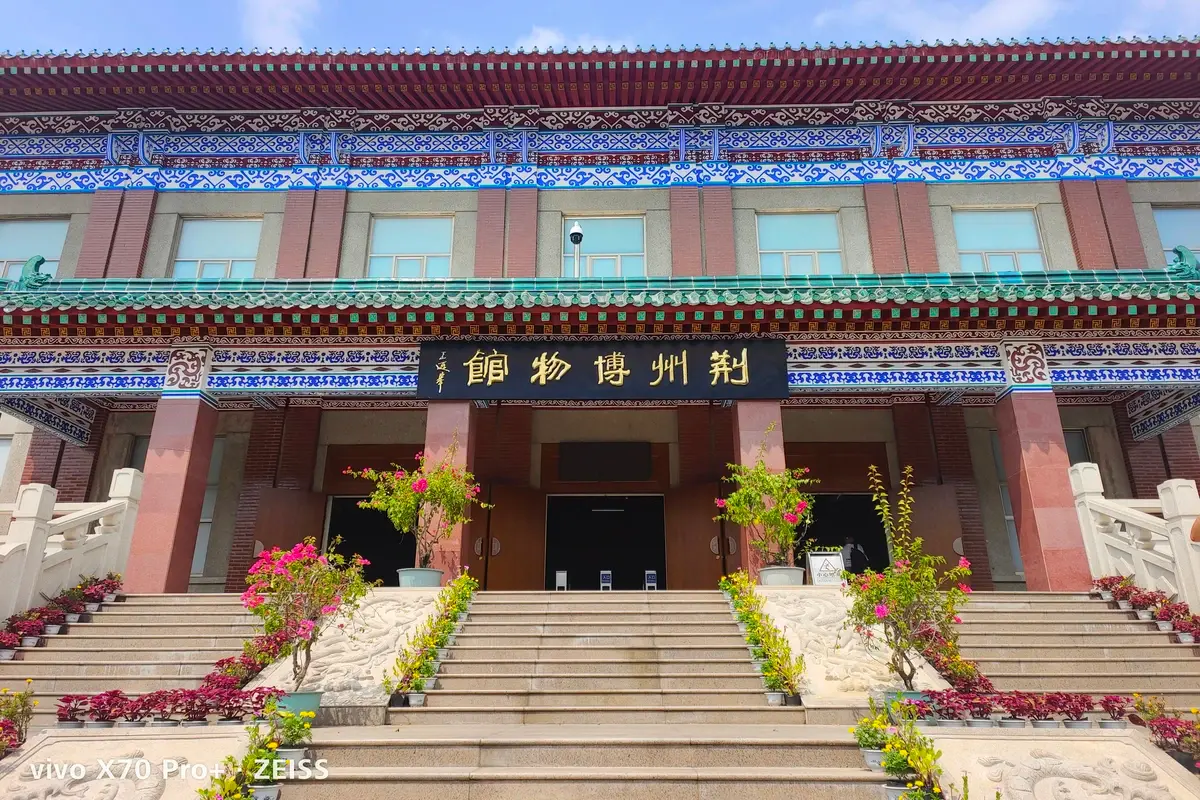
Hubei Travel Notes: Jingzhou Museum
On the morning of September 6, 2023, after breakfast at the hotel, we packed our luggage, checked out, took Metro Line 2 to Hankou Railway Station, and boarded the D5787 bullet train at 8:58 AM heading to Jingzhou, with a ticket price of 76 yuan. We arrived at Jingzhou Railway Station at 10:30 AM, then took Bus 104 to Shachang Long-Distance Bus Station and checked into the Home Inn hotel, where a standard room cost 102 yuan and included double breakfast. Although the hotel was quite far from the railway station, it was more convenient to take a bus to Jingmen the next day. After arranging accommodation, we took Bus 103 at 12:30 PM to the terminal stop at Ximen, intending to visit the Jingzhou Museum. We thought we would have lunch near the museum after getting off, but to our surprise, there were no satisfactory dining options nearby, so my wife had to buy two steamed rolls just to stave off hunger. At 12:50 PM, we entered the museum to begin our visit. A few years ago, we had come to Jingzhou and heard that the Jingzhou Museum has a very impressive collection in Hubei and is also renowned among provincial-level museums nationwide. Unfortunately, it was closed at that time, so we missed it. This time, we were determined to thoroughly enjoy it.
The Jingzhou Museum was established here in 1958... After more than sixty years, the Jingzhou Museum has developed into a local comprehensive historical museum that integrates various functions such as exhibitions, education, cultural relic collection and preservation, preservation of ancient cities and buildings, archaeological excavation and research, and archaeological site park construction. It is a national 4A-level tourist attraction, one of the first batch of national first-class museums, a national public welfare first-class institution, an art hall of Jingchu culture, and a shining name card of the ancient city of Jingzhou.
The Jingzhou Museum is one of the earliest units to obtain the 'People's Republic of China Archaeological Excavation Qualification' and also holds qualifications such as 'Movable Cultural Relic Restoration Qualification', 'Cultural Relic Protection Engineering Survey and Design Qualification', and 'Cultural Relic Protection Engineering Supervision Qualification'. It has been awarded honors including 'National Advanced Cultural Collective', 'National Excellent County-Level Museum', 'Xia Nai Archaeological Research Achievement Award', 'Top Ten Archaeological Discoveries in China', 'Top Ten Exhibition Boutique Awards in China', 'National Field Archaeology Award', 'National Archaeological Site Park', 'National Book Award', 'National Youth Civilization', 'Patriotic Education Base', and 'National Advanced Collective in Culture and Tourism System'. It has published more than 60 monographs and over 1,000 papers.
As of 2021, the Jingzhou Museum holds a collection of more than 196,000 items (mainly artifacts unearthed from archaeological excavations), including 17,950 pieces/sets of national precious cultural relics, among which 614 pieces/sets are national first-class relics, 1,259 pieces/sets are second-class relics, and 16,077 pieces/sets are third-class relics. Treasures mainly include prehistoric jade artifacts, pottery animal figurines, Shang and Zhou bronze vessels, Eastern Zhou Chu royal tomb jade artifacts, the Five Dynasties 'Sword of the King of Yue', embroidery pieces from Mashan Tomb No. 1, Chu, Qin, and Han bamboo and wooden slips, lacquered wood objects, Western Han embroidery pieces, Wei, Jin, Sui, and Tang celadon, Northern Song pottery statue of Guan Gong, Southern Song celadon lotus leaf cover jar, Yuan underglaze red porcelain jar, Ming Prince of Xiang and his consort's posthumous seals and books, and Qing Liu Yong's running script horizontal scroll. They are numerous in quantity, rich in variety, and high in value, serving as treasures to promote history and culture.
Currently, the Jingzhou Museum offers eight permanent exhibitions with strong local characteristics, systematically showcasing Jingzhou's history, culture, and fine artifacts: The Exhibition Building's 'Stars Shining Together: Jianghan Plain Primitive Culture Exhibition', 'Glorious Bronze: Jingzhou Unearthed Bronze Ware Exhibition', 'Selected Chu Jades: Jingzhou Unearthed Jade Ware Exhibition', 'Written on Bamboo and Wood: Jingzhou Unearthed Bamboo and Wooden Slips Exhibition', 'Wonders of Pottery: Jingzhou Unearthed Ancient Porcelain Exhibition'; the Treasures Hall's 'Five Grand Masters Sui: Han Tomb No. 168 at Fenghuangshan Exhibition', 'Splendid Lacquer: Exhibition of Fine Chu, Qin, and Han Lacquerware'; and the 'Kaiyuan Temple Historical and Cultural Exhibition' at the national key cultural relic protection unit Kaiyuan Temple.
The museum's top treasures are as follows: The Warring States painted lacquer wood tiger-base phoenix-bird hanging drum, about 1.7 meters high and 1.45 meters wide, with two tigers as the base and two phoenixes as the frame, a drum suspended from the phoenix crowns, the fierce tigers poised to pounce forward, the soaring phoenixes spreading their wings as if to fly, magnificent in momentum. The Warring States painted lacquer wood toad-base phoenix-bird feathered figure, composed of a feathered figure, a phoenix bird, and a toad. The human-faced, bird-beaked feathered figure stands with feet together on the head of the phoenix bird, which spreads its wings and steps on the back of the toad, a unique shape reflecting the mysterious religious beliefs of the Chu people. The root carving evil-warding figure, with a flat head resembling a tiger's head, a body like a dragon, overall shaped like a gecko. Its limbs are bamboo-like, varying in length, with three legs supporting the body unevenly and one leg raised as if walking. On its legs are carved a food chain: a snake eating a lizard, a lizard eating a bird, and a bird eating a cicada. The tiger-base flying bird, with a crouching fierce tiger as the base, majestic in expression, and on the tiger's back stands a long-necked phoenix bird with head raised and wings spread, dignified and imposing, with a pair of sharp deer antlers growing from the phoenix body, highly aesthetically valuable. The double-headed tomb guardian beast, carved as two beasts facing away from each other, most striking are the huge deer antlers on their heads, with intertwined branches, imposing and magnificent, strange and supernatural, as if the antlers truly possess a magical power. The reclining deer drum, created by imitating the image of a sika deer in nature. The 'Book of Songs, Lesser Odes, Deer Cry' says: 'Gently the deer cry, eating the wild artemisia. I have fine guests, so play the zither and blow the sheng.' 'Deer Cry' was a piece frequently played at feasts of Eastern Zhou nobles. The Chu people used the reclining deer as a drum stand, hoping to hear the sound of 'deer crying' while listening to the drumbeat. The Western Han cloud-phoenix pattern round plate, with the inner base of the plate lacquered black and then divided into three circles by wide red lacquer bands; the inner and outer circles are painted with the main pattern of cloud-phoenix patterns in red lacquer; the middle circle and the inner and outer walls of the plate are painted with triangular, deformed phoenix bird patterns, forming continuous decorative bands. Another top treasure of the Jingzhou Museum is the Western Han ancient corpse 'Five Grand Masters Sui', born over 2,000 years ago. Besides the ancient corpse, the ancient tomb also yielded precious artifacts such as writing brushes and ink, balance rods, various lacquerware, bronze ware, pottery, as well as bamboo and silk fabrics. However, since the Sword of Goujian, King of Yue, and other precious artifacts are already displayed at the Hubei Provincial Museum, many of the items here are replicas, which is a slight disappointment.
We finished our visit at 4:00 PM, just as the museum was about to close. After leaving the museum, we walked about one kilometer to the Guan Yu Shrine to have a look along the way.


