12/12-12/16 Tokyo 5-Day Free Travel (Part 3)
Yesterday I used the Toei One-Day Pass, and today I plan to buy the Tokyo Metro One-Day Pass to compare the differences between the two lines. LG concluded that the Toei pass is better to use, because the Oedo Line is a loop line, similar to Shanghai Line 4; of course, that depends on where you plan to go. I think each has its own strengths, and Tokyo's subway system is reasonably designed. I suggest that at Narita Airport, in addition to the airport line ticket, you should also buy a Tokyo Metro single-day ticket (600 yen, 710 yen outside the airport), or a two-day ticket (980 yen, only sold at the airport). These are available at the Ticket Pia counter in the arrival hall (Terminal 1: 7:00-22:00; Terminal 2: 7:00-21:00).
During our five days, we used the subway one-day pass on two days. On the first day, after checking into the hotel, we only had half a day left, so we just strolled around Shibuya. On the second day, we used the Toei One-Day Pass. On the third day, we used the Tokyo Metro One-Day Pass. On the fourth day, we shopped in Shinjuku and didn't need to take the train. On the fifth day, we took a walk near the hotel to pick up any missing items, had lunch, and headed to the airport around 2 pm, so no train needed. You can purchase according to your actual number of days. Also, for those going to Hakone, there is a travel agency behind the boarding point of the Keio Hotel shuttle at Shinjuku West Exit that sells day trip tickets to Hakone. There are several combinations to choose from, ranging from 9,000 to 12,000 yen. It's very convenient for a round trip on the same day. Every time we waited for the shuttle bus, we would take a look at the pictures, but we didn't go because our schedule didn't allow it.
Day 3: Today I plan to go to Tsukiji Market. I did some homework beforehand and saw many people saying you need to go to Tsukiji very early, otherwise it's meaningless; some even go at 5 am. I planned to get up early, but in the end, I got up as usual and took the 10 am hotel shuttle to Shinjuku West Exit. I bought a Metro one-day pass (710 yen), took the Marunouchi Line to M15, transferred to the Hibiya Line, and got off at Tsukiji Station.
Tsukiji Market is a seafood morning market selling all kinds of marine products: dried, fresh, pickled goods, and also freshly made tamagoyaki (rolled omelette) and such. It's somewhat similar to Shanghai's Tongchuan Road Market (though not as large and cleaner). It is divided into several sections, all set up in small alleys and lanes, more or less the same. There are also many restaurants around, selling fresh seafood sashimi bowls and so on. This is where we went:
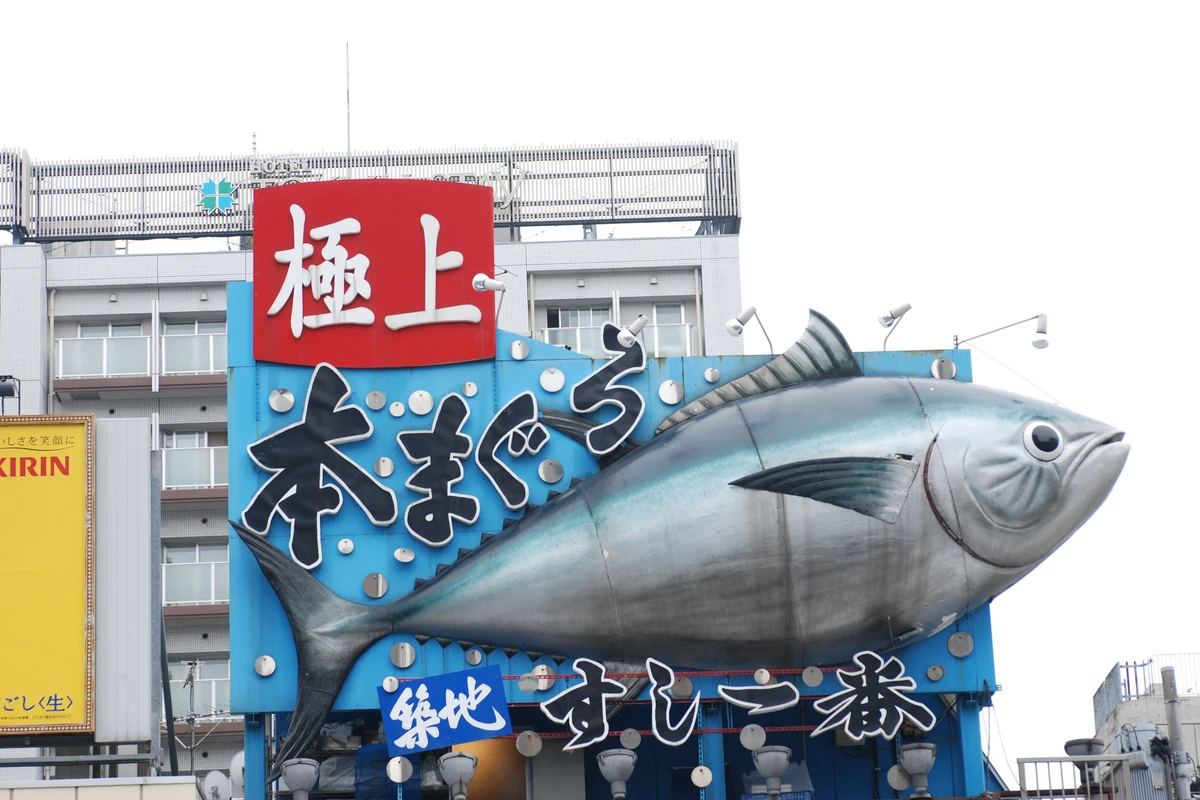
The alley under the big fish with a white banner leads into the fish market.
We arrived at 11 am. It had rained and was very cold, but the market was still very lively. Many middle-aged women were tasting food in front of shops in groups, lining up to buy freshly made egg and fish semi-finished products. The shop owners were shouting energetically but politely, unlike the yelling in our vegetable markets. Many shops had tasting samples set out, and the owners enthusiastically invited us in, saying "mishi mishi" (eat eat). Most were raw pickled seafood, which tasted good and was finely prepared, but had a strong salty and fishy smell. LG didn't like it. Although it was an open-air market, a seafood market, and it had rained, the ground was extremely clean and tidy, without any mud, water, or garbage, and no fishy smell.
This shop specializes in selling fresh fish. Once you pick your fish, the owner immediately processes it, slices it, packs it with ice, so you can eat it directly at home. The owner's movements were clean and sharp, attracting many onlookers and eager buyers.
After a stroll, we basically experienced the daily life of Japanese working people and decided to find some delicious food to reward ourselves. In the alley, one restaurant after another displayed photos and prices outside. It was just dinner time, and many local white-collar workers and residents were comparing restaurants before choosing one they thought suitable. We saw a few handsome guys comparing and then entering a small shop, so we followed. At the door, a gray-haired uncle was taking orders and collecting money. We ordered a 10-item combo (1,600 yen) and a 7-item combo (900 yen). Once inside, we found it was incredibly popular. The two-room shop was full, and people were waiting in line. A middle-aged woman handed us a handwritten number, which was our waiting number, just like when we queue for a meal.
Photos and prices were posted on the wall.
We happened to sit at the counter, so we could see the chef's operations.
Our delicious food arrived! Each item was indescribably fresh and sweet. The sea urchin was especially, especially delicious.
This was the other one, the 7-item combo. Both came with rice and soup. We were stuffed.
After eating and drinking, we wandered around the outer area, which was the street-facing shops. Many people lined up to buy food and ate standing at the door.
After Tsukiji, we took the Hibiya Line to Ginza and Yurakucho area to find Japan's largest MUJI. We asked the staff when exiting the subway but still went the wrong way. As we walked, we ended up strolling through Ginza's luxury brand street. Finally, we asked someone again and realized we had gone in the wrong direction (when we came back, we found that inside the subway, taking exit D9 would have led us directly there).
Fortunately, "MUJI" is understood by Japanese people. Our feet were about to break before we finally found it.
It was indeed quite large, three floors, with everything from food, clothing, and daily items to furniture. The second floor also had a dining and rest area, giving it a feel like IKEA.
As soon as I entered, I spotted a scarf and a coat, but then I found out they were not only made in China but also had tags entirely in Chinese. OMG, I really couldn't bear to bring them back to Shanghai like that, so I picked some Japanese-made cosmetics, stationery, and snacks. That still made two big bags. After paying, the staff signaled for us to wait at the exit, and then they carried the two big packed bags, respectfully delivered them to the escalator, handed them to us, and bowed repeatedly. Haha, this kind of attentive service really made us feel great!
Actually, there are two MUJI stores in Shinjuku, but this one is said to be the largest in Japan, so we made a special trip. For shopping, they are all the same.
Afterward, we first returned to Shinjuku to take the shuttle back to the hotel to drop off our things, then after resting, we took the shuttle out again at 6 pm from Shinjuku to Ikebukuro, since we didn't want to waste the one-day pass.
The Marunouchi Line goes directly to Ikebukuro. When we exited, we saw a pharmacy with a sign saying "35% off" or something like that. LG said it must be cheap, so we went in and browsed for a while. It was somewhat different from Hong Kong's drugstores. Japanese pharmacies still have more medicines, and the cosmetics are not the big international brands you can buy in Hong Kong, but rather Japanese domestic brands. Those who like Japanese brands like KOSE would be happy. Another great thing is that the sales staff don't bother you; they don't introduce or push products, letting you browse and look on your own. I bought heat-generating eye masks, KOSE makeup remover wipes, face masks, and a white bottle of Sekkisei—I asked the staff and was told the white one is the second generation or something, but I didn't quite understand.
When we came out of the pharmacy, we had another big bag. LG carried it while we walked around. Ikebukuro has shopping centers like Sunshine City, as well as electronics stores, but department stores close between 8:30 and 9:00 pm. In Japan, the same items sell for the same price everywhere, with almost no difference, so there's no need to compare prices, and there are no counterfeit goods. So we decided to wait until the next day to shop specifically in Shinjuku, rather than buying things that we would have to carry. We just strolled and ate.
The food street right outside Ikebukuro Station
There was so much delicious food that I regretted not having two stomachs.
This shop specializes in udon noodles, with dozens of ways to prepare them.
I really love onsen tamago (hot spring egg).
Tonkatsu (fried pork cutlet). I just don't understand how Japanese fried chicken and pork cutlets can be so crispy and non-greasy on the outside, yet so tender, juicy, and melt-in-your-mouth without getting stuck in your teeth!
This shop is famous for tofu, with over 100 tofu preparations, both savory and sweet. This is a matcha tofu ice cream, very unique, with no beany smell but plenty of milky flavor.
Originally, we planned to go to Roppongi, but since we really couldn't eat or walk any more, we went back.


