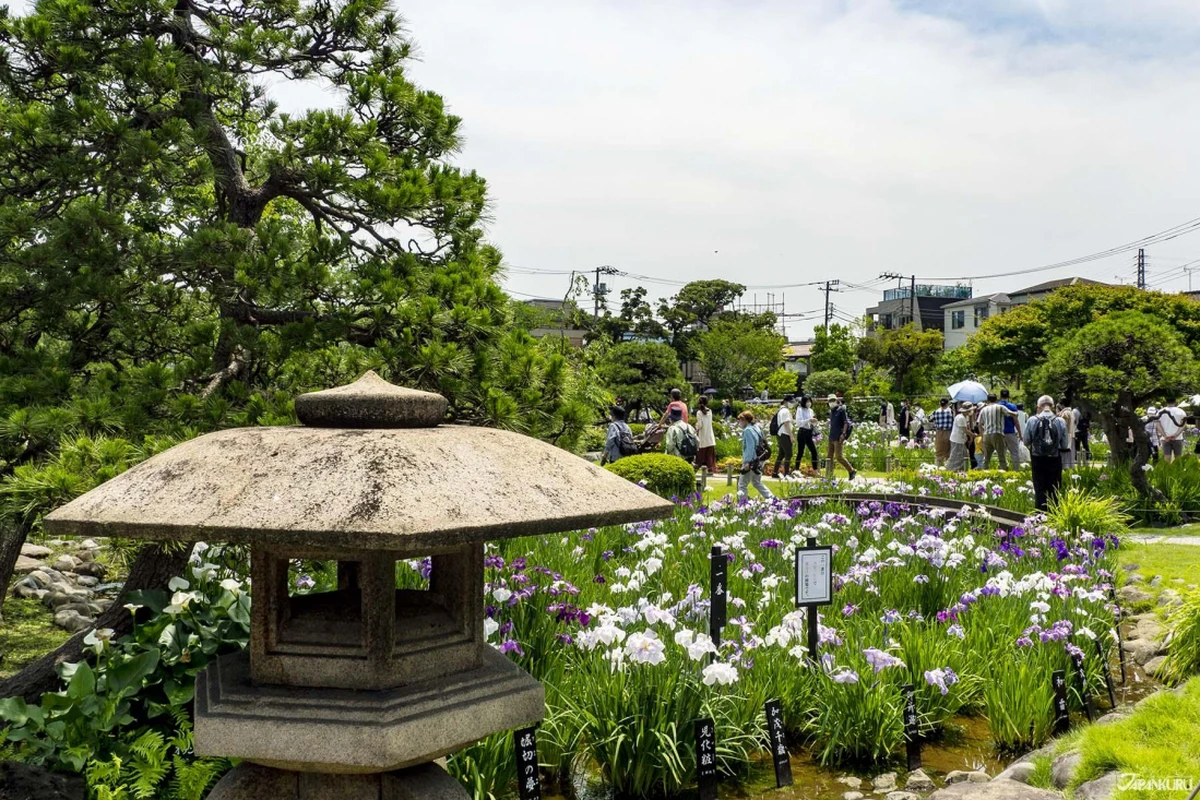
Tokyo's Horikiri Iris Garden and Skytree: An Early Summer Ukiyo-e Landscape of Edo Charm
Cherry blossom viewing is very Japanese, and hydrangea viewing is very Japanese, but did you know that viewing irises in May and June is also full of Edo-period Japanese atmosphere, and is a classic scene depicted by the ukiyo-e master Ando Hiroshige?
Early Summer Japanese Scenery: June Flower Viewing Recommendations in Tokyo
Among the famous ukiyo-e artist Ando Hiroshige's classic series "One Hundred Famous Views of Edo," there is a piece titled "Horikiri Iris Garden" that can be said to be a scene with a very Edo atmosphere. Honestly, before I came to Japan, when I thought of irises, only the Dragon Boat Festival came to mind, that we hang irises and mugwort to ward off evil spirits, but I actually had no impression of what irises looked like. It wasn't until I came to Japan that I incidentally learned about their tradition of taking an iris bath during the Dragon Boat Festival, and also discovered that there is a "Horikiri Iris Garden" within Tokyo—and then I found this flower scenery that, while different in atmosphere from cherry blossoms and hydrangeas, is equally full of Japanese charm.
Shitamachi Early Summer Stroll: Viewing Irises and Hydrangeas at Horikiri
Horikiri Iris Garden is a small garden located in Katsushika Ward, where Ryotsu Kankichi from "Kochikame" is based, with a history of at least a hundred years. According to legend, irises were cultivated in the Horikiri area as early as the Muromachi period, though another theory says it started in the Edo period. But no matter which period it began, the fact remains that the Horikiri area has been a famous spot for irises within Tokyo. Every year, the sight of irises in full bloom, as part of the "One Hundred Famous Views of Edo," has appeared in the works of ukiyo-e artists including Ando Hiroshige.
Before World War II, there were four well-known iris gardens in Horikiri, including the one originally called "Horikiri Garden" which is now Horikiri Iris Garden. Unfortunately, due to the war, only a part of Horikiri Garden was preserved, becoming today's Horikiri Iris Garden.
Today's Horikiri Iris Garden is actually not large. After getting off at Horikiri Shobu-en Station on the Keisei Main Line, you need to walk about 500 meters. Since the surrounding area is mostly residential, it feels quite hidden in the city. The garden grows 200 varieties and 6,000 plants of irises. During the blooming season from early to mid-June, the garden is filled with purple and white flowers covering the pond, which is particularly distinctive. These irises are of different types and each has its own elegant and romantic name; reading these names is also quite interesting. At the same time, the local community also holds an iris festival, with some stalls and events outside the garden, offering a shitamachi atmosphere different from Asakusa.
Besides irises, you can also see some hydrangeas and a small water lily pond inside Horikiri Iris Garden, making it truly a summer garden. However, I've heard that even outside the iris season, the garden has plum blossoms, wisteria, winter cherry blossoms, and peonies to enjoy.
On the way from the station to the garden, there is a small path called "Ajisai Dori" (Hydrangea Street) lined with hydrangeas, which is well worth a detour when heading to Horikiri Iris Garden. Although the Horikiri area is actually close to the Arakawa and Ayase Rivers and is quite a commoner's area, the residential district may lack a certain fashionable atmosphere compared to the Yamanote area, but precisely because of this, there seems to be a stronger sense of everyday life.
Arakawa Riverside: Irises and the Skytree
After leaving Horikiri Iris Garden, you might want to walk toward the elevated bridge, cross under it, and take a stroll at Horikiri Mizube Park along the Arakawa riverbank. There, you'll find a small flower bed where irises bloom during the iris season. Across the river, you can see the Skytree, so you can take photos of irises with the Skytree. The Arakawa embankment has always been a place I personally like, partly because I often saw such wide scenes of riverbanks and levees in Japanese dramas, and partly because in recent years I have lived near this river in Japan, so it gives me a strong sense of Japanese daily life inside and out.
If you come to Tokyo in early summer and want to see some different flowers, you can spend half a day around the Horikiri Iris Garden area. For the other half, I suggest visiting Shibamata, another popular shitamachi strolling spot in Katsushika Ward—it is an old street with a strong shitamachi atmosphere and the background setting for the TV series "Otoko wa Tsurai yo" (It's Tough Being a Man). If you want to plan such an itinerary, you can buy a "Shitamachi Hiyori Ticket" (下町日和きっぷ) from Keisei Electric Railway, which costs 510 yen and offers some savings.
Besides Shibamata, you might also consider visiting Kameari, where Ryotsu Kankichi from "Kochikame" lives! It is also a great place for a walk, and you can encounter characters from the series. We briefly introduced it a long time ago; maybe I'll write a new travelogue about it when I have a chance.
Address: 2-19-1 Horikiri, Katsushika Ward, Tokyo
Opening Hours: 9:00-17:00
Public Transport: About 10 minutes on foot from Horikiri Shobu-en Station on the Keisei Main Line
2023 Katsushika Iris Festival (葛飾菖蒲祭り)
Event Period: May 29 (Mon) – June 18 (Sun)
Night Illumination at Horikiri Iris Garden: June 9 (Fri), June 10 (Sat)
Illumination Hours: 19:00-21:00


