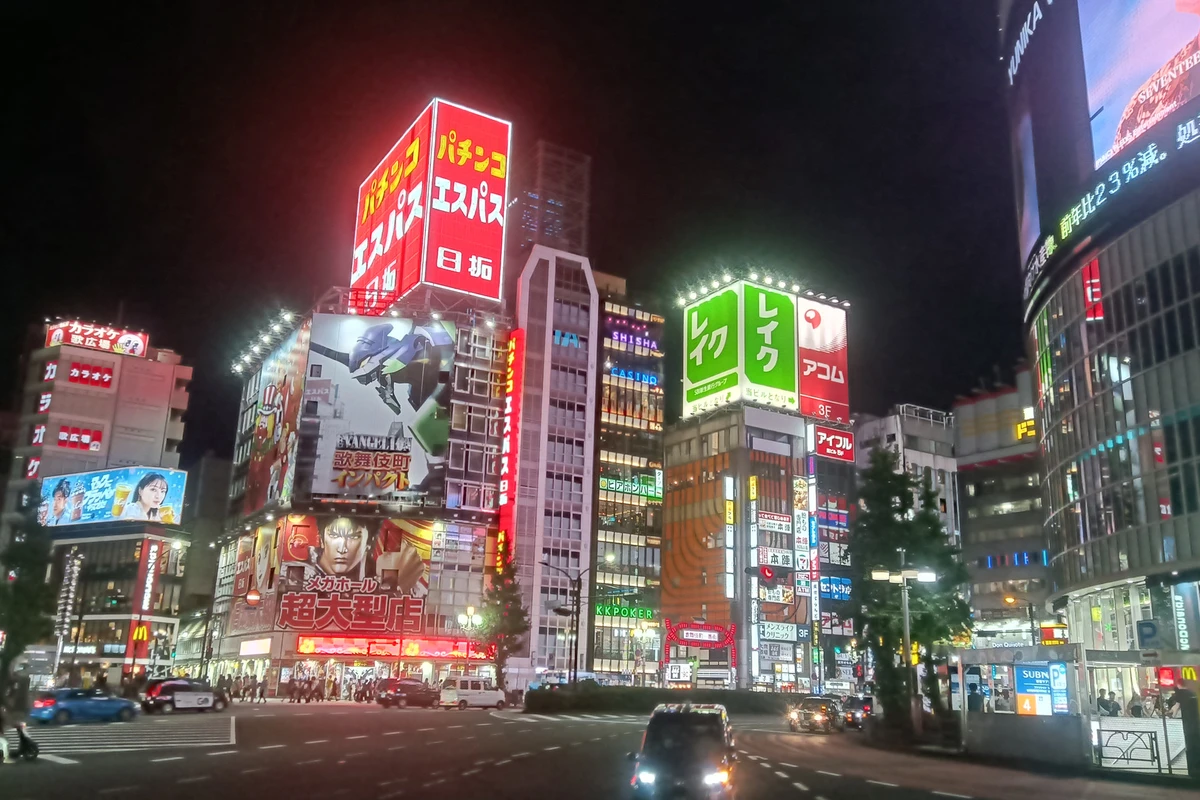
Tokyo Trip in September
After returning for a week, I've been dealing with backlogged work. Now I finally have time to write down this trip to Tokyo.
I'm not good at writing, so just treat it as a random log.
Because of work, I've been to the other side of the earth, but this island country right at my doorstep—I've never been before.
Going to Japan during such a sensitive period put some psychological pressure on me. Not to mention the real risk of nuclear radiation, but even the national sentiment alone could dampen the mood of the entire trip.
However, since work was the main purpose, these feelings could be ignored. As my colleagues Ah Xin and Peter said: 'Since we're here, let's just feel it with our hearts.'
My writing ability is limited, so I can't narrate clearly and logically. I'll try to use a few keywords as cues. [Due to length limits, the content is placed in the comments...]
When I landed in Tokyo, I saw Chinese characters everywhere, which indirectly confirmed the inseparable historical ties between this country and China.
Even without knowing Japanese, just by relying on these frequently appearing Chinese characters, we could guess half the meaning. So, even when the translator wasn't around, I could still use a few basic Japanese phrases and body language to order food and shop.
In Japan, English is really not that common. I tried to communicate with Japanese people of different ages, but whether old or young, even in business settings, English was difficult for them. This is in Tokyo, the capital of Japan. It's hard to understand how Japan, a country that started westernization (globalization) as a little brother to the US since the Meiji Restoration in 1868, seems to have lower English proficiency than China. From another perspective, maybe this is the same reason why their traditional culture is so well preserved.
【Tradition and Trend】
In Tokyo, I saw many polarized cultural elements. There are traditional cultural symbols like the Imperial Palace, and fashionable luxury districts like Ginza.
There are Buddhist sites like Sensoji Temple with over 1400 years of history. (If you go to Sensoji, you can visit a small shrine at the back right of the main hall. It's quiet there, no tourists, and it feels like that's where the god really dwells, because the front is too noisy.) And there are passionate entertainment districts like Shinjuku's Kabukicho.
There are torii gates everywhere (said to be gates separating the human realm and the divine realm). And there is the two-dimensional world of Akihabara! In these two-dimensional worlds, you can see traditional elements like temples, torii gates, and gods embedded everywhere. (Inuyasha, Totoro, Spirited Away... Fans of Japanese anime should be familiar with the descriptions about gods in these works.)
First, the most impressive thing was the cars on the streets—private cars, buses, official cars, construction vehicles, even garbage trucks and dump trucks—all were spotlessly clean. Not a single vehicle had traces of dust, and even the wheel hubs were polished shiny. On one hand, this shows how diligently they clean their cars daily; on the other hand, it reflects how clean Tokyo's streets are.
Also, on the exterior walls of buildings in Tokyo, apart from large billboards fixed with steel frames, you could hardly see any random posters or other advertisements that might dirty the buildings. It is said that property management companies there regularly use management fees to renovate and maintain building exteriors every few years. So even many old buildings show no peeling paint or rust. Perhaps this is one way for a city to maintain vitality.
In Japan, bowing is basically their iconic social and work body language, especially in the service industry. Every time a服务员 says 'thank you' or 'sorry,' they make you feel like they truly treat you as 'God.' Compared to 'thank you,' the word 'sorry' seems to appear more frequently in their daily lives. Sister Gao said it's because Japanese education emphasizes an awareness from childhood: try not to cause inconvenience to others. Whether troubling someone for help or obstructing someone, 'sorry' is always on their lips. Every time they cross a zebra crossing and a car gives way, they pause slightly, nod slightly to show 'apology,' as if saying, 'Sorry for blocking your way.' Brother Peter even joked, 'Maybe if I got rear-ended while driving, I'd have to get out and say sorry to the car behind me.'
For someone who loves drinking like me, izakayas in Japan are a must on my experience list. Small doors with half-length curtains are everywhere. Entering, all kinds of people gather around a long counter, order a glass of Asahi or a glass of Dassai, plus a bowl of ramen or snacks, and you can fully relax your body and mind. Going to such an izakaya alone doesn't feel lonely or awkward.
These izakayas mainly serve ordinary office workers, so the food and drinks are usually affordable. The menus generally don't have expensive dishes. So if you want to experience it, even if you don't know Japanese, you don't have to worry about 'price traps.' Feel free to order and try.
PS2. As a reference, Japanese yen to RMB: 20:1.
Generally speaking, the income of an average Japanese employee is about twice that of an average Chinese employee, and daily consumption is also about twice as much.
On izakaya drink menus, you'll usually see shochu and sake. Shochu is distilled liquor (like the well-known Dassai, Nikaido, Kuroshiro Nami, etc.), similar to Chinese baijiu but with lower alcohol content. Sake (also called seishu) is fermented liquor (like Sawanoi, Kamo Tsuru, etc.), similar to Chinese huangjiu but not as sweet. Personally, shochu with ice tastes better, while sake is better when served warm.
Besides shochu and sake, Japanese beer is also an unavoidable attraction. As far as I could see, Kirin Beer (represented by Ichiban Shibori) and Asahi Beer seem to be the most popular. They are smooth and refreshing. In the freezers at FamilyMart or Seven-Eleven, there are entire series of Kirin beer and various other local Japanese beers. Foreign beers are rare. I tried to go to FamilyMart every night to pick one or two types to taste, but I couldn't finish them all before leaving. I'll have to save them for next time.
Tokyo, as the first city in Asia to have a subway, now has the most comprehensive subway network in the world. Fast, extensive coverage, clean, and most importantly—lively. In Guangzhou and Shenzhen, subway stations usually follow the layout of commercial areas. But in Tokyo, it seems commercial areas follow subway stations (though this might be an illusion), because the commercial facilities around major subway stations are extremely large and complete. Shinjuku Station is a typical example—a station bigger than Tianhe City, with over ten exits and five or six floors, all filled with food, drink, and entertainment commercial facilities. Just walking around it took over ten minutes.
Also, when in Tokyo, you must take the Yurikamome Line to Odaiba and Tokyo Big Sight. The Yurikamome Line (like a light rail in China) runs on an elevated track, offering views of Tokyo Bay. Though short, it's a good sightseeing route.
Since this was a business trip, I only got a glimpse of Tokyo. What I felt might only be superficial, and even what I saw might partly be an illusion. So all summaries may not be accurate. But from a personal perspective, I would be willing to come again, with my family for tourism. Whether it's the culture, scenery, or food, everything makes me want to explore more.
Also, special thanks to tour guide Sister Gao and team leader Sophia for their help, and to my fellow traveling brothers (@Ah Xin @Peter @Jack @Thomas). Because of you, the entire trip became more wonderful and joyful. Cheers!


