Seven Days Six Nights|From Tokyo to Nagano, Hiking Through 500-Year-Old Giant Redwoods in the Snow!
Heading to Tokyo once again, both excited and nervous, as if time had returned to 2019! This was my second trip to Tokyo, Japan, also during the Spring Festival period, so airfare was slightly (very) more expensive. Everyone can ignore the airfare and accommodation prices for this trip, but the rest of the itinerary can be copied without changes, because I've already scouted it out—it's a premium route (self-rated)!
The whole route is: Tokyo - Kamakura - Nagano, traveling among three cities. Not a perfect circular route, but we've covered all the must-see scenery! Suitable for those who don't visit Japan often or are first-timers, wanting to check off as many spots as possible!
Detailed itinerary map below:
Haneda Airport is relatively closer to the city center compared to Narita Airport, reaching the city center in about half an hour. We took a red-eye flight, arriving at 4:30. Japanese minshuku or hotels have very strict check-in times, either 15:00 or 16:00. Since we couldn't go to the minshuku, we headed straight to Senso-ji! Early means fewer crowds!
[Shower] After customs, exit and turn right to the end, and you'll see the Haneda Airport shower room. Nothing beats taking a shower, putting on makeup, and feeling refreshed after a red-eye flight! You can always trust Japan's hygiene standards. This shower room costs 1500 yen per person (71 yuan) for 30 minutes. Grab your own toiletries before entering; the time is more than enough.
[Transport Card] If you have an iPhone, it's recommended to add a Suica card directly to your Apple Wallet. After arriving in Japan, top up online. Remember to bind your credit card in advance. If you have an Android phone, go to the subway ticket counter with your passport to buy a physical Pasmo (tourist version). Top up 1500 yen (tourist card requires no deposit), and the amount loaded is what you have. It's recommended to top up 1000 yen each time thereafter, as leftover money cannot be refunded and can only be spent at convenience stores.
A red-eye flight and Senso-ji are a perfect match! We stored our luggage directly at the Senso-ji subway station (there are many luggage lockers on the streets of Japan, but at Senso-ji, you still need to get there early)! By 7:00 we were already at the entrance of Senso-ji. Although the shops on both sides hadn't opened yet—they usually open at 10:00—I felt the shop owners sensed business opportunities, as some shops were already preparing to open around 7:00.
Many people have seen the Kaminarimon gate of Senso-ji, but may not have noticed the dragons under the lanterns. Each lantern in the temple has a different dragon carving. You can observe carefully. Walking forward, there is a place to draw omikuji (fortunes) for 100 yen. I didn't realize that at Senso-ji, about two-thirds are bad fortunes and one-third are good. But if you draw a bad fortune, don't worry—just fold it and tie it to a nearby rack, leaving the bad luck at Senso-ji. If you draw a good fortune, quickly fold it and take it home!
Turning around after praying, we found the place already crowded. So we headed to Akihabara, a world of anime! There are buildings full of figurines and shops full of anime merchandise. You can wander the streets and hunt for your favorite figurines. We, born in the 80s, found our childhood mini-4WD cars here.
For lunch, we randomly picked a ramen shop on the street in Akihabara. There was a famous wagyu beef rice bowl place next door with a long queue. We tried for 20 minutes, but the line didn't move, so we gave up. Japan's queue culture is really serious. Later, even when we went to the ramen shop, we had to queue. Hmm, we finally got to eat! Fortunately, the ramen didn't disappoint. The meat on top was about three times thicker than Ajisen's. My sister exclaimed it was too rich, hahaha.
In the afternoon, we visited the shopping streets on both sides of Senso-ji again, experiencing the prosperity of the local economy. It's truly bustling, completely opposite to the quiet streets of Shanghai.
At 15:00, exhausted, we went to the minshuku to catch up on sleep! This time we booked a minshuku in Nishi-Shinjuku, but it actually belongs to Shibuya Ward administratively. We booked a two-story house, one floor per family, with a large terrace on the 3rd floor. The only downside was that the toilet was only on the 2nd floor, but overall it was very clean and convenient. Two subway stops (178 yen) to Shinjuku Station, which is well-connected.
For dinner, we walked to Shinjuku and randomly found a shop specializing in grilled chicken. The waitress couldn't speak English well, and we couldn't speak Japanese, so we communicated in a mix of gestures and finally ordered successfully! Every dish we got was delicious, and we even tried chicken sashimi for the first time!! Average cost around 3600 yen per person.
For the most stunning urban view in Tokyo, it has to be Shibuya Sky! Standing 229 meters above Shibuya, enjoying a 360-degree view is truly an extraordinary experience.
Through the glass curtain wall, you can clearly see Tokyo Tower and Skytree. On a clear day, you can even see Mount Fuji in the distance. The iconic Shibuya Crossing in front of Hachiko Exit is a major highlight, especially when thousands of pedestrians cross at the same time.
⭕ Ticket booking: Purchase via the official website.
⭕ Ticket price: Official price 2200 yen per adult.
Be sure to buy tickets in advance!! Buy in advance!! Buy in advance!! Buying on the spot often results in disappointment, or you may not get the time slot you want. I missed the best sunset time and got a ticket for noon! People who went that day couldn't buy tickets at all!
⚠ Notes:
1⃣️ At the rooftop observatory, only phones and cameras with straps are allowed. Bags, hats, food, drinks, etc., are prohibited. Personal items must be stored in lockers on the rest floor, costing 100 yen (free to use but requires coin return).
2⃣️ The wind is very strong on the rooftop, so avoid wearing short skirts!
After viewing from the rooftop, we moved on to shopping in Shibuya and Ginza, which I won't elaborate on. Uniqlo and Muji in Japan are great for everyday wear and are definitely cheaper than in China. I bought a Uniqlo down jacket for 7990 yen (383 yuan!!) What a steal! Buy without hesitation!
Only women understand the exhaustion of shopping. In the evening, we had to treat ourselves to wagyu barbecue to soothe our tired bodies.
This was my second time in Kamakura. This town has been on my mind. Last time I stayed for an hour, this time for seven hours, and next time I will definitely stay overnight! Kamakura is truly a serene place, my heart's desire.
From Shinjuku to Kamakura, take the Odakyu Line (private railway) towards Fujisawa. Get off at Fujisawa Station, cross the overpass to the 2nd floor of the shopping mall, and take the Enoshima Electric Railway. Note: you can buy a day pass to get on and off along the way, stopping at various attractions. Prices are as follows:
Departing from Shinjuku: Adult 1640 yen, Child 430 yen (ages 6-11)
Departing from Fujisawa: Adult 810 yen, Child 410 yen (ages 6-11)
We left the minshuku at 9:00 and arrived at Kamakura High School Front Station in an hour. We took photos of the famous Slam Dunk scene and walked on the beach.
This station is getting more and more crowded. Now they no longer allow people to stand in the middle of the road to take photos.
⚠ But you don't have to take photos at this station. You can go directly to the next station, Shichirigahama, where you can also capture people, trains, and the sea, with no fighting over spots. As long as the weather is good, you can even see Mount Fuji from the roadside at Shichirigahama!
Having fun made us hungry. At Shichirigahama Station, we found a nearby trendy restaurant. This place called Coral Reef specializes in curry. Although we waited in line for 30 minutes, it was absolutely worth it! Even I, who doesn't usually like curry, was full of praise. The restaurant's view was also spectacular. Every one of us cleaned our plates and left satisfied.
Then we took two more stops to Hase, where we visited the Great Buddha. Along the way, we ate octopus rice crackers and taiyaki shaped like the Great Buddha. The Great Buddha itself is not recommended—it's fairly ordinary, considering China has the Leshan Giant Buddha and various grottoes. But behind it, there is a hidden hiking trail.
We used both hands and feet on this trail, encountering many unafraid squirrels along the way. The scenery was excellent, and we eventually reached the Zeniarai Benten Shrine (Money-Washing Shrine). It is said that if you wash your money here and then use it, the money will come back to you multiplied! Of course, I washed a 10,000 yen bill, hahaha.
On the way back, we got off again at Shichirigahama and captured an exquisite pink sunset. The day was complete!
For dinner, we returned to Shinjuku and had the ochazuke (tea rice) I had been craving. I highly recommend this restaurant! It's on the 7th floor of Lumine Est near Shinjuku West Exit. Just queue up and you'll be seated soon.
This was a very eventful day.
We left the minshuku at 10:00, stored our luggage at the Shinjuku Station South Exit (the new building with airport bus service), and then spent another day shopping in Shinjuku. I bought crampons at Mont-bell (for the Togakushi hike) and two hats for A-chan. A-chan bought a camera bag he liked at Bic Camera. It was a fruitful day!
Finally, we had the famous crab leg sandwich near Shinjuku South Exit (too small to fill us up), then bought many loaves of bread at Egg Slut downstairs to finally feel full.
After lunch, we went to the information center on the 2nd floor of Shinjuku South Exit to buy tickets to Yudanaka, Nagano. Japanese JR, Shinkansen, and subways have always been a mystery to me. Anyway, you don't need to study them; just go to the information desk at the station. Even if their English isn't great, you can point to your destination and ask them to buy tickets. They will also advise whether to buy a day pass or a single ticket.
⚠⚠⚠ We needed to take the Keihin-Tohoku Line to Omiya Station, then transfer to the Hokuriku Shinkansen to Nagano Station, and then change to the Nagano Electric Railway.
1️⃣ If all goes smoothly, the Keihin-Tohoku Line to Omiya Station takes 38 minutes on a rapid train, or about 58 minutes on a local train.
2️⃣ If the timing is right for the Hokuriku Shinkansen, you can get a direct train from Omiya to Nagano without any stops. These trains are usually reserved-seat only, but don't worry—if there are empty seats, you can sit down; empty seats mean no one will board before Nagano. If the timing is off, you'll have a local Shinkansen that stops at 7-8 stations along the way. Usually, local trains have non-reserved cars, so just find your seat. Station signs are in Chinese characters, so Chinese people have no trouble! The total journey takes 1 to 1.15 hours.
3️⃣ Nagano Electric Railway: This local train runs between Nagano City and Yudanaka Town. Suica cards are no longer valid here; you need to buy a separate ticket at the station. There is only one track, but the trains are divided into local, semi-express, express, and limited express! If you time it well, definitely take the limited express—you can sit at the front and enjoy the driver's view, which is incredibly cool. Along the way, we marveled at how they managed to maximize the use of this single-track rural railway! Express takes 38 minutes, local with transfers takes 58 minutes, but there's only one track. You have to admire Japanese meticulousness.
We arrived at Yamasakiya in Yudanaka at 20:30, a traditional Japanese hot spring inn.
There are two hot spring baths, a large one and a small one. Each time slot is about 40 minutes. You write your name on the board, effectively reserving it. It felt like a private bath! Amazing!
After bathing, we went to bed early; the day's travel was quite exhausting.
⚠ By the way, if the inn's onsen is fully booked, you can also visit the public baths in the village. First, ask the owner for a key. If the light is off and the door is unlocked, you can go in and bathe. Although they are public baths, they feel no different from private ones.
⭕ These are all public baths in the town. You can visit them one by one. There are stamps at the entrance to stamp your yukata!
Waking up in the morning, we found that Yudanaka had turned from rain to snow. Lucky us!
Actually, we should have stayed in Nagano City last night. That was one of the few failures in this trip. A round trip between Nagano and Yudanaka takes nearly an hour.
⭕ To go to Togakushi Shrine, you need to depart from bus stop 7 near Nagano Station. Take bus 70 or 73.
⭕ Buy a round-trip ticket at the ticket booth next to the bus stop. There is a Chinese-speaking girl at the service counter. I'm very grateful for her help. Although the bus frequency is reasonable, the distance is quite far, so it's better to catch the bus on time.
⭕ The journey is long, and most shops in the mountains are closed. There are no vending machines, so bring some snacks and water.
⚠ Key point: At the bus stop, there is an information center. If you didn't bring hiking shoes or crampons, you can rent them here. You'll need them on the mountain paths in winter!
⭕ Everyone must get off at this stop and hike 1.5 km to the giant cedar path.
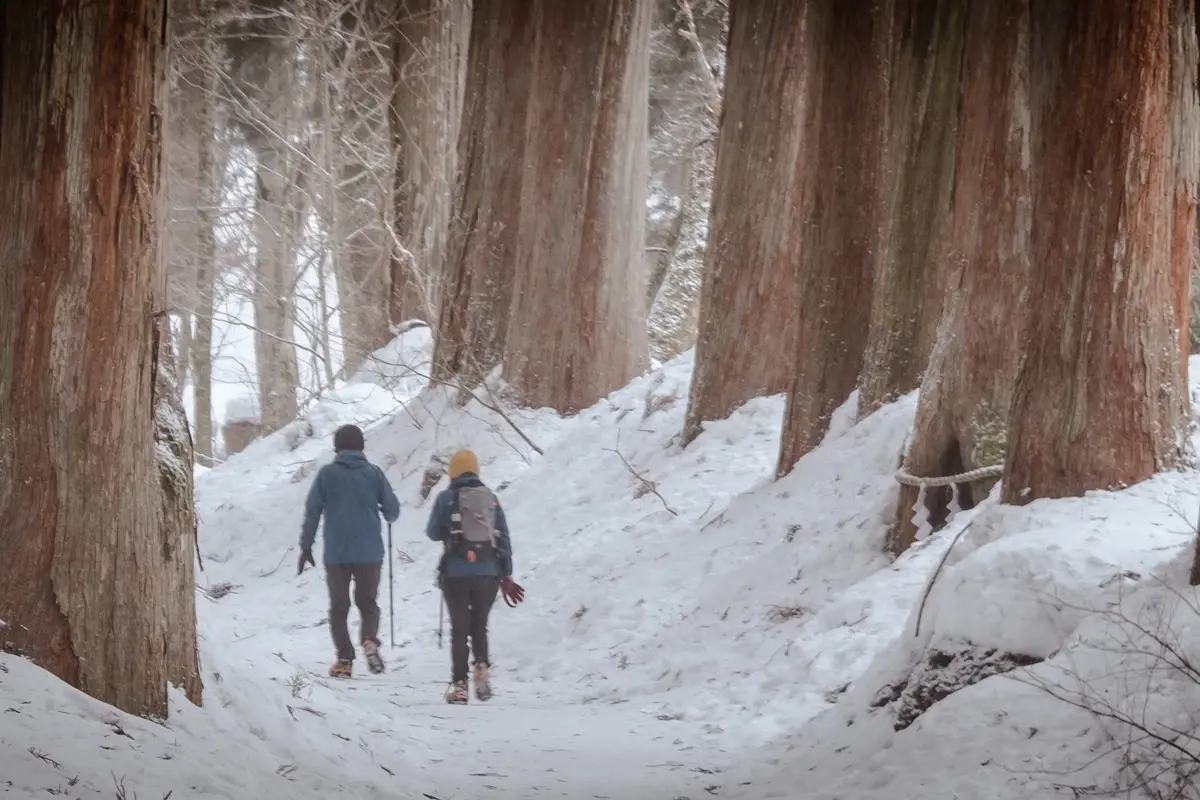
⭕ You must wear crampons here, as the road is icy and difficult to walk.
⭕ This path leading to Okusha (Inner Shrine) feels like being in a land of giants, with towering red cedar trees on both sides. It is said that these trees need over 500 years to grow so thick, and only along the path; farther away, they are not as large.
⭕ Do not underestimate the snow by the roadside—if you step into it, the snow can reach above your knees! ⚠
⭕ We planned only 2 hours for the hike, but it ended up taking 3-4 hours because the scenery along the way was incredibly beautiful. We came down at 15:30 and arrived back in Nagano City at 17:00.
⭕ We looked for two yakitori restaurants, but both were fully booked. We finally got seated at the third one, which turned out to be unexpectedly delicious. If you also visit Togakushi Shrine, this yakitori restaurant in Nagano City is excellent! And the prices were reasonable. We were so hungry that we only photographed empty plates—the owner served everything, and we cleared it all! (The young waiter's English was poor, so please use a translation app to order.)
On the way back at night, we took the limited express Nagano Electric Railway and sat at the front, feeling like the driver ourselves.
We had breakfast at the minshuku. Such exquisite Japanese breakfast, but a bit not filling. We asked the owner for extra rice to be full.
Do Japanese people really have such small appetites?
⭕ Nagano was the host of the 1998 Winter Olympics, so there are plenty of ski resorts.
⭕ From Tokyo to Nagano, you pass by Karuizawa, Hakuba, and a series of ski resorts.
⭕ Yudanaka Station has a free bus to Ryuoo Ski Park. Time it right, and the bus takes 20 minutes to the ski area.
⭕ This ski area is not huge, but many local Japanese go there to ski.
⭕ A full-day ticket is 5200 yen. We arrived at noon, so we bought a half-day ticket for 4200 yen—which was a bit uneconomical but overall still cheap. ⚠ You can rent helmets for free at the second-floor counter with your passport!
⚠ Gloves and beanies can only be purchased, not rented!
⚠ Ski suits, boards, boots, etc., are all for rent, with prices based on type and duration. It's a bit complicated compared to China, so I won't go into detail. In short, renting for the full day is more cost-effective, but bringing your own is the cheapest.
We had lunch at the mountain terrace, with stunning views.
Unfortunately, the last bus was at 17:15, so we had to stop before we were fully satisfied. Next time, we'll plan for two days of skiing.
For dinner, we returned to Yudanaka town. Options were limited, and we ended up at the worst izakaya of the whole trip. If we had a choice, we wouldn't have eaten there. The owner said they had no menu—it was chef's table (the chef cooks whatever he wants). After asking about our allergies, he started serving. 5 bowls of oden, 3 grilled ayu fish, a large serving of udon, one boiled chicken breast, 5 highballs, 1 orange juice, 1 beer—total 18,000 yen!
Hmm, well, I guess it's like domestic tourist prices.
⚠ If possible, we recommend booking breakfast and dinner at the minshuku, so you know exactly what you're paying for.
Originally, when planning the trip, I thought watching monkeys bathe would be boring, but once there, we all exclaimed, "So cute!"
⭕ After breakfast, the minshuku owner drove us to the entrance of Jigokudani Monkey Park. From the entrance, it's about 1.5 km to where the snow monkeys bathe in the hot spring.
⭕ Here, you also need to be careful. You can rent snowshoes or crampons at the entrance or at the visitor center. The mountain path is muddy! Even though the weather was clear, the road was muddy. In cold, overcast weather, it would likely be icy and slippery. Without crampons, we almost fell!
⭕ Jigokudani Monkey Park ticket: 800 yen per person.
⭕ Originally, this monkey troop would come down to Yudanaka village to bathe in hot springs. But since they are wild animals, accidents could happen. Later, an elderly man gradually guided the monkeys to bathe in the mountains, fed them, and even built a dedicated hot spring pool for them. Since then, humans and monkeys have coexisted peacefully. Tourists discovered this adorable phenomenon and flocked to see the monkeys' rosy cheeks.
⭕ Not all monkeys are willing to bathe in hot springs. Only these snow monkeys enjoy staying in warm water. Actually, their fur provides strong insulation against the cold, so they don't need the hot springs for warmth.
⭕ Next to the monkey park ticket office is Owakudani, where geothermal water gushes out. I believe this is the source of the Shibu Hot Spring! Walking down, it seems any small puddle by the roadside could be a hot spring!
Finally, we headed back: Yudanaka → Nagano City → Omiya → Shinjuku → Haneda Airport!
This concludes our joyful 2024 Spring Festival trip to Tokyo and Nagano! Thanks for watching!
Travelogue Directory
1. Tokyo | Small Tips for Landing at Haneda Airport
2. Day 1 | [Tokyo] Senso-ji - Akihabara - Shinjuku
3. Day 2 | [Tokyo] Shibuya Sky - Ginza - Wagyu
4. Day 3 | [Kamakura] Kamakura High School Front - Shichirigahama - Hiking
5. Day 4 | Tokyo - [Nagano Yudanaka] ♨️
6. Day 5 | [Togakushi Shrine ⛩️] One Day Snow Hiking
7. Day 6 | [Yudanaka] Ryuoo Mountain Skiing + Hot Spring Town
8. Day 7 | [Yudanaka] Jigokudani Monkey Park + Owakudani
Travel Information
Hotel Index
Itinerary Index
Ticket Index
Website Navigation
Travel Index
Cruise Index
Corporate Travel Index
Franchise Cooperation
Distribution Alliance
Friendship Links
Corporate Gift Card Procurement
Insurance Agency
Agent Cooperation
Hotel Franchise
Destination & Attraction Cooperation
More Franchise Cooperation
About Ctrip
About Ctrip
Ctrip Highlights
Contact Us
Careers
User Agreement
Privacy Policy
Business License
Safety Center
Ctrip Content Center
Intellectual Property
Trip.com Group Algorithm Disclosure


