7-Day Trip to Hokuriku, Japan
Last year, my travel buddy who went with me to Miyazaki in Kyushu for a "three-people-missing-one" trip invited me again for a Japan bargain-hunting adventure. As soon as I heard Tokyo, I shook my head and said no. Asked where to go, I said, let's go to Hokuriku.
The eager travel buddy immediately booked round-trip tickets for a 7-day itinerary. The outbound flight was from Shanghai Hongqiao (close to home) to Haneda. Suddenly we noticed the return flight was from Narita to Pudong, which puzzled us. Then it dawned on us—someone had mentioned that Haneda Airport's duty-free shops aren't big enough. So, Pudong ended up taking the blame for Narita.
Next, we booked hotels. For Kanazawa, we needed a minimum 3-night stay and chose Mitsui Garden Hotel. With 3 nights left, my buddy suggested shopping in Tokyo. No! So we added Toyama instead. For Toyama, we needed a minimum 2-night stay and chose Hotel Nikko City. Finally, we added one night in Tokyo. That Tokyo night was the most纠结. We initially wanted to book near Tokyo Station for easy airport access, but the surrounding hotels were too expensive, so we reluctantly chose Tokyo Dome Hotel.
Before departure, we should have done some research. But one saying goes, "the route is on your lips," and another, the hotel bookings roughly outline the itinerary. So we decided to figure it out on the go.
Though we didn't plan an itinerary, we still needed to pack. The focus was on checking passports, credit cards, and mobile roaming. The tricky part was deciding what to wear for the season, but we ended up bringing extra summer clothes.
Day 1 (May 19)
1. MU8631, from Shanghai Hongqiao to Tokyo Haneda Airport (about 2.75 hours flight)
After security, some people headed straight to Rishun (duty-free shop). Since our return wasn't from the same airport, we could only watch them carry their purchases on their backs, hehe.
2. Upon arrival at Haneda Airport, we asked the information desk about transportation to Tokyo Station.
We were told to take the monorail (signs in Chinese; in Japanese: モノレール) to Hamamatsucho Station (about 18 minutes), then transfer to the JR Yamanote Line to Tokyo Station. Fare: 540 yen per person (transfer tip: use the designated transfer gate, otherwise the ticket will be collected by the machine, and you'd have to buy a new ticket from Hamamatsucho to Tokyo Station).
3. At Tokyo Station, we went straight to the Shinkansen ticket office to buy tickets from Tokyo to Kanazawa (14,380 yen). We used a credit card to buy reserved seats (note: reserved seats are for a specific train and seat, like a high-speed rail ticket in China; non-reserved seats allow any train without a seat assignment).
To save time, we bought "ekiben" (station bento) at the station for lunch. Tokyo Station's bento shops are much larger than those at ordinary stations, and there are two of them, with a wide variety of bento—so many choices it was hard to decide. (Note: Eating and drinking are not allowed on Japanese subways and regular trains, but it's allowed on Shinkansen. Japanese people often eat bento and drink beverages on the Shinkansen, and there are restrooms on board.)
4. The Shinkansen from Tokyo to Kanazawa (via Toyama) takes about 2.5 hours. After arriving at Kanazawa Station and passing through the ticket gates, we planned to walk to the hotel. As soon as we exited the station (Kanazawa Station itself is considered a famous sight, but we didn't see anything special), it started raining. Dragging luggage and bags made walking difficult. Luckily, the "Traffic Information Center" was right there. A Japanese lady told us we could take bus route 11, which would arrive in 3 minutes. We got on and asked the elderly driver (white-haired) which stop to get off at. He looked confused and immediately used his intercom to ask the dispatcher. The dispatcher said to get off at Minami-cho Station. We hadn't taken a boarding ticket when we got on, but we asked the driver the fare (210 yen).
Tip: On Japanese buses, you pay when you get off. Take a boarding ticket (整理券) when you board. The electronic display on the bus shows the next stop and the fare (based on the number on your ticket). Press the button before your stop to signal, then deposit the exact change into the coin box when you exit.
Buses don't give change. If you don't have exact change, use the change machine next to the coin box (it only accepts 1,000 yen bills).
After three stops, we arrived at the hotel and checked in, paying 400 yen per person as accommodation tax.
We dropped our luggage and walked out toward the station area, bringing the hotel's spare umbrellas.
5. The hotel gave us two connecting rooms, which was rare. The rooms weren't huge but had all necessary amenities. The bathroom wasn't wet-separated, but since we didn't shower there for three days, it didn't matter.
Kanazawa's famous seafood market is Omicho Market, located between Kanazawa Station and the hotel, within walking distance. But when we visited in the evening, it was pitch black, so we randomly picked an izakaya for dinner—the most ordinary meal of our trip in Japan (so ordinary I forgot what we ate).
Back at the hotel, we went to the public bath on the 13th floor. We changed into the yukata provided in the room, brought our towels, and used the room key card to enter. It was open from 3 PM to 9 AM the next day. We went every day during our stay and only encountered 2-3 people. The mini-fridge had canned natural water; a cool drink after the bath was refreshing.
Day 2 (May 20)
1. After waking up, we turned left out of the hotel and found a FamilyMart about 10 meters away. Hotel breakfasts were expensive, time-consuming, and repetitive, so we relied on convenience stores for breakfast (recommended: mochi rice balls, onigiri, sandwiches, yogurt, milk, coffee; soft-boiled tea eggs were also good). For coffee, you pay first, and the clerk gives you an empty paper cup to fill at the self-service coffee machine.
During this trip, we tried FamilyMart, Lawson, and 7-Eleven, and felt FamilyMart had the better food (Lawson was okay too).
2. After breakfast, we went to Omicho Market. Stall after stall sold seafood. Some stalls offered sashimi and sushi for immediate consumption. We stood and ate oysters (1,200 yen each) and grilled beef (advertised as A5 but was actually very tough).
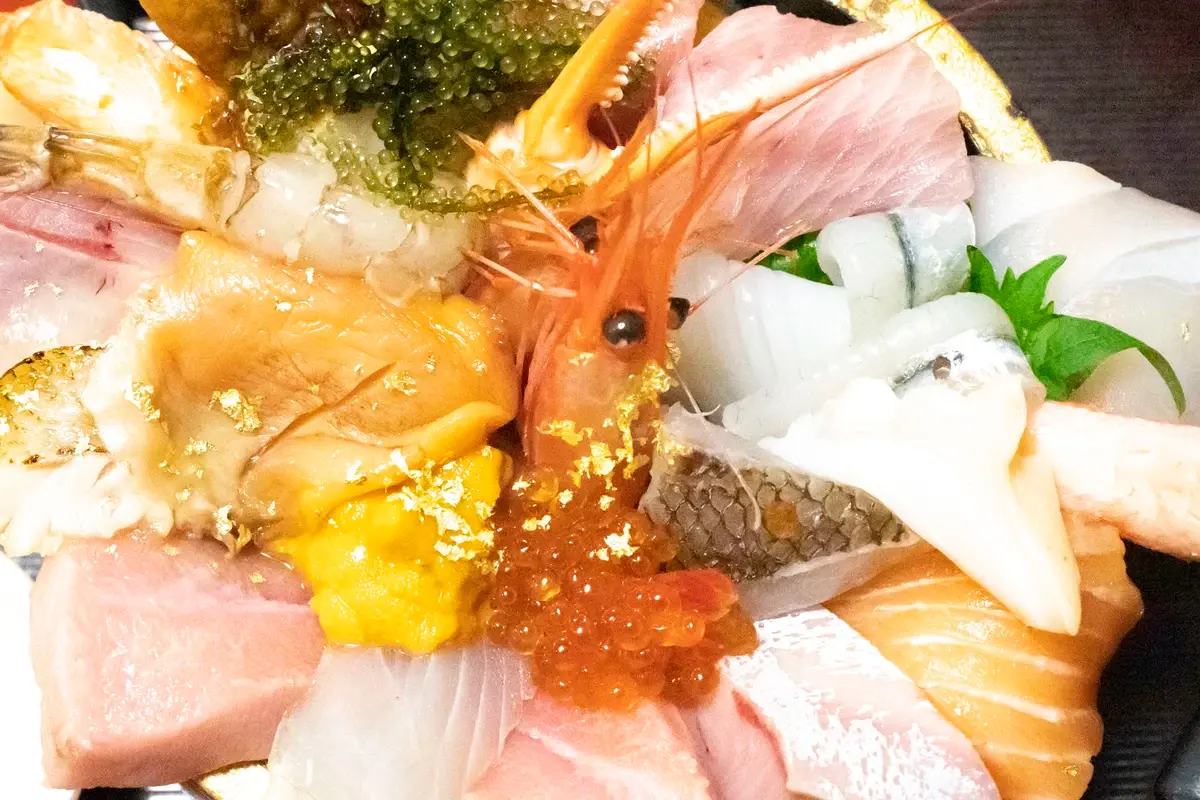
Around noon, we looked for a restaurant for lunch. There were many. One we saw through the glass had many diners; another we couldn't see inside but had a young Japanese woman soliciting at the door. We couldn't agree, and then we noticed a modest-looking restaurant further ahead. We pushed open the wooden door and saw mostly Japanese customers inside, so we chose it. We ordered kaisendon (seafood bowl). When it arrived, we saw it was sprinkled with gold leaf (truly Kanazawa).
(Postscript: Actually, we should have tried the raw sea urchin and scallops sold at the stalls.)
3. After lunch, we walked to Kanazawa Castle Park (the site of Kanazawa Castle). It was very large, with several tall traditional Japanese buildings. One of them required an entrance fee, so we bought a combined ticket with Kenrokuen (500 yen).
Kanazawa was the castle town of the Maeda clan, the ruling family of Kaga Domain (a feudal domain during the Edo period, equivalent to a country during the Sengoku period). It is also Japan's most famous gold leaf production center.
After leaving Kanazawa Castle Park, we planned to go to Kenrokuen, but my buddy insisted on going to the LV boutique. Since it was close to closing time, my buddy made a quick purchase. The clerk told us new stock would arrive the next morning, so we left with hope.
4. On the way back to the hotel, we passed Oyama Shrine, which has a statue of Maeda Toshiie on horseback.
5. In the evening, we found a popular restaurant along the street (mostly Western tourists with families) and ordered unagi don (eel rice bowl) and oden. The unagi don was decent.
Back at the hotel, we went for another bath.
Tip: Kanazawa's oden is also a local specialty.
Kanazawa Castle was the residence of the Maeda clan for 14 generations. During the Meiji era, it served as the headquarters of the Imperial Japanese Army, and later as the main campus of Kanazawa University (until 1996).
What is that large lantern behind Maeda Toshiie on horseback? It's called a "horo," made with whale baleen and bamboo as the frame and cloth as the cover. It was used to protect against arrows and stones thrown by enemies. Oda Nobunaga had two squads of horo warriors: the Black Horo (10 members, including Sassa Narimasa) and the Red Horo (9 members, including Maeda Toshiie), all vassals or trusted generals. Later, Toyotomi Hideyoshi formed the Yellow Horo, which served as his personal guard.
Day 3 (May 21)
1. Breakfast again from the convenience store. Then we headed straight to the LV boutique. It was said that lines at LV boutiques in Osaka and Tokyo could take over an hour. In Kanazawa, there was no line, and we received warm service.
2. After leaving LV, we continued to Nishi Chaya District (just a narrow street lined with traditional Japanese buildings and various small shops). One building was a museum—the former home of modern Japanese writer Shimada Seijiro. His most famous work is the "Earth" tetralogy, but he is less renowned than contemporaries Natsume Soseki and Akutagawa Ryunosuke.
We chatted with the museum staff, who told us that Kanazawa has many old buildings (second only to Kyoto) and is popular among Japanese tourists. Previously, transportation was inconvenient, but since the Hokuriku Shinkansen opened, more and more Japanese tourists visit.
In Nishi Chaya District, we found a small shop for soba noodles. The first floor had table seating. The owner invited us upstairs, where we took off our shoes. The upstairs turned out to be a tatami room with no other customers—it felt wonderful. In ancient times, chaya (teahouses) were places where customers sat on tatami, drank tea, and listened to geisha performances (shamisen, taiko, etc.), somewhat like Suzhou pingtan.
3. Then we went to the temple district across the street, which had dozens of temples of various sects marked on the map. The first we saw was Gannen-ji (a Shinshu Otani-ha temple). Its highlight was a wooden board with a haiku by Basho at the entrance, and a Korean bell from the Meiji era inside. It felt like a small farmhouse. Following a path, we came to the back gate of Myoryu-ji. At the main hall, a young Japanese woman and two older women were talking about fees. This was the famous "Ninja Temple." The fee was one thing, but the tour took over 40 minutes. The young woman repeatedly emphasized that it had nothing to do with ninjas and asked again if we didn't want to enter, she would close the gate. It took us a moment to realize the tour had scheduled times.
4. My buddy wasn't interested in temples, so we headed directly to Kenrokuen, one of Japan's three great gardens. It was large but felt like a big park. Exiting Kenrokuen, we saw Kanazawa Shrine. My buddy insisted on going to Higashi Chaya District. On the way, we passed the Ishikawa Prefectural Tourism and Products Center (bought a small box of edible gold leaf—to sprinkle on rice or soup later for a fancy touch) and the 21st Century Museum of Contemporary Art (still under repair due to the Noto earthquake).
5. Higashi Chaya District is much larger than Nishi Chaya, with more shops. We had the famous gold leaf ice cream (890 yen each). The gold leaf was tasteless, and the ice cream was just regular soft serve.
6. My buddy had been craving wagyu beef for days. We found a restaurant specializing in Noto beef on a local app, called Suzuyo. They required reservations, so we called twice but couldn't get through, and decided to go directly. Google Maps showed it wasn't too far, but as we were checking the direction, a taxi stopped at a red light. On impulse, we hailed it. The elderly driver didn't know the place, so we set the address and navigated. He even stopped halfway to ask a pedestrian. Fortunately, it wasn't far. My buddy got off first to ask if they had space.
The restaurant was called Suzuyo. The only staff was an old man who started shouting as soon as we entered: "This restaurant has only the president and chef—me—and I'm too busy. No reservations, no service!" In fact, only two elderly men were dining inside, and they chimed in. Probably because we arrived by taxi and ordered the most expensive set at 8,800 yen, he relented and let us sit. The shop was very small, with tight tables and chairs, a stove and chimney in the middle—basically cramped seating. First, they served beef slices about the size and thickness of a piece of tofu, with over half fat evenly distributed. After a quick grill, it melted in the mouth—amazing. We've eaten a lot of wagyu, but this Noto beef was the most delicious.
When we finished in a few bites, the owner got anxious again, saying he was too busy as the president and sole server.
We were initially puzzled why a small restaurant owner would call himself president. After chatting, we learned he actually was the president of a small company, and something happened, so he opened this restaurant for fun.
According to him, he can get genuine Noto beef. Only three head of Noto cattle are slaughtered per day, about a hundred per year, so 80% of what's sold on the market is fake Western beef. We talked about the story of Yangcheng Lake hairy crabs—production far less than sales. He was pleased, and after we paid, he gave us a small bottle of local sake as a gift.
Back to the hotel, and another bath.
Day 4 (May 22)
1. After breakfast, we checked out and went to the station (JR to Toyama). The ticket queue was very long, and we missed the next train. 20 minutes later, we arrived at Toyama Station and immediately bought tickets to Tokyo. Across the road from the south exit of Toyama Station, several hotels were lined up, including JAL CITY Hotel (Hotel Nikko City), just across the street. Unfortunately, check-in wasn't until 3 PM, but we could leave our luggage.
2. Toyama Station has a Matsumoto Kiyoshi drugstore, 7-Eleven, souvenir shops, and restaurants. We had lunch at a restaurant inside the station that specialized in seafood bowls. I wanted to order the white shrimp bowl, but my buddies insisted on the most expensive and popular seafood bowl (4,378 yen). It had many types of seafood with large pieces of sashimi, but it wasn't as delicious as expected.
3. After lunch, we decided to go to the seaside (Amaharashi). We took a local train (quite shabby), transferred at Takaoka Station, and arrived at Amaharashi after a short ride. The scenery at Amaharashi Coast was beautiful (a Japanese friend said it's becoming a popular spot among domestic tourists).
(Tip: A Chinese tourist who had done research was frantically buying a return ticket, saying the ticket office at Amaharashi Station closes at 17:30. We asked the elderly ticket seller, who said not to worry—on the return, we could board first, take a boarding ticket, and pay when we got off.)
Note: Amaharashi is just a small village-level station with almost no shopping or dining options. If you really like the scenery, there's said to be a hot spring hotel where you can stay overnight.
Back at Toyama Station, we found a tonkatsu (breaded pork cutlet) restaurant in the adjacent mall called Futonbuta, which was super delicious. The cutlet came in 300g, 250g, and 200g options, with two types of meat. We chose the 200g, pricier option (2,180 yen, Mizuho Imo Buta).
JAL CITY belongs to the Hotel Okura chain. Management and service were good. The room was spacious, with a wet-separated bathroom (shower outside the bathtub). Since there was no public bath, I soaked in the tub every day.
Day 5 (May 23)
Today's main itinerary was the famous Tateyama Kurobe Alpine Route to see the legendary snow wall.
This route has a combination ticket (covering round-trip trains, cable cars, and buses). The ticket office is on the second floor of Toyama Chihō Railway Station, just outside the south exit of Toyama JR Station. It's recommended to queue early in the morning, as the combo tickets are only available for the first three departures. While queuing, a friendly old man explained and recorded our booking info. When we reached the window, we handed over the money and info. We bought tickets for the 8:10 departure, which designated specific cable car times—you must follow those times, or there will be trouble. The Tateyama Kurobe Alpine Route is divided into several sections. We bought a round trip to Murodo (the highest point, taking over 5 hours). The cable car we took is said to have the largest capacity in Japan, carrying dozens of people as well as construction materials.
The snow wall is not far from the cable car station, with many tourists queuing for photos. After viewing the snow wall, we went up to the observation deck of the cable car station. I thought it was just a rooftop deck, but it turned out to be a circular snow trail. Hardly any tourists were there (probably not included in group tours). We trudged carefully for over an hour, our shoes and socks wet, and ended at a hot spring. We changed shoes, had a bowl of shrimp skin ramen at the hot spring cafeteria, and then soaked in the hot spring (non-guests can also use it). Entry fee: 1,000 yen; towel rental: 300 yen. The milky white hot spring water had a mineral smell and was very hot. After soaking, I felt refreshed.
Tip: Rinse off before entering the pool. If it's a natural hot spring, you don't need to shower afterward—just dry off and keep the mineral scent.
We returned to Toyama Station smoothly via the reverse route.
We had dinner at a sushi restaurant in the station mall (we had skipped it the previous night because of a long line of locals). Sushi came in pairs, several hundred yen per plate. Average per person was 2,200 yen. The white shrimp sushi left a strong impression—unique texture. The complimentary miso soup was delicious, and I had several bowls (good for warming up).
Tip: Trout sushi (masu sushi) is a specialty of Toyama. It's said to have originated when Yoshimura Shinpachi, a chef and Toyama Domain retainer, presented it to Lord Maeda Toshiyuki during the Edo period. It's flavored with vinegar. The restaurant we went to was a local famous shop, so no wonder it was so good.
Supplementary reading: The previously mentioned Sassa Narimasa, head of Oda Nobunaga's Black Horo (called "hitto"), has two anecdotes related to Tateyama: "Tateyama Crossing" and "Black Lily." After the Honno-ji Incident, Hashiba Hideyoshi (Toyotomi Hideyoshi) and Tokugawa Ieyasu fought for supremacy. Sassa Narimasa opposed Hideyoshi and, seeking help from Tokugawa, led over fifty men across the snowy Tateyama in winter—a feat known as the "Tateyama Crossing." After returning, he believed his wife's slander and killed his pregnant concubine, Sayuri. Before dying, she cursed: "I did nothing wrong, yet this happens. I will not rest in peace. I will become a black lily. When black lilies bloom on Tateyama, the Sassa clan will fall." The next summer, black lilies indeed bloomed on the mountain. Later, to curry favor with Hideyoshi's wife, Kita no Mandokoro (Nene), Sassa ordered a black lily from Tateyama and presented it for a flower arranging competition. But that day, Hideyoshi's concubine Yodo (Chacha) had her vase filled with black lilies. Kita no Mandokoro became furious and accused Sassa of deliberately embarrassing her. People believed this was Sayuri's vengeance. Sassa Narimasa was eventually forced by Hideyoshi to commit seppuku.
Day 6 (May 24)
At noon, we went back to that seafood bowl restaurant, specifically for the white shrimp bowl, but it was sold out that day—disappointing. After lunch, we took a loop train around the city, then went to the Muji store at Toyama Station to kill some time waiting for the train.
At 2:40 PM, we boarded the Shinkansen to Tokyo Station. Tokyo Dome Hotel is not near Tokyo Station, but it was only five stops on the Marunouchi Subway Line from Tokyo Station, which wasn't too troublesome. However, Tokyo Station is huge, so we had to figure out which exit leads to the Marunouchi Line transfer and stay inside the station, otherwise we'd have to find the subway entrance outside. Also, when exiting the Shinkansen ticket gate, don't forget to keep your ticket, because you'll need it to exit again when transferring to the Marunouchi Line (we wouldn't have figured this out without asking station staff).
The Marunouchi Line took us to Korakuen Station. The exit was a pedestrian bridge on the second floor. Across the bridge was the huge baseball stadium (indeed a giant dome). Walking along the circular path around the stadium for about 10 minutes brought us directly to the hotel's third floor. We took the observation elevator down to the first-floor lobby to check in. The room was spacious, with a separate desk and a large bathroom, but no separate shower stall—a design style from 20 years ago.
Across from the hotel was a roller coaster and circular sightseeing train.
That evening, to buy the currently popular Onitsuka Tiger German trainers for someone, we headed straight to the boutique in Ikebukuro. From Korakuen Station, three stops on the Marunouchi Line took us to Ikebukuro. The boutique was on the second floor of a department store, full of tourists trying on shoes—Europeans, East Asians. The staff were busy. After buying, it was nearly 8 PM. Ikebukuro's streets were packed with young locals out enjoying themselves, surrounded by shiny neon lights. We felt disoriented. We decided to go to the basement food supermarket to buy food and eat back at the hotel. We bought mentaiko, natto, apples, cherry tomatoes, yogurt, beer, and also a cup of instant noodles.
Day 7 (May 25)
Our flight was at around 4 PM, so we decided to check out, store our luggage, and walk around the hotel area. Nearby shops didn't open until 11 AM. We found that Uniqlo was having a 40th-anniversary sale—2900 yen items reduced by 1000 yen—a great deal.
We went back to the hotel to pick up our luggage and planned to take JR to Narita. Just as we were wondering how to handle the luggage pile, we saw a direct airport bus parked at the hotel entrance. We rushed over to ask if we could board. The hotel bellboy asked if we had a reservation. No, we didn't. He said to ask the driver. We asked, and the driver waved us on. What a stroke of luck! (When checking in, we had asked the front desk clerk about direct airport buses, and he said they were infrequent and recommended the train.)
The bus drove smoothly to the airport, stopping at the City Air Terminal (I remembered I had stayed near there once before). A station staff member came on board to sell tickets (3,800 yen).
At the airport, we found the duty-free shops had little to offer—just long lines of tourists buying snacks. We bought Japanese whisky and original cheese cakes from Tokyo Milk Cheese Factory. That shop also has a location in Shanghai, but it's often out of stock, and the taste isn't as good as the airport version.
These seven days were very fulfilling: beautiful scenery, delicious food, convenient facilities, and everywhere was clean. Perhaps the end of one trip is the beginning of the next.
Table of Contents:
1. Day 1
2. Day 2
3. Day 3
4. Day 4
5. Day 5
6. Day 6
7. Day 7
Travel Information: Hotel Index, Strategy Index, Ticket Index, Website Navigation, Travel Index, Cruise Index, Corporate Travel Index, Cooperation, Distribution Alliance, Links, Corporate Gift Card Purchasing, Insurance Agency, Agent Cooperation, Hotel Franchise, Destination & Scenic Spot Cooperation, More Cooperation, About Ctrip, Ctrip Hot Topics, Contact Us, Careers, User Agreement, Privacy Policy, Business License, Security Center, Ctrip Content Center, Intellectual Property, Trip.com Group Algorithm Notice.


