At least in this life, in that place, when we turned around, we didn't miss each other ^Mi Mi Tou^ A Tale of Two Italian Cities
Not every person who brushes past you on this planet will become an acquaintance, nor will every acquaintance tug at your heart. At least in this life, in that place, when we turned around, we didn't miss each other.
There are two cities in Italy that feel both romantic and sorrowfully melancholy. One is Venice, the romantic water city, where memories of happiness and sweetness as well as sadness linger; some say these are the tears of Venice. The other is Florence, which Xu Zhimo poetically called "Firenze of Cold Jade."
From "A Night in Firenze": "Are you really leaving, tomorrow? Then I, then I... you need not care, sooner or later that day will come; if you wish to remember me, then remember me... I only hope the sky is cloudless, so I can see that unchanging bright star in the sky, which is you..." It too reveals charm and sorrow.
May is the most beautiful season in Europe, with abundant sunshine, everything blooming and awakening. Follow Lin Xiaozhi as we explore two cities of romance and melancholy, the cities of lovers.
Arriving at the Venice ferry terminal, we take the ferry to Venice Island. The Port of Venice is one of Italy's largest ports, stretching 12 kilometers in length and covering a total area of 250 hectares, spreading wide and vast, with over ten thousand ships entering and leaving each year. Venice is not only unique in scenery but also a city of culture; as early as the Renaissance, the Venetian School of painting stood out.
The beautiful Adriatic Sea. Venice is known as "born of water, beautiful because of water, and prosperous thanks to water."
Along the Adriatic coast, the Venetian Lagoon consists of 118 man-made islands and a nearby artificial peninsula, crisscrossed by 117 waterways.
Along the Adriatic, there are beautiful Renaissance buildings from Italy everywhere.
After about a 20-minute ferry ride, we arrive at the main island of Venice. Venice, the water city, is the essence of the Renaissance, the only city in the world without cars. God shed tears here, but it made this place even more crystalline and tender, like a romantic dream floating on blue waves.
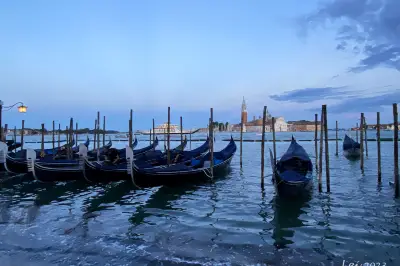
As soon as we step ashore, we see countless famous Venetian gondolas. These small boats carry countless couples through the waterways of Venice, and many romantic stories unfold on them. It is said that the success rate of proposals on a gondola is 100%.
The gondola has become a small tourist emblem of Venice. Mention Paris, and people immediately think of the Eiffel Tower; mention Venice, and they think of the swaying gondola.
Venice is located in northeastern Italy, a world-famous water town and a city of culture in Italy. There are many historical sites within the city, including various churches, bell towers, monasteries, and convents, over a hundred in total. The Grand Canal is the longest street running through the entire city, dividing it into two parts. Sightseeing along the canal is one of the best ways to experience Venice's scenery, with many famous buildings on both sides, where writers, painters, and musicians have left their footprints.
On the pier square stands the flag of the Venetian Lion of Saint Mark, with the Latin inscription: Pax tibi Marce, Evangelista meus, from the Gospel of Mark, the words of the angel to Mark, meaning "Peace be with you, Mark, my evangelist."
In the picture, the majestic bronze equestrian statue is of Victor Emmanuel II, the father of the Italian nation.
The romance of Venice lies first in its water scenery. The entire urban area is crisscrossed by waterways, and people travel by boat. These small boats are specifically called "gondolas," a type of lightweight, pointed boat with a history of over a thousand years. They have a retro and elegant appearance with great lines, used for daily transportation. Generally rowed by a single gondolier, it can carry up to six people and is known as the "Mercedes on water" or "Ferrari on water."
Visiting Venice, sitting in a gondola as the boatman rocks it gently, passing through canals, and experiencing the city's architecture and lifestyle from the water is truly a comfortable enjoyment.
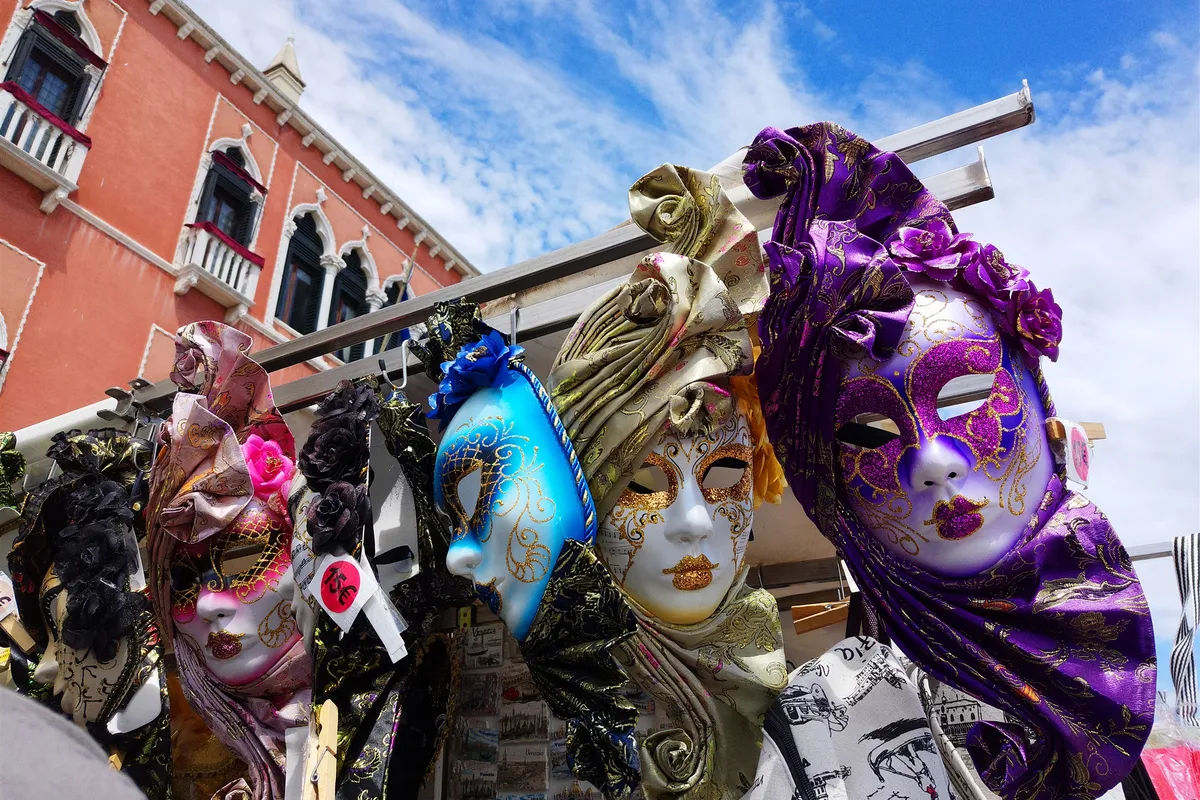
Venice's mask culture is unique in European civilization, one of the few cities where masks are integrated into daily life. Venetians have a long history of treating masks as part of everyday life. Before the 18th century, Venetian residents could not live without masks. People, men and women alike, would wear masks and cloaks when going out. This exclusive Venetian mask is the famous "Bauta."
Venetian masks are flamboyant, magnificent, and mysterious. They eliminate distinctions between rich and poor, hide beauty and ugliness. Under the masks, the unfathomable eyes, combined with a romantic air, conceal numerous twisted legends—some sad, some joyful, some mixed. The masks veil reality, leaving dreamlike and enchanting visions, freeing people from the bonds of identity, allowing them to release suppressed emotions while maintaining reserve and pride, like a gorgeous yet sorrowful aria.
The entire urban area is a network of waterways. Only on the water can one truly feel the architectural features and lifestyle of the whole city.
Luxury wooden yachts docked by the riverbank. Among the best-selling yachts in Europe, America, and Asia are Italian yachts, representing high-end luxury.
Perfect for couples to travel together by boat. As the ripples spread one by one, the whole city becomes romantic and dreamy, intoxicating people in these charming crisscrossing water streets.
The Bridge of Sighs (Italian: Ponte dei Sospiri) in Venice, Italy, is a baroque stone bridge near St. Mark's Square, beside the Doge's Palace. There are several bridges over the canal, but this one is a closed-arch bridge; looking out from inside, you can only see through small windows on the bridge. The Bridge of Sighs connects the courthouse and the prison. Death row prisoners would pass over this bridge just before their execution, sighing at the end of their lives, hence the name; it is one of the most famous bridges in Venice.
St. Mark's Square was first built in the 9th century, initially a small square in front of St. Mark's Basilica. Mark is the author of the Gospel of Mark in the Bible, and Venetians venerate him as their patron saint. According to legend, in 828, two Venetian merchants smuggled the relics of Saint Mark from Alexandria, Egypt, to Venice, and in the same year, they began building a church for Saint Mark. The church contains the tomb of Saint Mark, and the cathedral was named after him. The square in front of the cathedral was thus named St. Mark's Square.
Standing in St. Mark's Square, you can see a corner of the exterior of the Doge's Palace. The Doge's Palace was first built in 814 AD, historically serving as the residence of the Doge of the Venetian Republic. Today it is the Venice Museum of Art and Armory. The building's exterior is decorated with geometric patterns of white and pink marble, placing the solid wall on the third floor, while the second floor features a Gothic pointed-arch loggia adorned with quatrefoil carvings. This ingenious combination of Arab-style diamond patterns and Gothic pointed-arch colonnades makes it one of the most beautiful works of architecture.
The picture below shows the main entrance of St. Mark's Basilica. The five mosaic panels on the five arches depict the deeds of Saint Mark. St. Mark's Basilica was first built in 829 AD and rebuilt between 1043 and 1071. It was once the largest church in medieval Europe and a magnificent masterpiece integrating architecture, sculpture, and painting.
The semicircular pediment above the arch of the basilica is in Byzantine style, topped with Gothic spires. When we visited, half of the church's roof was under renovation, so we couldn't fully appreciate its exquisite architectural art.
The central main arch of the church is decorated with Roman-style reliefs. Above the main arch, there are replicas of four bronze horses (the originals are kept inside the church). These are bronze works from the 4th century BC. According to some information, they were war trophies brought back by Venetians from Constantinople in 1204.
The Clock Tower on the north side of the square is an early Renaissance building in Venice. On top of the tower, two mechanical figures strike the bell to announce the hour. The tower features a prominent winged lion, the coat of arms of Venice. This building was first built in the 12th century and is about 152 meters long. On the ground floor, there is a world-famous café. It is said that over the centuries, many celebrities have sipped coffee here, such as Byron, Alexandre Dumas, and Hemingway.
The winged lion, the coat of arms of Venice. When I took this photo, a pigeon was swooping down from the sky toward the winged lion.
Around St. Mark's Square, there are many cafes. Having a cup of coffee with your loved one while listening to live violin music played by local musicians is simply incredibly romantic!
The continuous arcades around the square house various boutiques with stylish window displays. There are also many bars and restaurants. This is the best walking area in Venice. You can order a famous Venetian dish—squid ink pasta (Nero di Seppia).
The restaurants around the square are decorated in a retro style. Sitting inside, sipping a small espresso, looking out at the beautiful Venetian Renaissance architecture, with waiters in white suits moving in and out, you almost feel as if you've traveled back to the prosperous and romantic Venice of the past.
A beautiful vintage brass doorbell—I absolutely love it.
The handsome Italian gondolier on the gondola greeted us friendly.
Once you visit Venice, you will fall completely in love with this water city. Romance is everywhere, emanating from every street and river.
Venice is a place that feels both romantic and sorrowful, like the tears of Venice. Where there is love, there are tears. As dusk approached, we reluctantly ended our visit to Venice. Tomorrow, we head to another romantic city, Florence.
Hotel near Florence where we stayed overnight, convenient for an early trip to the old town of Florence the next day.
The suite we booked came with a kitchen and a living room—not bad. If we had time, we could cook a Chinese meal to satisfy our taste buds.
After breakfast at the hotel in the morning, we set off toward Florence under the morning light.
We headed to the old town of Florence early in the morning. A cute little Fiat vintage car by the roadside was very charming.
Italy is famous not only for its world-renowned Ferrari sports cars but also for its adorable microcars. Because streets in European cities are relatively narrow, small cars are more suitable, so there are many small cars in Europe.
Italian motorcycles are also major manufacturers in Europe, ranging from high-displacement Ducatis to affordable Piaggio scooters. I recall that in the 1990s, the mopeds that flooded the streets of Shanghai came from Piaggio.
On the way into the old town, some shop doors were sprayed with graffiti, giving a sense of Italian street art.
The most common shops along the way were leather goods stores. Italian leather is very famous, especially Florence, which is the world's largest manufacturing center for leather goods. The comfort of shoes has attracted many celebrities. Many top luxury leather products come from Florence. When buying shoes, bags, or leather jackets in Florence, I recommend purchasing local Italian brands, such as Gucci, Roberto Cavalli, and Salvatore Ferragamo.
Florence is the city Xu Zhimo called "Firenze of Cold Jade," a paradise for art lovers, a historic and cultural city, the birthplace of the Italian Renaissance and also the cradle of European culture. It lies on a plain in the Arno River valley, surrounded by hills. It is in the Tuscany region of Italy, once the capital of Italy, and the cultural center of Italy.
The Cathedral of Santa Maria del Fiore, also called Florence Cathedral or the Duomo. There are many majestic churches in the world, but few are as charming as this one. This beautiful cathedral, clad in white, red, and green marble, perfectly interprets the classic, elegant, and free spirit advocated by the Renaissance. No wonder it was named "Santa Maria del Fiore" (Saint Mary of the Flower).
The Duomo is the first great architectural work of the Renaissance. Construction began in 1295 by Arnolfo di Cambio on the site of the earlier Florentine cathedral, and it was finally completed in 1496. It was once the religious center of the Florentine Republic. It is a beautiful cathedral decorated with white, pink, and green marble in geometric patterns.
Florence means "city of flowers" in Italian. The great poet Xu Zhimo translated it as "Firenze of Cold Jade" (翡冷翠). This translation is far more poetic, colorful, and fitting for the ancient city's temperament than the other translation, "Florence."
A hundred years later, Michelangelo built a similar large dome at St. Peter's Basilica in Rome, but he admitted in admiration, "I can build a dome bigger than it, but not more beautiful than it."
The Easter Cart Explosion festival (Scoppio del Carro) is a traditional Easter celebration in Florence, one of the liveliest Easter celebrations, with a history of nearly 400 years. Probably that day there was only a cart, no horse.
In those narrow streets, you can almost still hear the magnificent hoofbeats of the Renaissance. The architecture and paintings still shine with the brilliance of the Renaissance.
Italy is also a fashion capital. The Chanel store on the square, with two Italian policemen standing in front, perfectly fit the elements of a fashion magazine cover.
Palazzo Vecchio, also known as the Old Palace. "Vecchio" in Italian means "old," because it was the residence of the Medici family. After they moved to the Pitti Palace across the Arno River, this became the "old palace." Palazzo Vecchio is adjacent to the Uffizi Gallery, originally the town hall of Florence. Its 94-meter-high bell tower is the most prominent building in the city besides the Duomo. At the entrance stands a famous replica of Michelangelo's David.
Having watched the movie "Inferno" starring Tom Hanks, the beautiful scenes of Florence in the film evoked warm memories. I couldn't wait to open my photo album to find the familiar scenes from the movie.
A Taste of Italy: A must-try classic in Florence—T-bone steak.
Florence is the capital of the Tuscany region in central Italy and the birthplace of the Renaissance. There is a delicacy here that you will regret missing—the T-bone steak. This thick, delicious steak is a feast: crispy on the outside, rosy and juicy on the inside, with a T-shaped bone in the middle adding extra flavor. Who can resist such a description?
Italy is undoubtedly one of the most charming countries in the world, with intoxicating seas, glorious history, enchanting architecture, sexy football, and an unparalleled culinary culture. Italian pizza, pasta, and coffee have long been accepted by people in our country, but real Italian gelato is truly a classic among Italian delicacies! It's no exaggeration to call Italian gelato a true art form. In terms of production, simple recipes are the secret to pure flavor. No matter what flavor of gelato, the recipe never contains any additives. Every Italian gelato is handmade by professional chefs, showing its extraordinary origin. Italian gelato is not frozen too hard; it's delicate, light, and silky, offering an endless romantic sensation.
A beautiful red vintage mailbox makes you want to send the romance of Florence to your loved one.
Feeding pigeons in Florence's square is also a pleasant way to pass the time.
Italy—a country where romance meets passion, and classicism meets fashion. The impression of Italy is full of rich humanistic charm, like a person dressed in an elaborate gown adorned with noble purple lily patterns, exuding European aristocratic elegance, turning gracefully to captivate the world. The brilliant masterpieces of the Renaissance, combined with a sense of fashion, romance, and passion, make Italy intoxicating.
This concludes our romantic journey to the two Italian cities, allowing me to experience the romance of Venice, the water city, and Xu Zhimo's "Firenze of Cold Jade," Florence.
Thank you to all the travel friends who supported my travel notes! Every place has different stories waiting for you to discover! Like you, I look forward to sharing our next trip with you after each travelogue!
Travel friends interested in traveling together can privately message me! Let's explore the stories in travel together!