Endless Scenery Beyond the Eyes - A Quiet Chant of the Fondaco dei Tedeschi in Venice, Italy
After noon, I dined, feasting on the local delicacy - squid ink pasta (Spaghetti alle seppie). The pasta was mixed with squid ink and seasoned; its color was black, its shape lumpy, resembling burnt food, and its taste was beyond imagination. I felt suspicious and dared not lift my chopsticks.
After eating, my lips and teeth were all black, but my cheeks and mouth were fragrant, rich and delicious. Then I sipped coffee lightly and chatted freely about everything. I tried to glimpse the scenery outside the window, but it was obscured by narrow alleys, so I could not see far.
Soon after the hour of Wei (1-3 PM), I wandered through the alleys, where paths crisscrossed and wound together. My spirits soared as I wished to see the heart of the city. I went to visit the Fondaco dei Tedeschi, taking narrow paths and crossing small bridges. What met my eyes and ears was quite noisy, yet the scenic spot was so crowded that sleeves formed a shade — I deeply understood that.
It was the year Jihai (2019), in the month of Huai (April of the lunar calendar), just after Grain Buds. "The crabapple flowers have fallen, and the willow catkins are all gone," while Venice was also "a riot of purple and red competing in beauty." Under the blue sea and sky, early summer was full and vibrant.
Venice "was born of water, is beautiful because of water, and thrives on water." Thus it bears the reputation of "Water City" or "City of Bridges," "surpassing all in the world and renowned abroad" — a well-deserved honor. The Grand Canal winds through the city, its clear waves gently carrying gondolas. Waterways meander around streets and lanes, connecting them gracefully. "In water alleys, many small bridges," "houses all pillow on the river" — no description fits better.
Where there is water, there is spirit; where water meets, bridges are built, past and present alike. Thus countless bridges cross the rivers, all built of stone, either level or arched, long and short, connecting the banks. They are ingenious and quaint, and glimpses of the sea can be seen between the bustling crowds on them.
Clearly, Venice and Suzhou are counterparts, located in the East and West respectively. "The sun and moon are separated, gazing at each other in vain," yet they appreciate each other, shining from afar. "Spring water is greener than the sky; in painted boats, listen to rain while sleeping" — how similar they are! Water is their soul; without it, they wither. Water is their charm; lacking it, they languish. Yet the two cities share the same spirit but differ in expression: the same spirit lies in the blue water and picturesque bridges; the difference lies in sea currents versus river streams. "The sea embraces all rivers, great is its capacity." Thus, calling Venice a "great lady" and Suzhou a "small pretty girl" is most apt, beyond compare.
It was early summer, "summer trees are shady and pleasant," but Venice was warm and stuffy. Walking slowly in the sunshine, I was drenched in sweat. If I retreated into the shade, the heat suddenly vanished, and I felt the clothes were thin. Soon the Fondaco dei Tedeschi came into view, magnificent and imposing, captivating my gaze.
The Fondaco is an ancient four-story building, nearly eight hundred years old, standing prominently on the bank of the Grand Canal. It once served as the headquarters of German businessmen in Venice, and it is not far from the famous Rialto Bridge.
In the early 16th century, a fire destroyed it, but it was rebuilt, even surpassing its predecessor. It is striking in its craftsmanship, steeped in Renaissance style, and stands out among its peers even today.
The Fondaco dei Tedeschi as a trading post originated from the Hanseatic League, serving as a hub covering all trade between Venice and Northern Europe: spices and silk from the Orient, and goods from the North. The League was a business community that later evolved beyond that. It was vast in scale and extensive in influence, skillfully managing "the exchange of goods, harmonizing the many and the few," until "the branches were full of green canopy, and countless golden coins bloomed."
The Fondaco did not remain unchanged forever. It was once forced by Napoleon Bonaparte (1769-1821) to become a customs warehouse in the early 19th century; and intimidated by Benito Amilcare Andrea Mussolini (1883-1945), it turned into a post office in the early 20th century. These changes were inevitable under circumstances.
"The floating clouds over the Jade Fort change with time." Now the Fondaco has undergone a glamorous transformation, thanks to its ingenious renovation and exquisite decoration. The curtain rises to reveal "the quiet maiden, beautiful," with a smile that "blooms like a flower," and "her glance makes ten thousand flowers blush and fall." Bearing the weight of time, the Fondaco does not disdain to become a part of a global commercial giant, transforming into the DFS T Galleria Venice Fondaco dei Tedeschi. It is a model of "making the past serve the present," thus filling a gap in Venice's international commerce, a great achievement.
In the center of the Fondaco is an interior courtyard, spacious and bright. In the past, it was a shop in front with a warehouse and residence behind, where German merchants barely made a living, not daring to idle away their time. Today, it has been renovated, transforming into the famous AMO restaurant, which interprets the traditional flavor of Italian cuisine to perfection, pleasing overseas guests.
I toured floor by floor using an escalator. On the walls, patches of peeling paint revealed the original look of heavy history, while the escalator was decorated in carmine, captivating and irresistible, inspiring me to shop tirelessly — truly a finishing touch!
What is particularly laudable is the 19th-century ceiling, which was remodeled with a steel and iron frame embedded with large glass tiles, creating a bright penthouse space, and a panoramic terrace was added for visitors to look down and far.
"A single glance from the crowd, and all worldly beauty turns to dust." Once the top terrace was completed, everyone flocked to it, becoming a must-see in Venice, not to be missed. Visitors must make a reservation in advance and wait outside. A girl with blue eyes and blonde hair stood there, smiling, calling in the waiting visitors one by one.
Entering through the doorway, there was a narrow and short passage, barely allowing passage. After a few steps, it suddenly opened up. The terrace was made of wood, delicately structured, not large in area, truly "a universe within the sleeve, yet not feeling cramped."
On the terrace, there was little crowding, no clamor; people were scattered in twos and threes, courteous and polite. The pretty girl by the door managed the numbers, controlling the flow to ensure it was orderly and just right.
Leaning on the railing and looking afar, the lagoons of Venice glimmered; the Alps stood solitary and majestic — all fell before my eyes, vast and exhilarating. "The landscape inside and out is like a painting, clearly not of this world." Looking down, the Grand Canal was enchanting and winding, full of charm, with red-roofed buildings lining the streets, "houses connecting roof to roof," "ten thousand households like scales." Most were "markets and streets continuous," "the sound of the market gathering," and I suddenly thought, "Every glance becomes a painting; may it be remembered for another day."
Nearby, the Rialto Bridge lay across the water, serene and self-contained, looking down upon the surroundings like "an old fisherman on the river," having "grown accustomed to autumn moons and spring breezes" for centuries. It is a single-span arch bridge, a reconstruction, over four hundred years old, 160 feet in length, belonging to the oldest family of bridges across Venice — no false praise.
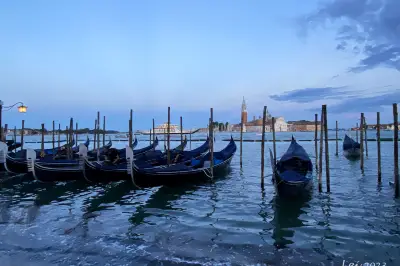
In the gentle breeze and warm sun, the terrace was so romantic! I could gaze left and right, clear and pure, open and dust-free. In that moment, the flowers were still and serene. "From afar, the mountain has color; near, the water is silent." Only the wine boats and gondolas gently swayed in the river bend, leisurely plowing the mirror-like water, slowly, gently, gradually disappearing into the vastness of the distant sea.
Such a scene — how could it not be painted?
Such a romance — how could it not become poetry?
2022.04.18.