Schönbrunn Palace: One of the Three Great Palaces of the Habsburg Dynasty in Vienna - Free Travel in Central Europe and the Austro-Hungarian Empire, Part 8
Day 4: Schönbrunn Palace, one of the three great palaces of the Habsburg dynasty in Vienna - Free travel in Central Europe and the Austro-Hungarian Empire, Part 8
On the third day of our free travel in Central Europe, November 25, 2019, we shared a ride from Český Krumlov in the Czech Republic to Vienna and arrived at our hotel in the city center at night.
Vienna is located in the heart of Central Europe, a buffer zone between Western civilization and Central Asian civilization. It was once the capital of the Holy Roman Empire, the Archduchy of Austria, the Austrian Empire, and the Austro-Hungarian Empire.
The most prominent Habsburg dynasty in Europe ruled Vienna for several hundred years, during which Vienna developed into the cultural and political center of Europe. However, the Ottoman Empire's forces pushed westward, besieging Vienna twice. In 1683, during the second siege that lasted two months, Schönbrunn Palace was destroyed by fire.
After that, Vienna entered a glorious era of construction, with much of the rebuilding showcasing Baroque artistic style. In 1743, Empress Maria Theresa of Austria ordered the construction of a luxurious summer palace here, remodeled in Rococo style.
On the morning of the fifth day, we picked up a rental car and drove from Vienna City Park to Schönbrunn. After some trouble, we found a parking spot on the west side of the palace and walked 1,000 meters east back to the main gate of Schönbrunn Palace.
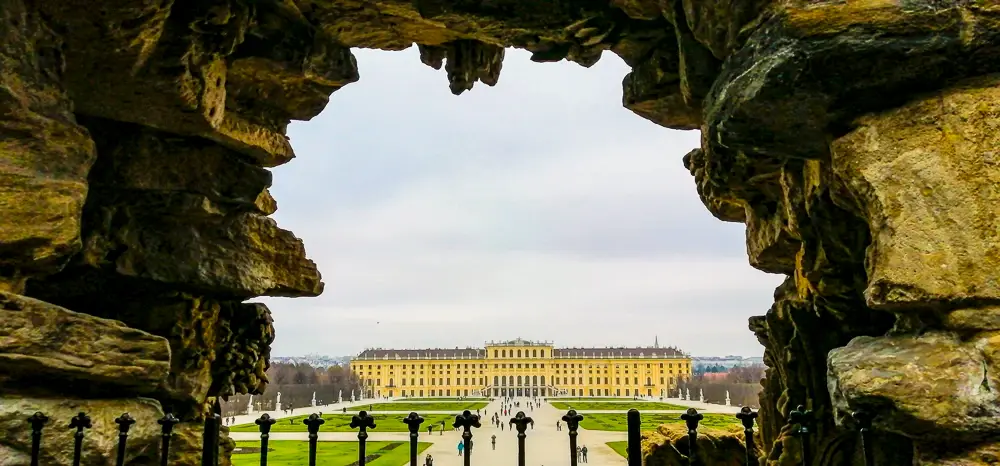
Schönbrunn Palace, one of the three great palaces of the Habsburg dynasty, is located in the southwestern part of Vienna, the capital of Austria. It was once the imperial residence of the Holy Roman Empire, the Austrian Empire, the Austro-Hungarian Empire, and the Habsburg dynasty. Today, Schönbrunn Palace and its gardens are listed as a UNESCO World Heritage Site.
Legend has it that in 1612, Holy Roman Emperor Matthias, while hunting here, drank from a spring and found the water refreshing and cool, so he named it "Schönbrunn" (beautiful spring). Since then, "Schönbrunn" has become the name of this area.
Schönbrunn Palace was designed on a scale and with a luxury comparable to the Palace of Versailles in France. The palace has 1,441 rooms, of which 45 are open to the public. The entire palace is in Baroque style, with 44 rooms decorated in Rococo style, featuring a unique feminine charm and艳丽 (bright and colorful) landscape.
During the periods of the Holy Roman Empire, the Austrian Empire, and the Austro-Hungarian Empire, Schönbrunn Palace served as the main residence of the imperial family.
Two years ago, during my trip to Vienna, I visited Schönbrunn Palace, but unfortunately, I was in too much of a hurry and missed the opportunity to go inside. However, the eagle emblem of the Habsburg family on the main gate pillars and the magnificent palace still evoked some memories.
Now, in the square in front of the Schönbrunn Palace ticket office, temporary stalls for the festive market were being set up, and Christmas lights were being decorated.
We entered, went through security, checked our backpacks and coats, and picked up a Chinese-language guide map at the ticket office before starting to tour the exhibition halls on the first and second floors.
Schönbrunn Palace offers insight into the history of the Habsburg dynasty from its glory to its decline, showcasing many stories from the only female emperor of the Holy Roman Empire, Maria Theresa, to Empress Elisabeth (Sisi) of the Austro-Hungarian Empire. Unfortunately, photography is not allowed inside Schönbrunn Palace.
On the walls of the palace corridors are portraits of successive Habsburg emperors and empresses, as well as portraits of the 16 children of Empress Maria Theresa.
The Hall of Mirrors - the reception hall, built in 1775, decorated in Rococo style. Legend has it that in 1762, the six-year-old Mozart performed for the empress. After his performance, he proudly ran to her knees, hugged her neck, and gave her a big kiss, which marked a turning point in his piano career.
Franz Joseph I, the first emperor of the Austro-Hungarian Empire, and Empress Elisabeth (Sisi) lived in Schönbrunn Palace for a long time. He was also the longest-reigning monarch of the dynasty.
Empress Elisabeth (Sisi) did not like Vienna; instead, she loved Hungary very much. Sisi became the Queen of Hungary, left the palace, traveled extensively, and lived the life she dreamed of. Eventually, she was assassinated while vacationing in Geneva.
Behind Schönbrunn Palace is a Baroque-style royal garden similar to that of Versailles in France. On both sides of the large flower beds are neatly trimmed green hedges, and within the hedges are 44 statues of figures from Greek mythology.
At the end of the garden is a beautiful fountain built in 1780, called the Neptune Fountain (Neptunsbrunnen). In the center of the pool is a group of sculptures based on the story of the Greek sea god.
Maria Theresa focused on the remodeling and decoration of Schönbrunn Palace. The avenues in the garden were designed in a star shape, with each avenue converging at the central axis of Schönbrunn Palace. The Baroque garden represents the imperial rule radiating from the inside out.
In 1752, Francis I, who had a passion for natural history, built the Schönbrunn Zoo next to the palace, making it the oldest zoo in the world.
The following year, a Dutch-style botanical garden was built on the west side of the palace garden, which was later converted into an English-style garden in the 19th century.
From the halfway up Schönbrunn Hill, one can overlook the Schönbrunn Palace buildings and the entire city of Vienna.
At home, I have a collection of the New Year's Concert from Schönbrunn Palace in Vienna, and I can vividly recall the magnificent scene of the symphony orchestra playing under the night lights. In just one month, the charm of the music capital will once again be on display here.
At the top of Schönbrunn Hill stands the Gloriette, a classical-style colonnade structure from the classical period, topped with the coat of arms of the Habsburg dynasty.
On both sides of the Gloriette are white marble mythological statues.
Walking slowly down the hill, the slope in front of the Gloriette is covered with green grass and deep woods.
Surrounding avenues.
The greenhouse in the botanical garden on the west side of Schönbrunn Palace Garden.
After visiting Schönbrunn Palace, we drove directly to Melk Abbey in the Wachau Valley.