Three-Month European Tour 7: "Imperial Tri-Color: Vienna, a Symphony of Imperial Afterglow and Immortal Art"
Continuing from the previous post: Three-Month European Tour 6: "Imperial Tri-Color: Budapest, Iron and Roses on the Danube"
As the lights of Buda Castle fade behind me, I follow the shimmering waves of the Danube westward, as if embarking on Empress Elisabeth's most beloved journey—the scenery on both banks shifts from Hungary's romantic charm to the imperial majesty of the Habsburg dynasty.
Vienna, the capital of Austria, is a world-renowned cultural city known as the "City of Music" and, for its long history, the "City of Culture"; the Vienna New Year's Concert has become an international musical event. Vienna is also called the "Goddess of the Danube." As the former imperial capital of the Austro-Hungarian Empire and the center of the Habsburg dynasty, Vienna boasts a rich historical heritage, famous for its grand Baroque architecture, palaces (such as Schönbrunn Palace and Hofburg Palace), and the historic city center.
Vienna Railway Station Hall
Novotel Suites Hotel in Vienna city center.
The hotel is about 800 meters from the U1 line, convenient for reaching the city center and attractions; staying here for five days.
What I appreciate most is the hotel's hearty breakfast.
Taking the U1 metro line to Vienna City Hall, on the way to the U1 metro.
Exiting the metro, I arrived in the city center.
The Burgtheater is the national theater on Vienna's Ringstrasse and one of the most important German-language theaters in the world. It was founded in 1741 by Empress Maria Theresa of the Habsburg dynasty, built next to the imperial palace. Three Mozart operas premiered here: "Die Entführung aus dem Serail" (1782), "Le nozze di Figaro" (1786), and "Così fan tutte" (1790). On April 2, 1800, Beethoven's Symphony No. 1 also premiered here.
The City Hall is in Gothic style, designed by Schmidt, built between 1872 and 1883. The iron figure on the tower is one of Vienna's landmarks. Opposite the City Hall is the City Hall Park, also known as Volksgarten.
The entire City Hall is under renovation, blocked by wire fences, so it's impossible to get close—a great pity.
The site of Volksgarten was originally part of Vienna's city fortifications. After these fortifications were destroyed by Napoleon, the park was built on the ruins and opened to the public in 1820. The park belongs to the Hofburg Palace complex.
Looking up at City Hall from Volksgarten.
Entering the rose garden in the park, I was instantly overjoyed: thousands of rose bushes were in full bloom, competing to display their beauty. A rich, sweet fragrance wafts over, filling the air with romance. Classic deep red velvet roses, delicate pale pink and soft yellow, pure white—all colors interweave under the sun, rich in layers, breathtakingly beautiful. This is the largest rose garden I have ever seen, with an extraordinary variety of species.
Blooming roses form a sea of flowers; bees and butterflies busily flutter among the blossoms, creating a vibrant classical tableau together with the ancient Temple of Theseus and the distant City Hall.
Tourists and locals stroll along the paths or sit quietly on benches, enjoying the view.
The fountain at the center of the rose garden seems a bit shy.
Basking in the warm sun, sitting around the rose garden, breathing in the warm, enchanting fragrance mixed from countless varieties, happiness flows in my heart.
The history of the Hofburg Palace dates back to 1279. Over the following 600 years, it underwent continuous expansion from a medieval castle to a magnificent palace. Successive monarchs, from Holy Roman Emperors to Emperor Franz Joseph I of Austria-Hungary, lived and governed here, witnessing the rise and fall of the Habsburg dynasty. In 1918, with the dissolution of the Austro-Hungarian Empire, the Hofburg became the official residence of the President of the Republic of Austria. Its architectural style blends Gothic, Renaissance, Baroque, Rococo, and other styles, making it an "architecture textbook." The entire complex comprises 18 wings, 19 courtyards, and over 2,600 rooms, covering an area of 240,000 square meters—a "city within a city."
Passing through Volksgarten, I arrived at the Hofburg Palace.
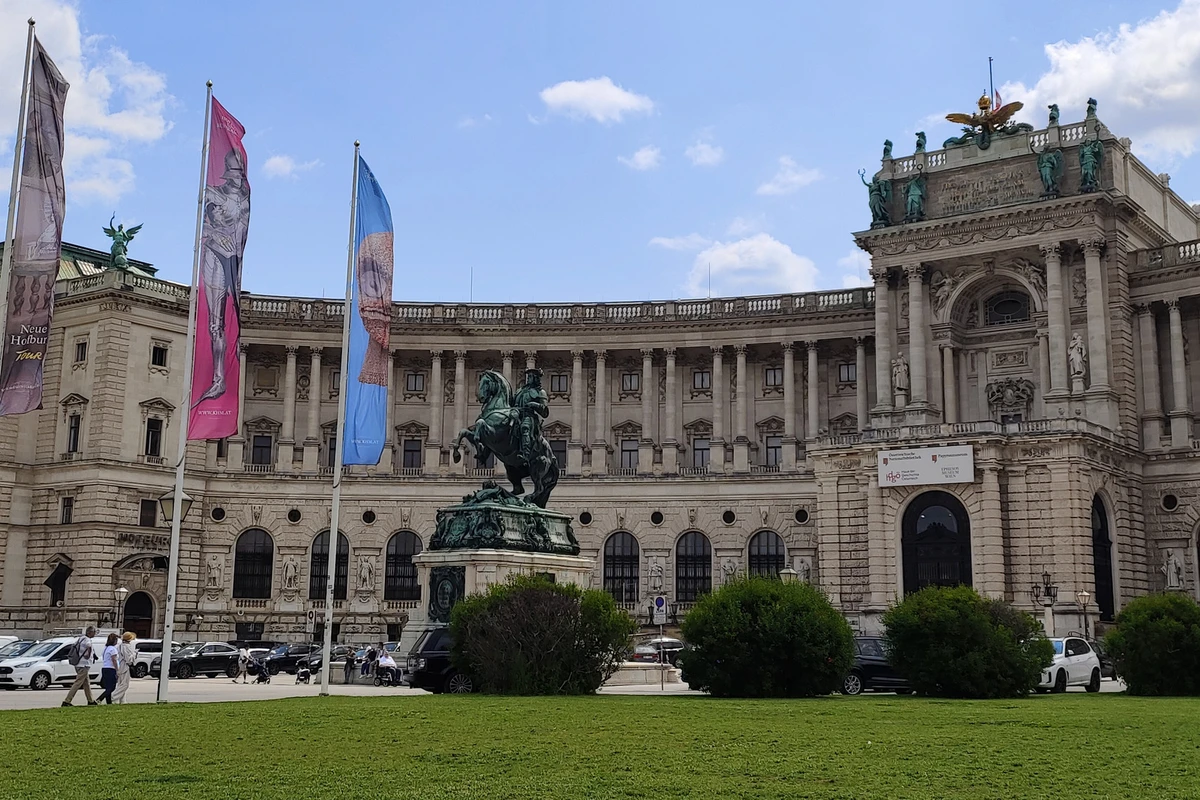
Equestrian statue of Archduke Charles on Heldenplatz
Archduke Charles, brother of Emperor Franz II, was a reformer of the modern Austrian army. In the Battle of Aspern-Essling in 1809, through excellent tactical command, he successfully defeated the French army led by Napoleon himself, greatly boosting the morale of the European anti-French coalition.
The New Hofburg Palace was commissioned by Emperor Franz Joseph I in 1881 and built by Karl von Hasenauer and Gottfried Semper.
Spanish Riding School of Vienna
Prince Eugene, born into the French nobility but rejected by King Louis XIV for his small stature, turned to Austria and eventually became a renowned general. His most famous achievements include three victories over the Ottoman Empire, particularly the Battle of Zenta in 1697 and the Battle of Vienna in 1683, which completely eliminated the Turkish threat to Europe.
Opposite Heldenplatz is Maria-Theresien-Platz.
Not far from the palace, there is a market, very lively.
Visitors can rest here, taste some Hungarian cuisine, and buy small souvenirs.
Wandering without a specific destination, I came across another market.
Local residents' recreational activities.
In the evening, I found a restaurant near the hotel.
Schönbrunn Palace (also known as the Summer Palace) is a royal building full of Baroque art. This palace once served as the imperial residence of the Holy Roman Empire, the Austrian Empire, and the Austro-Hungarian Empire.
Schönbrunn Palace is entirely in gold and black, the representative colors of the Habsburg family, covering a total area of 26,000 square meters. In Europe, its splendor and size are second only to the Palace of Versailles in France. Its name originates from Holy Roman Emperor Matthias. Legend has it that in 1612, during a hunting trip, he rested at Katterburg between Meidling and Hietzing and drank from a spring there. Finding the spring water crystal clear and sweet, he, as Holy Roman Emperor, bestowed the name "Schönbrunn" (Beautiful Spring) upon it. Since then, "Schönbrunn" has become the name of the area.
In 1743, Archduchess Maria Theresa of Austria, to demonstrate imperial authority, ordered the construction of a majestic palace and Baroque garden here. Schönbrunn Palace was subsequently expanded. During the Napoleonic Wars, it was here that the dissolution of the Holy Roman Empire was proclaimed and the Austrian Empire was established. In 1871, it was restructured into the Austro-Hungarian Empire. In 1918, following the defeat and dissolution of the Austro-Hungarian Empire in World War I, the palace became a museum of the Republic of Austria, allowing commoners a glimpse of imperial splendor and the former grandeur of the Habsburg Empire.
To visit Schönbrunn Palace, we bought the "Sisi Pass," which includes the "Imperial Apartments, Sisi Museum, Silver Collection" at Hofburg Palace, Schönbrunn Palace, and the Imperial Furniture Collection—excellent value, valid for one year.
At the end of the park is the Gloriette; we went there first.
The Gloriette was built in 1775 and is a landmark of Schönbrunn Palace. Designed by Austrian classical architect Johann Ferdinand Hetzendorf von Hohenberg, it was built as a "Temple of Glory" to commemorate "just wars." The Gloriette at Schönbrunn is the largest of its kind in Europe.
Behind Schönbrunn Palace, the Royal Garden is a typical French-style garden, with large flower beds flanked by neatly trimmed green hedges, within which are 44 figures from Greek mythology. At the end of the garden is the "Neptune Fountain"; to the east is the rather inconspicuous "Schönbrunn Spring" (Beautiful Spring), from which the palace takes its name. Directly opposite the spring is an artificial Roman ruin (Römische Ruine) and an obelisk.
Since 2004, the Vienna Philharmonic has held an open-air evening concert in the Schönbrunn Palace Garden every early June—the "Schönbrunn Night." Sound equipment is being set up in the garden.
Two symmetrical fountains on Schönbrunn Palace Square.
Entering Schönbrunn Palace for a tour.
Office of Emperor Franz Joseph I.
Bedroom of Empress Elisabeth (Sisi).
The Great Gallery (Grosser Spiegelsaal) is particularly spectacular: 44 meters long, with mirrors on the walls corresponding to windows, and ceiling frescoes depicting the deeds of the Habsburg family, creating a dreamlike play of light.
This room can only be viewed from outside; entry is not permitted.
Portrait of Maria Theresa.
The Blue Salon is Rococo style. In 1918, the last emperor of Austria-Hungary, Charles I, signed the declaration renouncing state affairs here, marking the end of the empire.
The Million Room has walls made of expensive Chinese rosewood, inlaid with Indian gilded Rococo carvings.
Maria Theresa with her seven children.
Leaving the palace for the garden.
On the way back to the hotel.
Children playing with spray at the railway station square.
A small shop in Vienna.
On the way to the Sisi Museum.
The museum hasn't opened yet; I took a stroll nearby.
The Sisi Museum is located on Michaelerplatz. Through a large collection of personal items, it vividly portrays the beautiful, rebellious, yet melancholic life of this legendary empress.
Empress Elisabeth's exercise equipment.
Marble statue of composer Wolfgang Amadeus Mozart, unveiled in 1896.
After visiting the Sisi Museum, I arrived at the main entrance of the National Library, but the visitor entrance is not here.
Young people relaxing on the grass and in the shade of trees on the square.
Double-headed eagle, the guardian spirit of the Habsburg family, on the library's gate.
Surroundings of the library square.
Following the navigation, I came here, but it's still not the entrance.
The courtyard inside the Swiss Gate is also called the Swiss Courtyard. Passing through the Swiss Courtyard, you can visit the Castle Chapel. Today, it is a venue for elegant weddings. Connected to it is the Hofmusikkapelle (Court Music Chapel), the cradle of the Vienna Boys' Choir. The five-hundred-year-old Vienna Boys' Choir sings at the Castle Chapel every Sunday and on religious holidays.
The old and new Hofburg Palaces are connected by the Ceremonial Hall; passing through the corridor of the Ceremonial Hall.
I arrived at Franz Joseph Square, which is the old Hofburg Palace. On the square is a statue of Emperor Franz II. This Holy Roman Emperor Franz II, to thwart the ambition of Napoleon (who had proclaimed himself Emperor of the French) to become Holy Roman Emperor, voluntarily dissolved the Holy Roman Empire in 1806 and simultaneously established the Austrian Empire. Thus, Emperor Franz II became Emperor Franz I of Austria.
In the center of Joseph Square stands an equestrian statue of Emperor Joseph II, built in 1806. This son of Empress Maria Theresa is remembered as an enlightened monarch and reformer.
The library entrance is under this golden sphere, a bit hard to find.
The Austrian National Library is the largest library in Austria. Its predecessor was the imperial library of the Habsburg dynasty, with a history dating back to 1575. It was renamed the Austrian National Library in 1920. Not only is its collection vast, but its magnificent Baroque building itself is an artistic gem, considered one of the most beautiful libraries in the world and part of the Hofburg Palace.
The Austrian National Library holds over 7.4 million items (some say 8 million), including not only books but also manuscripts, maps, audio-visual materials, and globes. Its collection focuses mainly on humanities. Particularly precious holdings include: 200,000 rare books published between 1501 and 1850 in the State Hall, ancient Egyptian papyrus documents, and some highly valuable Chinese paintings and maps, such as Matteo Ricci's "Kunyu Wanguo Quantu" (Map of the Myriad Countries of the World) and the "Huangyu Quanlan Tu" (Complete Atlas of the Imperial Territories) from the Qing Kangxi period.
The State Hall was completed around 1726, commissioned by Emperor Charles VI to house the imperial book collection. The hall is 77.7 meters long, 14.2 meters wide, 19.6 meters high, with a dome height of 29.2 meters—a typical Baroque architectural style.
The Hercules columns in the Hercules Hall symbolize Spain, behind which lies the historical story of the War of the Spanish Succession.
The dome fresco, painted by Austrian Baroque painter Daniel Gran between 1726 and 1730, is exquisitely beautiful.
Imperial statues: In the center of the hall stands a marble statue of Emperor Charles VI, surrounded by statues of 16 members of the Habsburg dynasty.
The library perfectly combines collection and art.
Ancient globes: In the center of the hall are four globes made by the Venetian Franciscan friar Vincenzo Coronelli, used for studying astronomy and geography.
St. Michael's Church is near the National Library; I went inside to have a look.
The square was originally the palace courtyard and was transformed in the 1990s into one of the world's top ten cultural districts, the largest cultural square in Vienna. Major museums include the Kunsthistorisches Museum, the Natural History Museum, the Vienna Art Hall, the Leopold Museum, and the Museum of Modern Art.
In the center of the square stands the monument to Empress Maria Theresa, 19.6 meters high, built between 1874 and 1888. Empress Maria Theresa sits on a throne, holding a scepter and a document, with a dignified expression. At her feet are equestrian statues and standing statues of the main generals and political advisors of her time. At the four corners of the monument are statues of four field marshals. The sculptures on the base's four corners symbolize justice, mercy, strength, and wisdom. The entire monument symbolizes the power, enlightened rule, and artistic prosperity of the Habsburg dynasty.
Flanking the square symmetrically are the Kunsthistorisches Museum.
And the Natural History Museum.
In 1891, the Kunsthistorisches Museum and the Natural History Museum opened simultaneously. They were built by order of Emperor Franz Joseph I of Austria-Hungary. These two museums share the same exterior and face each other across Maria-Theresien-Platz. Both museums were built between 1872 and 1891, designed by architects Gottfried Semper and Karl Hasenauer. The buildings are rectangular, with sandstone facades and 60-meter-high domes on top. The interiors are lavishly decorated with marble, stucco, gold leaf, and paintings, themselves magnificent works of art.
Stepping inside, the grand staircase, dome frescoes (painted by Austrian artist Gustav Klimt and his brother among others), marble columns, and gilded decorations make one feel as if entering a royal palace, already awestruck by the architecture before even viewing the artworks.
The Egyptian and Near Eastern collection houses precious artifacts from along the Nile, including mummies, sarcophagi, statues, and stelae, making it one of the world's most important Egyptian collections.
The Kunstkammer (Art Chamber) is an absolute highlight of the museum, reopened in 2013. It displays the Habsburg dynasty's treasures, such as exquisite clocks, automata, ivory carvings, gold and silverware, and crystal objects. The most famous exhibit is Benvenuto Cellini's gold salt cellar, hailed as the "Mona Lisa of salt cellars," a pinnacle of Renaissance goldsmith art.
Gemma Augustea, 9-12 AD.
Romanian gold vase.
The museum's masterpiece: Cellini's gold salt cellar.
Arrived at the rest area.
The domed hall of the ground-floor café offers a unique experience of enjoying coffee in a palace-like setting, a perfect respite amidst art appreciation.
"David with the Head of Goliath," Caravaggio, circa 1600.
"Madonna of the Rosary," Caravaggio.
"Susanna and the Elders," Tintoretto, circa 1555-1556.
"Nymph and Shepherd," Titian, circa 1570-1575.
"Madonna of the Meadow," Raphael, 1506.
"The Annunciation," Titian.
"Self-Portrait," Rubens.
"The Art of Painting," Jan Vermeer, 1666–1668.
"Self-Portrait," Rembrandt.
This is the richest and most essential collection of works by Pieter Bruegel the Elder in the world. His paintings are rich in detail, vividly depicting 16th-century Netherlandish folk life.
Bruegel's most famous "The Tower of Babel," 1563.
"The Fight Between Carnival and Lent," Pieter Bruegel the Elder, 1559.
Works by Pieter Bruegel the Elder.
"The Peasant Wedding," Pieter Bruegel the Elder.
"The Hunters in the Snow," Pieter Bruegel the Elder, 1565.
Works by Pieter Bruegel the Elder.
Kärntner Strasse is a famous shopping street in the center of Vienna, Austria. It runs from Stephansplatz in the north, past the Vienna State Opera at the Ringstrasse junction, to Karlsplatz. The street was first recorded in 1257 as an important trade route to Carinthia in the south.
The Vienna State Opera is a Renaissance-style building with 1,709 seats, built between 1861 and 1869. Initially opened by Emperor Franz Joseph I and Empress Elisabeth of Austria as the Vienna Court Opera, it was renamed to its current name in 1921 after the establishment of the First Austrian Republic. Currently, it is the home of the Vienna Philharmonic and the Vienna State Ballet. During the carnival season each year, the opera house often hosts the Vienna Opera Ball.
This shop attracted many people's attention.
The light is really good today; I captured a golden Saint Stephen's Cathedral.
Going to Belvedere Palace in the morning.
Belvedere Palace was once the palace of Prince Eugene of Savoy, a general of the Habsburg dynasty. After Prince Eugene's death, it was sold to Maria Theresa in 1752. The palace was damaged during World War II but was restored afterward. Today, it houses the Österreichische Galerie Belvedere (Austrian Gallery Belvedere). The Belvedere complex consists of the Upper Belvedere and the Lower Belvedere, connected by a lavish Baroque garden.
The Upper Belvedere primarily houses art from the 19th and 20th centuries, with highlights including Gustav Klimt's golden period masterpiece "The Kiss," as well as works by masters such as Egon Schiele and Oskar Kokoschka. It also holds works by French Impressionists like Monet and Renoir.
The Upper Belvedere has 24 oil paintings by Gustav Klimt, the largest collection of Klimt's oil paintings in the world.
Entering the museum, immediately works by Gustav Klimt.
Gustav Klimt, 1917-1918, "The Bride."
"Path in Monet's Garden at Giverny," Claude Monet, 1902.
Gustav Klimt, 1912, "Avenue Leading to Kammer Palace."
Gustav Klimt, 1907, "Garden with Sunflowers."
Gustav Klimt, 1917-1918, "Johanna Staude."
Gustav Klimt, 1906, "Fritza Riedler."
Gustav Klimt's masterpiece "The Kiss."
Works by Gustav Klimt.
"Plain at Auvers," Vincent van Gogh, 1890.
Panoramic view of Belvedere Palace taken from upstairs in the museum.
"Homage to Jacquin," John Knapp, 1821-1822.
This sculpture is also amazing; the expression on the face 😂.
"Napoleon Crossing the Alps," Jacques-Louis David, 1801.
Works by Egon Schiele.
Egon Schiele, 1918, "Crouching Couple."
After the visit, I went to the garden.
The Upper Belvedere is at a higher elevation, while the Lower Belvedere is lower. So, going from the Upper to the Lower Belvedere involves continuous downhill, with two fountain cascades built along the way to take advantage of the slope. This is a view of the Upper Belvedere and a fountain cascade to the south from the garden.
The Lower Belvedere primarily displays medieval art and Baroque works, including Romantic and altarpiece paintings.
Leaving Belvedere Palace, I saw a residential building; entering the courtyard, it looks like a castle.
Very few modern buildings are seen in Vienna.
Monument to Soviet soldiers of World War II.
St. Charles's Church (or Karlskirche) is a grand Baroque church. With its distinctive shape and deep history, it has become an unforgettable landmark on Vienna's skyline. In 1713, Vienna was struck by a terrible plague. Holy Roman Emperor Charles VI vowed to build a church to thank God if the plague ended. After the plague subsided, the emperor kept his promise and ordered the construction of this magnificent Baroque church, dedicated to Saint Charles Borromeo, the patron saint against the plague.
The building is in Baroque style, incorporating elements from ancient Greek, Roman, and Renaissance architecture. It features a 72-meter-high blue Romanesque dome, two spiral relief columns, a dome fresco that can be viewed up close, and lavish interior decoration.
Climbing the dome of St. Charles's Church.
The Musikverein building, home to the Golden Hall.
The history of Graben Street dates back to Roman times, when it was a ditch (graben) outside the walls of Vindobona (Vienna's predecessor). In the Middle Ages, the ditch was filled in and gradually developed into an important market and transportation hub within the city. During the Baroque period, especially after the plague of 1679, it was transformed into a grand Baroque representative street, marked by the erection of the Plague Column. After the Ringstrasse was built in the 19th century, it further established itself as Vienna's premier luxury commercial center.
The history of St. Peter's Church is mysterious and legendary. It is said that the earliest church on the site was built by Charlemagne around 800 AD, making it the oldest parish church in Vienna. However, the current Baroque building was commissioned by Emperor Leopold I in 1701 to replace an old medieval church. Its construction is also associated with a pious brotherhood; it is said that the emperor was urged in a dream by a Franciscan monk to build the church.
The Plague Column was built to commemorate the end of the great plague in Vienna in 1679, commissioned by Holy Roman Emperor Leopold I.
The Austrian Parliament Building was built between 1874 and 1883 and is the seat of the two houses of the Austrian Parliament. The Parliament Building covers an area of over 13,500 square meters, making it one of the largest buildings along the Ringstrasse. Today, it houses the National Council and the Federal Council. The Parliament Building has more than 100 rooms, the most important being the House of Representatives, the Senate, and the former Imperial House of Deputies. It is an important venue for state ceremonies, most notably the inauguration of the Austrian President and the parliamentary speech on National Day, October 26 each year.
One of the building's most famous features is the statue of Pallas Athena and the fountain, making it a well-known tourist attraction in Vienna.
St. Stephen's Cathedral (or Stephansdom) is the mother church of the Roman Catholic Archdiocese of Vienna. The current Romanesque and Gothic form of the cathedral, seen on Stephansplatz, was mainly initiated by Duke Rudolf IV of the Habsburg family (1339–1365), built on the ruins of two earlier churches. This was the first Vienna parish church, consecrated in 1147. As the most important religious site in Vienna, St. Stephen's Cathedral has witnessed many significant events in Habsburg and Austrian history. Its colorful tiled roof makes it one of the city's most recognizable landmarks.
Citizens spontaneously mourning the victims of the June 10 shooting in Graz, Austria, in front of the church.
Climbing the cathedral tower, overlooking the city center.
Andreas Zelinka (1802-1868, Mayor of Vienna) proposed the creation of the City Park, which remains one of Vienna's most popular parks.
Monument to composer Franz Schubert (1797-1828), unveiled in 1872.
Carefully feeding the pigeons.
Anton Bruckner, Austrian composer, artist, and writer.
The Strauss statue was built in 1921 to commemorate the musician who made immortal contributions to Viennese music.
From the City Park to the Imperial Furniture Collection.
Writing desk of Marie Antoinette, the youngest daughter of Maria Theresa and wife of King Louis XVI of France.
A birthday gift from Maria Theresa's son to his mother. A desk made in Italy.
This shop is near the hotel; I visited it two or three times.
St. Francis of Assisi Church was built to commemorate the Austrian victims of the 2004 Southeast Asian tsunami. The church's exterior resembles a fairy-tale castle, while the interior is simple and flowing, reflecting the Franciscan spirit of "poverty and humility."
DC Tower 1 is the tallest building in Austria.
Business center, where many renowned international companies, banks, and high-tech firms have their headquarters.
Danube Shopping Center, along with numerous restaurants, cafés, and bars, provides a full range of amenities.
The Vienna International Centre is one of the major offices of the United Nations worldwide, a futuristic-style building.
Taking the U1 line back to the hotel.
Vienna: an imperial dream woven with music, art, and coffee. Following in the footsteps of Empress Elisabeth at the Hofburg and Schönbrunn, encountering thousands of blooming roses in Volksgarten. The Kunsthistorisches Museum holds Bruegel's worldly poetry, while the Belvedere captures Klimt's golden kiss. From the Baroque splendor of Graben Street to the modern rhythms of the Danube, this city has distilled history into everyday life—ultimately all dissolving into the lingering aftertaste of a slice of Sachertorte in a café.
Next: Three-Month European Tour 8: "Imperial Tri-Color: Prague, a Never-Ending Fairy Tale of a Hundred Spires"
Itinerary Directory
1. Preface
2. Vienna
3. Volksgarten
4. Hofburg Palace
5. Schönbrunn Palace
6. Sisi Museum
7. National Library
8. St. Michael's Church
9. Maria-Theresien-Platz
10. Kunsthistorisches Museum
11. Kärntner Strasse
12. Belvedere Palace
13. St. Charles's Church
14. Graben Street
15. Parliament Building
16. St. Stephen's Cathedral
17. Vienna City Park
18. Imperial Furniture Collection
19. Danube Island
Travel Information
Hotel Index
Strategy Index
Ticket Index
Website Navigation
Travel Index
Cruise Index
Corporate Travel Index
Join Cooperation
Distribution Alliance
Friendship Links
Corporate Gift Card Procurement
Insurance Agent
Agent Cooperation
Hotel Partnership
Destination and Attractions Cooperation
More Partnerships
About Ctrip
About Ctrip
Ctrip Hot Topics
Contact Us
Careers
User Agreement
Privacy Policy
Business License
Security Center
Ctrip Content Center
Intellectual Property
Trip.com Group Algorithm Announcement