Into New York, Washington, and Boston: A Self-Drive Tour of Corning, Niagara Falls, and the Thousand Islands – Memories of an Eastern US Road Trip!
On June 18, after successfully completing our self-drive tour of the Western US Grand Circle, we flew American Airlines and after a 6.5-hour flight, arrived at New York Newark Liberty International Airport at 7 PM. Everything went smoothly until a small hiccup occurred. Just after leaving the airport, Douma suddenly realized she had left her phone in the airport restroom. She tried to go back in but was told she couldn't re-enter for security reasons. Through the help of friendly American friends and Doujiu, after communicating with the airport and waiting nearly an hour, Douma went through security again and re-entered the airport, but the phone was no longer there. We had to give up searching and called an Uber. A New York lady in her 30s pulled up in a car with the trunk full of children's items. We thought to ourselves, 'Even Americans have it tough—a mom has to drive Uber at night to make ends meet.' Along the way, the lady enthusiastically introduced us to New York. At 10 PM, we finally arrived at our New York hotel. Tomorrow, we will begin our Eastern US itinerary.
New York is the largest city in the United States and one of the largest metropolises in the world! It is called the capital of the world mainly because it is home to the United Nations headquarters, where diplomats from over 200 countries are stationed. New York is a world-class city whose every move directly influences the global economy, finance, media, politics, education, entertainment, and fashion! It also has the most skyscrapers of any city in the world—over 5,500 in Manhattan alone. The Statue of Liberty, Wall Street, Broadway, the World Trade Center, the Empire State Building, Central Park, Columbia University, West Point... these are all symbols of New York and its pride!
I remember a line from the TV series 'A Native of Beijing in New York': 'If you love someone, send them to New York, for it is heaven; if you hate someone, send them to New York, for it is hell.' New York is indeed a city that makes you love and hate it—it can elevate you to the sky or bring you down to the ground.
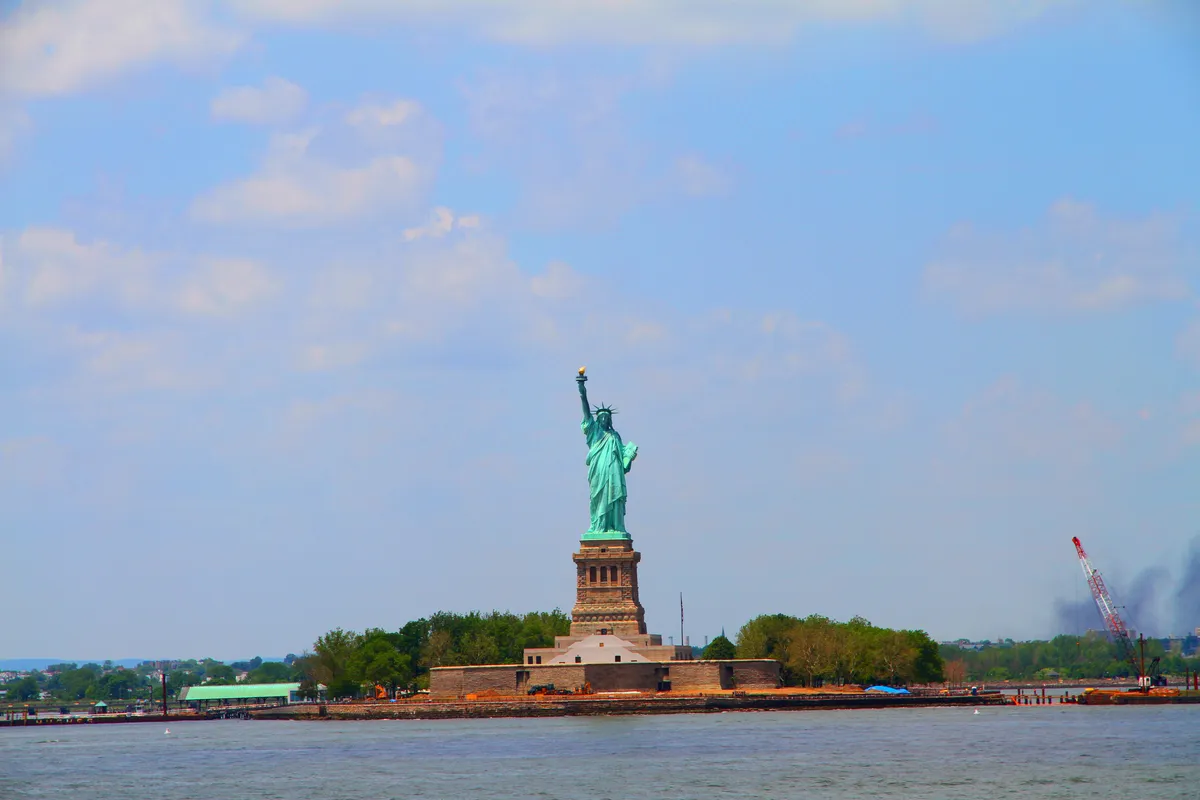
June 19 was sunny and the weather was perfect. Early in the morning, we took a taxi from the hotel to the ferry terminal, hoping to catch a distant view of the Statue of Liberty from the ferry. The Statue of Liberty was a gift from France to the United States in 1876 for its 100th anniversary of independence. Designed and made by French sculptor Frédéric Auguste Bartholdi, it took over 10 years to complete and was unveiled on October 28, 1886. The statue holds a torch symbolizing freedom in her right hand, and in her left hand, she holds a tablet inscribed with 'July 4, 1776' (the Declaration of Independence). At her feet are broken shackles and chains, symbolizing freedom and liberation from tyranny.
After getting off the ferry, we walked to Wall Street. Wall Street is actually a very short and narrow street, but it is world-famous as the 'financial center of the United States.' Major institutions like Morgan, Rockefeller, and DuPont have their banks, insurance, shipping, and railway companies here, along with the New York Stock Exchange. The famous Charging Bull is a major attraction and symbol of Wall Street.
Leaving Wall Street, we went to Ground Zero—a park commemorating 9/11. In memory of the lives lost on 9/11, two pools were built on the original sites of the Twin Towers. Water trickles down the walls of the pools, as if shedding tears of sorrow for the departed. The names of the innocent victims who perished in the disaster are inscribed on the bronze parapets. Although the sky was sunny, the scene made our hearts ache. We prayed for world peace so that such tragic disasters never happen again.
From Ground Zero, we took an Uber to Chinatown. Chinatown is not only a gathering place for overseas Chinese but also a must-visit for descendants of China to find familiar food. Walking along the bustling streets, you can hear various Chinese dialects. Shop signs are all in familiar Chinese characters. There are over 200 Chinese restaurants here, offering cuisines from all over China—sure to satisfy your Chinese stomach. Indeed, we found our favorite—Mala Xiang Guo (spicy stir-fry pot).
After eating and drinking our fill, we moved on to Rockefeller Center. Rockefeller Center is a complex of 19 commercial buildings. Inside, there are shopping malls and restaurants, as well as a small garden for people to rest. The plaza surrounded by high-rises is filled with flags from various countries—a sea of flags and a paradise for tourists.
After visiting Rockefeller Center, we arrived at Times Square. Times Square is not large, but it is surrounded by nearly 40 shopping malls and theaters, including the famous Broadway. Times Square is the cultural center of the United States, known as 'the Crossroads of the World.' At night, Times Square is dazzling with neon lights and bustling crowds. People from all over the world speak different languages, and street performances are everywhere. Douniu was very interested in the street performances, watching this and that, even though she didn't understand a word. But it was hard on Douma, who had to hold Douniu's hand or carry her to prevent her from getting lost.
We walked back from Times Square to the hotel, and it was already after 10 PM. Douma was upset because her iPhone was lost, and she wasn't used to taking photos with another phone. I tried using the 'Find My' feature on my iPhone to locate the lost phone. It showed the phone was still at Newark Airport. So I told Douma, 'I have a feeling this phone won't be lost.' I wrote on my phone: 'This is my beloved phone, with many memories of our time in the US. Please contact us.' I sent this message to the lost phone. As long as the phone is turned on, it will display this message. We'll wait and see!
On June 20, we went to Grand Central Terminal in the morning. Grand Central is known as 'the most beautiful train station in the world' and is one of New York's most famous attractions. It is both a transportation hub and an art殿堂. The magnificent main concourse, marble staircases, celestial ceiling murals, Roman columns, and classical statues all adorn this train station like a hall of high art.
From Grand Central, we drove 20 minutes toward the Hudson River to reach the United Nations Headquarters. The land of the UN Headquarters is international territory, consisting of the Secretariat Building, the Conference Building, the General Assembly Building, and the Hammarskjöld Library. Outside, flags of many nations fly on poles. As citizens of a permanent member of the UN Security Council, it was essential to visit the UN Headquarters when in New York. After making a reservation and going through security, we entered the UN Headquarters.
The UN Headquarters is very large. We followed the guide and took a brief tour; the assembly halls were not accessible. Suddenly, there was thunder and lightning outside, and it began to rain heavily. I had a sudden thought: I hope the storm can extinguish the flames of war around the world, making the UN Headquarters a place where people from all nations can share peace and happiness.
When the rain stopped, we continued our journey to Fifth Avenue. Fifth Avenue is a symbol of New York's fashion and prosperity. It is the world's most upscale shopping district, home to top luxury brands like Prada, Hermès, Chanel, Louis Vuitton, Tiffany, Cartier, Versace... The streets are always bustling with people.
Along Fifth Avenue, we passed St. Patrick's Cathedral and Trump Tower, then walked north for a while to reach Central Park, a major leisure spot for New Yorkers and a favorite destination for tourists.
Central Park is a huge green oasis in the heart of Manhattan, covering 3.4 million square meters with 93 kilometers of walking paths. It is the 'green lung' of New York and a tranquil retreat in this bustling metropolis. The park has lakes and forests, as well as a zoo, sports facilities, and playgrounds. Children especially love seeing the many small animals here. However, due to time constraints, we unfortunately missed the museums around the park.
After a short walk through Central Park, realizing it was getting late, we headed to the Empire State Building to take in the night view of New York. The Empire State Building is an iconic symbol of New York and the entire United States. Its construction speed is considered a marvel in architectural history, and it held the title of the world's tallest building for a long time. From the observation decks on the 86th and 102nd floors, visitors can see the Manhattan skyline and enjoy 360-degree views of New York City. It has always been a dream destination for tourists from around the world.
When you visit the Empire State Building, you hardly feel it's a building nearly a century old—it looks clean and beautiful outside, and the interior is spotless. We took the high-speed elevator and quickly reached the 86th floor. New York at night is even more enchanting, with colorful lights blooming like flowers over the city. Everywhere is brilliantly lit, but it was very windy on the observation deck.
After coming down from the Empire State Building, everyone received a commemorative certificate of visiting the Empire State Building. With that, our New York trip came to an end. For children, visiting big cities is far less interesting than seeing natural scenery.
Washington, D.C., also known as the District of Columbia, is the capital of the United States. It is located near Virginia and Maryland and is a federal district under the direct jurisdiction of the U.S. Congress, thus not part of any state. Washington is the political center of the United States, home to most federal government agencies and embassies of foreign countries. It is also the headquarters of international organizations such as the World Bank, the International Monetary Fund, and the Organization of American States. It boasts numerous museums and cultural landmarks.
On June 21, we took a U.S. bus from New York to Washington, arriving after a 4.5-hour ride. After a 20-minute walk from Union Station to our hotel and checking in, we went to the White House. The White House is the official residence and workplace of the President of the United States, owned by the National Park Service as part of 'President's Park.' Previously, it was possible to tour the interior by reservation, but after 9/11, interior tours are no longer allowed. When we arrived, there were a few protesters outside, and some had set up camp as if for a long-term struggle.
There were many squirrels on the lawn and trees in front of the White House, which got Douniu excited. The squirrels ran around on the trees and lawn, and Douniu followed them, running back and forth. The squirrels were not afraid of people at all; they stared at Douniu with round eyes from the trees. Douniu took out some snacks to feed them.
After strolling around the White House for a while, we went to the National Mall. In the distance, the Washington Monument soared into the sky, imposing and magnificent! The monument was built in memory of George Washington, the first President of the United States. Washington, D.C. has a strict rule that no building can be taller than the Washington Monument, reflecting Washington's high status in the hearts of Americans and making it a visible landmark throughout the city. The entire obelisk is smooth and has no letters, as if telling the world that Washington's contributions cannot be described in words.
Since it was late, we unfortunately missed the chance to go to the top of the monument. After visiting the monument, we went to the Lincoln Memorial. The Lincoln Memorial is a pure white Greek temple-style building built in memory of Abraham Lincoln, the 16th President of the United States. It is regarded as an eternal symbol of America and a landmark of Washington. The memorial has no doors, symbolizing that it is always open to the world. Inside, a large seated statue of Lincoln sits in the center. His gaze is deep, his expression stern, resolute, and firm. In front of the memorial, there is a rectangular reflecting pool 610 meters long, meant to inspire reflection on war and peace, and on American independence and freedom.
Under the sunset, Douniu had a great time playing on the National Mall—throwing a Frisbee, running against the wind, and searching for pine cones on the grass. We didn't return to the hotel until late at night.
Back at the hotel, Douniu's uncle (Doujiu) called to say that Newark Airport had called—they found Douma's phone and could send it to us, but we needed to pay for shipping. Ha, my prediction came true! Douma was very happy to hear the news.
On June 22, we had an appointment to visit the U.S. Capitol in the afternoon, so we decided to take Douniu to museums in Washington in the morning. Given the many museums and considering our child, we chose the Smithsonian National Museum of Natural History and the Smithsonian National Air and Space Museum.
The National Museum of Natural History is one of the most influential museums in Washington. Since opening in 1910, it has collected over 120 million specimens, from dinosaur fossils and early human artifacts to rare animal specimens and precious gems, preserving natural and cultural heritage well. As soon as you enter, a huge and lifelike African elephant appears before you, making you feel like you're on the African savanna. Children love this museum, especially the animal specimens and human origins. There is also a hands-on specimen room for kids.
After visiting the Natural History Museum, we passed through the National Gallery of Art Sculpture Garden. Although not large, the garden is beautiful, especially the various artistic sculptures that spark imagination. The fountain in the center was very pretty and attracted many children playing and splashing around.
From the sculpture garden, we walked a short distance to the National Air and Space Museum. This museum houses a vast collection of landmark aircraft, space probes, missiles, and more. It is also a research center for aerospace, planetary science, and Earth science. Inside, you can see a replica of the Montgolfier brothers' hot air balloon that flew over Paris, the Wright brothers' first airplane, the 'Flyer 1,' and the Apollo 11 lunar module 'Columbia' that first landed on the moon. The museum records every step of human flight history. There are also actual aircraft on display—265 in total—making it a favorite among aerospace enthusiasts. However, our little Douniu seemed not very interested in these high-tech exhibits, except for sitting in an airplane for a while.
From the Air and Space Museum, we hurried to the U.S. Capitol. The U.S. Capitol, whose cornerstone was laid by President Washington on September 18, 1793, is the meeting place of the U.S. Senate and House of Representatives. It is the highest symbol of democracy for a government of the people, by the people, and for the people. It is where presidential inaugurations are held and where the President delivers the annual State of the Union address. It is also the final resting place of the founding father George Washington. We felt honored to have the opportunity to enter this solemn and magnificent building and witness American democracy firsthand. However, unfortunately, the tour guide gave the entire tour in English, and we basically couldn't understand a word, so we had to figure things out on our own.
After exiting the Capitol, we went to the lawn in front of it. The green grass was lush, flowers were fragrant, and squirrels occasionally ran across the lawn—a harmonious scene of humans and nature. On the lawn, Douniu was full of energy, running around, while Douma and I lay on the grass, looking up at the sky and enjoying the warm afternoon sun.
From the Capitol lawn, we walked to the reflecting pool behind the Capitol. There were many ducks there, and Douniu watched them for a long time, regretting that she had nothing to feed them.
After visiting the Capitol, we went to the National Museum of the American Indian. This is the first museum in the United States dedicated to the history, life, language, culture, and art of Native Americans. It has the world's richest collection of Native American artifacts, spanning tens of thousands of years, comprehensively showcasing their material and spiritual life through aspects of daily living, production, and culture.
After visiting the Native American museum, our Washington trip came to a close. As a political center, Washington has numerous government agencies and foreign embassies, whose buildings have high artistic and historical value. As the 'city of museums,' there are still many museums we didn't visit. A complete tour of Washington would require 4–5 days.
On June 23, the sky was sunny in Washington. After leaving the hotel, we went to the car rental company. There were very few people, and the process was simple. We quickly got the car and hit the highway. Originally, we planned to drive directly to Niagara Falls, but considering the long drive, we chose Corning as a stopover. After about six hours, we arrived in Corning at 3 PM.
Corning was a quiet agricultural town before 1868; its English name means 'corn's hometown.' Today, Corning is the 'glass capital' of America. The Corning Museum of Glass is the world's largest museum of glass art, with about 100,000 glass pieces. The glassware is dazzling and stunning—colorful, crystal clear, exquisitely shaped, or innovatively designed. It felt like walking into an art palace. We walked and looked, always keeping an eye on Douniu, afraid she might accidentally break something. Douma was mesmerized, wanting to buy this and that. But since they were glass products, we had to give up.
After visiting the museum, we were starving. The small town had few dining options. We found a pizza place and ordered a pizza. Americans are really generous—the pizza was huge. Even though the three of us tried hard, we couldn't finish it.
On June 24, we drove from Corning to Niagara Falls City, arriving at our hotel after three hours. When we checked in, the hotel said they had no reservation for us. Even after showing the Ctrip booking confirmation, they still couldn't find it. We had to contact Ctrip. After about half an hour of communication, we finally got checked in. It started drizzling outside, so we braved the rain to go to the Niagara Falls Visitor Center, where there was a Chinese fast-food restaurant. After eating, the sky cleared up, so we went to purchase tickets for the 'Maid of the Mist' boat tour.
After buying tickets, we took the elevator down to the boat dock, got rain ponchos, and queued up (about 20 minutes due to the crowd). While waiting, we saw Niagara Falls in the distance—massive, powerful, with thunderous roars. Once on the boat, Douniu was extremely excited. We went to the second deck. As the boat slowly approached the falls, it was like a fierce storm. Standing on the deck, we got completely soaked. Although the view was spectacular and the experience thrilling, we quickly carried Douniu down to the lower deck, afraid she might catch a cold. After five or six minutes of excitement under the falls, the boat turned back. At that moment, a rainbow appeared over the falls, adding a touch of charm to the roaring water.
After disembarking, we walked to Goat Island to get a closer look at the American Falls and Bridal Veil Falls from above. Although not as large as Niagara Falls, the American Falls were still impressive, and Bridal Veil Falls resembled a gentle and beautiful bride. As it got dark, the falls were illuminated by colorful lights, creating a dreamy and enchanting scene.
On June 25, we drove from Niagara Falls to the Thousand Islands (USA side). Note: the destination should be set to Clayton, New York. After about 5 hours, we arrived in Clayton and parked at the boat dock. Following our pre-planned itinerary, the best way to explore the Thousand Islands is by boat tour. We bought tickets for the 'Uncle Sam Boat Tour' at the dock.
After waiting about 15 minutes, we set off. The lake was wide and dotted with boats; the water was deep blue, calm, and serene like a giant blue mirror. In the distance, the US-Canada Friendship Bridge arched across the lake like a rainbow. Villas were scattered across the islands, many with their own boat docks and marinas. Each villa seemed like an independent kingdom, owned by the wealthy and powerful.
After a half-hour boat ride, we arrived at the most famous spot—Heart Island. Why is Heart Island so famous? Because of the 'Boldt Castle' on it, which has a beautiful and poignant love story. When visiting the Thousand Islands, you must see this castle and learn its story...
The castle's owner, George Boldt, was a romantic and wealthy man. He bought Heart Island and built Boldt Castle as a gift of love for his beloved wife, Louise. Ordinary people give their spouses luxury bags or diamond rings, but Mr. Boldt gave an entire castle on an island. While construction was proceeding smoothly, tragedy struck. In January 1904, Mrs. Boldt suddenly passed away. Heartbroken, Boldt telegraphed the construction company to stop all work on Heart Island. He never set foot on the island again.
Thus, the unfinished Boldt Castle remained a 'white elephant.' It wasn't until 1977 that Boldt's descendants sold the castle to the 'Thousand Islands Bridge Authority' for one dollar, so that this lavish gift of love could be presented to the world. After touring the castle, we boarded the boat for the return trip. On the way back, we bought a bag of popcorn on the boat, which made Douniu very happy. With the treat, she no longer cared about the scenery outside.
On June 26, we planned to meet up with Doujiu in Boston. Since it was a long distance, the drive took 6 hours. After a simple breakfast at the hotel, we hit the road. After driving for over an hour, there was thunder and heavy rain. We were on a narrow rural road, and visibility was severely limited. Douma, the safety supervisor, was extremely nervous, eyes fixed on the road ahead. We had to turn on hazard lights and creep along. Fortunately, there were few cars. Half an hour later, we drove out of the rain area.
We rested at a rest area for an hour (there are very few rest areas on U.S. highways) to relax and grab a bite. At 5 PM, we finally arrived at Doujiu's big house in Boston. Douniu was very excited, forgetting her hunger, and ran upstairs and downstairs, babbling, 'Mom, when I grow up, I want to buy a villa too. Then you, Dad, Grandpa, and Grandma can all live in my villa.' Douma and I exchanged smiles, feeling warm inside.
Knowing we were coming, Doujiu had cooked several of his signature Sichuan dishes. Doujiu is not only good at studying and working but also an excellent cook. We ate, drank, and chatted, ending the day in a lively atmosphere.
On June 27, after a long journey, we could relax. In the morning, I went to return the rental car in Boston. When I arrived at the navigation point, I didn't see the rental agency. I drove into an underground garage and searched around, asking for directions. Finally, I found the rental office in a corner of the garage. It was clear that renting a car in the East was not only more expensive than in the West but the offices were generally smaller. After returning the car, I experienced Boston's over-100-year-old subway. Although these vintage trains weren't as comfortable or fast as Shenzhen's metro, they were still well-maintained.
Around noon, we agreed to meet Doujiu at Boston Common. Boston Common is in the center of Boston and is the oldest public park in the United States. It is also the starting point of the Freedom Trail (Douma and I walked the Freedom Trail in 2013; it was quite long, so we didn't retrace it with Douniu this time). At the entrance of the park stands an imposing equestrian statue of George Washington, a hero of the American Revolution. The Massachusetts State House is right next to the park.
Walking through the clean and tidy garden, we saw various cute sculptures, adorable squirrels, and a children's playground called 'Tadpole Playground.' Douniu immediately joined the other children to have fun.
After strolling around the park, we went to Quincy Market. For tourists, this is a place to taste local specialties. The value for money is good, and there is a wide variety of choices. Doujiu works nearby and is very familiar with the market.
After lunch, Doujiu went to work, and we planned to visit the Boston Children's Museum. Since it was still early, we wandered around the streets. Around 5 PM, we arrived at the Children's Museum. Unfortunately, it was closed early due to a special event. We could only watch some activities happening outside. Thus ended our Boston day with a bit of regret. In the evening, Doujiu took us to a famous lobster restaurant to make up for it.
On June 28, we drove to visit Boston's most famous universities—Harvard and MIT. These two top-tier schools are like large parks with no access restrictions; they are basically open to the public. What left a deep impression on us was their openness, which was truly astonishing. The campuses are lush with green grass and trees; visitors can freely tour classrooms, labs, libraries, and cafeterias.
First, we went to the Massachusetts Institute of Technology (MIT), located on the Charles River in Cambridge, adjacent to Harvard University. MIT is a leading global institution for high-tech and advanced research, renowned for top-tier engineering and computer science. As of 2015, 84 Nobel laureates have worked or studied here. On campus, you can see architectural works by world-renowned designers, such as Chinese-born architect I.M. Pei. The campus features both traditional, solemn buildings and many modern avant-garde structures, along with art sculptures and open museums and galleries.
After MIT, we visited Harvard University. Founded in 1636, Harvard is nearly 400 years old and one of the world's premier universities! It has produced 8 U.S. presidents and 158 Nobel laureates. Harvard's old buildings are mainly of red brick with a sense of history, presenting a picture where classical and modern perfectly blend.
After touring both universities, we walked and chatted, asking Douniu if she wanted to study here someday. She firmly said she wanted to go to Stanford—perhaps the Stanford campus left a stronger impression on her from our earlier trip.
On June 29 and 30, we dedicated our time to outlet shopping. The outlets in neighboring New Hampshire are tax-free, so we planned two half-days for shopping. On July 1, we rested and packed. On July 2, early in the morning, we would head back to China.
Writing this, the memory post of our one-month self-drive trip across the Eastern and Western US is complete. Although it's been a few years since the trip, writing it felt like it happened yesterday. Despite the long distances, the heat, cold, rain, and snow, recalling every detail of the journey still brings so much joy!
If you visit the US, renting a car is the best choice. Although both the US and China have left-hand drive, there are some differences. Based on our two self-drive experiences in the US, here are some tips and lessons:
1. Try not to speed: On US highways, there are few cars and most people speed. But police can appear out of nowhere, sirens blaring. Fines are severe, starting at over $100.
2. Avoid getting towed: At many small supermarkets, you must move your car after shopping. If you leave your car parked and walk away, it might get towed, costing about $500.
3. Merge onto highways at full speed: Entering highways is different from China; you need to merge at full speed. If there's a big truck behind you when merging, let it pass first—big trucks are scary.
4. Don't panic if you miss your exit: There are many exits, especially in cities. Just take the next one.
5. Don't change lanes randomly: Americans value right-of-way; random lane changes may earn you a middle finger.
Travelogue Index:
1. Eastern Route
2. New York: The Capital of the World
3. Washington: Political Center
4. Corning: Glass Capital
5. Niagara Falls: World Wonder
6. Scenic Thousand Islands (US-Canada)
7. Boston: City of Culture
8. Tips and Lessons from US Self-Drive
Travel Information: Hotel Index, Travel Guide Index, Airfare Index, Website Navigation, Travel Index, Cruise Index, Corporate Travel Index, Franchise Cooperation, Distribution Alliance, Friends Links, Company Gift Card Purchasing, Insurance Agency, Agent Cooperation, Hotel Franchise, Destination & Attraction Cooperation, More Cooperation
About Ctrip: Ctrip Highlights, Contact Us, Careers, User Agreement, Privacy Policy, Business License, Security Center, Ctrip Content Center, Intellectual Property, Trip.com Group Algorithm Publicity.


