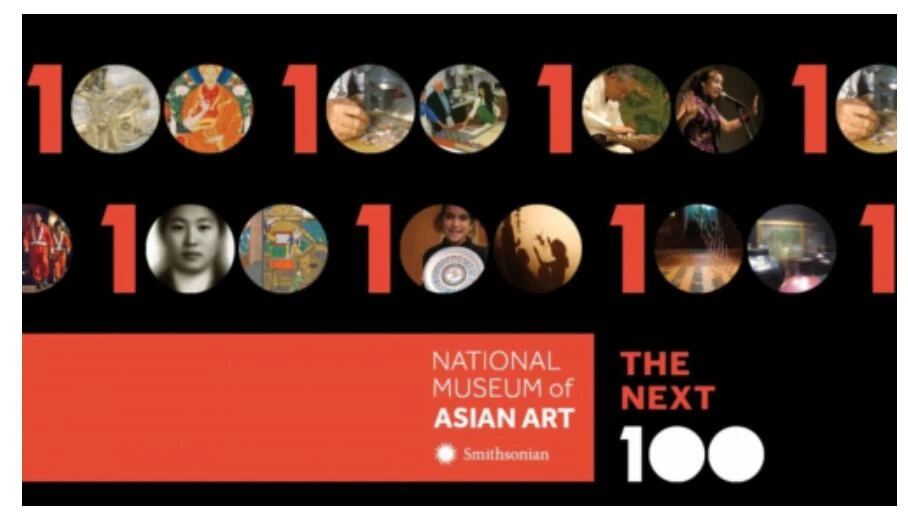
Smithsonian's National Museum of Asian Art Announces Centennial Celebration Plans
Exhibitions, public programs, and special events at the National Museum of Asian Art mark its role as a vital window for the world to understand Asian art and culture.
October 6, 2022, Washington, D.C. — The National Museum of Asian Art has announced its plans to celebrate its 100th anniversary. Starting this November and continuing through 2023, the museum will mark its centennial with a year-long series of activities and programs aimed at deepening global understanding of Asian art and culture. Centered on the theme of "Journeys," these events highlight the museum's significant transformation: it has become a key institution engaged in global and local public affairs.
To celebrate Asian American and Pacific Islander Heritage Month, the museum will host a two-week celebration from May 1 to May 13, 2023—its first major festival honoring this heritage month and a cornerstone of the centennial.
The Freer Gallery of Art, established after Charles Lang Freer donated approximately 9,500 artworks, opened to the public in 1923 as the first national art museum in the United States. Over the past century, it has built one of the world's most important collections of Asian art, mounted numerous influential exhibitions, and made outstanding contributions to Asian art history, conservation, and preservation science. The museum's collection creates a direct dialogue between Asian art and American works from the 19th and early 20th centuries, providing a vital platform for artistic collaboration and cultural exchange among the United States, Asia, and the Middle East. Through continuous acquisitions, the museum now holds a rich array of Asian art from before the modern era and presents the evolving cultural changes in Asia during the 20th and 21st centuries through art.
As it enters its second century, the museum is strengthening its strengths in conservation, curatorial work, and scholarship while exploring new ways to deepen and expand its impact.
"For nearly a century, the National Museum of Asian Art has played an important role in fostering greater understanding and appreciation of Asian art and its intersections with the United States," said Lonnie Bunch, Secretary of the Smithsonian Institution. "The museum's centennial represents a unique opportunity, while reflecting on its past, to look toward its future in line with the Smithsonian's broad goals of expanding the scope and impact of our national collections. We welcome the public to join the museum in commemorating this centennial and shaping its trajectory for the next hundred years."
"The museum's centennial is not only a milestone for the institution and the Smithsonian but also a catalyst for the next century," said Chase F. Robinson, Director of the National Museum of Asian Art, the Arthur M. Sackler Gallery, and the Freer Gallery of Art. "Our vision is to transform the museum into a space where a wide range of visitors can come together to celebrate, learn about Asian art and culture, including how they intersect with the United States, and engage with them. In our second century, we are becoming a space where people come together through art to learn, think, and connect."
Centennial Lineup
As it enters its second century, the National Museum of Asian Art is committed to becoming a national and global resource for understanding Asian art and culture and its intersections with the United States. On the occasion of its centennial, the museum is organizing a series of exhibitions, programs, initiatives, and celebrations, all responding to the needs of the United States and the international community: the modern world is increasingly interdependent with Asian societies, shaped and transformed by them, and the museum aims to foster deep respect for their art and culture and genuine cross-cultural understanding.
The "Journeys" theme encourages all visitors to chart their own paths through the museum and Asia's rich artistic traditions.
Signature Permanent Galleries
The museum will present new and renovated permanent installations, signaling its vitality as it enters its second century. The museum is also moving toward greater transparency, accessibility, and public engagement.
The newly preserved Peacock Room by James McNeill Whistler, which has captivated visitors since the museum's founding, has now been installed according to Charles Lang Freer's intentions. The room showcases a dialogue between American design and Asian objects and aesthetics, guiding visitors through its creation.
"Freer's Global Network: Artists, Collectors, and Art Dealers" will open on October 15, offering visitors diverse perspectives that shaped the museum's founding collection.
In April 2023, a new lobby will open, featuring large screens that rotate artworks, providing visitors with a way to engage with Asian art. This gallery will incorporate contemporary viewpoints to help visitors understand the layered histories of the objects and their relevance to modern and contemporary society.
The museum's first gallery dedicated to modern and contemporary art will open in summer 2023, featuring four video exhibitions.
The centennial celebration centers on three flagship exhibitions, each envisioning the museum's next century. The exhibitions employ cutting-edge digital technology and immersive experiences and forge global partnerships.
"A Splendid Land: Paintings from Royal Udaipur" (November 19, 2023 – May 14, 2024): Organized in collaboration with the City Palace Museum, Udaipur, managed by the Maharana of Mewar Charitable Foundation, this exhibition features a major series of works from Udaipur, Rajasthan, India. Ambient soundscapes by renowned experimental filmmaker Amit Dutta emphasize the sensory elements of the paintings, which center on local landscapes, lake systems, and palaces. A companion series of programs explores cultural attitudes toward water and addresses environmental racism, resource management, and climate issues in India and Washington, D.C.
"Anyang: China's Ancient King City" (February 25, 2023 – April 28, 2024): The first major exhibition in the United States on Anyang, the ancient capital of China's Shang dynasty. "Anyang" brings together over 200 objects from the museum's collections to examine the artistic achievements of the Shang dynasty and its capital more than 3,000 years ago. The exhibition will include digital features developed with award-winning production studio UNIT9 to help visitors understand the city and the significance of its discovery.
"Ay-Ō's Happy Rainbow Hell" (March 25, 2023 – September 10, 2023): Ay-Ō, known as the "rainbow artist," has gained international attention for his experiential works and prismatic silkscreen prints that prominently feature a bright rainbow aesthetic. "Ay-Ō's Happy Rainbow Hell" is the first museum exhibition in the United States dedicated to the artist's work. It will be accompanied by the first English-language publication on the artist. The exhibition will be enhanced by interactive gesture walls and digital tactile boxes, allowing visitors to experience Ay-Ō's world.
From May 1 to May 13, 2023, the museum on the National Mall and its surrounding areas will host various events to celebrate Asian art and culture, including talks, performances, interactive experiences, food, and community programs. This centennial festival is the museum's first major event for Asian American and Pacific Islander Heritage Month.
As part of the festival, the museum will collaborate with the Washington Performing Arts Center and the United States Air Force Band to present renowned composer Huang Ruo's oratorio "Angel Island," its Washington premiere, inspired by poems written by immigrants on the walls of Angel Island detention center in San Francisco. The festival will also screen silent films from the 1920s, accompanied by live performances by Min Xiao-Fen.
Throughout 2023, a series of "Journeys" public programs will experiment with new forms of storytelling and create opportunities for visitors and staff to share their own experiences. The year will feature special film screenings that allow audiences to see the world through filmmakers' eyes. Other partners in 2023 include Pulitzer Prize winner Viet Thanh Nguyen, contemporary artists such as Ravi Agarwal, musicians from Marlboro and the Shanghai Quartet, and numerous Asian embassies and cultural centers. Annual celebrations such as Nowruz, Diwali, the National Cherry Blossom Festival, and Lunar New Year create journeys through cultural practices.
As part of the centennial, the museum will also host a range of scholarly programs and hold major symposia across various museum disciplines. Finally, the museum's official website will be redesigned to offer audiences access to digital storytelling, interactive features, and various lectures—allowing everyone, anywhere, to join the centennial "journey."
Full details of the National Museum of Asian Art's centennial activities will be announced in the coming months. Stay tuned for updates.
Bank of America is the Lead Sponsor of the Smithsonian's National Museum of Asian Art's centennial celebration.
About the Smithsonian's National Museum of Asian Art
The Smithsonian's National Museum of Asian Art is dedicated to preserving, presenting, researching, and interpreting art to deepen our collective understanding of Asia and the world. With over 45,000 objects, it houses one of North America's largest and most comprehensive collections of Asian art, featuring works from China, Japan, Korea, South Asia, Southeast Asia, and the Islamic world, from ancient times to the present. Its rich collections create a direct dialogue between Asian art and a significant collection of 19th- and early 20th-century American works, providing an important platform for creative collaboration and cultural exchange among the United States, Asia, and the Middle East.
Beginning with a gift in 1906 that paved the way for the museum's opening in 1923, the National Museum of Asian Art is a premier art resource for American and international visitors, students, and scholars. Its galleries, laboratories, archives, and libraries are located on the National Mall in Washington, D.C., as part of the world's largest museum complex, which typically welcomes over 27 million visitors annually. The museum is open to the public free of charge 364 days a year (closed December 25), and its exhibitions, programs, learning opportunities, and digital initiatives are available to global audiences.


