North America Travel: From Washington, D.C. to Philadelphia, USA (Photos) Part 1
Today, I was delighted to see the good news that China and the US have agreed to hold the '14th China-US Tourism Leadership Dialogue', which couldn't help but remind me of a trip along the East and West Coasts of the United States during my North American journey. On November 19, 2015, at 10:50 AM Pacific Time, I, as a reporter, left the Arizona Tharlies Hotel in Las Vegas with the tour group 'Appreciating Famous Cities of the East and West Coasts of the United States'. After shopping at the Las Vegas Outlets, we headed to Las Vegas International Airport, where we would take US domestic flight 2755 to the eastern city of Washington, D.C., the capital of the United States, for the East Coast tour.
The group leaves Las Vegas (Photo by Wang Jue)
On November 20, 2015, at 2:15 AM Eastern Time, after nearly four hours of flight, the group smoothly arrived at Washington Dulles International Airport. The local guide Li Qi, a young man from Kaifeng, Henan, came to pick us up. Due to flight delays, he had already been waiting at the airport for several hours after traveling from New York, so he looked extremely tired. He told everyone that the time difference here was three hours later than on the West Coast. Moreover, it was destined to be a tough day, as after arriving at the hotel, everyone could only sleep for about five hours before starting the Washington tour.
Hotel in Washington (Photo by Feng Ganyong)
The capital of the United States, Washington, full name 'Washington, D.C.', is affectionately called the 'heart of the nation' by Americans. It was named to honor the founding father George Washington and Christopher Columbus, who discovered the New World. Washington is very different from other US cities, with a strong political atmosphere.
Scenery on the outskirts of Washington (Photo by Feng Ganyong)
Historically, Washington was inhabited by Native Americans. European immigrants established tobacco plantations here in the early 17th century. In 1789, Washington was chosen as the site for the capital. The entire city is laid out in a regular quadrilateral shape, with a balanced arrangement and wide views. No building in the city exceeds the height of the Washington Monument, and the Capitol Building in the city center is the tallest, at only eight stories. The city has almost no factories, making the environment exceptionally clean. Most local workers are government employees, and the rest primarily work in culture, commerce, entertainment, and tourism.
Lincoln Memorial in Washington (Photo by Feng Ganyong)
On that day at 9:30 AM Pacific Time, our group left the Comfort INN Hotel in Washington and first drove to the famous Lincoln Memorial for a visit. The Lincoln Memorial, regarded as an eternal statue of the United States and a symbol of Washington, D.C., was built to commemorate the 16th President of the United States, Abraham Lincoln. It is a Greek temple-style memorial built entirely of white granite and marble.
Group photo at the Lincoln Memorial (Photo by Wang Jue)
The memorial stands at the western end of a relatively independent National Mall, about 400 meters in diameter, on the eastern bank of the Potomac River, facing the Capitol Building to the east. Above ground, there is a granite foundation nearly 5 meters high. The memorial itself, built on the stone platform, is about 18.3 meters tall, and including the foundation, it is over 23 meters high. The colonnade of the memorial is about 36 meters wide from east to west and about 57 meters long from north to south, forming a rectangular structure.
Guide Li Qi introduces the site (Photo by Feng Ganyong)
Outside the east gate of the memorial, wide stone steps ascend layer by layer, leading countless visitors into the sacred memorial. There are 36 stone columns around the outer corridor of the Lincoln Memorial, each 13.4 meters high with a bottom diameter of 2.26 meters. The tall and sturdy columns of the outer corridor have the style of the Greek Parthenon, symbolizing the 36 states of the United States during Lincoln's time. On the top parapet, there are 48 hanging flower ornaments, representing the 48 states at the time of the memorial's completion. The names of the 48 states are carved on the railings above the columns. At the far end of a long, clear pool in front of the memorial stands the famous Washington Monument; on both sides of the memorial are the Vietnam Veterans Memorial and the Korean War Veterans Memorial. The entire surrounding environment of the memorial is dignified, elegant, and beautiful, blending together harmoniously.
View of the Washington Monument from afar (Photo by Feng Ganyong)
Ascending the stone steps to the high memorial platform, entering the memorial and looking up, a marble statue of Lincoln is placed in the center. His hands rest on the armrests of the chair, with a solemn expression. Above the statue is an inscription: 'Lincoln will be immortal, forever in the hearts of the people.' This seated statue of Lincoln was created by the famous American sculptor Daniel Chester French.
Seated statue of Lincoln (Photo by Feng Ganyong)
Looking closely at the seated statue of Lincoln, it is very lifelike. Lincoln's gaze passes through the door, fixing on the towering Washington Monument across the Reflecting Pool and the Capitol Building at the end of the National Mall. The symbolism here is profound, worth pondering. This statue is very large; if converted into a standing statue at the same scale, it would be 28 feet (about 8.53 meters) tall. The statue was carved from 28 pieces of stone and then assembled, appearing seamless. It was based on the sculptor's model and carved by the Piccirilli brothers, taking over four years. The estimated cost of the entire statue was $88,400.
Columns of the Lincoln Memorial (Photo by Feng Ganyong)
On the wall above Lincoln's white marble statue, four lines of large text are engraved: 'In this temple as in the hearts of the people for whom he saved the Union the memory of Abraham Lincoln is enshrined forever.' On the north and south walls of the memorial are two famous speeches by Lincoln. On the south wall is the full text of the 'Gettysburg Address.' On the north wall is Lincoln's second inaugural address from 1865, which is slightly longer. The second inaugural speech is powerful and full of emotion.
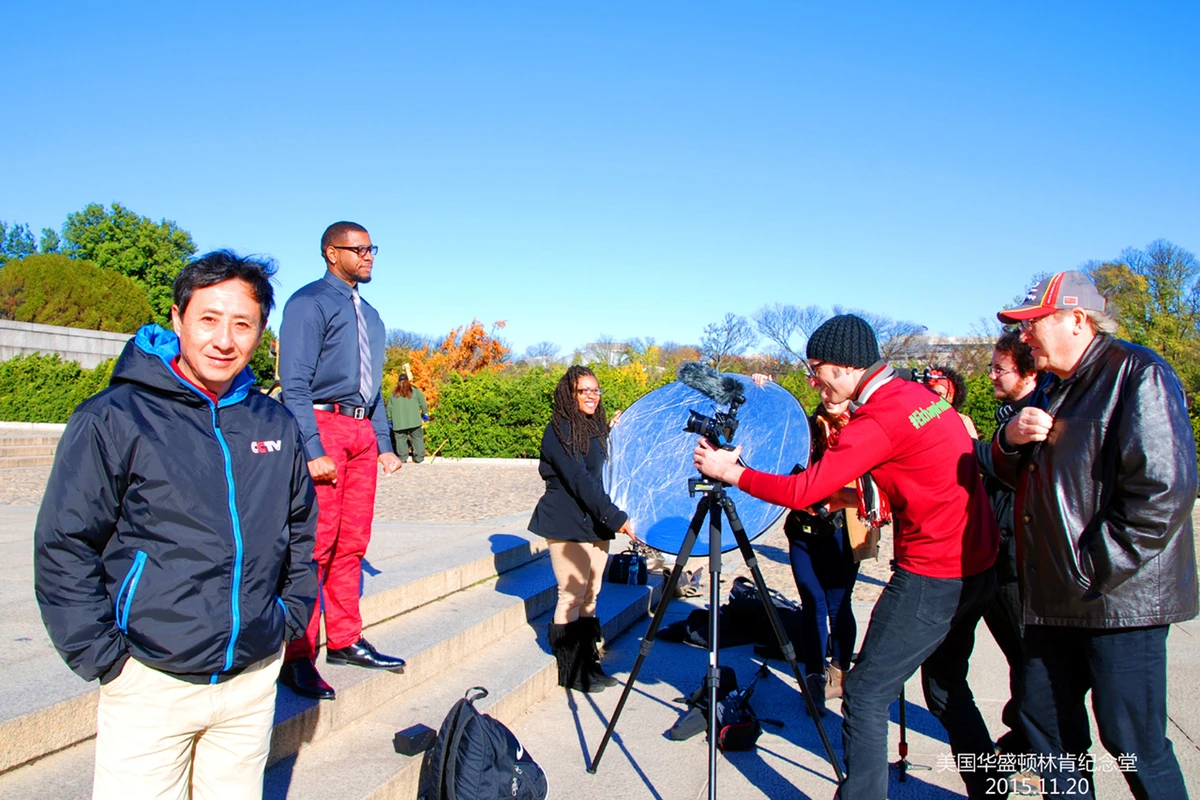
Encountering a film crew in front of the memorial (Photo by Wang Jue)
The Lincoln Memorial broke ground in 1914 and was completed in 1922. The memorial has a solemn atmosphere, with tourists from all over the world visiting every day. The late President Lincoln is one of the most respected American presidents. The people will not forget his contributions to the United States—emancipating slaves and preserving the Union. It was he who saw the evil of slavery from the lowest levels of society and exposed the hypocrisy of 'all men are created equal.' Although he was tragically assassinated, his spirit will forever remain in the Lincoln Memorial.
Statue of American soldiers in the Vietnam War (Photo by Feng Ganyong)
Coming down from the memorial, I first visited the Vietnam Veterans Memorial Wall on the left. The Vietnam War (1961-1975) was a war between the Republic of Vietnam (South Vietnam) and the United States on one side, and the Democratic Republic of Vietnam (North Vietnam) and the National Liberation Front (Viet Cong) on the other. It ended with North Vietnam unifying South Vietnam and the withdrawal of US forces. During this war, China provided substantial political, diplomatic, economic, war materials, and military support to North Vietnam. The United States lost this war. For the sake of remembrance, in 1982, the US Congress decided to build the Vietnam Veterans Memorial, funded by private donations, like the Korean War Veterans Memorial.
Visiting the Vietnam Veterans Memorial (Photo by Feng Ganyong)
The design was by Maya Lin, a 21-year-old Chinese-American student at Yale University's School of Architecture, who stood out among over 1,400 design proposals. Her design is what we see today: a black granite wall over 3 meters high, starting low at both ends, rising up, and meeting at ground level in the middle. The granite is engraved with the names of 58,132 soldiers who died in the Vietnam War. Outside the memorial wall, there is also a statue of three US soldiers in full combat gear, their piercing eyes fixed ahead, as if guarding the spirits of those who sacrificed their lives in this war.
Vietnam Veterans Memorial area (Photo by Feng Ganyong)
Visitors touring this wall are like reading a history book. In Maya Lin's own words: '(The living and the dead) will meet again in the world of sunshine and the world of darkness and silence.' Her design concept is: it is people, not politics, who, after accepting the reality of death, can dominate and return to the light. Therefore, the entire design has no words introducing or evaluating the war.
A family at the memorial wall (Photo by Feng Ganyong)
While visiting, I saw a family. The elder, perhaps a grandfather, was leading several children in rubbing paper over the names of the fallen on the wall. Perhaps the deceased were their relatives, and they were rubbing the names of family members for remembrance. War is cruel. If the fallen here are aware in heaven, knowing that future generations still remember them, they may find great comfort.
Korean War Veterans Memorial (Photo by Feng Ganyong)
Leaving the Vietnam Veterans Wall, I went to the Korean War Veterans Memorial not far opposite. The Korean War (1950-1953) is what we commonly call the War to Resist US Aggression and Aid Korea. On June 25, 1950, the Korean Civil War broke out. On June 27, US President Harry S. Truman issued a statement announcing the dispatch of troops into Korea. On July 7, the UN Security Council passed a US proposal to form a 'United Nations Command' under General Douglas MacArthur.
Wall at the memorial (Photo by Feng Ganyong)
At that time, besides South Korea, 16 countries sent troops: the United States, the United Kingdom, the Netherlands, Australia, New Zealand, Canada, France, the Philippines, Turkey, Thailand, South Africa, Greece, Belgium, Luxembourg, Ethiopia, and Colombia. The US committed one-third of its army, one-fifth of its air force, and half of its navy to the war. On October 19, under the command of General Peng Dehuai, China entered the war under the name 'Chinese People's Volunteer Army'. On October 25, the Volunteer Army fought their first battle after entering Korea, marking the beginning of the War to Resist US Aggression and Aid Korea. The war lasted nearly three years. On July 27, 1953, the warring parties signed the armistice agreement, and the border remained at the 38th parallel, dividing North and South Korea.
Signalman at the memorial (Photo by Feng Ganyong)
At the Korean War Veterans Memorial, I saw 19 statues of American soldiers. They wear helmets and ponchos, forming a skirmish line, trudging through muddy terrain. Their expressions are complex: tired, helpless, fearful, scared, vigilant... conveying the cruel atmosphere of war. In American terms, they went to fight for a people they did not know and had never met, and ended up signing an agreement at Panmunjom at the cost of over 50,000 soldiers killed and wounded, and nearly 10 million dollars.
Group photo at the memorial (Photo by Wang Jue)
For Americans, the Korean War is one of their most reluctant memories. This is why they call it 'the forgotten war.' How many losses did the Chinese and American militaries and the UN forces suffer in this war? Engraved on several granite stones at the memorial are the following numbers: Deaths: USA 54,246, UN 628,833; Missing: USA 8,177, UN 470,267.
Scenery around the two memorials (Photo by Feng Ganyong)
Luo Youlin, a retired cadre from the Academy of Military Sciences of the People's Liberation Army, who was also a member of the tour group, was deeply moved after the visit. He wrote in his WeChat: 'On both sides of the Lincoln Memorial are two meticulously designed cemeteries by Americans—the Korean War and Vietnam War (which we call the War to Resist US Aggression and Aid Korea and the War to Resist US Aggression and Aid Vietnam). Why have these two wars left such an indelible mark on American history? In my eyes, it is because they are related to us Chinese. In previous wars the US had fought, they were always invincible, especially in World War II. This earned them the crown of the world's 'boss.' However, these two wars alone dampened their prestige and diminished their spirit. The heavy cost forced them to do this; otherwise, they could not answer to history and the people.'
Luo Youlin viewing photos (Photo by Feng Ganyong)
'I walked slowly through the cemetery, feeling two emotions at once. One is pride and honor—because it was the Chinese who hurt them, scared them, and made them pay such a heavy price. In the Korean War, we fought face-to-face. In the Vietnam War, we played the role of an 'invisible killer,' contributing greatly, which they 'know well.' The other is pity and regret—because war is inhumane. How many American families lost their loved ones and children? Watching those who came to pay their respects, my thoughts were many, but one thing is common: we commemorate those who sacrificed for their country and promote the spirit of patriotism.' (Text and photos by Feng Ganyong)


