North America Travel: From Washington, D.C. to Philadelphia (Part 2 with Photos)
The reporter's North America "Appreciating Famous Cities on the East and West Coasts of the United States" tour group, after finishing the visit to the Lincoln Memorial and the two nearby war memorials, drove a short distance to the Jefferson Memorial, still on the other side of the Potomac River. The Jefferson Memorial was built in memory of Thomas Jefferson, the third President of the United States. Construction began in 1938 under the direction of President Franklin D. Roosevelt and was completed in 1943.
Jefferson Memorial (Photo by Feng Ganyong)
This memorial, designed in the Roman temple-style domed architecture that Jefferson loved, is a white marble building 96 feet high. In the center of the hall stands a bronze statue of President Jefferson nearly 6 meters tall. On the stone wall behind it is engraved Jefferson's words: "I have sworn upon the altar of God eternal hostility against every form of tyranny over the mind of man." Every April, the cherry blossoms beside the Tidal Basin bloom, and with the reflection of the memorial in the lake, the scenery is very beautiful.
Jefferson Statue (Photo by Feng Ganyong)
This white domed building surrounded by Corinthian columns, built in memory of Jefferson, itself became a classic. The entire memorial is elegant and pure, with 54 granite columns on the outside, each 43 feet (about 13 meters) long and weighing 45 tons, giving a sense of calm. On the north side of the memorial is a large sloping staircase. Visitors must look up to see a solemn marble relief on the gable of the portico supported by eight large stone columns.
Corner of the Jefferson Memorial (Photo by Feng Ganyong)
That scene depicts Jefferson and four others, commissioned by the Continental Congress on the eve of American independence, drafting the Declaration of Independence. Young Jefferson stands in the middle, with Benjamin Franklin and John Adams on his left; on his right are the other two collaborators, Roger Sherman and Robert Livingston. The stone carving group was created by New York sculptor Adolph A. Weinman, who was commissioned by the Jefferson Memorial Construction Committee to complete the work before the memorial's completion.
Jefferson Memorial Columns (Photo by Feng Ganyong)
Ascending the 7.6-meter-high stone steps, one enters the memorial. The circular main memorial chamber is 82 feet (about 25 meters) in diameter, with the floor paved in pink and gray Tennessee marble. The main memorial chamber is surrounded by 16 stone columns over 13 meters high. The 5.8-meter (19-foot) black bronze statue of Jefferson sits on a 1.8-meter-high white Minnesota marble base, forming the center of the circular memorial. The white dome of the memorial is constructed of Indiana granite, rising 20 meters above the top of Jefferson's head.
Potomac River Bank (Photo by Feng Ganyong)
After the group finished paying respects at the Jefferson Memorial, they drove to the famous White House. Along the way, they passed several museums, including the National Gallery of Art and the National Air and Space Museum. Li Qi introduced that these American museums actually all belong to the Smithsonian Institution.
Street Photo in Washington (Photo by Feng Ganyong)
Headquartered in Washington, D.C., the Smithsonian Institution owns some of the world's most famous museums, including: the National Museum of American History, the Art and Industries Building, the Hirshhorn Museum (a renowned contemporary art museum), the National Museum of American Art, the National Museum of African Art, the National Air and Space Museum, the National Museum of Natural History, and so on.
Scenery Around Washington Museums (Photo by Feng Ganyong)
These exhibition halls are located in the heart of Washington, D.C., on both sides of the large lawn between the Capitol and the Washington Monument, with 14 national museums concentrated in the area. For example, the National Gallery of Art is near the Capitol end, adjacent to the famous National Museum of Natural History. The National Gallery of Art has two buildings: the West Building, which has a neoclassical style consistent with other museums, and the East Building, a completely modern triangular structure designed by I. M. Pei. The different architectural styles of the East and West buildings also reflect the different collections of the two buildings. The East Building collects only modern artworks, while the West Building collects paintings and sculptures from the Middle Ages to the present.
Street Map in Washington (Photo by Feng Ganyong)
Looking at major countries around the world, every capital has at least one national-level large art museum, but the construction of the National Gallery of Art in the United States was not easy. When the idea was proposed, American history was only a hundred years old, and culture was scarce. Building a grand national art museum was no small feat! The eventual completion of this national gallery owes much to former U.S. Treasury Secretary Andrew Mellon. He wrote to President Roosevelt, expressing his willingness to donate all his personal collections to build the museum, and hoped that upon completion it would be named the "National Gallery of Art" so that other collectors would donate their treasures. After his proposal was approved by Congress, the 80-year-old Mellon personally appointed John Russell Pope, the famous architect who designed the Jefferson Memorial, to design and construct this magnificent and elegant national gallery.
Street Food Stalls in Washington (Photo by Feng Ganyong)
The beauty of this museum lies not only in the number of its collections but also in the fact that the museum itself is the finest architectural art. The winding dome, finely carved arches, painted glass... all of these are full of vitality under the sunlight, attracting the eyes of every visitor. Every step offers a view, and an inadvertent glance can make one stop for a long time.
White House in Washington (Photo by Feng Ganyong)
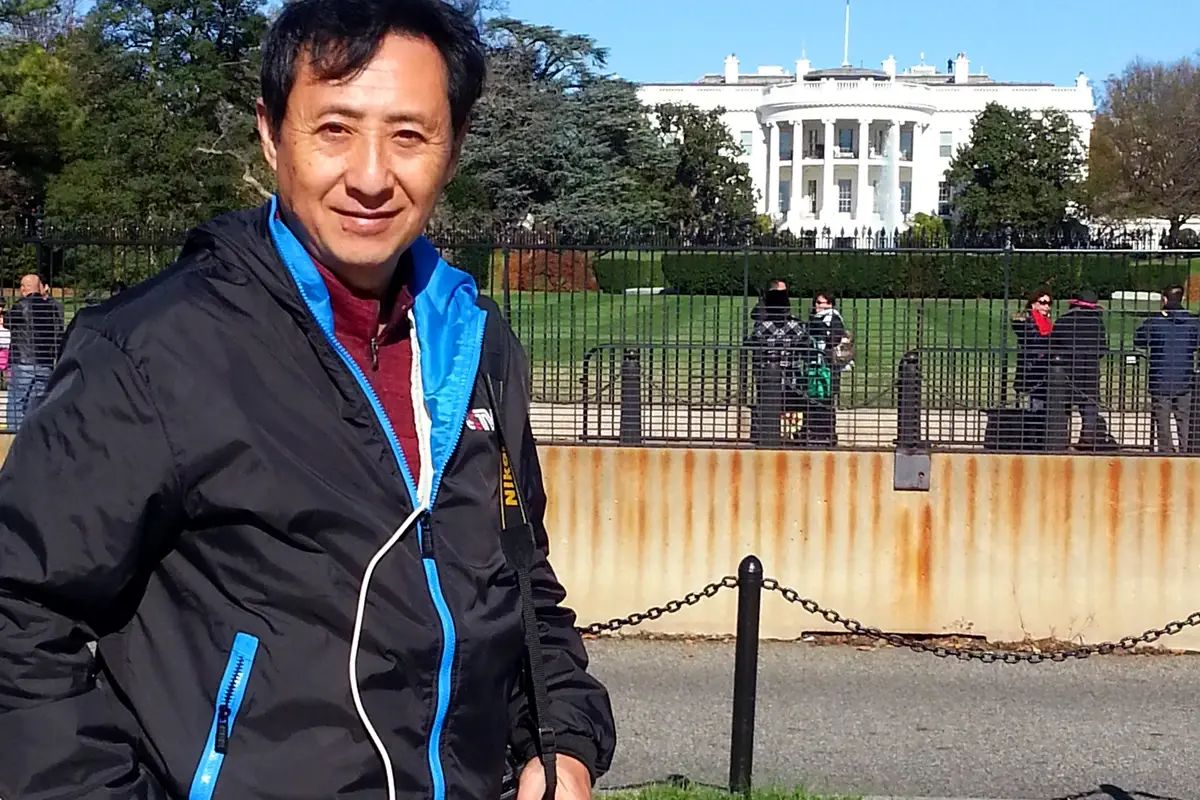
Finally, we arrived at the heavily guarded White House. The White House, across a street, is surrounded by iron fences. Armed police patrol the entrance, and some plainclothes security personnel are also visible. People can only look inside through the gaps in the iron fence.
Photo in Front of the White House (Photo by Qu Lu)
I remember seeing an American film called "White House Down," also known as "The Fall of the White House." In that film, the White House was open to tourists, and terrorists posed as visitors to hijack the U.S. President, leading to a thrilling story of hostage-taking and counter-terrorism. So, in the reporter's view, given the current severe global counter-terrorism situation, such a high level of security at the White House is completely understandable.
Group Photo in Front of the White House (Photo by Feng Ganyong)
The White House is the official residence and workplace of the President of the United States. It is owned by the National Park Service and is part of the President's Park. The Secret Service code name for the White House is "Crown." The back of the twenty-dollar bill features an image of the White House.
Reporter's Photo at the White House (Photo by Wang Jue)
The White House, located at 1600 Pennsylvania Avenue NW in Washington, D.C., is a white neoclassical sandstone building. It is bordered by Lafayette Square to the north, the Ellipse to the south, and faces the towering Washington Monument. It is a two-story white building. Because the White House is where the U.S. President lives and works, the term "White House" often refers to the U.S. government, e.g., "The White House announced that British Prime Minister Gordon Brown will visit the United States."
Street View Near the White House (Photo by Feng Ganyong)
On the way back from the White House, we had a close-up view of the Washington Monument, which we had seen from the entrance of the Lincoln Memorial when we looked out into the distance. The Washington Monument is a landmark in Washington, D.C., built to commemorate President George Washington. The stone obelisk is hollow inside and is the world's tallest stone structure. Mills' original design included a colonnade of founding heroes at the base surrounding the monument, but when U.S. Army Corps of Engineers Colonel Thomas Lincoln Casey was entrusted to redesign the foundation and shaft, he abandoned the colonnade idea, focused on building the obelisk, deepened the foundation, and redesigned the main tower using ancient Egyptian proportions.
Scenery Outside the White House (Photo by Feng Ganyong)
The Washington Monument is located in the center of Washington, D.C., on the axis of the Capitol and the Lincoln Memorial. It is a marble obelisk, square in shape, 22.4 meters wide at the base and 169.045 meters high. Inside the monument, there are 50 flights of iron stairs and a high-speed elevator that reaches the top in 70 seconds. Visitors can look out from small windows at the top to see the entire city of Washington, Virginia, Maryland, and the Potomac River. The interior walls of the monument are inlaid with 188 memorial stones donated by individuals, groups, and from around the world, including one with Chinese characters donated by the Qing government. The monument is surrounded by a large grassy lawn, where rallies and parades often take place.
Distant View of the Washington Monument (Photo by Feng Ganyong)
According to Li Qi, if you look down from the air, you will find that the Washington Monument sits at the center, like a central axis connecting the Capitol, the White House, the Lincoln Memorial, the Jefferson Memorial, etc., with the buildings on both sides forming a cross shape.
Close View of the Washington Monument (Photo by Feng Ganyong)
The last stop in Washington was the United States Capitol. The Capitol is located on Capitol Hill, 25 meters high, and is the heart of the United States. It is a well-known Washington building with its white exterior and dome, and it is the center of American power. Unfortunately, this time we happened to catch the famous building under renovation. The dome, which we had seen in many news stories but never in person, was completely covered in scaffolding. It was difficult to see its true appearance. If there was a slight regret on this trip, it was this.
Capitol Under Renovation (Photo by Feng Ganyong)
The Capitol was built from 1793 to 1800. Like many important buildings in Washington, it was not spared from destruction during the War of 1812 with Britain. After post-war reconstruction, the Capitol underwent several expansions over the centuries, including a massive reconstruction from 1851 to 1867, eventually forming its current layout.
Photo in Front of the Capitol (Photo by Wang Jue)
The Capitol is a three-story building with a total length of 233 meters, primarily made of white marble. On the central rooftop stands a highly recognizable three-tiered large dome, atop which is a 6-meter bronze statue of the Statue of Freedom. The north and south wings on either side of the large dome house the House of Representatives and the Senate, respectively. The House of Representatives chamber is where the President of the United States delivers the annual State of the Union address. Modeled after the Panthéon in Paris, it strives to express grandeur and emphasize commemoration, and is a representative work of the Neoclassical Revival style.
Capitol Hill Guide Map (Photo by Feng Ganyong)
The large lawn east of the Capitol is where the presidential inauguration ceremonies are held. Looking from the lawn, the columned portico under the Capitol dome is magnificent. Inside the portico are three heavy bronze "Columbus Doors," with reliefs depicting Columbus discovering the New World. Inside the doors is the Capitol's Rotunda. In the Rotunda, one can see a缩影 of American politics.
Statue in Front of the Capitol (Photo by Feng Ganyong)
On the walls of the Rotunda hang eight paintings recording important moments in American history. On the 55-meter-high dome is a large painting by 19th-century Italian artist Constantino Brumidi and his students. At the center is George Washington, the founding President of the United States, flanked by the Goddess of Victory and the Goddess of Liberty. The other 13 goddesses in the painting represent the original 13 states. The stone statues of distinguished presidents in the Rotunda each represent an era. There is also a专门的雕像厅 on the south side of the Rotunda, where statues of famous people from all 50 states are gathered together, symbolizing the cohesion of the United States.
Group Photo in Front of the Capitol (Photo by Li Qi)
After sightseeing in Washington, the group drove to the second stop of their Eastern U.S. tour: Philadelphia. After a journey of over three hours, they arrived in Philadelphia around 4:00 PM that afternoon. What impressed the reporter most about Philadelphia was the Philadelphia Orchestra, which first performed at the Beijing Nationalities Cultural Palace in September 1973. However, when actually arriving in the city, they learned that the Liberty Bell Museum, one of the symbols of American independence, and Independence Hall, where Washington signed the Declaration of Independence, are truly the pride of Philadelphia.
Corner of Downtown Philadelphia (Photo by Feng Ganyong)
Philadelphia, located in Pennsylvania, is the fifth-largest city in the United States and a beautiful city. The square near Kennedy Boulevard, standing in the center of the river, is the commercial core of Philadelphia. From here, the city's grid layout is fully visible. The Philadelphia Museum of Art, the Rodin Museum, the Fels Planetarium, and the Benjamin Franklin Museum are located on Benjamin Franklin Parkway, which leads to the world-famous Fairmount Park. Also, Independence Hall, where the Declaration of Independence was born, has a simple and ancient appearance and is a witness to American history. Here, races blend, happy classical music fills the air, and the streets are full of joy. The four seasons are distinct and the climate is pleasant, earning it the nickname "City of Homes."
Liberty Bell Museum (Photo by Feng Ganyong)
Due to time constraints, the first stop was the Liberty Bell Museum. Upon entering, they watched a video documentary about the birth of the Liberty Bell. Through a thrilling piece of history depicted in the film, visitors gained a vivid and profound understanding of Philadelphia, the Liberty Bell, and the American independence movement.
Liberty Bell (Photo by Feng Ganyong)
The Liberty Bell is a symbol of Philadelphia and a symbol of American freedom. It is a source of pride for Americans. It participated in the most important events in early American history. Although the Liberty Bell's history is only about 250 years, it weighs just over 900 kilograms and is cast from a mixture of metals. In 1751, the Pennsylvania Assembly ordered it from Britain for £100. The craftsmanship of the time was obviously limited. When the bell arrived in Philadelphia the following year, it cracked during a test ring. A year later, two local foundry workers recast it, and it was finally successful.
Photo in Front of the Liberty Bell (Photo by Wang Jue)
In 1835, during a celebration of Washington's birthday, children cracked it with a one-foot-long crack. Ten years later, during a similar event, it was rung for several hours, resulting in the famous jagged crack we see in the exhibit hall, though in fact it is not the only crack. The Liberty Bell could never be repaired. Except for Independence Day each year, when church bells ring across the country, the Liberty Bell is the first to sound. Although it is rarely used, its not particularly loud sound proclaims America's freedom and independence.
Philadelphia Independence Hall (Photo by Feng Ganyong)
Not far opposite the Liberty Bell Museum is the famous Independence Hall. Built in 1732, it originally served as the Pennsylvania State House. It is a two-story old red brick building with cream-colored doors and windows, a cream-colored spire, and a large clock embedded in the spire. The top of the spire was where the Liberty Bell once hung. The whole building is unadorned yet solemn, inspiring reverence. On both sides of Independence Hall are two symmetrical small buildings, with the same red brick walls and architectural style, which were the old Parliament House and the old City Hall respectively.
Statue of General Washington (Photo by Feng Ganyong)
The meeting room on the first floor of Independence Hall is where the Declaration of Independence and the Constitution were signed. The desks, chairs used by General Washington, Franklin, Jefferson, and delegates from various states, the quill pens and ink used for signing, and the front desk of the meeting room where Washington read the Declaration of Independence are all presented to people in their original state. In the quiet space, visitors can't help but recall the heated debates that took place here over 200 years ago. Their courage and wisdom changed the destiny of the United States and laid the foundation for the values of the American people today. Outside Independence Hall stands a striking statue of Washington, which complements the entire building and blends into one.
Street Sculpture in Philadelphia (Photo by Feng Ganyong)
The reporter's "Appreciating Famous Cities on the East and West Coasts of the United States" tour group completed their sightseeing in Washington, D.C. and Philadelphia, marking the successful conclusion of the first leg of their Eastern U.S. itinerary. Afterwards, the group drove at full speed to their final stop, New York, and checked into the For your Safety hotel that evening. The next day, the North America tour would continue with their last sightseeing in the United States. (Text and photos by Feng Ganyong)


