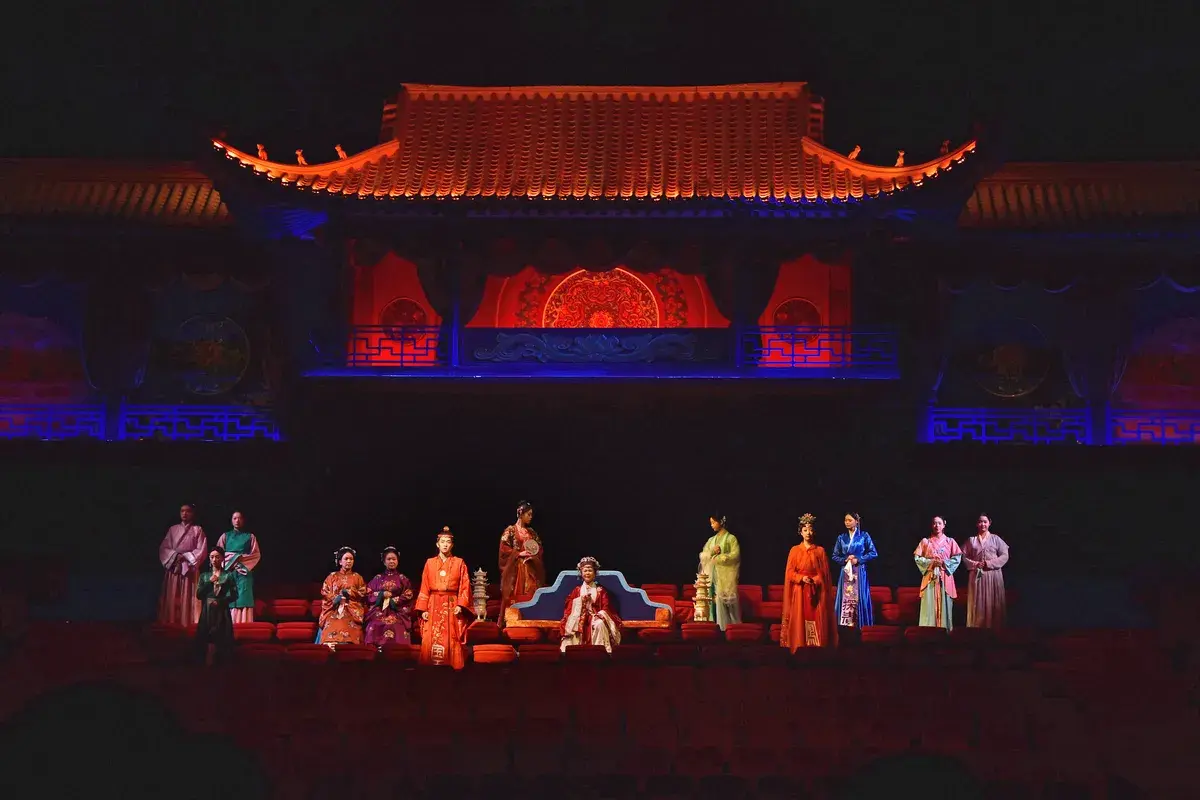
Only Red Mansion Dream Theater City: Step into the Fantasy, Immerse in Drama and Dreams
I heard that a new fun attraction has been added in Langfang between Beijing and Tianjin, themed on Dream of the Red Chamber, with many wonderful performances and great photo opportunities. So this spring, our family made a special trip to Only Red Mansion Dream Theater City to check it out.
The ticket gate faces a row of doors of various shapes, as if each doorway leads to a different story. I heard that if you don't do your research here, you might miss many performances. So we planned our route in advance based on the show times. First, we came to a small open-air theater called 'Impermanence' (Wuchang).
One black and one white, yin and yang interweaving, two people mirroring each other, meeting by chance in time and space. The black-and-white pavilion sometimes separates and sometimes merges, with mist rising from the ground, adding a fantastical and eerie atmosphere to the scene.
Watching one show, strolling through several gardens to take photos, then queuing for the next performance—this is the basic rhythm of touring the Dream Theater City. The scenic area is a square city, divided by roads and walls into a grid of small squares of various sizes. Each square is an independent space. Through imaginative design, doors and skylights of different shapes create 108 garden spaces with distinct styles: fantastical, classical, retro... The subtlety, restraint, and dignity of Chinese aesthetics, along with the mystery, ethereality, and emptiness of dreams, appear sequentially or together in these spaces. Large areas of negative space give infinite room for imagination.
Wearing Tang suit, Hanfu, cheongsam, or horse-face skirt, matching the period scenes, makes the photos more flavorful. Taking photos is just the seasoning; watching performances is the main course.
Set in 1970s Suzhou, the protagonist Wang Zhigang is a seemingly delicate young man who always thinks of others, a true warm-hearted guy nicknamed 'Jia Baoyu'. Through the characters' misunderstanding to understanding and acceptance of him, the play interprets the warmth and coldness of human relationships and the genuine feelings among neighbors.
It's a rotating theater; the audience sits in the middle of a siheyuan (courtyard house) and turns direction with the plot, watching whichever side has action. The story takes place in 2018. Three original households with distinct personalities in the siheyuan go from rejection to acceptance and then reluctance towards two 'Granny Liu' tenants. This forms the main plotline. Through the dialogue full of local flavor, you feel the unique pride and warm-heartedness of old Beijing.
The theater features a procession-style performance. The audience enters from the backstage, witnessing the props room, dressing room, and actors preparing. The audience and actors swap positions, experiencing being on stage and watched. They watch the actors and characters from the book conversing across time and space. Then the audience takes their seats, and the grand dramas in the Jia Mansion begin...
It tells the story of businesses scheming against each other in the Shanghai International Settlement in 1917, and the entanglement of love and hate among characters. The plot is full of twists and turns, with an unexpected yet reasonable ending.
It takes us to the factory dormitory area of Panzhihua in 1965, telling a story that takes place before the opening of the film 'Dream of the Red Chamber'. In that passionate era, the elders dedicated their youth and blood, enduring hardships of two generations in one, laying a solid foundation for our good life today.
Through the thoughts and feelings of readers, it recreates scenes from the book. The audience moves between three sets, with two where they stand in the middle, watching vignettes of joys and sorrows performed around them, shuttling between reality and fantasy.
It showcases the various doubts and debates that 'Dream of the Red Chamber' has faced since its publication, especially regarding the last forty chapters—whether they were written by Cao Xueqin or continued by Gao E and Cheng Weiyuan. Over the centuries, readers have expressed regret, dissatisfaction, and even anger. A debate across time and space thus unfolds.
With the same name as the scenic area, this can be watched as the grand finale. The audience surrounds the stage, which is set in the center. Each time the lights go out, props and scenes rapidly change in darkness. Readers from different eras, places, and identities, along with different fragments and insights, interweave and collide here. The light and shadow transformations are amazing, the stage effects are stunning. When director Wang Chaoge's voice sounds and her name appears on the big screen, emotions instantly peak.
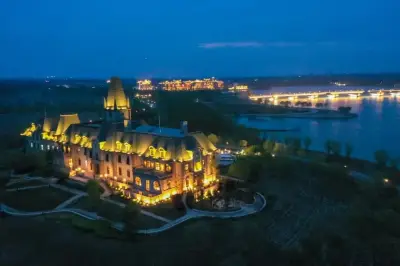
In one day, we watched nine performances, which was quite packed. But compared to the total of 21, it's not even half, so we'll leave it as a thought for a future visit. When we left, night had fallen, and the illuminated night scenery was also charming. Only Red Mansion uses modern technology to empower stage theater. In dreamlike light and shadow effects, it collides and harmonizes the original story with modern tales. In an immersive experience, it reinterprets the classic, awakening the Red Mansion gene deeply hidden in traditional culture, and builds a dream Grand View Garden in the audience's hearts. I think this is also a way for the director to pay tribute to the classic novel and Chinese culture.
Around the scenic area, there is the Shuiyunjian Commercial Street with many fast food, coffee, Sichuan cuisine, and snack shops. Inside the scenic area, there are dining options such as Jinling Noodle House, Granny Liu's Baozi Shop, Graduation Season Canteen, Haitang Restaurant, as well as garden afternoon tea and direct drinking water.
Near the scenic area, there are Yunsu Suji, Qixiu Hotel, Arcardia Hotel, Orange Crystal Hotel, Hampton by Hilton, Z Hotel, Wanda Realm Hotel, etc., offering hotel-plus-ticket packages that are more affordable than buying separately. We stayed at Arcardia Hotel; the room was clean and spacious, breakfast was rich, and it was great value for money.
The scenic area offers single-day, two-day, and night tickets, as well as single, double, and family packages. Choose according to your situation. For a two-day visit, it's recommended to buy a hotel-plus-ticket package, which is more cost-effective than buying separately.
There are direct buses from Beijing to the scenic area, with stops at Beitucheng Metro Station and Guomao Metro Station.
From Daxing Airport, Capital International Airport, and Tianjin Binhai Airport, there are intercity buses to Langfang. The terminal, Langfang City Terminal, is less than two kilometers from the scenic area.
By train, get off at Langfang Station or Guangyang Station, then take a taxi or ride-hailing service to the scenic area. Get off at the North Gate and walk to the entrance.
Self-driving visitors can navigate directly to the scenic area parking lot.
Travel Diary Directory:
1. 'Impermanence'
2. Strolling Gardens
3. 'Second Store'
4. 'Siheyuan'
5. 'True or False'
6. 'Shanghai Road A No. 36'
7. 'Zhang Yingchun'
8. 'Reader Theater'
9. 'Endless Book'
10. 'Only Red Mansion'
11. Tribute to the Classic
12. Food Guide:
13. Accommodation Guide:
14. Ticket Guide:
15. Transportation Guide:
Travel Info, Hotel Index, Guide Index, Airline Index, Website Navigation, Travel Index, Cruise Index, Corporate Travel Index, Franchise Cooperation, Distribution Alliance, Friendly Links, Corporate Gift Card Purchasing, Insurance Agency, Agency Cooperation, Hotel Franchise, Destination and Scenic Area Cooperation, More Franchise Cooperation, About Ctrip, Ctrip Hotspots, Contact Us, Careers, User Agreement, Privacy Policy, Business License, Safety Center, Ctrip Content Center, Intellectual Property, Trip.com Group Algorithm Disclosure