Langfang: A Bright Pearl Set in the Beijing-Tianjin Corridor
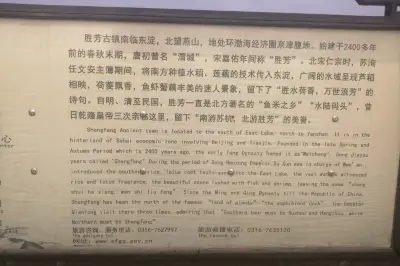
First stop from Beijing is Shengfang Ancient Town, very close, only 2+ hours drive. Shengfang Ancient Town is located 35 km east of Bazhou city, built at the end of the Spring and Autumn period, named after Emperor Qianlong's inscription 'Shengshui Hexiang, Wanshi Liufang' (Blessing Waters with Lotus Scent, Flowing for Ten Thousand Generations). It was known as 'South has Suzhou and Hangzhou, North has Shengfang' during Ming and Qing dynasties. Navigate to this memorial archway, but don't park here—police won't allow it. First visit the nearby Wenchang Pavilion, then park in the small parking lot opposite the Sino-Soviet Friendship Cultural Palace.
In the square west of Wenchang Pavilion stands the stele 'Record of Rebuilding Shengfang Ancient Town'.
Shengfang developed from an ancient small fishing village. After the great migration in early Ming, Shengfang's population surged; merchants gathered, shops lined up, and it quickly became a commercial and cultural hub in North China. Due to convenient water and land transport, it became a transshipment center for Beijing, Tianjin, and Baoding, listed as one of the six major towns of Zhili. The ancient town is not large, and many locals still live there, so commercialization is not too strong. The town has 'Three Treasures'—the stage, the memorial archway, and Wenchang Pavilion, plus well-preserved Qing dynasty residences such as Zhang Family Courtyard, Wang Family Courtyard, and Yang Family Courtyard.
Wenchang Pavilion, built in the 14th year of Ming Zhengde (1519 AD). It is three stories high and square, with two plaques: vertical 'Kuixing Tower' and horizontal 'Wenchang Pavilion'. It stands majestically, with the main body towering three zhang and three chi (about 11 meters), symbolizing 33 layers of heaven. It was a sacred site for scholars seeking literary prosperity. It underwent many repairs, but the largest was in early Qing Qianlong period, supervised by Zhili Governor Fang Guancheng.
Wenchang Pavilion is free, just register at the door. It is surrounded by high walls, with a red-lacquered gate opening to the south. Climbing several steps, you look up to see the three-story pavilion with flying eaves and brackets decorated with blue-green paintings; at the top hangs a vertical plaque inscribed 'Kuixing Tower' in gold. On the wall above the first floor's main door, a stone horizontal plaque is embedded, inscribed with 'Wenchang Pavilion'.
Inside Wenchang Pavilion, the central multi-tiered shrine enshrines Taoist deities. Along the east and west walls, there are narrow wooden staircases, only enough for one person. Climbing to the second floor, there are brick walls on three sides; in the center is a bronze statue of Wenchang Emperor. The three walls are decorated with marble-backed brass reliefs depicting auspicious motifs like 'Duzhan Aotou' (standing alone on the turtle's head) and 'Zhuangyuan Jidi' (top scholar), as well as a portrait of Confucius.
The third floor is not accessible. According to records, the third floor houses a statue of Kuixing. It symbolizes 'Kuixing pointing at the dipper, standing alone on the turtle's head'. The southern door is also not open, but looking through the window offers a nice view: in front, Zhongting River, and to the south a wetland of reeds and water plants, remnants of the ancient East Dongting Lake. At that time, Shengfang Wenchang Pavilion was the tallest among over 500 such pavilions in China. The 4-meter-high spire made it the highest point in the old town along Zhongting River. In the past, boatmen on East Dongting could always return to Shengfang by heading toward the spire. Unfortunately, the river hasn't been cleaned yet, looking somewhat unsatisfactory.
Behind Wenchang Pavilion is a lotus pond with clear water. In midsummer, lotus flowers are in full bloom, but the most eye-catching is a square pavilion by the pond. Inside stands a stele from the Qing dynasty, inscribed with poems composed by Emperor Qianlong during his two visits to East Dongting, praising the beautiful scenery 'the flowing waters surround the green lake'. But it's in the middle of the water, so you can't get a close look. This stele tells us that Qianlong made six trips to Jiangnan, all detouring through Shengfang, showing how beautiful Shengfang was as a water town.
Next to it is the ancient town's street. Along the streets are many snacks and small shops; the houses still look like the 1980s. The ancient town is different from others—because there are still original residents, the pace is slow. Along the way, I saw old men playing chess under trees, women chatting, and when you go into shops, they don't force you to buy.
After wandering for over an hour, we found this pancake restaurant, which has been open for a long time and is popular among locals. The pancakes are cheap, and they have the su mao (vegetarian cap) I wanted. Su mao soup is a sour and spicy specialty soup mainly made from bean sprouts, tofu balls, etc. I haven't seen it in Beijing yet. The price is really cheap; we three spent only about 30 yuan.
In the ancient town, there are two courtyards worth seeing. The first is Zhang Family Courtyard, free with registration at the door. Zhang Family Courtyard was built in the 10th year of Qing Daoguang (1830) by the Zhang family of Juxingtang, one of the Eight Great Families of Shengfang. Zhang Yi, style name Jizhi, also Zhongjin. He was a Fushan in Qing dynasty, acting county magistrate in Shandong, gradually promoted to Tongzhi, Prefect, and official in the province, with a second-rank title. He made outstanding contributions in inspecting the Fourth Army in Zhili. He was specially rewarded with a three-generation first-rank title. He served in various positions in Zhili and Shandong, then resigned and went to Tianjin to run businesses, becoming a wealthy man in Tianjin. In his later years, he did many good deeds for his hometown Shengfang.
Zhang Family Courtyard faces south with a north entrance. The total area is 1648 square meters, building area 1015 square meters, divided into four siheyuan arranged in a 'tian' shape. The two western courtyards are Qing-style wood-framed gable-and-hip roofs; the two eastern courtyards are Western-style buildings. Each small yard has a small door connected by corridors. The layout is mostly original.
In the left and right side rooms, you can see the former owner's furnishings. Strangely, the walls are very thick, about one meter. Over nearly 200 years, Zhang Family Courtyard is not only a symbol of family glory but also has high architectural and historical value. More importantly, it holds many unforgettable memories. General Sun Yi once commanded the Shengfang Defense Battle here, bearing a glorious red imprint. Before the Pingjin Campaign, over 7,000 takeover cadres assembled and trained here, laying a good foundation for the Party to smoothly take over Tianjin, making it the 'red departure point' for the Party's formal takeover of large cities. The Tianjin Daily was first published here; Xinhua News Agency Tianjin Branch and Tianjin People's Radio Station were established here. Some say: 'This is the Xibopo of Tianjin Municipal Committee.' Red 'Ji' memory.
Around the 10th year of Qing Xianfeng (1860), a group of large merchants in Shengfang became prosperous one after another, among whom the eight leading families were called the 'Eight Great Families'. They are: Jiqingtang (also Lixianghao) Cai family (prospered 1845); Liugengtang Wang family (1860); Chengqitang Wang family (1860); Shizhutang Wang family (1870); Duqingtang Yang family (1878); Jingshengtang Wang family (1854); Juxingtang Wang family (1848); Qingtaitang Niu family (1860).
Juxingtang—the main reception hall of Zhang Family Courtyard, elegantly furnished, showing the integrity and courage typical of Shanxi merchants; their business was once booming. The worn furniture and windows witness past glory.
Zhang Family Courtyard has been used many times as a filming location for historical buildings by film and TV crews, such as the movie 'Zhang Ga the Soldier Boy', TV series 'Blood Splattered Tianjin', 'Yanzi Li San', and 'The Dragon-mouth Brass Teapot'.
There are many snacks and beverage shops in Zhang Family Courtyard, including Yuxiang Baozi and the century-old Xue Ji pastries. Xue Ji is very famous here, a municipal-level intangible cultural heritage food and a Yan-Zhao old brand. I bought green bean cake, which was good.
This tall bell tower is near Wang Family Courtyard. Walking here is a fork; you can visit either direction first. Shengfang Ancient Town is not large, plus there are few tourists on weekdays, so it's easy to tour. Some tourists said it's crowded on holidays, very lively, with many performances.
Opposite the bell tower is another famous Wang Family Courtyard, originally named 'Shizhutang', built in the 6th year of Qing Guangxu (1880). The original owner was Wang Zijian, one of the 'Eight Great Families of Shengfang'. The compound consists of four small yards, combining European, African, and traditional Qing Chinese architectural styles. The design and construction were done by engineers from Tianjin, reportedly costing 30,000 silver taels. In the 1976 earthquake, the southwest and southeast yards, along with the main gate, second gate, and third gate, were destroyed; the northwest and northeast yards remain largely intact.
The first is the gatehouse. The upper part of the gatehouse has delicate brick carvings 'Three Directions', depicting Beijing's Baitasi, Shanghai's Broadway, and Tianjin's Qiangzi River. Behind the gatehouse is a brick screen wall, in the middle of which is carved 'Shengshui Hexiang' (Blessing Waters with Lotus Scent).
Wang Zijian prospered around 1870. He was wealthy but uneducated, pleasure-loving, and extremely luxurious. It was he who spent a huge sum to build this Chinese-Western mansion. Besides, he also built a private garden, kept many famous dogs and several fine horses for his own enjoyment.
The architectural style of Wang Family Courtyard is very rare. Not only in that era, but even now it looks very striking. The overall building combines Western Byzantine, Chinese gable-and-hip roofs, and African architectural styles, blending Chinese and Western elements harmoniously.
During the War of Resistance and the War of Liberation, some revolutionary predecessors lived and fought here. During the Pingjin Campaign, Nie Rongzhen, Yang Chengwu, and Liu Bingyan commanded battles here. After liberation, it hosted Deng Xiaoping, Nie Rongzhen, Yang Shangkun, Chen Yi, He Long, Liu Bocheng, Xu Xiangqian, Ye Jianying, Liu Lantao, Rong Gaotang, An Ziwen, Guo Moruo, Zhou Yang, Li Dequan and other central and national leaders. Delegations from Britain, the US, France, Italy, Bulgaria, Czechoslovakia, Mongolia, Yugoslavia, Iraq, North Korea, the Soviet Union, Vietnam, etc., also visited here.
Next to Wang Family Courtyard is the 'stage', the first of Shengfang's 'Three Treasures'. Also known as 'Jiucheng Tower', built around Qing Qianlong, rebuilt during Xianfeng. The stage faces south, Qing dynasty grand-style structure, with a gabled roof decorated with ornamental beasts, chime bells at the eaves, and two columns supporting the front with fine paintings.
The stage is about one meter high; originally the floor was wooden planks with a hollow space below (rebuilt now with bluestone), surrounded by white marble strips. In the middle, a wooden screen separates front and back. The screens have two doors labeled 'Exit General' and 'Enter Minister'. In the center of the stage hangs a vertical plaque with the regular script 'Jiucheng Tower' by Liu Biao of Qing. 'Jiucheng' means 'nine layers', extremely high.
Leaving Wang Family Courtyard and turning right, there are several food stalls. The first is lotus root starch. I rarely eat it because it's hard to prepare properly, but this shop makes it delicious, adding brown sugar and osmanthus, 10 yuan a bowl.
This is the most famous food in the ancient town: Xing Ji century-old 'Beiqiao Fried Cake' shop. It's said to have been operated for several generations. For decades, the hardworking and kind owner has been running this old fried cake shop. Their fried cake uses top-quality yellow rice flour. There are two rare fillings: bean paste and hawthorn.
Guangji Bridge, commonly called West Bridge, spans the Chuanxin River leading to Zhongshan Street. Built around Yuan Shundi Zhizheng period (about 1341), changed to a wooden bridge in Ming Yongle late (1424). After many expansions, by Qing Kangxi (about 1700), it became a bridge 4m wide, 36m long, with a movable span allowing boats to pass and vehicles to cross. It underwent two major repairs around liberation.
Seeing the bridge marks the end. Returning, Shengfang is really authentic, because many original residents live there, so the food is down-to-earth. It's not like other ancient towns that are stereotypical; there are no high-rises, only these residences.
This is Shengfang Museum, formerly the Sino-Soviet Friendship Cultural Palace, built in 1958 to commemorate Sino-Soviet friendship. The museum is free. It includes Part 1: Beautiful and Rich - Shengshui Hexiang, fishing tools; Part 2: Water and Land Wharf - Bustling Merchants, Eight Great Families; Part 3: Northern Ancient Town - Thousand-Year Culture, Religious Beliefs, etc. Unfortunately, we went on Monday when it's closed.
Not far ahead is Tongji Bridge, commonly called East Bridge. Built in late Yuan, by late Ming Yongle (about 1420), it could carry small vehicles. By Qing Kangxi (about 1700), it became a stone-wood structure, 4m wide, about 30m long, with a movable span of over 7m. It was demolished and rebuilt in 2007.
Shengfang Ancient Town is worth visiting—no makeup, natural, very human-touch. We toured for half a day, then drove 10 minutes to the next stop, Dabei Buddhist Temple.
A must-see is Dabei Buddhist Temple. Seeing the memorial archway above is Dabei Temple, formerly called 'North Temple', one of Shengfang's 'Three Temples, Two Nunneries, Eighteen Shrines'. Built in late Yuan, rebuilt in Ming Tianshun 1st year (1457), renovated in Ming Zhengde 5th year (1510), it reached its peak in Qing dynasty, famous in Baxian and surrounding areas as a flourishing incense temple. Later due to natural disasters, war, and Cultural Revolution, most of the three temples, two nunneries, and eighteen shrines were destroyed; only one hall of Dabei Temple remained. In 2008, reconstruction began north of the original site with private donations. After three years, it was completed in October 2010, with the consecration ceremony on October 29.
Dabei Buddhist Temple is very grand, consisting of three parts: east, west, and middle. The mountain gate, Heavenly King Hall, Ancient Buddha Hall, Mahavira Hall, and Ten Thousand Buddha Tower are on the central axis. On the east side of the axis from south to north: Dharma materials circulation, bell tower, guest hall, dining room, wealth deity hall, Medicine Buddha hall, Kshitigarbha hall, scripture hall, temple management building. On the west side from south to north: drum tower, Buddha recitation hall, monks' quarters, Sangharama hall, Amitabha hall, Patriarch hall, 500 Arhat hall, abbot's building. Outside the west hall are three gardens: rose, monthly rose, peony. At the white marble steps, the mountain gate has two fierce generals (Heng and Ha) on the sides, with couplets: 'Shengshui Hexiang, the path to enlightenment is vast; Fangxin Huiku, the Dharma door is compassionate.'
The five-bay stone memorial archway is majestic, with four characters 'Dabei Sacred Realm' in the middle.
Passing through the mountain gate hall, we enter the first courtyard, the first building on the axis: Heavenly King Hall. Inside enshrines Maitreya, Four Heavenly Kings, and Skanda protector; on either side are bell and drum towers and stele pavilions.
Guanyin Pavilion, surrounded by water, looks very familiar, as if the Temple of Heaven's Hall of Prayer for Good Harvests in Beijing.
Ancient Buddha Hall—this hall enshrines three of the seven ancient Buddhas.
The last hall on the central axis, also the tallest building: second floor plaque 'Ten Thousand Buddha Tower'; third floor plaque 'Scripture Repository'.
Dabei Temple is not large but magnificent inside, with solemn halls, small bridges and flowing water on both sides, and many cute cats.
Leaving Dabei Temple, we drove over an hour to Langfang. The hotel is newly opened, swimming free, rooms spacious, cheap. Only downside is it's next to a high-speed rail, sometimes you hear train sounds.
Locals recommended Tongfu Restaurant.
D2: Morning: Langfang Museum, Cultural Park. Lunch: Longfu Temple He Su. Afternoon: Longfu Temple, Tianqiao Old Railway Station. Dinner: KFC. Night view of Shuiyunjian, stay at Yilong Hotel.
This trip to Langfang was mainly for the kid to go to Only Red Mansion Dream City, but we adults weren't interested. So we dropped the kid off in the morning and visited Langfang Museum, located in the City Cultural Park. The main building is three stories, with a partial fourth. It houses over 40,000 pieces including bronze, iron, ceramics, gold, silver, jade, etc., among which 77 are national precious cultural relics.
Upon entering, the museum's treasure: the Ever-Burning Lamp Tower—the earliest known dated Tang dynasty lamp tower with inscriptions. The lamp tower is a Buddhist temple utensil, carved in the 4th year of Chui Gong (688 AD, during the reign of China's only female emperor Wu Zetian). White marble, composed of a square base with doors, a round lotus base, an octagonal stone pillar, and a lotus tray. Total height 3.4m. The pillar is divided into three parts: lower part has pointed arch niches with relief musicians, six playing instruments like flute, pipa, panpipes, two dancing with long ribbons; middle part has a seal-style inscription 'Song of the Ever-Burning Lamp Tower at Longfu Temple, Youzhou, Tang Dynasty', followed by donors' names, official titles, Heart Sutra, Lamp Verse, etc.; upper part has double-layered pointed arch niches each with a Buddha figure, 16 in total. The lotus tray has grooves and a central round shallow hole—according to contemporary stone lamps, the upper part likely had a lamp chamber. Compared with contemporary stone lamps, this one is finely carved, dignified and simple, a Tang stone carving masterpiece. Also, the pillar includes Buddha images, musicians, sutras, gatha, prefaces, and verses.
This is a display of food around Langfang, looks good.
The second floor is 'Footsteps of Langfang' exhibition hall, giving an overview of Langfang's development from Neolithic to Ming and Qing.
I really liked this—the painting of the Eight Immortals, very delicate.
This interested me because as a Beijing guide, I've explained the gold bricks of the Hall of Supreme Harmony countless times but never seen them up close. This shows the detailed history of gold brick making.
This scene upstairs is also interesting; although it depicts Langfang in the 1980s, it's familiar to me.
Leaving the museum, we drove 20 minutes to the famous Longfu Temple, originally built in late Sui and early Tang. According to the 'Song of the Ever-Burning Lamp Tower at Longfu Temple, Youzhou' written by Anci County Lieutenant Zhang Xuan in 688 AD, it was built for national protection, promoting Buddhism, and cultural exchange. The temple's Ever-Burning Lamp Tower is white marble octagonal, 3.4m high, now in Langfang Museum, a national special-grade cultural relic.
At noon, we had vegetarian food at Longfu Temple. I rarely eat vegetarian but really liked it—healthy and fresh.
Vegetarian options include Wufu noodles, bean products, vegetarian meat, all delicious.
Entering Longfu Temple, the first thing you see is the Heavenly King Hall. Inside, Maitreya Buddha smiles; the Four Heavenly Kings stand majestically guarding the four directions, symbolizing favorable weather and national peace. Pilgrims worship devoutly, feeling the spiritual comfort of Buddhist culture. Beijing tourist Zhang Xingguang said: 'Entering the Heavenly King Hall, the solemn atmosphere immediately infected me; time seems to slow down, making the heart extremely calm.'
The newly built Longfu Temple main buildings include mountain gate, Heavenly King Hall, Guanyin Hall, Mahavira Hall, Kshitigarbha Hall, Scripture Tower, Bell and Drum Towers, Dharma Propagation Hall, Medicine Buddha Hall, Amitabha Hall, Manjushri Hall, Samantabhadra Hall, Release Pond, Ever-Burning Lamp Tower, etc.
The temple's rice cakes are famous and cheap, many people come to buy them.
First, the Heavenly King Hall... (the description repeats the earlier paragraph, so we keep as is).
Passing the Heavenly King Hall is the Mahavira Hall, the core hall of Longfu Temple. In the center enshrines the Three Bodies of Buddha, on both sides the Twenty-Four Devas. The Buddha statues are solemn, inspiring awe.
Longfu Temple has a history of nearly 1,400 years, with continuous incense and many eminent monks. According to the 'Song of the Ever-Burning Lamp Tower' by Zhang Xuan, the temple was built for promoting Buddha's teachings and for national protection and cultural exchange. The Northern Song official Lü Duan praised it in a poem: 'The majestic temple soars as high as the clouds', and 'The pagoda reaches the northern sky, the celestial light returns.' It shows how grand and prosperous the temple was.
Here you can also participate in the alms meal, with very strict rules. Outsiders can try to put down their phones and quiet the mind.
Only the 3.4-meter stone Ever-Burning Lamp Tower remains as a witness from the ancient Longfu Temple. According to the inscription, in 688 AD, the lamp tower was placed in the ancient temple, illuminating ten directions, and the temple was also called 'Ten Li Temple'. The Ever-Burning Lamp Tower is white marble, octagonal, carved with dozens of Buddha images and thousands of characters. Now it's in Langfang Museum, and luckily I saw it there.
Leaving Longfu Temple, we went to the Old Tianqiao (Overpass) Park near the hotel. In the 18th century, Langfang was still an obscure remote village. After the Beijing-Shanhaiguan Railway was completed west of the village in 1897 and Langfang Station was established, Langfang gradually became a market town. Along with the railway, an old railway station and a footbridge over the tracks were built. The overpass was at the old Triangle area, the former living and commercial center. The railway passed through the city, and the overpass was the main north-south passage. On market days, people crossed the overpass to buy goods on South Street and West Street, bustling with activity. With rapid urban development, the old overpass was slated for demolition and was completely removed early on June 17, 2002.
The old overpass not only carried people's deep feelings for past life but also had profound historical significance: during the Boxer Rebellion against the Eight-Nation Alliance, the Boxers fought heroically here, and the Langfang Great Victory became a lasting legend. Although the overpass was removed, the 'Langfang Spirit' it embodied never disappeared. To restore history, educate descendants, and promote Langfang's soul, Tianqiao Park was rebuilt in 2015.
In 1897, the Beijing-Fengtian Railway opened, and Langfang Station started operation. To facilitate passengers boarding, the designer built a simple wooden footbridge across the railway between the north and south platforms. Standing there, you can almost imagine the bustling crowds.
Around the park are attractions related to railway culture with Langfang characteristics, such as an old locust tree, old station, large water tower, supplemented by railway elements like signposts, signal lights, traveler sculptures, recreating the look of old Langfang Railway Station. There are many old photos.
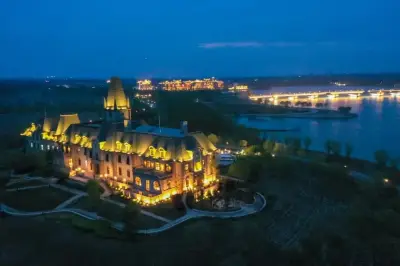
In the evening, we picked up the kid and went to Shuiyunjian (Water-Cloud Realm) Cultural and Commercial Street. A small river surrounds the area. It's lively at night with food and night views; walking around is pleasant. There are many restaurants at Shuiyunjian to choose from.
D3: Morning: Anci Old Street. Lunch: Food Street snacks. Return to warm home.
The last morning, we went to Anci Old Street, which recreates the 1980s. As a post-70s, it looked interesting. It has two floors; the second floor is a small theater. Essentially it's a food street with many snacks, but fun.
Langfang is very close to Beijing, so our trip was short, but it left a deep impression. We'll come again if we have a chance. After all, so close and so beautiful, Hebei on weekends.