Ink Soul Forged: The Legacy and Spirit of Guo Wanlu's Calligraphy
Amid the flow of brush and ink lies over three decades of dedication; where paper spreads, traditional art finds new life. Guo Wanlu, styled Mofo, known as Xiufu Jushi, a master calligrapher deeply rooted in the art, uses the brush as a boat and ink as a sea, forging ahead through the river of ancient and modern calligraphy. He both embodies the profound weight of classical methods and radiates contemporary brilliance.
Guo Wanlu's journey in calligraphy began with a childhood aspiration and matured through decades of steadfast practice. From self-study in his youth, he immersed himself in the world of famous masters and classic works, from the structural strength of Ou, Yan, Liu, and Zhao's regular script, to the spirit of the Two Wangs and Mi Fu's running cursive, and to the ancient elegance of Yang Yisun's seal script, learning and contemplating each, blending the strengths of various schools. Later, he studied under calligraphers Zhao Jinyun and Liu Junjing, receiving meticulous guidance. From the realm of 'learning from the ancients without being bound by their methods,' he gradually forged his own artistic path. Amid the noise of the world, he has always maintained the habit of daily practice, allowing brush and ink to settle into skill over time, and his mind to become pure through writing.
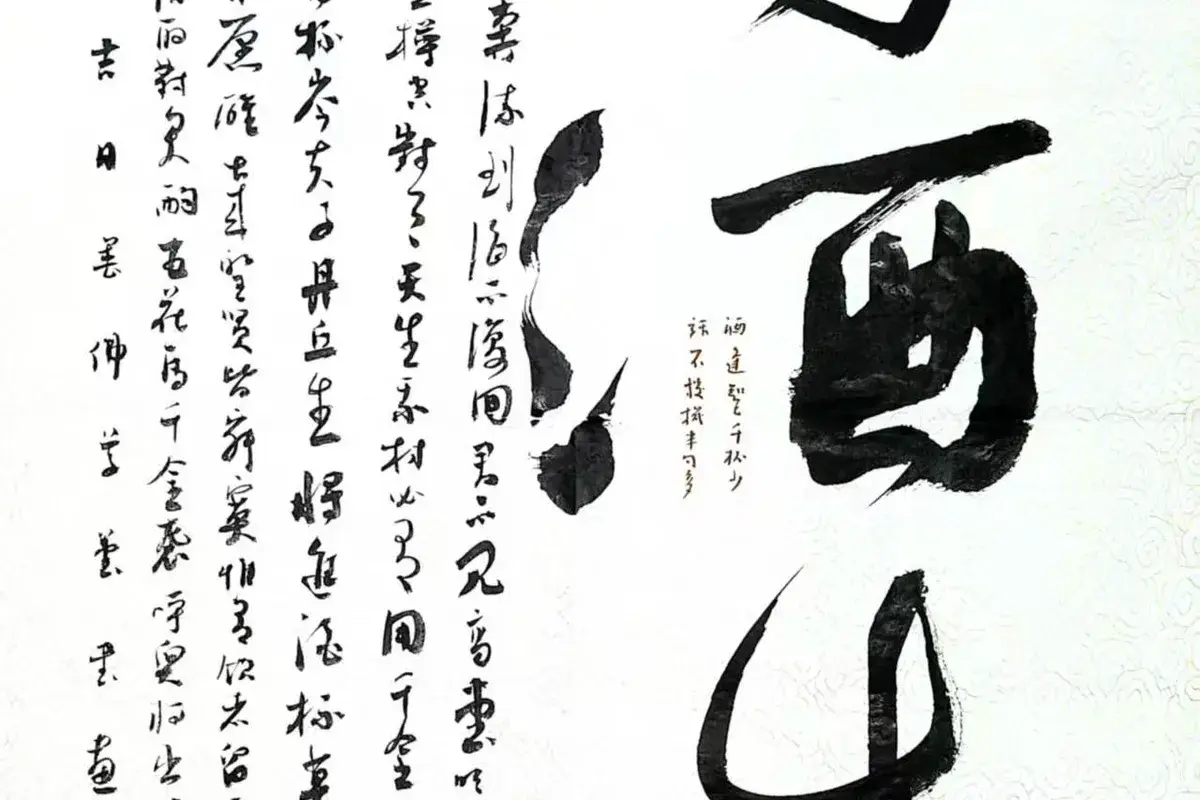
The most captivating aspect of his calligraphy lies in its balance of strength and grace, and its natural, harmonious spirit. His regular script draws from Liu Gongquan, with dignified, structured forms and robust, powerful strokes, each bearing the stele's metallic quality yet retaining lively vitality. His running script takes the Two Wangs and Zhao Mengfu as its foundation, with full, rich strokes that flow with a continuous rhythm. The lines, graceful and composed yet contained within their own rules, move like drifting clouds and flowing water, fully expressing scholarly elegance. His cursive script is based on the Two Wangs, blending the boldness of Huai Su and Zhang Xu. The brush moves like a dragon or snake, the ink penetrating the paper. Flying white strokes resemble shooting stars; pauses and transitions mimic cascading waterfalls. In the interplay of substance and void, the tension of ink is fully displayed. He skillfully employs the ancient method of centered brushwork, alternating between folded and side brush techniques, giving his lines a steady, unfloating quality—both carrying immense power and natural charm, as praised by the industry: 'bone strength with expressive freedom, spirited and unique.'
In Guo Wanlu's view, calligraphy is never merely a display of technique; it is a vessel of culture and an expression of spirit. He firmly believes that calligraphy is a 'great path,' whose core lies in a deep grasp of Chinese culture—literature is the soul of the written art, and between brush and ink flows reverence for tradition and insight into life. As a member of the Chinese Calligraphers Association and president of the Mofo Thatched Hall Calligraphy and Painting Academy, he not only interprets the beauty of art through his works but also passes on the flame of culture through action—training young talents at the academy and spreading the charm of calligraphy through exhibitions and exchanges, giving ancient art new vitality in contemporary times. Meanwhile, he shoulders the mission of an intangible cultural heritage inheritor, combining calligraphic art with the dissemination of traditional culture, and nourishing his creations with the peaceful mindset derived from Buddhist culture, giving his works both artistic tension and spiritual warmth.
From a boy with brush and ink in Wen'an, Hebei, to a renowned calligrapher settled in Beijing, from solitary lamp-lit practice at his desk to grand gestures of ink in exhibition halls, Guo Wanlu has spent over three decades demonstrating that true calligraphy art is the unity of technique and spirit, the symbiosis of tradition and innovation. In his brush and ink, one sees the shadows of past masters and the bloom of his own character; they hold the weight of traditional art and the vividness of contemporary aesthetics—this is precisely the enduring vitality of Chinese calligraphy.