7-Day Self-Guided Tour of Lijiang, Shangri-La, and Dali in Yunnan
Brief introduction to Yunnan: Yunnan, abbreviated as Yun (Dian), with Kunming as its capital, lies on the southwestern border of China, with the Tropic of Cancer cutting across the south. It covers a total area of 394,000 square kilometers, accounting for 4.1% of the country's total area. To the east it neighbors the Guangxi Zhuang Autonomous Region and Guizhou Province, to the north it faces Sichuan Province across the Jinsha River, to the northwest it adjoins the Tibet Autonomous Region, to the west it borders Myanmar, and to the south and southeast it meets Laos and Vietnam respectively, with a total land border of 4,061 kilometers. It boasts famous tourist attractions such as the Old Town of Lijiang, the Old Town of Dali, Erhai Lake, the earthly paradise of Shangri-La, Tiger Leaping Gorge, and more — a popular travel route. Travel destinations: Lijiang, Shangri-La, and Dali in Yunnan.
Travel style: This trip was primarily a family parent-child self-guided tour.
Essential items reminder: sun-protective clothing and hat, sunscreen, lip balm, an umbrella, and a coat for deep autumn (preferably a windbreaker, as temperatures in Shangri-La are low).
Travel route: We chose Lijiang as the transfer hub for this journey because it is centrally located among these scenic spots, offers the freshest air and comfortable temperatures, and is suitable for a stay. When visiting other places, we could leave unnecessary luggage at the Lijiang inn, making travel lighter. The specific route: Hefei fly to Lijiang — Tiger Leaping Gorge — Shangri-La — Lijiang — Dali — Lijiang — fly to Nanjing.
Cost: Excluding round-trip airfare, about 2,500 RMB per person.
Travel reflections: Travel — how people adore this word. It allows you to break away from the daily grind of mundane matters, a temporary escape from ordinary life. Sightseeing, taking in mountains and waters, experiencing local customs and traditions — not only does it cultivate the mind and broaden horizons, but it also refines character and dispels confusion. As the saying goes: “Just three miles from home, and it’s a different village style.” Only by stepping out can you savor the pleasures of nature, stretch your heart, and purify your soul! Parent-child travel gains: It’s often said: “Without climbing a mountain, one doesn’t know its height; without wading into water, one doesn’t know its depth; without seeing extraordinary scenery, how can one appreciate its wonder?” “Reading ten thousand books is not enough; one must also travel ten thousand miles.” Only through firsthand experience can one truly feel it. Gazing from a summit, you’ll grasp Du Fu’s spirit of “Gazing atop the peak, all mountains seem small.” Pausing in the mountains, you’ll sense Lu Xun’s mystery of “Shut myself in a small room, ignore the seasons.” Crossing hills and streams, you’ll understand Li Bai’s pursuit of “Seek immortals in the Five Great Mountains, travel far without complaint, a life loving famous mountains.” Once nature’s different scenery occupies your vision and thoughts, you’ll find that life is not always dull, that everything is so perfect, and everywhere is filled with sunshine.
So let’s start this trip, follow me…
Day 1, July 28: Took a flight from Hefei to Lijiang. In the evening, stayed in Shuhe Ancient Town. We chose Shuhe as our relaxing base because a friend said it’s quieter, you sleep better, the inn environment is good, and Shuhe itself is very distinctive. You can also explore Shuhe. If you want to go to the Old Town of Lijiang, it’s just about 6 kilometers away — a taxi costs 30 RMB (15 RMB in the off-season) and takes 15 minutes. We booked the Yiren Lanting Inn online; the surroundings were really nice, plenty of places to eat nearby, and the host was warm and attentive, even picking us up at our drop-off point.
Hefei airport is well built, but a bit far.
Flying to Lijiang, we transited at Kunming Airport. Viewed from afar, Kunming Airport looks like a soaring flight, full of dynamic energy.
Scenery outside Kunming International Airport.
Our inn in Lijiang’s Shuhe Ancient Town, recommended by a friend and booked online — the environment was lovely.
The family suite, looking comfortable at first glance.
Day 2, July 29: Headed to Tiger Leaping Gorge and Shangri-La.
Woke up naturally in the morning, then strolled around the town near the inn and grabbed a bite. A special reminder: local breakfast stalls charge locals one price and tourists double. For example, the local baba bread — locals pay 2.5 RMB, tourists pay 5 RMB. You might ask how they tell locals from tourists — they just know by looking, sometimes without even hearing you speak. Close to noon, we took a taxi to the bus station to catch a bus to Tiger Leaping Gorge. It was past 11 a.m. when we arrived; the earliest bus was at 12:10, but we didn’t depart until 12:40. The buses here have little sense of punctuality; they usually wait until the bus is full before leaving, probably due to cost, which is understandable. On board, we met fellow travelers heading to Shangri-La — a couple from Sichuan planning to travel together. About 2.5 hours later, we reached Tiger Leaping Gorge Town. As soon as we got off, many drivers approached us asking if we wanted to go to the scenic area, because Tiger Leaping Gorge is still 7 kilometers from the town, and only by vehicle can you reach it — unless you’re a trekker, you can also walk up. After bargaining, the round trip by car cost 180 RMB, averaging 40 RMB per person. At the entrance to the scenic road, someone stopped us to buy tickets, seemingly 60 RMB each — I didn’t buy the tickets, so I don’t remember clearly. On the way up, due to heavy traffic, ticket checks, and about 40 minutes later we finally reached the gorge. Tiger Leaping Gorge is truly remarkable, worthy of its reputation as “famous for danger,” one of China’s deepest gorges. It includes Upper, Middle, and Lower Tiger Leaping Gorge, and a high-road hiking trail. We chose to explore Upper Tiger Leaping, the narrowest section, 9 kilometers from Tiger Leaping Gorge Town along the highway. There, a massive boulder splits the river in two, creating a cascading drop and thunderous waves. Legend says a tiger once leaped across from Jade Dragon Snow Mountain to Haba Snow Mountain using this stone, hence the name Tiger Leaping Stone. After about an hour, we had seen enough. Since we needed to head to Shangri-La, a 2.5-hour drive under normal conditions — longer if there’s traffic, as this G214 road is a busy route to Tibet with many mountainous risks — we set off early. On the way here, the driver had mentioned that if we went to Shangri-La, he could arrange a friend’s car to take us, which would be convenient and cheap, 30 RMB per person. We thought it reasonable and went along. All along the way, beautiful scenery accompanied us. Whenever there was a particularly nice view, the driver would stop for us to take photos and rest, also helping us acclimate to the high-altitude cold. By around 7 p.m., we arrived in the beautiful earthly paradise — Shangri-La. We had the driver drop us at Dukezong Ancient Town, the best-preserved and largest Tibetan residential cluster in China and a hub of the Tea Horse Road. We checked into our pre-booked inn. It was very cold — while back home we were sweltering in 40°C heat, the temperature here was only 12°C, even colder at night. To avoid public outcry, I didn’t even post on social media. To warm up and taste local specialties, we chose a hotpot restaurant for yak meat hotpot, about 100 RMB per person. Authentic yak meat, two platters — one raw, one cooked — with local condiments, vegetables, and mushrooms. The flavor was excellent. After dinner, we strolled around Moonlight Square in the ancient town, enjoyed the local Tibetan group bonfire dance, and could also visit the nearby Red Army Memorial Hall and Guishan Temple — all famous sights. But it was too cold, so we ended up buying windbreakers at a nearby clothing store — 150 RMB each, much better value than renting at 50 RMB, and you could also buy various shawls to keep warm. The night sky was clear and serene, distinctly carrying the feel of high-altitude cold. The ancient town, illuminated by lights, looked exceptionally beautiful, clean, and bustling. We spent an unforgettable night there.
A roadside scene in Shuhe Ancient Town.
On the way to Tiger Leaping Gorge: Lijiang and Shangri-La are separated by a river. Just after leaving Lijiang, crossing a bridge, you’re in Shangri-La.
Soon we approached the Tiger Leaping Gorge scenic area. This is the queue at the entrance.
Looking down at Tiger Leaping Gorge from above.
Layered peaks, majestic and grand.
Turbulent waves, magnificent and spectacular.
After about an hour’s visit, we finished and took the car to Shangri-La. The whole route was filled with scenery. A view on the way to Shangri-La.
Without traffic, 2.5 hours to reach Shangri-La. This is Moonlight Square in Dukezong Ancient Town.
Local Tibetans on the street.
The entrance of our hotel.
A snack shop in the ancient town — looked decent, but hygiene inside left something to be desired, haha.
Day 3, July 30: Visited the first national park, Pudacuo National Park, and scenic spots along the way.
In the morning, we took our innkeeper’s commercial vehicle — 30 RMB per person for round trip — along with seven companions, to visit beautiful Pudacuo National Park. Pudacuo is located in the heart of northwestern Yunnan’s “Three Parallel Rivers” World Natural Heritage site, comprising the international important wetland Bita Lake Nature Reserve and the Shudu Lake scenic area of the Haba section of the “Three Parallel Rivers” heritage. Its main components are Bita Lake, Shudu Lake, and Xiaji Tibetan Cultural Village, making it one of Shangri-La’s key attractions. Altitude ranges from 3,500 to 4,159 meters. It’s a provincial nature reserve and an integral part of the “Three Parallel Rivers” scenic area. Pudacuo boasts geological landforms, lake wetlands, forests and meadows, river valleys and streams, rare flora and fauna, with its pristine ecological environment well preserved. It’s 22 kilometers from Shangri-La city, covering about 1,313 square kilometers. Planned visit time: 7 hours. Tickets cost 138 RMB, plus 120 RMB for the eco-friendly shuttle bus, totaling 258 RMB. Note: Those with altitude sickness or weaker constitutions should carry two canisters of oxygen — just in case.
By 3 p.m., the driver took us to the bus station to catch a bus back to the transfer hub, beautiful Lijiang. We continued staying in Shuhe Ancient Town.
On the way to Pudacuo Park.
The gate of Pudacuo Park — truly worthy of being the first national park.
Tranquil lake, beyond words to describe its peace and beauty.
Azure sky, fresh air — you just want to take an extra deep breath.
Emerald meadows, distant yaks and sheep…
Heaven on earth, beautiful Shangri-La.
A scenic spot on the way back, mainly shopping — free travel, buying or not is up to me.
Treat the journey itself as a time to appreciate beautiful scenery, and you won’t find the ride boring.
Day 4, July 31: Planned to explore Lijiang Old Town. We’d been here several days without visiting it, so today was the day. After breakfast, we intended to take Bus No. 6 right outside to save money, but after waiting over an hour for two buses, both drivers wouldn’t pick us up. Asking locals, the reply nearly made us faint: they said few people take the bus here; seeing you’re tourists, they want you to take a taxi and spend more money. Left with no choice, we tried to hail a taxi but it was hard, so we used data to call a DiDi Express car — it came in 2 minutes! We got in, set the destination to Lijiang Old Town South Gate (heard there’s a section here that doesn’t require the Old Town Maintenance Fee, allowing free entry — to save 80 RMB per person, we chose this. Not that we were stingy, but we felt the fee really wasn’t worth it; after 6 p.m. when staff knock off, it’s free). The driver was polite and chatty. I kept Gaode Maps open and soon spotted something fishy — the driver was taking a roundabout route, and the fare was about to exceed 20 RMB. I said, “Why aren’t you taking the usual route?” He replied there was traffic that way. I said, “I’ve been here a few times, I know the route.” The driver, an old hand, realized he was in the wrong but stayed calm, claiming it saved us time. Seeing the DiDi fare approaching 30 RMB — about the same as flagging a taxi with an agreed price — I told him to stop it. His face instantly changed, twisted into a demonic expression (the locals have dark skin anyway). As we spotted the old town gate, we got off. So I advise everyone not to use DiDi Express in the old town unless you specify the route; otherwise, just do a fixed-price taxi ride. The old town is vast, truly worthy of its national fame, a 5A attraction. Lijiang Old Town, also called Dayan Town, was first built in the late Song and early Yuan dynasties (late 13th century). Situated on the Yunnan-Guizhou Plateau, it covers 3.8 square kilometers. It is one of the second batch of nationally approved historical and cultural cities, and one of only two old towns in China that have successfully applied for World Cultural Heritage status as an entire town. Lijiang Old Town is vibrant with local ethnic customs and entertainment — Naxi ancient music, Dongba rituals, divination culture, town bars, and the Naxi Torch Festival, all distinctive. It fully embodies the achievements of ancient Chinese urban construction and is a unique type of Chinese residential architecture. We entered from the South Gate; initially no Old Town Maintenance Fee ticket was needed, but about 800 meters in, guards at various entrances required the fee. Before coming, I had searched Baidu and heard there’s an entrance through the Gu Zhongyi vegetable market — and sure enough! We slipped in from the market gate and began exploring. Regarding the maintenance fee, it’s only needed for spots like Mufu Palace and Jade Dragon Snow Mountain; elsewhere you can bypass it. In the evening, we took a taxi back to Shuhe for dinner and rest. To satisfy our craving for the Shangri-La yak meat hotpot, we found a nice little shop in Shuhe and had an authentic one — delicious!
Shuhe Ancient Town also has strong ethnic character, just smaller than Lijiang Old Town.
A map of Lijiang Old Town.
Lijiang Old Town, filming location of the TV series “Mufu Fengyun” — majestic.
The Loyalty Archway at the entrance of Mufu Palace.
Climbing Lion Hill in Lijiang Old Town, the panoramic view of the town.
In the distance is Jade Dragon Snow Mountain — not much snow left now.
Can you see Jade Dragon Snow Mountain ahead?
The statue of Chairman Mao beside the old town.
Back in Shuhe, turns out we were staying right at the foot of Jade Dragon Snow Mountain.
Day 5, August 1: This was Army Day, which felt quite commemorative. We planned to visit Dali, famed for “Xiaguan wind, Shangguan flowers, Cangshan snow, and Erhai moon” — these four scenes weave the romantic “Wind, Flower, Snow, Moon” motif. The Bai people have thrived here for generations, and this was the seat of the historical Dali Kingdom and Nanzhao Kingdom, the home of the Duan clan from Jin Yong’s novels, and the starting point of the Yunnan-Tibet route. Beautiful stories and a long history cannot hide the chaos of Dali’s tourism. We chose to take the train, experiencing what it’s like to ride the rails in Yunnan. We took a taxi to the train station, about 17 kilometers from our inn in Shuhe, for a fixed 60 RMB. Lijiang Train Station, like Lijiang itself, is very beautiful. By noon we arrived in Dali, and then headed to Xizhou Ancient Town. We had booked a sea-view hotel room right by Erhai Lake — a king-size bed room for 475 RMB per night, including breakfast. After settling in, we admired the Erhai scenery from the hotel’s backyard. In the early evening, we rented an electric tricycle that could go 50 km, at 15 RMB per hour, and rode along the lakeside road to Xizhou and Haishe Park. Xizhou Ancient Town — those ink-wash-charm residential clusters are neatly arranged along ancient stone alleys. Each courtyard’s layout strives for naturalness and fitting grace, exuding a refined elegance. There are over a hundred Bai-style dwellings from the Ming, Qing, Republican, and modern periods. As we wandered, we tasted local treats like Xizhou crispy baba bread and an elderly lady’s homemade popsicles, both famous snacks. We dined at a distinctive restaurant in Xizhou, then returned to the hotel by 9 p.m. to rest.
Lijiang Station feels perfectly matched to a tourist city.
A street scene in Xizhou Ancient Town.
The very famous old lady’s handmade fresh milk popsicle shop — the taste was really great.
Day 6, August 2: Continued exploring Erhai Lake and learning about local customs. At 7 a.m., I rented a bicycle and rode from Xizhou toward Shuanglang Town, planning a half-day trip. But partway, as the weather grew hotter and the sun fierce, and I was somewhat tired from the previous days, I couldn’t persist all the way to Shuanglang Ancient Town. After 11 kilometers, I turned back. By 10 a.m., I was back in Xizhou and visited the nearby Peach Blossom Island Park. Considering Dali was hotter than Lijiang, we decided to return to Lijiang earlier to prepare for the next day’s journey home. We changed our train tickets and arrived in Lijiang just after 5 p.m., checking into a hotel near the old town — a newly opened, slightly luxurious family room. At night we visited the old town again, enjoyed the night scenery, sampled famous local snacks, and bought some local gifts to share with colleagues and friends.
Erhai Lake sunrise in the morning.
Cycling toward Shuanglang Ancient Town.
Scenery along the way — one of the sights.
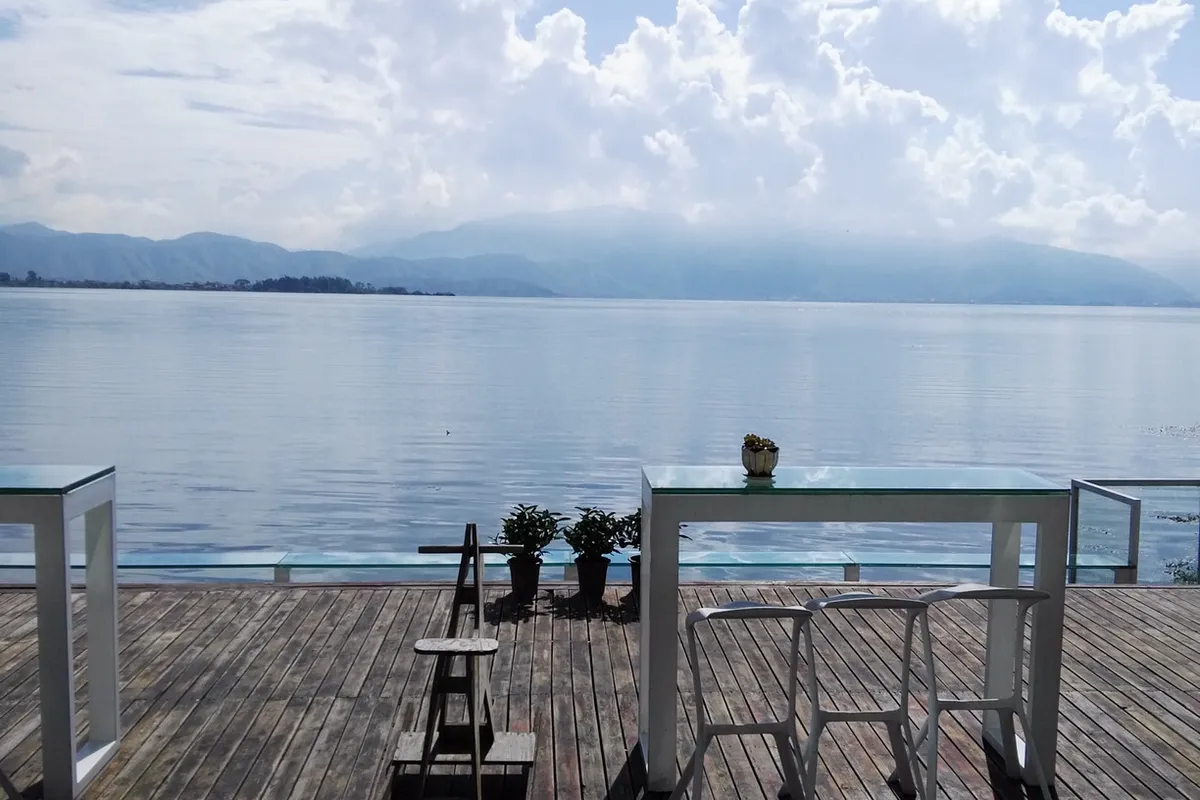
Erhai Lake is truly beautiful.
Peach Blossom Island Park near Xizhou Town, just a 10-minute walk from our Jinque Hotel.
The front gate of Dali Ancient Town.
Street view opposite Dali Train Station.
Yunnan produces fresh flowers; a rose costs just 0.4 RMB — incredibly cheap, right?
Trains on the Dali-Lijiang route are all old green trains; the train attendant said resources are limited, and these trains were scavenged from other places, haha.
Arriving at Lijiang Station — buses are scarce and crowded.
Lijiang Station is quite nice and distinctive.
A scene in Lijiang Old Town — a rainbow appeared, can you see it?
We even saw a double rainbow upon arriving at Lijiang Old Town.
The hotel we stayed at, very clean and cozy.
The hotel environment was excellent; newly opened, this is a corner of the lobby.
Across the street from the hotel is the old town. We visited again — this is a bar street.
The old town at night, or rather at nighttime, is bustling with tourists, brilliantly lit, and full of life.
Day 7, August 3: Wandered around the old town and prepared for departure. In the morning, we went to the Gu Zhongyi vegetable market to see what local specialties were like. Since it’s close to the tourist area, many local products had dual pricing — one for locals, one for tourists. To avoid being ripped off, we barely bought anything. After lunch, we headed to the airport bus station (Blue Sky Hotel Civil Aviation Reception) and took the shuttle to the airport, 20 RMB per person, about 50 minutes to Lijiang Sanyi Airport. We boarded our flight back.
Outside the hotel restaurant, enjoying views of the old town.
A random shot on the way to the airport — Lijiang Airport and Lijiang Train Station are truly well-built, a hallmark of a tourist city.
Scenery outside the bus window.
Arrived at the airport, walked along the service road to a nearby shop for some snacks.
A corner of Sanyi Airport.
A corner of Lijiang Airport.
Seeing such a blue sky, I couldn’t resist a quick snap.