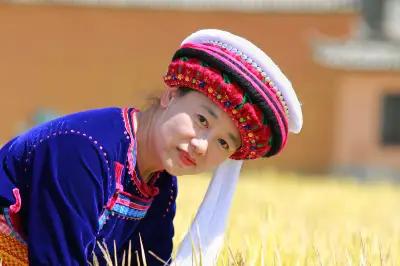
The Wind Rises. Dali in May: A Few Things About Rice Fields and Breezes
Every day in Dali, whenever there's blue sky and sunshine, I love to look up. In May, with spring scenery at its brightest, I savor the spring light and commune with the quiet moments in Shaxi. My heart is like a drifting cloud, my thoughts like flowing water. In solitude, the end of time is peace of mind.
After being cooped up for months by the pandemic, I'd even climb to the rooftop just to photograph the sunset over the city. The moment the thought of traveling somewhere in China popped into my head, Dali was the first place that came to mind. I've been to Yunnan nine times: in autumn the ginkgo leaves blanket the ground in Tengchong, in summer Meili Snow Mountain sees snowflakes in June. Everyone says Lijiang is full of charm, but my favorite is still Dali. Checking flights, a round trip from Chongqing to Dali was over a thousand yuan, but to Lijiang only three hundred. Thanks to the pandemic, many guesthouses were a steal. I immediately bought round-trip tickets to Lijiang, rented a car online. I heard Baisha Town is quiet and ancient, that Shaxi bears the rings of history. So I decided to drive slowly, stopping in those sparsely visited places. When you turn your back to Cangshan Mountain, face Erhai Lake, first wander the ancient town, entrust your feelings to the fishing fields, and leisurely idle the days away, only then will you understand why so many people want to go to Dali.
In Xizhou's fields, rice, wheat and green crops, May skies among the clouds. Summer's warm sun, a pot of clear tea, unaware that days and months grow long in the mountains. The walls of Bai courtyard homes are very high. In Dali, even 6 p.m. doesn't feel late for sunshine. Monet's painting – flowers blooming across the hills. Drunk, unaware the sky lies on the water, a boat laden with clear dreams pressing down the Milky Way.
You absolutely must drive yourself in Dali. There might be a chance encounter with a scene along the way that makes the trip worthwhile. To your left, steep cliffs layered in green; to your right, the deep, romantic charm of Erhai Lake. There's a glass house with transparent walls on all sides, humming "I'm going wandering," reaching out at night to pluck the star-filled sky. See, surprises often come when you least expect them.
Arriving in Shaxi, you'll discover it's as if this place dozed off in the river of time, carrying us through a thousand years back to the days of the ancient Tea Horse Road when horse hooves rang out. Waking early, climbing to the rooftop to bask in the sun, the puffy white clouds are so beautiful. Xizhou's quiet is a quiet you can't imagine. Living by the water, watching clouds rise and fall. Autumn scenery in summertime, soft wheat fields and sunlight. Vast shimmering waters open a heavenly realm, mountain hues encircle the sapphire screen all year round. Lying on the gray-white tiled rooftop, holding sparklers, gazing at the starry sky – is this the life you want, too?
The pandemic isn't over yet; staff wore protective suits, passengers all had masks, yet the flight was surprisingly full. I casually picked up a copy of Zhang Jiajia's "Cloud Edge Goes to a Small Shop" at the airport store, flipped through a couple of pages but didn't like it much – just killing time. Perhaps I'm getting older and prefer lighter, more cheerful tastes over such deliberately melancholic and tragic novels.
Landing at Sanyi Airport, a chill hit me, with scattered drizzle in the air. This was my third time in this city of romance and scenery. Dragging my suitcase through layers of green health codes and temperature checks, the first thing on my mind after leaving the airport was, oddly, handmade yogurt.
Dali is perfect for renting a car because most of the scenery is along the road. If you don't drive around the West Erhai Lake Road – Erhai on your left, rice fields on your right – you've wasted your claim of having been to Dali. With this fuel-efficient, comfy little Corolla, I could slow my pace, leisurely take in the passing views, and reach those less-traveled small towns, spending an entire afternoon over a slow coffee. Wherever I wanted to stay, I'd stay.
After finishing all the formalities, I set off. Even though it drizzled along the way in Dali, it didn't dampen my spirits one bit. My route this time was rather offbeat; I wanted to find quiet little towns, let life slow down, more scenery and fewer crowds, and spend time among rice paddies, mountains, and waters. So I had no plans to linger in downtown Lijiang and headed straight for Baisha Ancient Town. A 40-minute drive via the Dali-Lijiang Expressway, arriving at this tranquil little town before dark. Opening the window, the raw smell of cow dung hit me, mingled with the fragrance of grass in the air. After following a few winding paths, I found the Banruo Homestay I'd been longing for.
The owner came out with an umbrella to lead us to a parking spot. The hostess had prepared steaming bowls of rice noodles. Lights came on in the small courtyard. A few cats huddled by the stove. Yes, this was the earthy warmth I love.
A fruit platter carefully prepared by the hostess.
Raindrops pattered into the pool. In such weather, I just wanted to burrow under the covers. Dali in May was so cold, it felt like winter again. Luckily, the room was equipped with heating and an electric blanket, tightly snug and windproof.
On rainy nights, I like going to bed early, lying by the window listening to the wind and rain, dreaming of armored horses crossing icy rivers – the armored horse was you, the icy river was you.
The next morning, the pattering rain woke me. In my dreams, the small town had rain, flowers bloomed, wind rose, frost fell, and there even wafted the aroma of roasted sweet potatoes. Breakfast was fried rice noodles and plain congee. Vases held freshly picked flowers. The corn was sweet and refreshing. The owner kept three cats and a dog. The dog was called Dimple, who liked to compete jealously with the cats for attention, refused dog food but loved cat food. When guests wanted to visit the ancient town, Dimple would merrily lead them out. The cat was called Qiuqiu, with the face of a Garfield cat and a British Shorthair's body. She ate very daintily; because her face was so flat and round, one bite would smear her whole face, so she'd take a bite then groom her fur, another bite then groom again. Checking the forecast, it was supposed to rain all day, so I lazily finished breakfast and decided to lie down first, and head to the ancient town in the afternoon.
Lying by the window listening to the rain, even on a gray rainy day, I could find my own leisurely contentment. At times like this, I'm especially grateful to have a book to pass the long hours.
The raindrops falling from the eaves were like strings of pearls.
Listening to the wind and rain, I spent a leisurely morning in the small courtyard. After lunch, I borrowed an umbrella from the owner and walked about ten minutes to the ancient town. Having been to Lijiang three times before, I'd always visited the bustling Shuhe Ancient Town, where bars glowed with lights and night markets swirled with crowds. But this time, I preferred to feel an older, quieter Lijiang, a Lijiang free from commercialization.
Time in Baisha is slow time. The people here go about their daily chores at an unhurried pace, maintaining a traditional way of life.
Walking on the flagstone paths, strolling leisurely through the old streets. An old grandmother sitting in a courtyard corner, a craftsman carving wooden paintings, young arty types making handicrafts. The distant Jade Dragon Snow Mountain shrouded in mist interweaves with the ancient streets and alleys weathered by wind and frost. There are no hurried footsteps, only time flowing back and forth.
Exploring little shops, the lanes barely had the usual musical clamor of ancient towns; more common were restaurants and artsy spots. Stall owners selling antiques and tie-dye shawls sat together playing cards, seemingly indifferent to the number of tourists or how business was going. Elderly Naxi people basked in the sun, gathered at the town center, chatting about everyday matters. Two little dogs – the younger one called Xiaodan because he was especially timid, liked to stay close to his owner; the older one was quite aloof, only glancing at me when I entered the shop, stubbornly keeping watch at the door. The shopkeeper said it just wanted to go out for a stroll.
"I want to go out." "It's raining, we can't go out!"
The handmade yogurt I'd been yearning for – thick, slightly sweet with a strawberry aroma. The room was warm, with a fireplace and heating. Baisha had few visitors, the streets were quiet, and the café was peaceful, with rain drizzling outside. If you're willing to walk along the flagstone path and spend an afternoon in Baisha Town, right here, you can learn about another kind of life – simple and tranquil.
The owner of the homestay told us there was a "Steamed Bun Poet" in town, who recited poetry while making buns. His shop was so popular you couldn't buy any if you went too late. Once the rain let up, I went out strolling again and ended up right in front of the poet's shop. The small sign read: "My Buns, My Poems." The subtitle: "Left hand holds buns, right hand holds poetry."
Next to the bun shop was a small restaurant where quite a few tourists were dining – relatively busy for the quiet Baisha Ancient Town. I ordered three dishes and a soup. The brown-sugar rice cake was incredibly delicious! Later I asked the owner if they sold it; they said it was handmade by an elderly woman at the market, wouldn't keep long, and would spoil if I took it back. I stubbornly searched online for brown-sugar rice cakes and bought a few vacuum-packed bags to see if they tasted like this.
At night, the rain seemed to have stopped. I checked the weather forecast several times, hoping tomorrow would be a sunny day.
A day woken by the sounds of cicadas and birds, without an alarm clock. Staying on the ground floor, the large windows didn't block the light. The morning sun streamed lazily into the room. I went out for breakfast. A dog and a cat were sprawled in the middle of the courtyard, blocking the way. The courtyard was bathed in gentle, warm sunlight. The succulents by the pool were so plump and full. Seeing the sun, I knew what a beautiful day this would be.
Breakfast was set amid a wheat field. Due to yesterday's rain, I hadn't realized the rooftop had a golden wheat field with a backdrop of the snow mountain. Western-style breakfast today – the hostess's hand-brewed coffee attracted Qiuqiu, and in a moment of inattention while taking photos, the cat stole a drink!!
White clouds drifted swiftly, revealing the summit of Jade Dragon Snow Mountain. A divine breakfast beneath snow mountain, rice fields, and a sea of clouds.
The moment I saw this picture, I felt it resembled a scene from a Hayao Miyazaki anime – "The Wind Rises."
Autumn scenery in summer – soft wheat fields and sunlight.
This place is truly perfect for photos. Besides the dreamy breakfast, the rooftop also has a small terrace with a mirrored surface, creating reflections of the blue sky and snow mountain. In the courtyard, the pool had a glass boat – you don't need an aerial camera; just shoot from the second floor to get beautiful shots.
This homestay isn't large, but small as it is, it has everything. Every corner is photogenic. While I was shooting this set, a girl upstairs asked if I was here for a travel photoshoot. I said no, I'm just staying here and casually taking a few pictures; I'd coordinated my outfits before leaving home. Shouldn't life be lived exquisitely?
Driving toward Shaxi, after 60 kilometers on the Dali-Lijiang Expressway, we entered a provincial road, then from Jianchuan onwards, the road became a winding forest path.
The mountain road to Shaxi was twisty and steep, with cliffs on the left and big trucks coming and going. Most curves had arcs over 180 degrees, and the road was narrow. Looking at the map, I was stunned – all 360-degree hairpin turns. If you get carsick, remember to bring motion sickness patches, and definitely be careful.
After crossing what felt like eight hundred mountains, at the end of the winding path, we finally turned onto a tree-lined asphalt road. This centuries-old town hidden deep in the mountains has a mysterious, Shangri-La-like aura.
In spring, Shaxi's air carries a gentle, graceful scent. White magnolias were in full bloom. The noon sunlight became dappled through the leaves' filter. Stepping onto the flagstone paths, my first impression of Shaxi was how truly quiet it was. Shaxi isn't well-known. The restaurant hostess told us there are 18 villages around here, each with its own history, culture, and stories. Before 2015, mainly foreigners came; only after 2016 did Chinese people start visiting. After I posted on social media, a young woman messaged me privately, saying she'd once stayed in Shaxi for a week and begged me not to write about it and let others know, to keep it a secret for those who love it. What a wonderful place, that one would want to hide it away, keep it for oneself.
I especially love the plaque on this shop – every line brims with poetic charm.
People who love ancient towns all have a bit of romantic sentiment deep down, always wanting to place quiet reflections amidst the carved beams and painted rafters weathered by time.
At the heart of the ancient town stands a centuries-old opera stage. I stood there looking up, watching history's wheel roll relentlessly forward. The hopes, beliefs, and destinies that once were here have faded with time into mottled memories, slowly, gradually, as if they'd never existed. Pausing before the stage, it's built in three tiers: a Kuixing Pavilion above a stage at the street corner, front stage behind a pavilion, with flying eaves and layered corners, 14 wing-like corners soaring outward. The unique structure and exquisite craftsmanship are truly astonishing.
When tired, just sit on a bench in the square, listen to carefree Bai elders chatting about everyday life, a cup of coffee, steeped in the stories of old streets.
Later I read in an article: "The ancient village of Shaxi, through the word-of-mouth of pioneers, has become Yunnan's last hidden realm. Here, it's still just the ordinary life of daily necessities. There's the last market on the Tea Horse Road, where you can enjoy the fun of primitive bartering, hear the old Bai tunes hummed by horse drivers everywhere, and if you're lucky, you might even see a plump black pig sprawled on its back in the ancient town's sunlight..."
Mottled walls bear the marks of year after year. Rows of houses are neatly arranged; even the faded red bricks and gray tiles carry the weight of time. This place is filled with the aura of history, traces of caravans, old shops, bluestone roads – on paths bathed in soft sunlight, a warm, mellow amber glow.
This is where we ate. Most small eateries in Shaxi are renovated from old buildings; with such a weighty foundation, every shopfront exudes charm. The people who open shops here must be those who love life. Perhaps not really business people, just lovers of a certain lifestyle, with shops decorated out of longing and emotion, without a hint of commercialism. I ordered a couple of dishes. The owner enthusiastically introduced the various sights in nearby villages, all the while telling us we must visit Yujin Bridge at dusk and shooing his big dog to take a bath in the river.
I always think, merchants who can open a shop in such a quiet ancient town are just giving themselves an excuse to live here.
Every day in Dali, whenever there's blue sky and sunshine, I love to look up. In May, with spring scenery at its brightest, I savor the spring light and commune with the quiet moments in Shaxi. My heart is like a drifting cloud, my thoughts like flowing water. In solitude, the end of time is peace of mind.
Here is the other end of Yujin Bridge, where willows drape in green and blue sky reflects. An ancient locust tree, an old opera stage, a square, the Black Hui River, an old stone bridge.
Where I'd lay my head tonight: Tianye Panshan Resort Hotel. I didn't stay inside the ancient town; I love rice fields and want something freely open.
From the room's window, I could see the distant mountains and fields. With my feet dangling, I could sit on the windowsill ledge and gaze down upon the landscape of this land from above.
The Black Hui River flows from north to south through Shaxi, meandering quietly past the east side of the town. Against the towering green mountains in the distance, an ancient bridge arches like a crescent moon over the water – that is Yujin Bridge.
Yujin Bridge at dusk: small bridge over flowing water, flagstone lanes. Like an oil painting, it reminded me of the line, "Withered vines, old trees, crows at dusk; a small bridge, a flowing brook, a cottage." A villager with a basket on his back just happened to cross the bridge, bringing to my mind the image of horse-trading caravans walking across in bygone years. Yujin Bridge is a must-pass route for the Bai people living in Shaxi for generations, leading to fields, labor, and trade. The stone slabs have been trod by horse carts and travelers until they gleam blue-gray, full of pits and bumps. It bears Shaxi's weighty history, greeting and sending people off year after year, striking a perfect balance between old simplicity and worldly clamor.
Walking to where the landscape opens up, the waters of the Black Hui River silently carry the former bustle of Shaxi on the Tea Horse Road into the distant sea.
One eye on the sea of clouds beyond the mountains, the other on the light submerging into the lake.
This used to be the strategic pass from Dali to Tibet, and no one knows how many horse caravans came and went over it. Times change, and only the quietly flowing Black Hui River beneath the bridge has witnessed it all.
Our little Corolla that accompanied our slow journey. You must drive yourself in Dali – maybe a sudden roadside scene will make the trip worthwhile. Slow down, and you'll truly understand this land.
I really like the architectural style of Tianye Panshan, with antique charm in every detail, rewarding close appreciation.
Breakfast was served on the ground floor, where floor-to-ceiling windows blended with carved wooden pillars. Lamps were bamboo-basket covers, flowers were reed tassels – taste lay in every detail.
Even the gauze drapes had such texture, as if staying in the courtyard mansion of some prominent family during the Ming or Qing dynasties.
On the top floor of the courtyard there was a glass tea room, with no decoration besides a single lamp, facing rice fields. All opulence was discarded, letting nature's tranquility accompany the tea drinker. When friends come from afar, I greet them mostly with tea.
Plain dwellers never part from glutinous rice cakes; mountain folk never part from bitter tea.
The drive from Shaxi to Xizhou takes three hours, mostly on the Dali-Lijiang Expressway. Along the way, clusters of white clouds looked like oil paintings – every frame lifted the spirits.
Passing a viewing platform, if high mountains and seas represent ideals, then rice fields and farmhouses are life itself.
Thanks for your hard work, master driver – have a chicken drumstick 🍗
The white clouds today were so beautiful.
In early summer of May, I went to a guesthouse called Fruit Tree. Warm summer sun, a cup of clear tea, idly passing the days. Staying in such a place, my heart is filled with poetry and distance; how could I mind the trivialities of worldly life?
What I loved most about Fruit Tree was the light – natural light. In the early morning, afternoon, and evening, it streamed through gentle gauze curtains, pouring onto a soft sofa. A small side table, a cup of tea, a book, a pot of water quietly waiting nearby. Every time I see this image, I want to walk right in and lie down on that sofa. There was a glass room, entrusting myself to the landscape.
Slowing down time, stretching the days long.
Fruit Tree has a tree, standing there year after year, sunbathing, sheltering from wind and rain. I sat beneath it for a little over half an afternoon; that afternoon, I was just as wealthy as that tree, able to leisurely waste lots of time and sunshine.
Xizhou has a long-standing silverware and tea culture, famous for its Three-Course Tea. As they say: "First bitter, second sweet, third aftertaste." Life, I suppose, is much the same.
Stars were still, the moon faint. Fruit Tree that night was almost too quiet. A starry sky overhead, scattered stars filling the dome, as vast as blue satin. Drunk, unaware the sky lies on the water, a boat laden with clear dreams pressing down the Milky Way.
I've been to Yunnan nine times, to Dali three times, and I love Xizhou the most. Walking out of the village lanes into the fields, strolling through Xizhou's countryside: candy-colored sky, white cloud clusters, the stretching Cangshan Mountain, old Bai residence walls tinged with vintage light. Verdant trees, green fields. Run, and there's wind.
Driving to Haishé (Snake Tongue) Park, which has been closed for construction since last March. I could only glimpse it from afar across the wild grass. The day was clear, water lush and grasses abundant – "glittering ripples" perfectly described it. Dense aquatic plants surfaced, intertwined with black dead branches, a kind of messy beauty in its own right.
Roadside grassy beaches, wetlands. Sunlight filtered through gaps in the trees, making the grass gleam.
Water vivid blue, grass and trees fresh green.
Short trees growing low in the water, clustering in groups.
The only reason I love Xizhou is the West Erhai Lake Road. Everyone talks about the charm of Shuanglang and the Yang Liping connection in Wase, but to me, none compare to the roadside woods, the scenery along the way – shallows, wetlands, lake water, and mountains – just on this road.
At noon, I caught two sunflowers ablaze under the strong sun.
Xizhou's most famous snack is Xizhou baba, available in sweet and savory versions. Round flat cakes are brushed with sesame oil, placed in a pan, and baked over charcoal from both above and below. But now it's hard to find authentic Xizhou baba; charcoal baking yields limited quantities, and with more tourists, most now use ovens, so the crust isn't as crispy.
Between Cangshan and Erhai Lake lie ancient villages, vast fields, and clean tie-dye. Tie-dye is a unique traditional dyeing craft of the Dali folk, with diverse and distinctive techniques. Cloth dyed this way has rich, varied hues, and no two tied patterns are ever alike. You can see stalls selling it in all the towns and shops in Dali. In Xizhou, there's a fairly well-known small workshop; from the outside, it looks more like an ordinary family home. The yard is hung with varying shades of deep and light blue cloth. When I visited, workers were doing tie-dye and let us look around after a brief introduction.
The house itself was decorated like a work of art. Some of the tie-dye items here were indeed much finer than most I'd seen elsewhere; the decorations and objects were very tasteful. The rooftop had a large terrace for hosting guests, set amidst farmland, offering a panoramic view of the rural scenery.
Arriving in Dali Ancient Town, things suddenly became lively. Pedestrians walked with a light yet somewhat lazy gait. What sets it apart from Lijiang's Shuhe Ancient Town is that it's lively but not noisy. Peach blossom wine, snack stalls, passing various shops and stands, brushing shoulders with countless people.
First thing in the ancient town: eat! There's a wise saying in Chengdu: If one hotpot meal can't solve a problem, then make it two!
Hot off the grill, sizzling big pork ribs – one bite, a mix of lean and fat, hot oil lingering on lips and teeth, cumin and seasonings covering the whole rib. Just thinking back makes my mouth water. Hahaha.
This tofu might be my favorite. Crispy fried skin on the outside, tender sweet tofu inside, crisp outside and silky inside. One bite, smooth texture; you can dip it in chili sauce, but I prefer the original flavor.
Inside the ancient town, there are many artsy little shops offering all sorts of fruit wines and desserts, meandering through the leisurely hours. Perhaps due to the pandemic, the streets weren't crowded; a few couples strolled hand in hand. Some shops were shuttered. The quieted-down ancient town revealed a different kind of charm. After a round, I bought some plum wine my mom likes and handmade yogurt for myself.
A furniture shop I really liked – carpets and cushions in various patterns, arranged in every corner of the shop, exuding an air of relaxation.
Perhaps everyone who settles in Dali can find the life they want here. Actually, what truly warms you in Dali isn't the scenery or the food, but the people living here. They always manage to make simple, ordinary days feel comfortable.
After wandering the ancient town, I returned to the West Erhai Lake Road. The sun gradually dipped behind the mountains, casting golden rays radiating outward from behind dark clouds.
In the sky, light gathered and broke through the clouds. The sky that had just cleared was now ablaze with a vivid sunset.
Having a barbecue at the guesthouse was a blissful thing. Friends from all over sat down, exchanged pleasantries, and as we talked, we started planning the next trip together. Why do I love traveling? Because this is what traveling is about.
The sky is clear, the moon comes with the breeze.
Night deepened, lights came on in the small courtyard.
The smoke and fire of human life – nothing soothes the heart of ordinary people more.
Sometimes I often think: how to chew the bland days into something flavorful. Many times I feel I'm clear-minded; whatever I like, I go do it without pause, buy things I like right away, say sweet words to those I love, buy flowers to take home, invite friends on outings, photograph scenes I love, take walks under the setting sun. At other times, I think we're all worldly people – just look at this hustle and bustle. An old monk said, ultimately I still see mountains as mountains. In Water Margin, it says: "On the Qiantang River the tide signal came; today I finally know I am myself." Those years where mountains were not mountains, the starry seas, were probably the grand dream youth gave itself, a long river of time cutting off reality. When the dream ended, the youth grew up. But isn't youth exactly like that – with passionate and pure dreams, courage to leave at a moment's notice, longing for all beautiful things? And finally, the smoke of daily life isn't about abandoning youthful dreams, but understanding after going through everything that this is life. This night of holding sparklers and gazing at the starry sky reminded me of a song – "All the Beauty in the World Embraces You."
Savoring slowly the worldly smoke and fire, idly watching the long passage of human time. I want to live with you in some small town, sharing endless dusks and the unending toll of bells.
Even though at home I could sleep until noon every day, in Dali I woke early every morning. Climbing to Fruit Tree's rooftop, today I'm a quirky girl.
I so love the blue sky, the white fence – even the electric wires look like a scene from an anime. There should be a ponytailed girl with a backpack, wearing a Japanese-style pleated skirt, bumping into a boy in a school uniform, biting a cola straw, wearing baggy jeans and walking sloppily – yes, the boy must be wearing a gray necktie.
Today I'm a quirky girl~
Slowly strolling through Xizhou town. When I took this photo, I just found the colors beautiful, unaware of its history. Luckily, after touring Xizhou I understood what poetic dwelling means. Researching for this travelogue, I then learned of the grandeur of the Nanzhao Kingdom.
This is Xilinyuan (Joyous Forest Garden), the earliest guesthouse in Xizhou Ancient Town, renovated from a Bai residence. The owner is American, and it's an iconic lodging in Xizhou. Later, this wall became a signature photo spot in Xizhou.
In the distance were rows of white houses, the fields a expanse of green crops dotted with small blooming flowers. Bathed in soft light, gauze-like clouds in the distance tangled around Cangshan, birdsong unending. Under the blue sky, white clouds swirled between ancient banyan trees, casting sacred beams of light.
At noon, Guoguo took us to a Hunan-style restaurant in Xizhou – though called Hunan style, it had been adapted to local tastes. The bottom right is stir-fried pork with pomegranate blossoms, bottom left is spicy stir-fried flat noodles, and there were various dishes like stir-fried pork with jasmine flowers – dish names you'd never imagine. The food was excellent, super appetizing.
Why do I say you must drive yourself in Dali? Because the scenery along the way makes you feel the trip is worthwhile.
At the foot of the snow mountain, free-spirited ripples on the water, boundless fields wildly devouring the horizon.
At dusk, I headed to Shuanglang Town to stay. Shuanglang is surrounded by mountains on three sides, facing the lake on one. Comprising several small fishing villages, looking west you see Dali Ancient Town far across the water. Sometimes you'll hear elders talk about Shuanglang's old days a decade ago: villagers returning from fishing, chimneys smoking in courtyards, Bai women with baskets woven through the alleys – a remote, quiet, unassuming little fishing village. Now, it has become commercialized. All kinds of comfortable lakeside inns, restaurants, specialty shops, and endless streams of people along Erhai Lake. Of course, if your heart is abundant and content, you can still enjoy this town amidst the noise.
I parked the car at Mingyue Parking Lot, closer to the village villa. Walking into the ancient town, the sharp increase in vendors lining the road made it clear that Shuanglang is indeed the liveliest ancient town along Erhai Lake. This journey from Baisha to Shaxi to Xizhou had all been quiet time spent with oneself. Shuanglang, however, was different. Gazing over the entire Shuanglang peninsula from the road above, the dense residential buildings, the small boats on the lake, and the number of tourists all signaled a boisterous world. Locals say Shuanglang is an anomaly – first came tourists, then those who fell in love with this place ran their own guesthouses. Every inn and bar here is worth savoring and experiencing, to feel the beautiful mood you can't find in the hustle and bustle of big cities.
After passing several bustling commercial streets, there's a stone bridge. Further in, a long wooden boardwalk appears, the best spot to view Erhai Lake. Dusk light spilled over the stone pillars; pigeons lined up in a row.
Following the boardwalk inward, the crowd thickened. Many tourists gathered here to watch the sunset. All around were restaurants and taverns decorated with a lot of character. As for me, I was still fixated on Shuanglang's rose handmade yogurt – thick, creamy, fragrant, with real rose petals. If you pass through Dali, remember to taste the handmade yogurt here.
Past the noisy shops, the tie-dye stores, the various handicraft stalls – crowds surging, elongated dusk shadows casting a ground teeming with silhouettes. The further I walked, the quieter and narrower it became. I recalled a few clothing stores with a strong ethnic flair, though a bit pricey. Turning a corner, I arrived at Cunshu (Village Villa) Seaview Hotel.
Viewing Cangshan, listening quietly to Erhai Lake, basking in the warm sunlight – I'm utterly absorbed in this blue Erhai, calm yet secretly turbulent. Sitting down and quietly gazing at the lake – this is what I repeatedly do in Shuanglang.
Sitting here, you can watch the sun slowly sink into Cangshan Mountain in the west. If your luck holds, you might even see a radiant golden glow.
The long branches seemed almost to stretch into the lake.
I really love this tree, so I wanted a photo of me running toward it. Looking back, it was truly a soft, tender time.
Life is but a dream – one person, one courtyard, a stretch of slow time.
After Dali's recent renovation campaign, Cunshu was redecorated. The interior is full of design sense, with careful attention to materials and details, every corner exquisitely fine.
The room features a 180-degree floor-to-ceiling window with an unparalleled lake view.
The rooftop tea room, flanked by deep red wooden pillars, evokes a Zen feeling that blends perfectly with the tea room concept. The tea rooms are separated to give guests private space. Between them is an infinity pool reflecting the soft-hued sky and clouds – sky and water in harmony.
Sitting here in such a twilight, one loses track of time in the mountains. Through the clouds, sunlight lightly brushed Erhai Lake, the water colored warm. Aside from the whooshing wind and the occasional cry of egrets, there was no other sound.
See, surprises often come when you least expect them.
The seaside blazed with golden light, shimmering water, clouds rolling and unfurling.
On the last day, I drove directly from Shuanglang to Lijiang. Returning the car at the airport was super convenient – done in five minutes, then I could check in. On the flight back, the prosperity of the city below turned into specks of light. I thought of the always hazy Cangshan Mountain in the distance, the strong wind when cycling by Erhai Lake, the wandering singer in the ancient town, the old farmers in the fields, the wind I've felt and the sun I've basked in. My heart was filled with excitement, and a passion and hope for life.
Day 1: Chongqing – Lijiang – Baisha
Day 2: Baisha Ancient Town
Day 3: Baisha – Shaxi
Day 4: Shaxi – Xizhou
Day 5: Xizhou – Shuanglang
Day 6: Shuanglang – Dali – Chongqing
Lijiang [Banruo Homestay] 300-500 yuan. A 10-minute walk from Baisha Ancient Town, on a small country lane, very quiet. The hostess is super nice; the room has good hot water. Heating and electric blanket provided. On the rooftop terrace, there’s a dreamy breakfast, and a rice field where you can take photos all day. When the weather is good, you can see Jade Dragon Snow Mountain. There's even a glass boat in the pool.
Xizhou [Fruit Tree Homestay] 300-700 yuan. A very photogenic guesthouse; many photographers go there for shoots. There's a pool and a rooftop – you can reach for the moon and stars in the pool below. The owner has a deep feeling for homestays: the kettle is European-style, the hairdryer is a Dyson, the toilet is electronic, even the makeup mirror is prettier than most. Overall, it was my favorite stay of the trip.
Shuanglang [Cunshu Seaview Hotel] 1,800-3,200 yuan. A hotel with a super beautiful tree. Except for standard and family rooms, every room has a 180-degree lake view. The public area is a super lakeview spot, looking across at the Sun Palace. Every corner offers full-day photo ops. The materials and texture of the rooms are top-notch among guesthouses; breakfast is lovely too. After the recent renovation, the experience is even better.
Shaxi [Tianye Panshan Resort Hotel] 190-600 yuan. I also really love this hotel. Not inside Shaxi Old Town, but in the rice fields near Yujin Bridge. The whole courtyard has an antique elegance that matches Shaxi's temperament. The rooms are filled with a scholarly air. About a 3-minute drive from the old town, very convenient for seeing sunrise and sunset at Yujin Bridge.
1. For touring around Erhai Lake, it's best to drive yourself. There are also cars and bicycles for rent locally, but bicycles under the sun are really too scorching, and buses won't let you enjoy the roadside scenery.
2. Sunscreen! Sunscreen! Sunscreen! Yunnan's UV rays are no less intense than an island's. My mom fell asleep in the car without closing the window and her arm got sunburned by the time we reached Shuanglang. Never underestimate the sun in Yunnan.
3. Face masks! Face masks! Face masks!
4. Girls with sensitive skin should bring a hydrating mist; the climate is quite dry.
5. The weather on the plateau is unpredictable; it's best to carry an umbrella as it might rain any time.
6. Those heading to Shaxi must be careful on the cliffside roads – very sharp curves and many big trucks. Drive safely.
7. Mornings and evenings in Dali and Lijiang are very cool; bring a light jacket.
8. Apart from current high-risk areas, no special procedures are needed to go to Dali. Before boarding, flight attendants will provide two QR codes to fill in some basic info; after landing you’ll get a green code, scan it and you're through. The pandemic isn't fully under control yet, so be sure to wear a mask on the plane.
Some new friends I met during the trip – the homestay owner, the front desk girl, a photographer shooting alongside. On quiet nights we sat and chatted, sharing stories. This is it: stepping away from life as you know it, linking up past memories, and meeting interesting people beyond daily routine with an open mind. So later when I encounter many unbelievable people in life, I think: the world truly has so very many kinds of people, living in myriad ways, holding different values – making the world complex yet fascinating, giving resonance to those who understand them, and topics to those who don't. And the more roads I travel, the more humble I become, knowing how vast the world is and how small I am. Thus we grow more tolerant, learn to appreciate different values, and better know how to love and cherish. Peace, joy, and may all go well for you.