If Your Heart Is Broken, Accept This Love Letter from Dali, Lijiang, and Lugu Lake
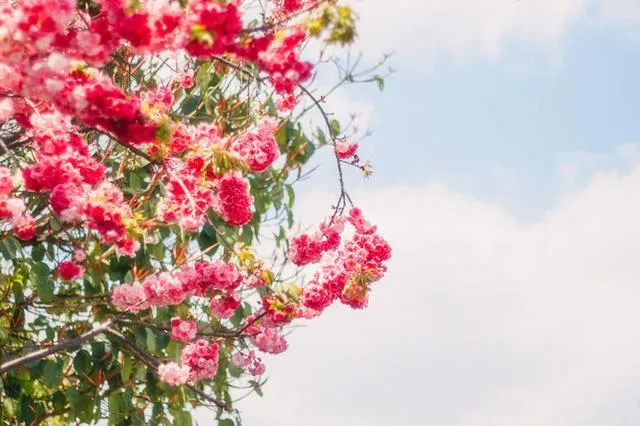
As I walked through Dali's bustling crowds, under the city's brilliant sunlight, I met you beneath the cherry blossoms, still and silent as ever. You said, 'I know we'll meet again, in the warm sunshine of the ancient town, under the cherry blossoms.' I smiled. In this life, the most beautiful thing is anticipation. I longed for the sunshine of Dali Old Town, just as I longed for you, and for this journey.
Sometimes the mundane world is a hateful thing; it turns all that is raw and pure into something utilitarian, stripping away its natural beauty. Over the years, I have visited some old towns, most of them tainted by worldly airs. The Dali in my memory was the romantic dream of many—a place I imagined overflowing with endless charm and allure. But I was merely a traveler, immune to such charms, unseeking of romance. Yet Dali Old Town was not quite what I had pictured. Though the streets were lined with shops, and crowds of visitors came and went, I could detect no garish restlessness in it all. You said you preferred those lanes, filled more with local life. You were right. In those very alleys, I saw children returning home from school, and light piercing through the old town, casting shadows and beams. The stories encountered on the road, the joys and sorrows of passersby, the truths hidden beneath a worldly surface—I may not have captured them in photos, but I kept them in my heart.
By Dali's Cangshan Gate, the sun was setting; that was our laziest, most leisurely time. Sometimes travel needs no map or destination. A meandering stroll, an accidental turn into an overlooked corner, a discovery of offbeat beauty—these are the most delightful surprises. Later, we passed the Confucius Temple, then Yu'er Park. Not exactly tourist sights, these spots were simple and clean. That day, Yu'er Park had remarkably few visitors, giving us a rare peace. The park was planted with cherry blossoms, Dali's renowned camellias, and countless unnamed wildflowers. As early spring arrived, the garden was bathed in fragrance. I knew you loved the quiet here, so we sat for a long time, bathed in the lingering sunset glow.
When the sun had fully slipped behind Cangshan, a dusky veil fell over the old town. Lights began to glimmer, then multiply, until they shone brightly, like a multicolored gown draped over the still-shallow night. Dali's night was bustling but not exaggerated; people clung to this moment of ease, reluctant to disperse. Walking from the north gate to Wuhua Tower, you must visit the most bustling Foreigner Street, with its noisy bars and shops. I wasn't interested. Skirting those shops, I stumbled upon a small artsy bookstore. In such a busy area, anyone who could still sit and read surely possessed a certain style. Compared to those noisy main streets, the obscure little alleys hid some charming small bars and coffee houses. Through windows, under dim yellow lights, young men strummed acoustic guitars and sang softly—who knows how many restless, earnest dreams they held in their hearts.
That night, you went to bed early, while I stood on the rooftop of our youth hostel, gazing out at the far-off night scene. The distant lights were still bright, and I could even make out the famous Three Pagodas of Chongsheng Temple. I had hoped to sit leisurely under the wide roof and count stars, but the bright lights around washed out all but a few twinkling points. As the saying goes, when the moon is bright, stars are few. Luckily, a clear bright moon kept me company, along with the gentle night breeze. I recalled the song 'Evening Breeze' by the duo Good Sister: 'Gentle evening breeze, softly blowing, into a lover's dream; gentle evening breeze, softly blowing, into the sky of home; gentle evening breeze, softly blowing, through the city's lights. Tonight's evening breeze, where are you going? Please tell me.'
You said we hadn't taken a single photo together those days. So, we casually found a random corner by the road, set the tripod, and snapped this picture. In truth, my feelings for you were not those of vulgar, complicated admiration, nor a heart-stirring impulse. We were merely fellow travelers on the same journey, not dwelling on the past or questioning the future. I often envied you—your carefree, relaxed way of traveling, and your fearless courage for distant places. And I also sympathized with the vulnerability and loneliness of traveling alone. You loved sampling all kinds of local delicacies, searching out local foods wherever you went. Traveling with you meant a feast for the palate, a true blessing.
Erhai Lake—here lies every beautiful fantasy: Cangshan's snow, Erhai's moon. Yet we saw Erhai's moon not at deep night, but at sunrise. That early morning at Caicun Wharf, the sky was washed clean. Standing on the shore, we could only hear the water gently lapping the bank, a sound so peaceful it was intoxicating. Neither of us spoke, waiting in the slightly chilly wind. Finally, the mountaintop in the distance turned from pitch black to crimson, then burst into magnificent golden light—spectacular and fleeting. As the first rays sprinkled glittering light on the lake surface, Erhai was like a newborn child, displaying its pure beauty before us.
What moved me most that day wasn't the glory of the rising sun, but your silhouette. From the dim twilight to the dawning light, you sat bathed in the morning glow, leaving me only a lonely back view. What were you pondering? I could not know, nor did I want to. But all those past sorrows had already pained you for so long—why make it harder for yourself, adding to the grief? Now that the sun has risen brightly, why not pack your bags again and set forth?
Dali's clouds are intoxicating. It's because of these clouds that Erhai Lake doesn't feel monotonous and lonely. Look—the clouds rimming the horizon constantly change shape, drifting with the wind. Sometimes they adorn the azure sky, sometimes they veil the blazing sun. Then the sunlight pierces through, casting enchanting crepuscular rays, illuminating the distant rolling mountains and lush fields in an on-and-off dance. This must be the most beautiful moment at Cangshan and Erhai.
You said you had dreamed countless times of coming to Dali: leaning against Cangshan, facing Erhai, setting a round table, brewing a light cup of tea, and chatting about life with a couple of close friends. Life spans mere decades. Once you've seen through the countless fleeting reputations, it's all inferior to a soft song hummed low. I said, this must be the life so many yearn for. Each of us has the right to choose our own path. Take you and me: the ups and downs of big city life may have grown somewhat tiresome, but if truly given poetry and the distant horizon, you would hesitate again. Eventually we'll return to our hometowns, then yearn for faraway places again. You didn't agree or disagree. On life's long road, hometown and far-off places—which matters more? I don't know.
In Xizhou, I met a girl like a poem. Perhaps the road construction on the West Erhai Ring Road was a pity; from Dali Old Town to Xizhou, we mostly took the Dali Route. But the Dali Route had its own charming scenery. That day, riding an electric scooter, we would stop whenever we saw a view we liked to take photos. One quiet deep night, flipping through pictures, I remembered our days in Xizhou. So, under the dim yellow lamplight, I wrote that opening poem. In a place far from the city, endless fields, and houses with white walls and grey tiles—wasn't that exactly the distant land and hometown we longed for? I still remember how you ran freely that day, under the blue sky, beside white clouds, in the fields. That day in Xizhou was our freest moment. You said you liked that photo of your back, but what I liked most was your melancholy gaze toward the distance.
Softly chanting a sutra of the heart. Our original plan the next day was to go to Shuanglang. But Shuanglang was under road construction those days. Afraid that difficult road conditions would spoil the travel mood, we changed plans. The youth hostel we'd booked had to be wasted—a real pity. I'd never seen anyone recommend the Silent Light Nunnery (Jizhao An) in Dali guides, had never even heard of it. But that day I fell in love with it. I'm sure you did too. 'Lose on the swings, gain on the roundabouts.' It's the regrets and surprises on the journey that make it all so precious.
Jizhao An is built halfway up Cangshan Mountain, but taxis could only drop us at the foot, so we had to hike a long way up. You said, in this life, you absolutely hate mountain climbing, yet both times traveling with me, you got tricked into climbing. I knew you meant the previous Maolan trip, where we hiked the mountain paths in high summer, walking for over half a day—truly exhausting. But compared to that, this was nothing. We passed Gantong Temple and kept going, walking and taking photos for about half an hour before seeing Jizhao An's gate. The four of us traveling together that day sat down for a group photo. Later, at lunch, we ordered a braised chicken with mushrooms and added an egg. You dubbed our little group 'Braised Chicken with Egg.' But I was used to it, because last time I knew you named every group chat after food...
The rear courtyard's layout could only be described as exquisitely elegant. Bamboo baskets whispering to small flowers, a tiny pond with white walls and a fish pool—if I didn't know this was a nunnery, I'd swear it was the private retreat of a whimsical poet or writer. You know, I've often imagined that when I grow old, I'll pick a place of leisure and interest, build a small courtyard house, plant flowers and grass in the yard, and the moment I push the door open, I'll see green waters and blue mountains. In those days, I'll brew a pot of tea, read a book, and gently grow old. And Jizhao An was exactly the image I had in mind.
Shuhe: no regrets about returning, only regret that time flew by. You said you didn't like Lijiang—too much drunken debauchery; staying there too long makes one restless. To reach Lugu Lake, one must pass through Lijiang. You suggested staying in Shuhe, which isn't far from Lijiang but offers a different style. I had actually thought of Shuhe earlier. I'd never been to Lijiang, so I had no idea what it was like. But Shuhe did suit us better. You said Shuhe was exactly how you imagined an old town should be.
By nine at night, the small town grew quiet. On the little lanes away from the center, shopkeepers had closed early, leaving only faint, dim lights. Guided by these lights, we found our way back. When we occasionally got lost, we weren't in a hurry; after a few turns, we'd always find our way out. The Sifang Tingyin Plaza, bustling with people by day, was now quiet, almost desolate. I liked Shuhe with its bit of liveliness, but I equally liked it in such solitude. Perhaps not desolation, but a pause—a quiet moment of reflection after the bustle.
That evening in Shuhe, we had an excellent gourmet meal. We found a restaurant by the creek with a wonderful environment and great popularity. We ordered the house specialty, copper pot rice, which was incredibly fragrant; the rice was delicious. I must recommend this to everyone. The steam pot chicken had an especially good broth, so fresh and tasty, absolutely superb. The yak meat was very aromatic, paired with onion—perfect. And the local specialty vegetable, 'water-based yanghua'—haha, it was my first time hearing that dish name, and I was stunned, but the taste was actually quite good. The boss was very hospitable and even gave us some ice jelly, very nice. The boss was also a tall, beautiful woman, a feast for the eyes, haha!
Departing Shuhe that day, the weather wasn't good. It had been overcast when we set out, and soon it started drizzling. We also encountered an accident on the road and had to take a long detour, so by the time we reached Lige, it was already afternoon. That day, Lugu Lake was like early spring of the four seasons—all things still withered but gradually coming back to life. Through occasional gaps in the clouds blown by the wind, I glimpsed an azure sky, which gave us hope for tomorrow.
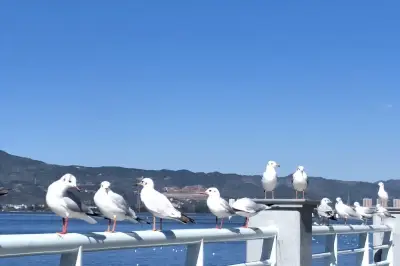
At Lige's pier, we met many seabirds. These spirits of Lugu Lake would sometimes float quietly on the water, sometimes call out and rise in flocks. They also had a bit of greed, following the little boats heading out into the distance, flying far after the food people threw. You said it was a pity we didn't see seagulls in Dali, and we didn't expect to see them at Lugu Lake. But we only had that one encounter; after that day, when the weather cleared, they were nowhere to be seen. I just treated them as a gift from Lugu Lake on an overcast day, bringing a touch of color to the gray sky.
But Lugu Lake's weather is as fickle as human affairs. The morning haze was swept clean away; clouds were blown into shreds, drifting among the mountains. The sky over Lugu Lake cleared to a brilliant blue.
Arriving at Nisai Village, we finally reached the lakeside. Nisai has few households. Compared to Lige and Daluoshui, it felt much quieter, but the scenery was no less stunning. The sunlight that day was strong, yet you said, the sunshine is just right. They say Nisai Village has two Lovers' Trees, but we didn't find them. Curiously, both Dali and Lugu Lake seem to have Lovers' Trees, yet we never saw them. Perhaps those legendary trees were never meant for us.
After Nisai Village, then Xiaoluoshui, a few simple clouds drifted across the sky. And it was these very simple clouds, reflected in the lake water, that added color to the monotonous blue. But even those colors paled next to your vividness. By the lake, you seemed to add light to the scene, making it brighter and more alive.
On the road, we spotted drifting boats. This stretch was not particularly busy, but the weather was stunningly beautiful. Those boats and clouds became the perfect embellishments to the water and sky. So we walked very slowly here, so slowly that we wanted to leave a photo at every step. I remember you also took a picture with a road sign. You said you liked taking pictures with road signs—those little girlish whims. I found it interesting, and a bit funny.
Then you suddenly asked me, would the one you're waiting for appear on the other side of the mountain? I looked into the distance and said, he will surely come. In some morning awash with dawn's rosy clouds, at the moment dreams fade into wakefulness, through the sunlight that seeps into life through the cracks—he will eventually arrive, with your far-off horizon, following his wandering. You know, on this trip, I imitated those artsy free-spirited youngsters and put a copy of Liang Shiqiu's 'A Cottager's Sketchbook' into my backpack. But sadly, I never had the chance to read much of it and brought it back just as it was. Perhaps the scenery along the way was too beautiful; I had no time to spare for that book. Or perhaps the chats with travel companions were so lively that they surpassed even those beautiful views in my memory.
Alright, I'll stop writing here.
Travelogue Contents: 1. Dali Old Town 2. Erhai Lake 3. Jizhao An (Silent Light Nunnery) 4. Shuhe Old Town 5. Lugu Lake
Travel Information: Hotel Index, Guide Index, Flight Ticket Index, Website Navigation, Travel Index, Cruise Index, Corporate Travel Index, Join Cooperation, Distribution Alliance, Friendship Links, Corporate Gift Cards, Insurance Agency, Agent Cooperation, Hotel Joining, Destination & Scenic Area Cooperation, More Join Cooperation, About Ctrip: About Ctrip, Ctrip Hot Topics, Contact Us, Talent Recruitment, User Agreement, Privacy Policy, Business License, Security Center, Ctrip Content Center, Intellectual Property, Trip.com Group Algorithm Disclosure.