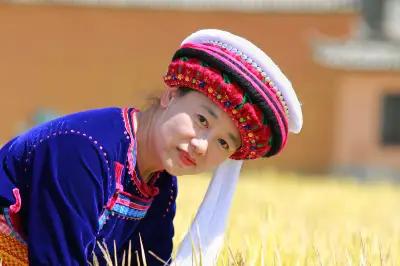
So-called life has a way of living, a journey, a longing, and a dream!
I am waiting for you in Dali, Yunnan, at Cangshan Mountain and Erhai Lake!
The most precious thing in life is to meet the right person, the right scenery, and the right life at the right time. Yu Hua wrote in "To Live": "Time changes, and no one can reverse it. The years are indeed cruel, but also gentle; they take something away and give some compensation in return. The past cannot be revisited, and time never stops. To have experienced is the best reunion. Not fearing the future, not dwelling on the past—this is the most beautiful response to time."
Travel is the most beautiful time, and it is also the freedom that people most yearn for. A journey can bring people a lot of joy and memories, immersing them in a carefree life. The experiences of a person's life can be summed up in four words: wind, flowers, snow, and moonlight. Dali is also a city of "wind, flowers, snow, and moonlight." Having experienced a life of "wind, flowers, snow, and moonlight," one must also appreciate the scenery of "wind, flowers, snow, and moonlight."
The wind of Xiaguan, the flowers of Shangguan, the snow of Cangshan, and the moon of Erhai—"wind, flowers, snow, and moonlight" encompass the most beautiful scenery of Dali. Some say Dali is lonely, while others say it is romantic. Dali is different in everyone's eyes. Among the myriad landscapes, there is always one that will make you linger and leave a deep impression. Dali is located in the central northwest of Yunnan, with a superior geographical location and a suitable climate throughout the year. It is a beautiful tourist city.
https://vacations.ctrip.com/tour/detail/p24090229.html
I. Preparations before traveling to Dali
(1) Dali is located on the Yunnan-Guizhou Plateau, with an altitude of about 1,800 meters. The temperature difference between morning and evening is large, and the daytime radiation is strong. You need to keep warm, protect yourself from the sun, and moisturize.
(2) The summer in Dali is the rainy season. Be sure to bring rain protection measures before traveling.
(3) Tourist attractions in Dali: Dali Old Town, Three Pagodas Temple, Erhai Lake, Cangshan Mountain, Wase, etc.
(4) Must-eat food in Dali: wild mushroom hotpot, cured pork rib hotpot, sour and spicy fish, chicken hotpot, etc.
(5) Accommodation options in Dali: Dali Old Town, Shuanglang, Wase, Xizhou, etc.
(6) Choice of travel style in Dali: mainly self-driving and independent travel.
(7) Before coming to Dali, choose and book accommodation online (Dali Old Town offers good value for money).
(8) The most suitable number of days to play in Dali: 3–5 days.
II. Accommodation options in Dali
Accommodation is a very important choice for travelers. Choosing a guesthouse or hotel with high cost performance is the beginning of maintaining a good mood during the trip. There are many guesthouses and hotels in Dali. For tourists, choosing a guesthouse is a good choice. Hotels have different styles and experiences across the country, but Dali's guesthouses are relatively well-known nationwide. The biggest difference between hotels and guesthouses is the experience and the feeling of staying. Hotels are more oppressive compared to guesthouses; hotels are enclosed, with fewer places for leisure. Guesthouses are more open and distinctive, giving people a very free and comfortable feeling, with more places for leisure. They are an excellent place for tourism and relaxation.
Dali's guesthouses are concentrated in places like Dali Old Town, Shuanglang, and Wase, with different styles and prices. Dali Old Town is the transfer hub for Dali travel, with very convenient transportation. Dali is also a city with a long history. For accommodation, it is recommended to choose a guesthouse in Dali Old Town, which offers good value for money and is convenient for travel. The style of Dali's guesthouses is also quite distinctive with ethnic cultural characteristics. Take a guesthouse in Dali Old Town as an example to comprehensively introduce its architectural style, guesthouse environment, and guesthouse services.
Dali Guesthouse: I Am Waiting for You in Dali · Ark Muzhai
I Am Waiting for You in Dali · Ark Muzhai is located on the lower section of Renmin Road in Dali Old Town, with convenient transportation. It is a mid-to-high-end guesthouse. The guesthouse environment is very elegant, and the overall design combines Chinese retro style with modern design, exuding a fresh vibe.
To experience the soft time of Dali, a guesthouse is a very good choice. In a quiet courtyard, sip a cup of tea, read a favorite book, enjoy the beauty of time, and feel the soft time belonging to the guesthouse. My favorite is the courtyard of Ark Muzhai, comfortable and cozy. Sitting in the courtyard, thinking quietly, turns out to be another kind of enjoyment. It seems that every guesthouse has a Zen-style tea room for guests to sip tea, chat about life, and talk about ideals. Isn't this the "poetry and distance" in people's hearts?
To experience the soft time of Dali, a guesthouse is a very good choice. In a quiet courtyard, sip a cup of tea, read a favorite book, enjoy the beauty of time, and feel the soft time belonging to the guesthouse. My favorite is the courtyard of Ark Muzhai, comfortable and cozy. Sitting in the courtyard, thinking quietly, turns out to be another kind of enjoyment. It seems that every guesthouse has a Zen-style tea room for guests to sip tea, chat about life, and talk about ideals. Isn't this the "poetry and distance" in people's hearts?
III. Dali's special cuisine
The local special cuisine in Dali is mainly sour and spicy. Many tourists may not be used to it, but most of it is still in line with the general taste and quite delicious. For example: home-style stir-fries, hotpot, cured pork rib hotpot, and wild mushroom hotpot are all very delicious and suitable for the general taste. Cured pork ribs and wild mushrooms are very special local delicacies in Dali. The very famous local specialty dish in Dali, sour and spicy fish, is mostly run by locals and is one of the dishes worth tasting. However, many tourists may not be used to it. I recommend the wild mushroom hotpot, which suits the general taste and may be more popular. Wild mushrooms are a unique local delicacy in Yunnan. They are subject to restrictions such as plateau and climate conditions, making other cities unable to provide a growing environment for wild mushrooms. Therefore, wild mushrooms are extremely precious and delicious ingredients. Wild mushrooms have very high nutritional and medicinal value for the human body.
There is a popular wild mushroom restaurant in Dali: I Am Waiting for You in Dali · Ark Fat Chef Kitchen. It is one of the must-visit places during a trip to Dali.
I Am Waiting for You in Dali · Ark Fat Chef Kitchen is located on the lower section of Renmin Road in Dali Old Town, with a superior geographical location and convenient transportation. The restaurant's environment features a retro design style, simple, elegant, spacious, and with a touch of warmth. All wild mushrooms are paired with better ingredients to increase their nutritional value. The restaurant offers multiple set meals for visitors to choose according to the number of people. The prices are affordable and the value is high. Often passing by the restaurant entrance, you can see a long line outside, which shows that it is deeply loved by tourists.
Restaurants that are often loved by people are usually simple, without too much luxurious decoration, just ordinary. The restaurant is not large, mainly with two floors. Wild mushroom cuisine is really delicious; the mushroom soup is fresh and tasty. There are many types of wild mushrooms, such as matsutake, bamboo fungus, and morel mushrooms, all tender and delicious. Coming to Dali, tasting wild mushrooms may be the most beautiful "time" of the trip.
IV. Scenic spots in Dali
Encounter the most beautiful scenery, meet the best time, meet Dali, face Erhai Lake, and enjoy the spring blossoms.
(1) Dali Old Town
Dali Old Town is a must-visit place for many tourists coming to Dali. It is one of the iconic scenic spots in Dali. Dali is a city full of stories and a sense of history. The wind, flowers, snow, and moonlight of Dali are mainly reflected in the bar street at night, with bright lights,动人的music, and a constant flow of tourists. Dali Old Town was built in the Ming Dynasty and was once called Yeyu City, Forbidden City, Zhonghe Town, etc. There is a moat outside the old town, and the buildings in the old town are all green tile roofs, simple and plain. Dali Old Town has many cultural relics: ancient city towers, ancient academies, and ancient temples. The best time to stroll around Dali Old Town is at night. At night, the old town is lit up with twinkling lights, and the scenery is pleasant. Dali Old Town is not very large; you can walk slowly on the bluestone slab road and savor the historical charm of Dali. Reminder: Dali Old Town is packed with people during the peak season. Parents with children must take good care of their kids at this time.
(2) Three Pagodas of Chongsheng Temple
Chongsheng Temple faces Erhai Lake to the east and leans against Cangshan Mountain to the west. It is a symbol of Dali's history and is located near Dali Old Town with convenient transportation. Chongsheng Temple is famous for its three pagodas, also known as the "Three Pagodas of Dali," which are one of the famous Buddhist pagodas in China. The three pagodas consist of one large and two small pagodas, standing in a tripod-like posture. Viewed from afar, they are majestic and magnificent, one of the "scenic spots of Cangshan and Erhai."
(3) Cangshan Mountain
Cangshan Mountain is also a relatively famous scenic spot in Dali. It is the main peak at the southern end of the Yunling Mountains, composed of 19 peaks stretching from north to south, starting from Eryuan Dengchuan in the north to Xiaguan Tiansheng Bridge in the south. The 19 peaks of Cangshan are majestic and mighty, forming a sharp contrast with the beautiful Erhai Lake scenery. Among them, the highest peak is Malong Peak, with an altitude of about 4,122 meters. Between each two peaks, there is a small stream that flows eastward and eventually into Erhai Lake. These are the famous 18 streams of Cangshan. The best travel time is from April to October. Reminder: The best season to visit Cangshan is winter. In winter, Cangshan is very beautiful. It snows on Cangshan in winter, and the view is covered in white snow, which is very charming.
(4) Erhai Lake
Erhai Lake is the most beautiful and romantic place in my impression. The sky and the water merge into one color, serene and beautiful. Escape from the flashy hustle and bustle, and find your own poetry and distance! The romance of Erhai, the tranquility of Erhai, the seagulls on Erhai, the encounters by Erhai... these are all unique landscapes of Erhai. Many people may lose themselves on Erhai, but they may also find themselves. It is all the soft time of Erhai.
Erhai Lake is located between Cangshan Mountain and the Dali Basin, in Xiaguan, Dali City. It has three islands, four islets, five lakes, and nine bends. You can take a boat tour of Erhai scenery from Erhai Park in Xiaguan Town. The best time to visit Erhai is after 3 pm, when the sun is not too strong. You can choose to cycle around or rent a car to tour the entire Erhai. When tired, find a place to rest and take photos. Photography enthusiasts can choose to take pictures at dusk, which is very beautiful. The most important thing when visiting Erhai is your state of mind: slow down and carefully savor the time of Erhai, feeling the beauty of life. Encountering Erhai is, after all, encountering the truest version of yourself. The best travel seasons are spring and winter. Reminder: The wind at Erhai can be strong, so you need to keep warm.