Escape the Hustle and Bustle: Walk with Me in Yunnan
I had been planning to travel to Yunnan since the beginning of the year—partly because Chongqing was too hot, and partly because I’ve long had a fixation on Lijiang. So in the second-to-last week of August, I embarked on my Yunnan road trip.
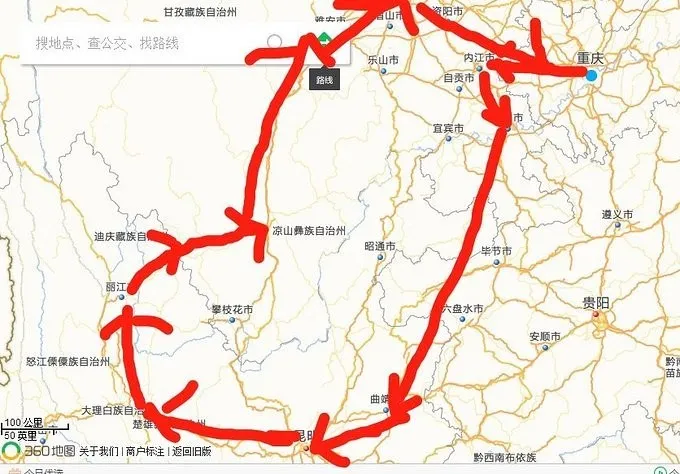
The route: Chongqing → Neijiang (to pick up a friend) → Luzhou (lunch) → straight to Kunming → Dali (staying in Dali) → Lijiang (staying in Lijiang) → Lugu Lake (staying at Lugu Lake) → Xichang (staying in Xichang) → Chengdu (dropping off the friend) → back home in Chongqing.
The first day was probably the toughest because we spent the whole day on the road—it took about 15 hours to reach Kunming. You can stop for lunch in Neijiang along the way, or take a detour to Zigong. Zigong cuisine, a branch of Sichuan cooking, is delicious.
We arrived in Kunming late that night, almost past midnight. I’d wanted to try some Crossing-the-Bridge Noodles, but it was too late. If you arrive earlier, there’s a great place near the Jinma Biji Square that serves excellent rice noodles. I’ve been to Kunming a few times, and honestly, there’s not much to do. If you have time, you can check out Dianchi Lake and the Yunnan Nationalities Village.
We had a lakeside room, just a stone’s throw from Erhai. The guesthouse was recommended by a friend in Dali, located inside the Erhai Tianyu villa complex in Xiaguan, Dali. First off, the setting: it’s a new guesthouse, and except for a slight odor in the room, everything was perfect. The room had an amazing view—pull back the curtains and Erhai Lake was right there—and the balcony was absolutely stunning…
As I mentioned, new hotels often have that lingering smell, but here it was faint, and they’d done a great job with deodorizing. The room was spacious and the bed was super comfy. I fell in love with the floor-to-ceiling windows that let you gaze at Erhai the moment you open the curtains.
If life’s not satisfying you, if you haven’t laughed in a while and don’t know why, if you’re unhappy and don’t like where you are—why not head west to Dali? Driving along the shore of Erhai, listening to the song “Go to Dali,” with the wind in your hair, time slows down.
You can’t come to Dali and not circle Erhai Lake. The first time I visited Dali years ago, Shuanglang was still just a tiny fishing village, and Erhai was just as beautiful.
Park the car on the roadside, pick any lane down to the lake, and you’ll find views like this.
Around Erhai, there are plenty of places to rent electric scooters. If you’re not driving, I’d recommend giving them a try—just make sure your riding skills are up to par. These scooters usually have a range of about 30 kilometers. Once, the battery died on me and I had to push it a full 5 kilometers. Starting from Shuanglang, you can ride roughly as far as Xiaoputuo Island and then turn back.
There are also many charming little villages around Erhai. Stepping into one feels like entering a hidden paradise, and they’re great for photos. I can’t even remember the name of the village I visited.
After one more spin around Erhai in the car, we headed for Lijiang. It’s all highway, taking about two and a half hours. I have to admire the weather in Lijiang and Dali—on the highway, a sudden downpour can appear out of nowhere. We drove straight to our hotel as soon as we arrived in Lijiang because we’d splurged on it. Even before arriving, I’d imagined the gorgeous scenery, a close-up view of Jade Dragon Snow Mountain, and the superb environment. The only downside was that it was a bit far from the ancient town, with a stretch of mountain road. But once you’re here, it’s all worth it—after all, the cheapest rooms start at over 1,000 yuan a night. It’s also very close to the Yuzhu Qingtian scenic area.
After parking, we opened the front door just as dry ice mist was released on both sides of the pond, making the place feel like a fairyland. At reception, they quickly checked us in.
I loved the room layout—mostly standalone little villas, with rooms on the ground and first floors. Each villa has its own private garden, and the surroundings are wonderful.
On clear days, you can sit in the garden and see Jade Dragon Snow Mountain up close.
From this platform, you can also gaze out over the ancient town of Lijiang.
Then there’s the room itself. Absolutely fantastic. It was huge, and truly worth the money. They provided two large bottles of Nongfu Spring water, almost as if they were afraid we’d get thirsty. My favorite feature was the stargazing room—the roof is glass, so you can see the stars directly above.
After freshening up at the hotel, we headed to the old town. What I love most about Lijiang is probably Shuhe. What’s the point of visiting Lijiang? Zoning out! Shuhe is even better for that—find a quiet bar, order a drink or a beer, and just space out.
Let me recommend a great spot. Keep walking uphill until you reach a place with a panoramic view of Shuhe. I stumbled upon it by chance once.
At the entrance of Shuhe, there’s a wind chime that’s perfect for couples. You can write your promises to each other on it.
Lijiang has plenty of wandering street singers. You can easily stop and listen for a long time.
Shuhe is so peaceful—it carries a sense of ease without the noise.
Dinner was in Shuhe Ancient Town. We picked a popular restaurant that many celebrities have visited. I highly recommend the dry pot black goat—not gamey, delicious, and plenty of meat! I didn’t come here planning to eat grilled fish, but I had a feeling this would be good, and it didn’t disappoint! The signature small pot rice initially seemed like just rice and veggies, but it packed a punch with plump grains and rich texture. The bok choy and crispy pork soup was a bit bland on its own, but together with the dry pot black goat, these three made a perfect combo. Highly recommended!
[Service bell] Service: Since we were on the second floor, it seemed like they were a bit overwhelmed, but the service was still great [mint].
Ambience: Beautiful, comfortable, clean and tidy.
On the fourth day, we went to the Songcheng Lijiang Eternal Love Scenic Area, about 5 kilometers from Lijiang Old Town. It’s known as a “living” Tea Horse Road. The park echoes Jade Dragon Snow Mountain and digs deep into Lijiang’s local cultural elements, featuring four main zones: Tea Horse Ancient City, Nacuo Village, Lijiang Paradise, and Love Suicide Valley. What I looked forward to most was the Eternal Love performance. There was a bit of drama beforehand because I, an experienced driver, followed a bad navigation app and took a wrong turn, making us almost late. When we rushed in, the show had already started, and to make things worse, a heavy rain began pouring down. The prologue, “Naxi Genesis,” was almost over when we entered. I only caught the tail end—with rain pelting down, I glimpsed the giant roc bird for just a second, which left me with a sense of regret.
Then the show opened with a pair of lovers dancing inside giant red lanterns. The lighting and choreography brought their love story to life vividly.
A call to assemble followed, and the horse caravan gathered, ready for a new journey.
This scene depicted a prosperous Lijiang with a mesmerizing dance, showcasing people living and working in peace during the Mufu era.
Thanks to the Tea Horse Road and the friendly relations maintained by the Mu chieftains with surrounding ethnic groups and states, Lijiang became the economic hub of southwestern China during the Ming dynasty. In 1382, the central Ming government, to honor the Lijiang chieftain’s loyalty and diligent governance, bestowed the surname “Mu.” News spread, and people from all ethnicities came to congratulate.
This part told the story of Naxi people who defied worldly norms and risked everything for love. A couple broke through barriers and found their “Third Kingdom of the Jade Dragon.” Forgive my brief summary; I’m just not that into love stories.
Finale: Searching for Shambhala
Shambhala, transliterated from Tibetan, is also called Shangri-La, meaning “paradise.”
Finally, images of Jade Dragon Snow Mountain and the ancient town alternated on the screen—seasons changed, stars shifted, but our search for Shambhala endured. When prayer flags swept uniformly across the stage, the climax arrived: everyone stood up, hands clasped, in devout prayer.
Lijiang always struck me as an ancient town, but the Eternal Love park added a touch of modern flair.
Bumper cars were probably my favorite ride—thrilling and fun. I remember getting a bump on my head playing them as a kid.
You can also find childhood joys here.
On the fifth day, we drove to Lugu Lake. One warning: if the weather’s bad, try not to go, because the road is prone to landslides. We left around 10 a.m., and including lunch along the way, it took about five hours. Since the journey is long, you can stop for lunch in Ninglang. The entrance fee to Lugu Lake from the Yunnan side is 110 yuan.
At Lige Peninsula, you can ride a pig-trough boat for a spin around the lake—about 50 yuan per person.
Lige Peninsula is probably the most beautiful spot. The landscape forms a natural heart shape, so make sure to take a selfie here.
I absolutely loved the starry sky here. Sitting by the lake, wind in my face, gazing at the stars, sipping a drink, with music playing from the car—it was pure bliss.
Food along Lugu Lake is a bit pricey, but still good. I definitely recommend the barbecue here—grilled potatoes dipped in chili powder are divine.
The next morning, we opted to circle the entire lake. Unfortunately, we missed the sunrise over Lugu Lake. I remember one winter morning when I saw the sun shining on the golden mountain peaks.
Walking Marriage Bridge is in the Sea of Grass area, in the southeastern part of Lugu Lake—the only bridge on the lake. Over the years, silt has built up, making the water shallow and allowing dense reeds to grow. From a distance, it looks like a sea of grass, hence the local name. The bridge is where Mosuo men and women meet for romantic rendezvous. The Mosuo people along Lugu Lake practice “walking marriages,” where men don’t marry and women don’t wed.
You’ll also find many sunflowers planted around Lugu Lake, another great spot for photos.
After our loop around the lake, we headed toward Xichang. The road from Lugu Lake to Xichang is treacherous, so be extra careful. We arrived in Xichang around 7 p.m. I’d wanted to see Qionghai Lake, but it was too late. Qionghai in Xichang is incredibly beautiful. And you must try Xichang’s fire pit barbecue.
Xichang → Ya’an → Chengdu → Chongqing.
We had a smooth trip dropping our friend off in Chengdu, then continued on to Chongqing.
Travelogue Contents: 1. Erhai 2. Lijiang Old Town 3. Shuhe Ancient Town 4. Lijiang Eternal Love 5. Lugu Lake Travel Info Hotel Index Guide Index Flight Index Site Navigation Travel Index Cruise Index Business Travel Index Partnerships Affiliate Program Friendship Links Corporate Gift Card Purchase Insurance Agent Agency Partnership Hotel Franchise Destination & Scenic Spot Cooperation More Partnerships About Ctrip Ctrip Hot Topics Contact Us Careers User Agreement Privacy Policy Business License Security Center Ctrip Content Center Intellectual Property Trip.com Group Algorithm Disclosure