Revisiting Lijiang: Chasing Romance Beneath the Colorful Clouds of Yunnan
I've lost count of how many times I've been to Lijiang; in my memory, I come here once a year. Regardless of how commercialized others say Lijiang is, I still love coming here to do nothing, zone out, and play with the dogs. Though the ancient streets can be noisy, there's always a peaceful corner to be found. After spending too long in the city, I always yearn to come to Lijiang to live my own little slow life.
China has countless tourist cities, but many are one-visit wonders. A city that makes you want to return again and again must be captivating in every way. For me, that place is Lijiang, under the colorful clouds of Yunnan. Lijiang holds countless deep memories for me. Since my first visit four years ago, I've returned nearly every year to stroll through this familiar ancient town.
I'm not sure when it started, but Lijiang became synonymous with romantic encounters. Yet nowadays, opportunities for such meet-cutes are rarer. More people come to stay in guesthouses, sunbathe, and zone out. When it cools down, they venture to nearby sights; when tired, they sip tea and read in a B&B. In Lijiang, I never rush to tick off scenic spots. I prefer to relax and watch the clouds drift by in the most comfortable way possible.
In the square of Sifang Street, the Naxi people sing and dance, and their unique minority dances always attract tourists who crowd around in layers. But it seems the performers change each year; this year, there were noticeably more Naxi aunties.
Whenever I need a break, I come to Lijiang. No matter how commercialized it gets, the pace in the ancient town is still so languid compared to the city. Going against the river of time, the people I've met and the stories that have unfolded in this little town have all drifted away. Returning to Yunnan and Lijiang in this extraordinary 2020 wasn't just to seek old memories, but also to truly unwind. This trip wasn't for the sights, but for a leisurely holiday. Some places, fatefully, always draw you back.
On this visit to Lijiang Old Town, I discovered a new spot: Dayan Flower Lane, a newly popular Instagram-worthy photo location. Bougainvillea blooms abound, and folk music wafts through the air—here in Dayan Flower Lane, you encounter the real Lijiang. Actually, I hadn't seen it on previous visits; it must have been built in the last year or two as a trendy new attraction, adding a fresh splash of color to the already mature Lijiang ancient town.
Dayan Flower Lane is located near the north gate of the old town. With the theme 'Encounter Lijiang,' it's an ancient cultural lane that combines sightseeing, entertainment, leisure, and cultural experiences. At the north gate, you'll see a large plaque reading 'Dayan Flower Lane.' To be honest, it's simply a new Instagrammable hot spot in Lijiang, decorated with tons of photo-ready elements.
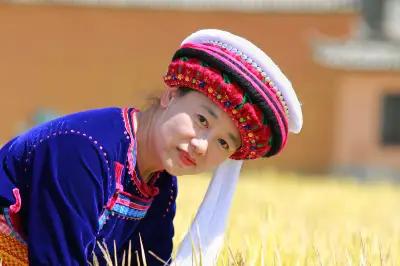
The brightly painted staircase is the most eye-catching spot when you enter the lane. The patterns likely symbolize aspects of Naxi folk culture. There were swarms of people taking photos. While I was shooting, a cleaning lady dressed in local ethnic attire happened to pass by. I invited her to sit with me for a photo. For me, blending in with the locals is far better than being a solo poser.
One wall is completely covered with all kinds of wishing plaques. Lijiang's tourists come in every variety—couples, families, close friends, or solo travelers—but they all share a common artistic sensibility. Wishing plaques allow us to pour out our heartfelt blessings and poetic sentiments, hanging them forever in a corner of Dayan Flower Lane.
Dayan Flower Lane is quite an artificial attraction, with man-made decorations everywhere. Some people love it, others roll their eyes. However, they've built a 'Lijiang Eye' here—a panoramic viewing platform for Lijiang Old Town. No need to buy a ticket at Lion Hill to see the whole town; from this high platform, you can take in the entire old town in one sweeping view.
Dayan Flower Lane is also a haven for folk musicians. In summer, a folk music festival is held in the lane's square, drawing huge crowds. A group of ballad singers brimming with poetry and wanderlust gather to help visitors forget earthly troubles. The stage remains, and occasionally resident singers still strum and sing there—not necessarily for money, but more to have a platform for their talents.
Still, Dayan Flower Lane is dominated by flowers, especially bougainvillea, which has become a symbol of Lijiang. If you come in early spring, you can also see cherry blossoms, hydrangeas, and wisteria—that's when the lane is at its most beautiful.
Lijiang Boxinyunshè
Every time I head to Lijiang, I search carefully for a guesthouse or B&B, because in the old town, a comfortable stay is paramount. This time, with a single glance, I fell for Boxinyunshè at the foot of Lion Hill. I was captivated by its descriptions and photos, and quickly made my decision.
A courtyard at Boxinyunshè: I prefer calling it a courtyard rather than an inn or B&B. It's next to Mu's Mansion in Dayan Old Town, very close to Sifang Street yet wonderfully quiet. While outside is bustling, here you enjoy your own pocket of tranquility. It's a 10-minute walk from the old town gate. Cars aren't allowed inside, so Uncle Yang from Boxinyunshè comes with a tricycle to pick up guests and luggage.
Stepping into the courtyard, I was genuinely stunned by the soaring Chinese garden and Naxi-inspired design—it's simply enormous! Previous guesthouses I'd stayed at in the old town were all quite small, due to intense competition. But Boxinyunshè's first impression is sheer spaciousness: large common areas, a big courtyard, and huge rooms.
Boxinyunshè feels more like a garden, with flowers, trees, birdsong, and a pond that also holds a swimming pool. The two water bodies appear connected but are actually separate: the outer ring is a clear water pond, while the inner part is a swimming pool. In the hot summer, guests can cool off here. At night, softly lit, the rippling water is especially beautiful. Water seems to be the soul of Boxinyunshè; every Boxinyunshè property features such a clear pool.
The courtyard is planted with many succulents and colorful flowers, brimming with vitality. Every step reveals blooms, every glance a picture. Staying here feels like living in a garden. Amid the floral embraces, photos turn out beautifully—girls will absolutely love it. While I was taking photos, some tourists even wandered in thinking it was a scenic spot; the staff were very welcoming.
At Boxinyunshè, I felt like I'd returned home. The staff call us 'miss' and 'mister,' instantly breaking the ice. There's no defined front desk; it's not a traditional hotel or inn—you feel like you've walked into your own courtyard. I especially loved the atrium area, with its full wall of books. Reading and sipping tea there was utterly calming.
The log-cabin style seems very Jiangnan, yet incorporates many local Naxi elements. Boxinyunshè's homes blend so naturally into the local cultural environment. Thoughtful design is evident in every detail, from the tea tables to the light fixtures, reflecting the owner's pursuit of quality.
The atrium also serves as an open-plan dining area—you might not notice at first glance. The buffet breakfast is sumptuous, offering not only usual items but also local specialties like rice noodles, erkuai (grilled rice cakes), roasted milk fan, and Lijiang baba. On my first morning in Lijiang, I got to have the erkuai and milk fan I'd been craving, and memories of my first trip to Lijiang came flooding back.
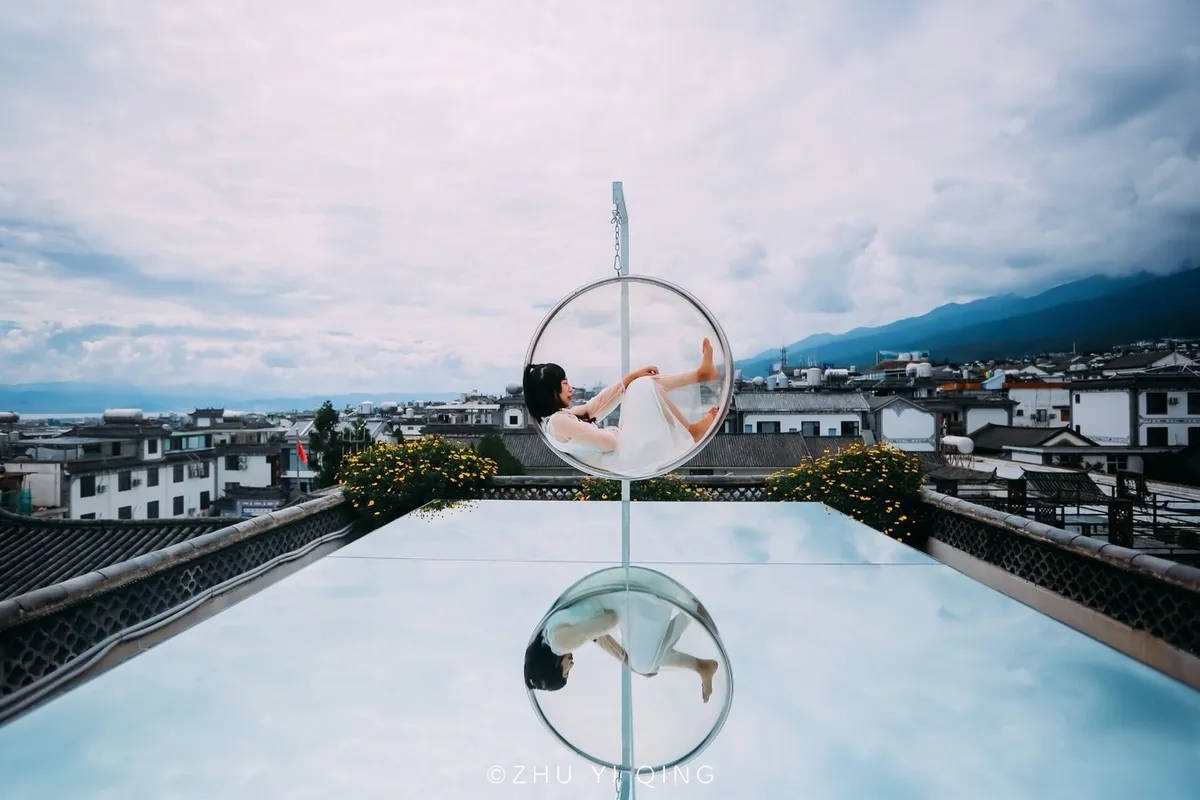
When the weather is clear, the rooftop terrace offers distant views of Jade Dragon Snow Mountain and the entire old town. I loved coming up here in the evening to feel the breeze.
There's also a huge mirror on the terrace, perfect for creating those 'sky mirror' shots—provided the weather cooperates. If not, you can always find a way to capture some moody shots.
A private master bedroom: Ultimately, a guesthouse or inn leaves a good impression based on the room, since that's where you truly rest. Boxinyunshè's exclusive master bedroom made me feel like a VIP.
I stayed in a standalone courtyard called 'Three Flowers,' named after the Naxi festival Sanduo. The room has high ceilings. A few delightful surprises: 1) The linen slippers and bamboo-fiber towels are yours to take home. 2) The wooden comb, personally selected by founder Mr. Xiangzi, is also a take-home gift. 3) Being on a high plateau with dry air, there's a humidifier. 4) A dedicated towel dryer. 5) Facial cleanser, hand soap, laundry detergent, and body lotion are all provided. 6) A complete tea set on the tea table—perfect for tea lovers.
In the room's elegant Chinese style, one small design detail caught my eye: the bedside lamp, shaped like a round fan, exuding vintage elegance and a girlish charm. It paired perfectly with the canopy, and I wanted to buy one just like it.
Two sink basins make it convenient for a family to wash up together without fighting for space. The marble backsplash immediately elevates the sense of style.
The bathroom is semi-open, with a small bathtub nearby for those who enjoy a soak. It's thoughtfully equipped with a bathtub liner and bath salts, and the towel dryer is a personal favorite of mine.
By the bedside, controls for the Bluetooth speaker await. As soon as you insert the key card, mellow music fills the room. Music truly has a magic—my tired body instantly relaxed.
Staying in Lijiang was so comfortable that these past few days, apart from wandering the old town, I just spaced out in my room. That's the true rhythm of a Lijiang holiday!
An ancient town: September in Lijiang coincided with the rainy season. Walking through the old town in the drizzle had its own charm. I especially enjoyed street photography with my camera. Even at 3 p.m., people were still having lunch—I guess that's just the Lijiang pace.
Flowers were everywhere; though not as profuse as in June, they still added vibrant touches to the old town. Even in this unusual 2020, the town was bustling, perhaps with others like me who love Lijiang's escapist slow life.
Travel isn't about rushing. Find a cozy spot in Lijiang Old Town, like Boxinyunshè, and watch the flowers bloom and fade, the clouds roll in and out. Time seems to slow down here—everything is leisurely—yet it also flies, and you never want to leave. So, do you like holidaying in Lijiang? What are your favorite spots? Feel free to share your thoughts.
Wandering Lijiang's ancient lanes, indulging in bar-hopping revelry, and getting addicted to daydreaming under the blue sky—this is where you find yourself. Lijiang's nights always enchant me. Sleepless in Lijiang, the brightly lit restaurants in the old town buzz with crowds. A cool breeze blows; nighttime in Dayan is the most comfortable time, revealing Lijiang's true character.
Walking the flagstone lanes, I noticed something different from previous years: the street-side djembe drums of 'Little Baby' were gone. That music used to be the rage in Lijiang. Snacks might be priced like Fan Bingbing but taste like Feng Jie (a colloquial jab meaning overpriced and underwhelming), but often you're not buying anything—you just want to stroll and take in the atmosphere.
But this year, Lijiang has another viral sensation: the one-of-a-kind Cherry Blossom Restaurant. More than a restaurant, it's Lijiang's hottest photo spot of the year. Flowers fill the canal, and at night, warm yellow lights create a very bobo vibe.
The restaurant has tables for two and four, but even if you're not dining, you're free to wander in. Fresh flowers outside and wooden tables inside create a natural, elegant atmosphere. When the flowers bloom, beauty is on full display.
There are many photo-worthy spots here—almost every step reveals a new scene. You have to admire the owner's sense of aesthetics and marketing savvy. This place draws the biggest crowds in the whole old town, so much so that it's almost impossible to move.
Restaurants in the old town no longer win on taste but on ambiance. Decorate a place beautifully, and tons of people will come for the photos. But as for the food, I can't say I'm impressed; I think eateries outside the old town are tastier.
Just a few steps from the Cherry Blossom Restaurant is Oil-paper Umbrella Street. According to the girl at my guesthouse, this street is also a recent addition. The entire street is hung with oil-paper umbrellas, each painted with different patterns. Under the lights, they're beautiful and vivid. If you're caught in Lijiang's fickle weather and it starts drizzling, you can even take shelter under them.
I've been to Dayan and Shuhe, but few people have heard of Baisha. I don't mean white sand, but Baisha Ancient Town. Lijiang Old Town consists of three parts: Dayan, Shuhe, and Baisha. Most tourists just visit Dayan. But for those who love peace and authenticity, Baisha Ancient Town is the best choice.
The reason Dayan isn't what it used to be is that too many tourists came, commercialization set in, and local residents moved out, leading to its current state. Baisha Ancient Town, on the other hand, is pristine and undisturbed, the town that best preserves Naxi heritage. Out of an interest in Dongba culture and a desire to experience a more authentic Naxi village and its people, I traveled from Dayan to Baisha.
Although only 10 kilometers from Dayan, Baisha is noticeably more primitive. The famous Mu chieftain family of Lijiang originated right here in Baisha. The town sits at the foot of Jade Dragon Snow Mountain; wherever you look up, you can see the mountain's stern face.
Compared to the overly touristy Dayan, Baisha is an extremely quiet corner. No clamor, no glitz. Walking into Baisha gives you a sense of calming power. It hasn't been developed, and everything remains perfectly preserved, just as a Naxi ancient town should be—simple and tranquil.
Elderly folks sit by the roadside, chatting and selling vegetables. They don't seem too serious about it, as if just going through the motions; thanks to their children, they're well provided for. The town has had little contact with the outside world, still maintaining a lifestyle of farming and weaving. Life here is even more laid-back than in Dayan.
Before coming, I'd heard Baisha is most famous for tie-dye. You'll see tie-dyed fabrics drying everywhere. Tie-dye is a unique folk method of dyeing and drying cloth, and since many families make a living from it, it forms Baisha Ancient Town's most beautiful scenery.
Tie-dye is a traditional and unique Chinese folk dyeing craft. Threads are tied into knots on the fabric before dyeing; after dyeing, the threads are removed, revealing various patterns. It's said that even if you tie thousands of knots, no two will emerge identical—a truly distinctive artistic effect.
Tie-dye patterns are relatively simple and plain, like butterflies, wintersweet, and crabapple blossoms. There are also full-panel designs, such as the 'fish roe' pattern of tiny white dots or the slightly larger 'agate' dots. Today, this traditional craft is listed as a national intangible cultural heritage, and several dye workshops in Baisha carry on its legacy.
There are hands-on experiences in the dye workshops, allowing you to dye a small piece of fabric in a short time. I arrived a bit late, past the best drying time, so I could only take some photos with the dyed cloths and chat with the owner. Baisha's tie-dye mostly uses banlangen (Isatis root) and indigo as dyes—yes, the same banlangen used to treat colds. Compared to chemical dyes, these plant-based dyes not only produce natural, non-fading colors, are gentle on fabric and durable, but most importantly, they pose no harmful stimulation to the body; they can even have anti-inflammatory and skin-care benefits, making the clothes comfortable to wear.
Though the patterns may look simple, they all carry auspicious meanings, like 'romantic beauty' or 'wealth and honor.' I asked the owner: a plain blue tie-dyed cloth costs just over 200 yuan. Adding colors costs extra, but even the price of the blue fabric alone is a fair deal you'd only find in such an idyllic town!
There are few tourists in the ancient town. Walking on the flagstones, only colorful dyed cloths flutter in the wind, expressing the town's vitality amid its calm. Entering each dye house feels like stepping into a tie-dye museum. These rainbow-hued textiles, caressed by sunlight, tell the essence of an ancient craft and its history. The artisan spirit is quietly passed down in this quaint town.
Baisha's houses retain their original appearance, though interiors have been renovated to suit the owners' needs. Even if they look a bit shabby outside, inside they incorporate many Naxi cultural elements.
At a street-side café, I ordered a cup of homemade yogurt (don't ask why I'm drinking yogurt at a café...), glanced up at the colorful tie-dyed cloths hanging on a mottled wall. The cloths flapped against each other in the breeze, while little birds perched on the beams chirping lazily. This touch of liveliness within the ancient atmosphere was delightful; once seated, I really didn't want to move.
Wenhai: Lijiang's Hidden Secret
Having heard too many horror stories of being ripped off at Lashi Lake, I decided to flee the crowds and head to another secluded beauty: Wenhai. It's like Lijiang's secret hideaway, even less crowded than Three Streams.
The drive from the old town to Wenhai takes about an hour, crossing a mountain pass. Many hire a car, or you could rent a motorbike—I even saw someone cycling there. Because it's a hassle to reach, few visitors to Lijiang make it here, missing out on the most beautiful sea of flowers.
Wenhai is part of the Lashi Lake Plateau Wetland Reserve, but with far fewer people. It's a seasonal lake, perched on a ridge of Jade Dragon Snow Mountain at over 3,000 meters. In autumn and winter, it's full of water and migratory birds. The mountain's reflection in the lake is serene and fairy-like. In spring and summer, the water recedes, grasses grow, and wildflowers burst into bloom, as if you're standing in a sea of flowers.
Everything in Lijiang is intertwined with the Tea Horse Road, and Wenhai as a natural landscape is no exception. It was once an important stop on the route, where horse caravans rested and grazed their horses. Today, you're more likely to see cattle herds from local families.
Due to the high altitude, Wenhai's flowering season lasts only a little over a month, right in late spring and early summer. The mountainsides are covered with all kinds of flowers, turning Wenhai into a sea of color. Vibrant clusters dot the landscape, incredibly beautiful. I happened to visit in June when the meadow was in bloom, perfect for photography.
There are a few scattered houses on the meadow's edge—open and quiet, with almost no one around. So you don't have to worry about finding a good photo angle; no one's in the way from any direction!
Right now, the meadow is blooming with primroses, one of Yunnan's eight famous flowers. Vast patches of purple-red can be seen from the winding mountain road, like colorful clouds scattered on the grass. After parking, I made my way to the lake, stepping over grass tufts and cow pats. Up close, the primroses were bursting in clusters, as if treasuring the hard-won spring.
Herds of cattle and horses graze freely on the grassland. In spring and summer, although flowers bloom, the lake water doesn't rise much, so you don't get to fully enjoy the sight of crystalline blue water. That's why Wenhai deserves two visits: one for the flowers, one for the blue lake.
Wenhai—Lijiang's secret place, vast and lonely, with boundless sky and earth. In that moment, a tiny me stood on this huge planet, and the tiny me wanted to dream a big dream.
Dali: Ancient Town and Erhai Lake
If Lijiang is Yunnan's city of romantic encounters, then Dali is the city of healing. I still remember seven years ago, as a naive girl on my first trip to Yunnan, I arrived in Dali Old Town. The unique Bai houses and the aroma of roasted milk fan in the old town left a deep impression. After yet another hurried trip through Dali later on, I knew I would return.
With its ancient town, Cangshan Mountain, and Erhai Lake, Dali is full of romantic elements, making it my favorite place in Yunnan. Sometimes doing nothing but gazing at Erhai Lake is pure comfort.
Dali Old Town sits at the foot of scenic Cangshan Mountain and was the capital of the ancient Nanzhao and Dali kingdoms. The temperature is pleasant, the architecture simple and classical, and roadsides are ablaze with flowers and greenery.
Looking back at Erhai Lake, the biggest regret this time was not seeing it under sunny skies, missing its deep blue surface. Maybe that's a reason to return.
As for how to enjoy Erhai, the young crowd rents a sports car to cruise around the lake. The lakeside road is excellent—smooth and flat, easy even for novice drivers. Especially when you see one flashy car after another packed with handsome guys and beautiful girls standing up, it dawns on me: no wonder there were no young people in the old town; they're all here.
Many people come to Erhai for stunning influencer-style photos. In the last couple of years, a spot on the lake—Lose Hill in Wase, also known as Cliff Shoal—has been discovered by photographers and turned into a photo hotspot. You need to follow a small path down; there are plenty of photo elements: a cave, an abandoned window frame.
But! I arrived during Dali's rainy season, and the lake's water level had risen, flooding the path to the 'cave.' And because this spot has gone viral, hordes of people come to recreate the same shots. There was even a line at the window frame, with more people constantly arriving, so I could only snap a couple of quick photos. The experience wasn't great. In the end, I just took a few pictures by the lakeside. But with the weather alternating between sunny and cloudy, I could only shoot hastily when the sun peeked out.
Actually, if not for stopping to take photos, driving along the eastern shore was the most enjoyable. Cruising on this boundless coastal road, the vast horizon offers a sense of openness you never feel in the city. The breeze scattered my thoughts, yet made me relish the moment even more.
Leaving Dali isn't the end, but a beginning. Next time, I hope to see Dali under a clear sky.
In every Chinese city you visit, there's bound to be a temple, whether in a bustling metropolis or a remote village, at least one temple for people to pray. Temples are generally considered to be filled with incense smoke, solemn and reverent. But up on Cangshan Mountain in Dali, there's a fascinating temple where no one burns incense. It's spotlessly clean and surprisingly decorated with many different flowers, even showcasing specially designed arrangements of colorful potted plants.
This romantic temple is Jizhao Nunnery in Dali. It's more like a garden than a temple. Though not large, every corner is planted with flowers—along paths, under eaves—bursting with colorful blooms and succulents. If not for the statues of Bodhisattvas and Buddha, you'd think you were in a garden, not a temple. Jizhao Nunnery is known as China's most artistic nunnery. There's none of the usual solemnity or incense smoke; it feels more like a personal courtyard where you can play with flowers and plants.
Jizhao Nunnery was first built in the early Ming dynasty, destroyed, and rebuilt during the Republican era. A variety of plants surround it, filling the air with freshness. Aside from flowers, one striking feature is the abundance of succulents—they dominate the temple. Due to its prime location with ample sunlight and the big day-night temperature swings in Yunnan, the succulents thrive, looking plump and healthy.
It's said that Jizhao Nunnery has over 200 kinds of succulents, each different in type, size, color, and shape, like a succulent expo. On the ground are various succulent pots; hanging from beams are seasonal flowers of Yunnan. Many tourists specifically visit to see these flowers and succulents, even though the nunnery is halfway up the mountain: after driving, you still have to walk a bit. Despite the hassle, visitors keep coming.
With no incense burning, the air and environment are excellent; the whole temple is impeccably clean, yet it doesn't lack solemnity and refinement. Tall ancient trees, flowers everywhere, lush greenery—people call it China's most beautiful and romantic temple. You may wonder why there's no incense worship like in other temples.
Jizhao Nunnery is actually a Buddhist nunnery. The resident nuns say that Buddha lacks nothing and cares not about incense but about a devout heart. So they don't practice rituals or worship daily, and naturally don't burn incense. However, for visitors who've come a long way, there is one room designated for incense burning. If you wish, you can go there to pray, but group incense burning is discouraged. No wonder it stays so clean.
Also, because the temple is in the mountains, surrounded by vegetation and near forests, burning incense could easily cause fires—very dangerous. So it's not suitable. Surprisingly, the nuns themselves built and designed the nunnery's structures, gathering stones and wood to construct rooms using natural or recycled materials. That's why it feels so steeped in time.
The plants and flowers you see now weren't achieved overnight; they've been cultivated over decades, slowly growing into the garden-like temple environment, so full of life on Cangshan Mountain. What started as the nuns' personal hobby has now drawn crowds. Visitors come not just to pray, but to see this unique nunnery in Yunnan. Some girls, after visiting, even say they'd like to stay and live here.
Jizhao Nunnery not only offers flower viewing; its vegetarian meals are also exceptional. Many come specifically for the self-service vegetarian lunch at 20 yuan per person. Though similar to home-cooked food, the ingredients are carefully selected, and the cooking uses minimal salt and oil, no MSG or other additives, so you can taste the natural flavors of the ingredients. Without heavy seasonings, the food still has its own character. Every day, hundreds line up for the meal.
Dali Boxinyunshè
Morning, Dali! Crossing thousands of kilometers just to meet this moment again. Having seen all the usual sights on this trip, I decided to slow down, pick a homestay, take photos, lounge, and zone out, savoring Dali's slow life. Boxinyunshè, which I'd stayed at in Lijiang, also has a branch here in Dali. I chose it without hesitation—just a 5-minute walk from the old town gate.
Stepping into Boxinyunshè was like entering another world. A huge pond occupies the center of the courtyard. Compared to the one in Lijiang, I felt this one was even larger and more classical. The shimmering water reflects the sky, while the greener part in the middle is the swimming pool. Though they seem connected, the two are completely separate. This angle is perfect for photos.
Like its Lijiang counterpart, Dali's Boxinyunshè also embraces the concept of 'big.' The public space opens right up to the second floor. You could call it a tea room, a dining room, or a café, but you'd never guess it's the front desk. To make it feel more like home, there are no typical PoS machines. Upon entry, you're offered tea and a warm greeting from the staff, who sweetly call you 'miss.' The warm service starts the moment you walk in.
Curled up on a sofa in the foyer, watching the drizzle outside, I couldn't go out to play, but staying in at Boxinyunshè had its own charm. With its elegant Chinese style, every corner is photo-ready. Since I couldn't go out, I just took plenty of pictures in the courtyard.
If you like, you can ask a staff member to make you a coffee and enjoy it by the floor-to-ceiling window, savoring Dali's unique laid-back flavor.
The girl who made the latte art was incredibly skilled—not only did she write 'Boxinyunshè' in the foam, but she also drew the courtyard. I spent ages photographing it and could hardly bring myself to drink it.
The girl taking photos said my outfit matched the throw pillows perfectly—must be fate!
Having stayed at the Lijiang Boxinyunshè, I knew each guest gets their own exclusive suite. In Dali, I stayed in the Cangshan Room, and just the name had me excited. The moment I opened the door, I was stunned—it was so infused with local character!
Every room at Boxinyunshè has a different theme, with unique design elements to match. In my Cangshan Room, the floor was covered with pebbles to reflect the character of Cangshan Mountain. The doorframe's lines mimic the shape of a mountain range. Inside, the antique-style room is a cozy nook for relaxation.
The bedding is also very thoughtful: a Simmons mattress, latex pillows. With a press of a switch, the curtains and sheers automatically close. No matter how tired you are, you can get a good night's sleep here.
Since the old town's climate is dry, the room has a humidifier, saving my skin from dehydration.
A professional tea set is provided, too. Tea lovers can sit by the bed, look out at Cangshan and the clouds, and relax over a brew.
The rooms at Boxinyunshè, from design and materials to the little knick-knacks, all blend Dali's ethnic culture and folk customs, making each stay unique. From the moment you check in, you'll feel the essence of Dali. Also, the bamboo-fiber towels, linen slippers, and peach wood comb in the room are yours to take home, carrying your memories of Boxinyunshè with you.
After resting a bit in my room, I went up to the terrace. The terrace in Dali is much bigger than the one in Lijiang, and there are two of them, planted with flowers and plants, like a small garden. Even better, behind them stretches a sea of clouds and snowy mountains. The vast scenery had me snapping photos nonstop.
Boxinyunshè's common areas are very well-equipped, with a tea room and an open kitchen. If you're traveling with family and want to cook for yourselves, that's totally doable.
After dark, Boxinyunshè takes on a special tranquility. The courtyard lights up, with reflections dancing on the pond water—just gorgeous. In the foyer, some elders play cards and chat, others sip wine under the trees, lost in Dali's night. All worries cast aside—such contentment.
Woken by birds in the morning, the rain had stopped in Dali, and I could see a faint corner of Cangshan Mountain from the window. Downstairs for breakfast, I got to taste a variety of Dali delicacies. The local specialty, xidoufen (a thick pea paste), is the most famous breakfast. When eating xidoufen, you must have a fried dough stick, cut into pieces and mixed in—absolutely delicious! I guarantee you'll fall in love with it.
Rice noodles are a must for me at breakfast in Yunnan. They say a Yunnan morning starts with a bowl of rice noodles: minced meat, greens, and a tomato slice—that's the taste of Yunnan on your tongue.
Of course, in Dali, you can't miss erkuai, milk fan, and Xizhou baba. These Yunnan specialties turned my breakfast into a brunch feast.
Dali: 'Nice to Meet You, Little Fairy' – One evening, waiting for sunset in Dali but not getting it, a friend recommended a modern Yunnan restaurant called 'Nice to Meet You, Little Fairy' just outside the old town. From afar, I saw its bright lights; up close, it was bustling, with many couples dining.
The signature dish is steam pot chicken, said to be cooked without a drop of water. The three of us also ordered xidoufen, double-pepper fresh porcini mushrooms, mini tofu cubes, yak meat, wooden-bucket rice, black pepper mountain pork chops, and little fairy white fungus soup.
① The steam pot chicken is served two ways: the soup is the highlight, incredibly fresh—not seasoned freshness, but the pure umami from the chicken steaming. Drink several bowls, it's good for you.
② The porcini mushrooms are another signature. In a few days, they'll be out of season, so timing is key. They're bursting with flavor—worth a try.
③ The mini tofu cubes are my favorite—eat them hot; they're crispy outside and tender inside.
④ Xidoufen is a Yunnan specialty, a thick pea paste. You can customize with chili, scallions, and dried fish.
⑤ Bamboo tube rice: traditional sticky rice; the moment the bamboo is opened, the aroma floods out.
⑥ The yak meat and mountain pork chops are tender; though they look heavy on chili, they aren't really spicy.
As a love-themed restaurant, Little Fairy has a romantic atmosphere, with interactive 'love certificates' to play with—perfect for couples, but of course, also great for friend gatherings.
Lijiang: Er'ge Rice Noodles – Highly recommended! Probably the best food I had in the old town! Must-try is the signature chicken broth rice noodles. The free-range chicken series is the star, using black-bone chicken with great care. The broth is naturally delicious, and the noodles are smooth and springy.
Whether it's mealtime or not, the place is always full. I went at 3 p.m. and it was packed—such popularity is amazing. The windows are half-open; I sat with my bowl of noodles by the window, watching people pass by. Living in the ancient town is truly pleasant and cozy.
Old Town: Prince of Western Yunnan – This one was a bit of a letdown. Although it had high ratings on a certain review site, I find most ratings for old town eateries on that platform can't be trusted. The restaurant is decorated in a Naxi style, and the staff wear traditional costumes.
The two of us ordered three dishes, all said to be signatures: lotus leaf-wrapped grilled beef tenderloin, Dai-style hand-grabbed rice, and a lamb dish. Overall, the taste was mediocre, not as stunning as the reviews claimed.
I also ordered a drink, Paoluda, which was truly a miss: just coconut milk with a few bits of dried bread on top—not worth the price.
The End
Lijiang, sunny one moment, rainy the next. When I arrived at the airport in the early hours, it started raining—as if reluctant to let me go. Lingering at the airport, I hesitated to go through security, just to imprint Lijiang's mountains into my mind once more. I once dreamed of traveling the world with a sword, to see all its splendor. Lijiang and Dali are distant lands I cannot forget. Perhaps at some future moment, I'll long to return, to live that faraway slow life once again.