Exploring the Land of Colorful Clouds: Embrace Poetry and the Distant, Chase the Ethnic Soul
During the first half of the year, the pandemic hit the pause button on life, locking many people at home. I was no exception, cooped up for months. As the situation improved recently, I couldn’t contain my desire to get out, to breathe fresh air, to see the scenery, and more importantly, to immerse myself in the cultures of different ethnic groups and see how they live.
In our vast country, Yunnan is the province with the most ethnic minorities. Among China’s 56 ethnic groups, Yunnan is home to 52. This time, seizing the moment when time was just right, I set off towards the Land of Colorful Clouds with my girlfriend. It wasn’t just to see the poetic distant lands that everyone talks about, but more to search among the mountains and valleys for the ethnic souls that cling together like pomegranate seeds, and to experience a different kind of life.
Dali – Xizhou – Kunming – Chengjiang – Jianshui – Yuanyang – Honghe Hani and Yi Autonomous Prefecture – Puzhehei – Wenliu – Shilin – Kunming – Dali
After a six-day journey through ethnic cultures, we set off from Dali heading south. These days on the road let us encounter a different side of the Land of Colorful Clouds.
In Yunnan’s largest natural village, we experienced the Bai people’s unique tie-dye craft and made a handkerchief with our own mark.
At the world’s largest terraced field scenic area, we stumbled upon a fairytale-like mushroom house and had an unforgettable chat with a Hani grandmother.
Amid endless lotus leaves in the karst landscape, we paddled a small boat as if drifting among clouds, and encountered the most distinctive Zhuang tribe deep in the mountains.
Every person I met and every mountain I crossed on this journey remains vivid in my memory. This trip to Yunnan was not just about seeking poetry and distant lands; it was more about deeply appreciating the splendid charm of Chinese ethnic culture.
Though it was only six short days, it gave me unique insights—not just about travel, but more about the inheritance of ethnic culture. This time, I’ll break it into three parts to share the Land of Colorful Clouds as I see it.
Dali, for me, is the most beautiful dream of the distant land from my youth. When I graduated in 2013, my heart was racing with the urge to go west to Dali. So I set off alone, hiking and hitchhiking all the way to the ancient Nanzhao Kingdom. Seven years later, I’m off to Dali again, this time with my beloved and driving the WEY VV6 to revisit Dali in a different way. This return to Dali was more comfortable and more profound.
Dali has a wonderfully soothing comfort; no matter how restless your mood, the scenery here will calm you, letting you quietly enjoy all the beauty around.
Without the youthful urge to hike, and to give my girlfriend a comfortable and relaxing travel experience, the vehicle this time had to be safe and comfortable, and most importantly, have enough space for all our luggage for the coming days. Our choice was the WEY VV6, and we especially chose the latest 2021 model to go over mountains and see the sights together.
Before setting off, we packed our luggage into the trunk—two 24-inch suitcases fit with room to spare, no awkward reaching needed. After checking the tire pressure, we adjusted the seats to the most comfortable position and headed north along Erhai Lake, searching for traces of Dali’s Bai culture.
Driving along, the trees outside the window whizzed by, and only Erhai remained by our side. In the afternoon, a drizzle began to fall. After the rain stopped, the sun shone on Erhai, and the shimmering light on the water was breathtaking. Ahead on the road, a curved rainbow bridge appeared!
How lucky—good omens right at the start! In Dali, you always encounter unexpected beauty!
Our first stop was the Jizhao Nunnery hidden in Cangshan Mountain. It’s called the “most beautiful nunnery in China,” where they don’t burn incense but plant flowers, and succulents are everywhere in every corner of the temple.
On the way to Jizhao Nunnery, there was a bumpy stretch of stone path, very rough. A sedan would have had to creep along carefully. But we had the foresight to drive an SUV with better clearance, so we could go with confidence. The VV6’s four-wheel independent suspension effectively reduced the bumps from the uneven road, and with good sound insulation, the ride was only slightly bumpier than on a flat road.
We could only drive to the entrance of Gantong Temple, then walk up. At Jizhao Nunnery, the gate is the Bai-style “three-drip water” door. Inside, the temple isn’t large, but it contains the whole world.
Despite being prepared, I was still stunned by the flowers and plants everywhere! Especially the flower boat placed on the ground, bursting with vitality, bringing life to old, withered wood. In the backyard, hydrangeas were blooming, though some had already faded—exactly the look of autumn.
We also tasted the Bai-style vegetarian meal and tea here. For 20 yuan per person, you can eat your fill but must not waste. We loaded our bowls with vegan food according to our appetite, found a spot, and happily ate. It was really good.
After the meal, we sat with locals and visitors in the garden, chatting with the nuns. Our mood was very cheerful.
When leaving, we found a clingy little cat lying on the steps. After playing with it for a while, we returned to the car. Sitting in the soft seats, thinking about everything we’d encountered today, I felt so comfortable and at ease~
No matter how restless your heart, it will be healed in Xizhou’s rice fields. We started uphill and set off for Xizhou.
When we came in early August, the Xizhou rice fields were still emerald green. A month later, they had turned golden. I excitedly opened the windows and sunroof, letting the scent of rice drift into our car with the autumn breeze.
With the windows down, the car was bright inside, and the sleek body lines framed the scenery and clouds into a beautiful picture scroll. The two of us, in this exquisite car, taking in Dali’s wonderful sights—so beautiful!
Driving through the endless rice fields, my heart couldn’t help but calm down, and the speed slowed. The car stereo happened to play “Rice Fields,” and when the familiar melody “Remember, you said home is the only castle, run along the rice-scented river…” came out, the whole world seemed to quiet down!
One car, two people, the whole world—everything was so comfortable and free.
Then, we parked by the rice fields near Xizhou Ancient Town, snapping hundreds of beautiful photos, capturing the lovely scenery, the comfortable car, and our happy selves into our cameras.
Two people, one car—goodbye, Dali!
Arriving in Xizhou, we drove around the town.
Xizhou is a famous Bai historical and cultural town with a history of over a thousand years. Even Chinese National Geography says it is “the most prosperous and beautiful paradise.”
What attracts people most in Xizhou are the Bai architectural complexes. The typical Bai courtyard layouts like “three buildings and one screen wall,” “four courtyards and five sky wells,” “one entrance with two yards” (six harmonies in spring), and “galloping horse corner tower” give Xizhou ancient town a strong historical flavor, very impressive!
On a white wall in the town, Mr. Lao She’s “Notes on Travel in Yunnan” is inscribed: “Xizhou is a miracle. I can’t recall seeing such a dignified town in any remote place in China.” Even Mr. Lao She praised it as a paradise!
Driving in the ancient town was a bit tricky, with winding roads and pedestrians to watch out for. Any carelessness could lead to bumps. Fortunately, the VV6 always kept an eye on nearby pedestrians, and with its 360-degree panoramic camera, even a female driver could navigate the ancient lanes with ease!
There was one little incident: I was about to get out to take pictures at the corner tower, and as I opened the door, a bicycle sped by. The VV6 gave an early warning, so we avoided a collision.
For our first night in Yunnan, we chose to stay in a village near Xizhou. Falling asleep to the croaking frogs was especially pleasant. We got up early the next morning and drove to the village entrance to search for Bai delicacies, only to stumble upon a Bai market that happens once a month.
What a lucky coincidence! We found a good spot to park and followed the Bai people into the market, discovering the place with the most lively, down-to-earth atmosphere nearby.
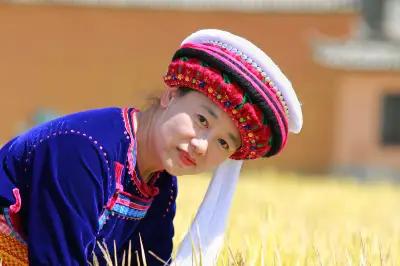
Most of the women here wore traditional Bai costumes, mainly red and white. The Bai people revere white, seeing it as a noble color. The upper garments have intricate patterns, while the lower part is simpler. The most distinctive feature is the Bai headdress with its “wind, flowers, snow, and moon.”
The hanging tassels represent the wind from Xiaguan; the bright flower decorations are the flowers of Shangguan; the white hat top is the snow of Cangshan; and the curved shape is the moon of Erhai. Such a small headdress encapsulates so much Bai culture.
On the first day of each lunar month, the Bai people hold their market. Following the steps of a Bai grandma, we entered the bustling bazaar.
The market sold mostly daily necessities, clothing, and fruit. The street wasn’t long but was packed with stalls. Groups of Bai grandmas carried baskets to shop, and one grandma clutched a handful of small bills, weighing how to spend them. It’s been a long time since I’ve seen the familiar sight of cash.
We lingered for over an hour, infected by the lively scene of the Bai market, reluctant to leave.
Back in the car, recalling this magical morning, it felt like a dream. Life keeps moving forward; we choose more comfortable cars and more convenient living, yet we must not forget that such vibrant ethnic cultures are still waiting to be discovered.
After leaving the Bai market, we drove along Erhai to Zhoucheng to experience the Bai traditional tie-dye craft. Zhoucheng is Yunnan’s largest natural village, known as the “home of Bai tie-dye.”
The Bai people’s lives are inseparable from tie-dye. Walking the streets of Xizhou, you can see tie-dye art everywhere. Whether it’s the Bai people’s clothing, tablecloths in coffee shops, or the handkerchiefs in a Bai granny’s hand, all are Bai tie-dye art, a treasure listed as China’s first batch of intangible cultural heritage.
In Zhoucheng, many places offer tie-dye experiences. We chose the well-known “Puzhen Tie-Dye Workshop,” which is also a tie-dye museum.
As soon as you step into the workshop, you can feel the beauty of tie-dye art. In the backyard, rows of vintage dye vats stand, and a Bai granny was dyeing a white skirt.
We followed the Bai granny to make a handkerchief. We did it ourselves, experiencing the cultural charm of Bai tie-dye stitch by stitch.
The thousand-year-old “secret recipe” of Bai tie-dye is the well-known herb Isatis root (Banlangen), which has long been used in traditional Chinese medicine. It’s precisely because the dye comes from Banlangen that Bai tie-dye boasts the purest blue and white in the world.
The whole process took over an hour, from threading needles to hand-dyeing, and finally drying. What looked easy actually required great attention to detail. I turned a plain white handkerchief into my own unique pattern—a truly special experience.
This Dali journey into ethnic culture let me rediscover Dali, delve into Bai culture, and experience folk art. Besides beautiful scenery, I discovered countless ethnic cultural treasures. Next stop, I’m taking my girlfriend to the world’s largest terraced field scenic area to visit the mysterious Hani tribe.
Rivers and mountains, canyons and basins, stone forests and gobi—there are so many majestic natural landscapes in the world. Every time I encounter an astonishing natural scroll, I feel a surge of awe. This time, the Yuanyang Hani Terraces left me even more shocked. For thousands of years, the Hani people of Yunnan have worked hard to cultivate barren land, using diligence and wisdom to create the most spectacular terrace landscape in the world. Through the tiny, day-by-day human efforts, they sculpted a breathtaking natural masterpiece.
After farewell to the Dali Bai, we continued our journey south from the Hangrui Expressway in the VV6, crossing Kunming to visit the world’s most magnificent terraced fields, the human miracle created by the Hani people.
The whole distance was about 650 kilometers. The scenery along the expressway flashed by, and I drove for five hours to reach Kunming. Long drives inevitably tire you out, but the VV6’s comfortable driving experience kept me relaxed. The perforated leather seats perfectly wrapped my upper body, and the back support made driving more comfortable. On the highway, setting the full-speed adaptive cruise control helped me a lot, so I drove straight to Jianshui in Honghe Hani and Yi Autonomous Prefecture. After a short rest, we set off to find the human-etched picture scroll.
From Jianshui into the Yuanyang Hani Terraced Field scenic area, the wide asphalt road gradually turned into a single-lane mountain road, occasionally with bumpy dips. But we weren’t worried at all. In sport mode, the throttle response was very eager. The VV6 handled every kind of road with ease, allowing us to save our energy for the scenery.
Following the navigation, we entered the Yuanyang Hani Terraced Field scenic area. Layered terraces began to appear outside the windows, and we occasionally saw Hani people working hard in the paddies. It was harvest season; although it had started to rain, the golden fields filled us with joy.
Rounding a bend, we emerged from a lush forest lane, and suddenly a continuous stretch of golden terraces unfolded before us. A massive terrace painting greeted us so stunningly. We had arrived at our first viewing platform—Quanfuzhuang Viewing Platform.
We found a suitable place to park, put on our raincoats, and went to admire this masterpiece of humanity and nature.
Gazing into the distance, clouds drifted among the mountains. When the wind blew, they moved to the next peak. The golden terraces rose and fell in undulating layers, vast and magnificent, like a scene from a fairytale.
The Yuanyang Hani Terraces are the masterpiece of generations of Hani people over a thousand years. The hardworking Hani people opened up the barren mountains, adapting to local conditions and using the terrain to build terraces. Some are as large as several acres, others as small as a winnowing basket. On any slope you look at, there are thousands of terraces—a majestic and wondrous spectacle.
It was my girlfriend’s first time seeing such spectacular terraces, and she was overjoyed. Despite the overcast sky and drizzle, she insisted on walking right into the rice fields, into this painting, to feel the wonder with her own feet.
The moving scene from the Quanfuzhuang Viewing Platform had already thrilled her. I checked the time: there was an hour until sunset, so I planned to take her to the most beautiful sunset viewing spot for the Yuanyang Terraces.
We drove on toward the core scenic area, winding along narrow paths through fields of rice, gliding effortlessly through the pastoral picture. I opened the panoramic sunroof, and my girlfriend glanced at the sky, noticing a small patch of blue appearing outside the window. “Maybe we’ll have a sunset today after all.” It always brought us good luck.
At Yuanyang, every time of day offers a different view of the terraces. But the most beautiful sunset spots are Bada and Tiger Mouth. However, Tiger Mouth has been closed recently due to safety concerns, so we chose the Bada viewing spot.
From the flat road, we turned onto a bumpy stone path. Up the sloping stone road for about ten minutes, we arrived at Bada, the best spot for shooting sunsets. Instead of going to the Bada viewing platform, we found a roadside spot with an even better vantage point—locals say it’s the absolute best.
We parked by the road and waited for the sunset. The sky began to turn golden, clouds flowing, every minute bringing a different picture.
After more than half an hour, my girlfriend suddenly said, “Look!” A beam of Jesus light pierced through the clouds, bursting out from a gap. Wherever the light touched turned golden instantly, making the rice fields come alive with light and shadow. This was the wonder we had been waiting for.
From daylight to darkness, we kept admiring this beautiful scene until the last ray of light faded. Back in the car, reminiscing about the magical day, it was cold outside but warm inside the car.
We continued on in the dark. The light rain in the evening gave good grip on the original Michelin tires when starting on a slope.
Leaving Bada, we arrived at the Duoyishu Scenic Area, the best place for sunrises with plenty of hotels. We planned to wait for the sunrise at the Duoyishu viewing platform the next morning, but it rained lightly throughout, with dense fog reducing visibility to less than five meters. We had to give up and visit the next village.
In the morning, the Yuanyang Terraces were shrouded in clouds and mist, visibility under five meters. Despite the bad weather, as the Chinese saying goes, “Since we’re here, let’s make the most of it.” We slowly drove to Azheke to find the Hani mushroom houses.
If you drive to Azheke, be aware that parking is difficult in the village, so we left the car at the village entrance and walked in.
As soon as we entered the village, we saw a six-year-old girl carrying a large cardboard box. She looked like she was struggling, so I offered to help, taking the box from her. It was indeed quite heavy.
Following the little girl, we walked down a rugged stone path to reach the village. The path ended at the traditional Hani village; it turned out Azheke is an ancient hamlet nestled on the mountainside.
Entering the village, you could clearly feel the uniqueness of the Hani people. All the houses were made of straw and mud, called “mushroom houses” by locals—hidden architectural gems in these terraced fields.
The village was sparsely populated, and it was damp and overcast. Kids were happily jumping rope, while chickens and ducks strutted boldly on the roads. Old people gathered on street corners chatting, curiously eyeing us two outsiders. The scene made me feel as if I’d stepped into another world.
Azheke is shrouded in mist most of the year. To avoid dampness, most mushroom houses are three stories: the ground floor for livestock, the second for living.
Walking along the village path, we saw a Hani woman passing by. She had a bamboo basket on her back and a sickle in hand, returning from the fields. Her skin was tanned a wheat color—the healthy hue from years of working in the fields. She smiled at us, and even on a cloudy day, I felt a sudden warmth.
Azheke isn’t large; you can walk through it in half an hour. We took our time, wandering and observing. Standing by the roadside, I suddenly felt something licking my foot. Startled, I looked down—it was a yellow local dog, wagging its tail and looking at me.
As if it had a soul, it followed me wherever I went. Sometimes it ran ahead like a guide, sometimes it jumped into the river to play on its own. If it saw I was getting far, it would immediately catch up. It treated me like a friend.
The misty clouds, the free-roaming chickens and ducks, the simple Hani people, and the little yellow dog that followed me—for a moment, I felt a sense of familiarity, as if I wanted to stay.
Wandering without purpose, I discovered an elderly woman full of stories in a corner. She was sitting at the doorway of her second floor, doing needlework. She was focused on threading a needle. Though she was advanced in years, the embroidery skills of the Hani people had long been engraved in her bones, and her deft technique had not faded with age.
In Hani culture, every woman learns embroidery from childhood. With industrious hands, they create exquisite patterns, using bright colors to craft eye-catching totems. The fine stitches embody the profound Hani ethnic culture.
We quietly watched the Hani grandma, her stitches swift and precise. When she noticed us, she smiled kindly and then returned to her embroidery.
Far from the city, the Hani people still strive with their own hands for a better life, creating miracles on the land they have cultivated for generations.
Leaving Azheke, the little yellow dog accompanied us all the way to where the car was parked. After saying goodbye, we left the village reluctantly. Sitting in the car, replaying the scenes recorded on camera, reminded of the Hani people who stay and work the terraces, the touching stories of their hard work and land reclamation. I couldn’t help but sigh. More than this mountainous landscape, Hani ethnic culture inspires awe in me.
If the Yuanyang Terraces gave me spiritual shock, then Puzhehei conquered me visually.
Along the way, the car’s built-in navigation was very accurate. The central control console had a large LCD screen supplied by Japan’s JDI, with 4GB RAM and 64GB storage, running very smoothly.
On the fourth day, we were heading to Puzhehei in Wenshan Zhuang Autonomous Prefecture. From Yuanyang, there were two routes; most people doubled back to the city and then went to Puzhehei. Our companion, Xiao Wei, found two routes for us. The other was a newly built road that few people used. After confirming with locals that it was finished, we set off in the VV6 on our new ethnic culture journey.
Descending from the misty Azheke, the altitude gradually dropped. The temperature difference caused the windshield to fog up. I shared my little annoyance with Xiao Wei, and she enthusiastically turned on the defogger, clearing the way forward. She’s truly a good friend.
Don’t be fooled by the distance of only 380 kilometers from Yuanyang to Puzhehei. Since we couldn’t drive fast in the mountains, staying mostly at 60 km/h, the drive took over six hours. We reached Puzhehei nearly at night.
For the first night, we chose to stay near Xianrendong Folk Village in the Puzhehei scenic area, a popular accommodation and rest area. The next morning, we got up early to see the karst landscape in the mist.
Xianrendong (Fairy Cave) is one of the 83 colorful karst caves in Puzhehei, but it was temporarily closed for special reasons. So we went directly to the Xianrendong folk village to see the most beautiful ethnic village in Wenshan Prefecture.
Xianrendong Village was originally a small village relying on traditional agriculture and fishing for generations. Since tourism developed, the village has become prosperous. If you’re not staying in the village, outside vehicles aren’t allowed in.
After asking the host, we drove the VV6 into the village. The roads were narrow and winding, a bit tricky to navigate. But the VV6’s smart features helped us avoid many obstacles, and we easily reached the lakeside guesthouse.
In the morning, strolling through this small village, it felt different from the hurried arrival the night before. Looking closely, I saw that most houses in Xianrendong Folk Village were antique-style buildings made of dark red wood, typical of Yi traditional houses. The coffee-colored, dark-yellow walls and tiled roofs reminded me somewhat of Lijiang Old Town.
The village isn’t big; it only took about ten minutes to walk from the main street to the lake. Although the lotus season was coming to an end, the vast expanse of green leaves stretching to the horizon was still enchanting. Looking at the distant mountains, you could faintly see fishing boats drifting on the lake—very poetic.
Most villagers in Xianrendong are Yi Sani people, known for their songs, dances, simplicity, and kindness. On the street, we saw a Sani woman selling things, with a few lotus flowers beside her. Seeing that my girlfriend liked them, I bought a few. The woman even gave us three extra lotus pods. I could feel the unpretentious warmth of the Sani people.
Thirteen years ago, Puzhehei was unknown. It boomed after the variety show “Where Are We Going, Dad?” and gained further fame from “Eternal Love.” Our main purpose this time was also for Puzhehei’s karst landscapes.
Though Xianrendong Village and Puzhehei Village are only about a kilometer apart, driving from one to the other actually takes 19 kilometers because of the rich karst terrain in between.
After lunch, we continued in the VV6 toward the paradise. The weather was clearing up, so we opened the windows to let the natural breeze into the car. It felt so refreshing, reminding me of the day I got the new VV6. When I drove out of the dealership that day, it was the same comfortable wind, sunny sky, and same sense of freedom. It made me feel everything was bright, as if a wonderful future had already started its prelude with an important event.
On the road into the village, something amusing happened: a group of “roadblock sheep” blocked the way, with Yi herders chasing behind them. We didn’t intend to overtake, just slowly followed. Sometimes, escaping the concrete jungle of city life and driving out to the countryside can bring a different state of mind.
We arrived at the filming location of “Eternal Love” and drove into this unique karst landscape. With clear water, blue sky, and flocks of birds, it felt as if we had stepped into nature’s most beautiful pastoral painting.
I took some aerial shots, capturing the VV6 together with the karst terrain. The fluid-designed car looked especially stunning among the stone peaks and forests. I kept pressing the shutter, wanting to record this wonderful moment. I have to say, the VV6’s stylish exterior really enhanced the photos.
After parking, we walked into the scenic area. You can not only see the most beautiful filming site of “Eternal Love” but also enjoy a unique experience: paddleboarding through the lotus fields, which has a special charm.
I tried it for over half an hour. At first, I was a bit unsteady on the paddleboard, but I gradually got the hang of it. Paddling on the lake, when seen from above, it felt like drifting among clouds—an infinite view.
After farewelling Puzhehei, we were headed to a village yet to open to the public, to find the ancient Zhuang culture hidden deep in the mountains. That was Shibie Village, the most beautiful Zhuang village in Qiubei County, Wenshan Zhuang and Miao Autonomous Prefecture, Yunnan.
Entering Qiubei County, the road changed from asphalt to gravel. But thanks to the VV6, we didn’t feel too many bumps. On the narrowest sections, the 360-degree panoramic camera helped us avoid scratches completely, ensuring a safe passage.
Along the Qingshui River, we reached the river valley of Wenliu Township. From afar, we could see a spectacular sight: nearly two hundred stilted houses with over a hundred years of history, arranged in tiers on the hillside. The houses retained their original look, layered and clustered in a beautiful, staggered pattern.
The navigation led us to the upper part of the village. To get into the village, you had to go down a steep side slope, which looked a bit risky. After assessing the road conditions, I decided to drive the VV6 down.
On the sloping road, I turned on the VV6’s 360-degree panoramic camera, projecting the surroundings onto the screen to reduce blind spots and keep an eye on all sides. Only then did I feel confident to drive safely to the village entrance. Even crossing a large pothole posed no problem.
At the village entrance, I checked the VV6’s wheels—perfectly intact, as expected of an outstanding SUV.
We got out and walked along the path into the village. The roads were so narrow that in some places only a motorcycle could pass. It was easy to see the friendly, close-knit neighborly relations among the Zhuang people in Shibie.
Due to traditional cultural influences and limited conditions, most houses in Shibie are built on stilts, perched on the mountainside. They prefer sunny spots at the foot or halfway up a hill. The ground floor is for livestock, the second for living, and the loft stores grain. As we walked, we met a local Zhuang woman who was very happy to see us and warmly invited us to her home.
Stepping inside her house, I immediately felt much cooler than outside. I asked the woman, and she explained that they use tile roofs with earthen or wood walls, which are not only damp-proof and cool but also very sturdy. It’s warm in winter and cool in summer, a traditional building method passed down for generations to create today’s happy life. After hearing her words, my heart was filled with deep respect for this mountain ethnic group.
The Zhuang people’s warm hospitality is deeply felt in Shibie. Every Zhuang person who passed us stopped to exchange a few words, and some elderly people even warmly invited us home for lunch. They said that anyone who comes to Shibie is a guest, and having a meal is no problem at all.
In this remote Zhuang village, there is so much beautiful scenery and fascinating customs. The Zhuang people’s simplicity, warmth, and diligence deeply moved me. Though far from the city, it’s easy to see from their smiling faces that they have guarded this place for generations, free from too many disturbances, living in harmony and ordinary happiness. It touched me profoundly. China’s vast and profound ethnic culture, the roots and souls in our blood, our spiritual home—we should dedicate more attention to these ethnic cultures.
Travelogue Contents
1. Our Itinerary
2. Searching for Culture: Dali Bai People | Wind, Flowers, Snow, and Moon Under Cangshan Mountain; Bai Holy Land by Erhai Lake
3. In Search of Dali Bai
4. Every Flower and Tree at Jizhao Nunnery Is a World
5. Dali’s Rice Fields Heal All Unhappiness
6. Xizhou Round Corner Tower: Folk Houses Amid Wind, Flowers, Snow, and Moon
7. Stumbling Upon a Bai Market: The Bustling Life in Xizhou
8. Zhoucheng Tie-Dye: DIY a One-of-a-Kind Handkerchief
9. Searching for Culture: Honghe Hani People | Into the World’s Largest Terraced Fields, Encountering Nature and Simplicity in a Fairyland
10. First Encounter with Terraces: Quanfuzhuang Viewing Platform
11. Meeting the Jesus Light at Bada
12. Azheke: A Fairyland Tribe
13. The Hani Elderly
14. Searching for Culture: Wenshan Zhuang People | A Tiny Boat in the Karst Mountains, Deep Ethnic Imprints in the Mountains
15. Yi Style: Xianrendong Folk Village
16. “Eternal Love” Scenic Area: Magnificent Karst Landscapes
17. Zhuang Culture Hidden Deep in the Mountains: Shibie Village
Travel Information
Hotel Index
Guide Index
Flight Index
Website Navigation
Travel Index
Cruise Index
Corporate Travel Index
Affiliate Cooperation
Distribution Alliance
Friendship Links
Corporate Gift Card Procurement
Insurance Agency Cooperation
Hotel Joining
Destination and Scenic Spot Cooperation
More Affiliate Cooperation
About Ctrip
About Trip.com
Ctrip News
Contact Us
Recruitment
User Agreement
Privacy Policy
Business License
Security Center
Ctrip Content Center
Intellectual Property
Trip.com Group Algorithm Disclosure