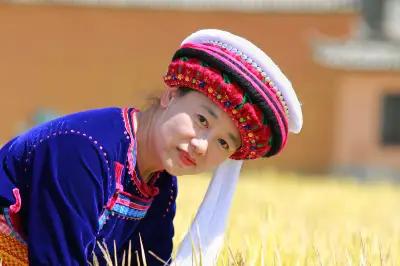
Dali Story: Travel Is a Healing Journey
You ask why the wind lifts the migratory birds in flight
Yet blows in a way that makes them flustered
You ask why the rain nourishes all living things to grow
Yet soaks his clothes through
You ask why he kisses his scars
Yet cannot bring him home
You ask me why I still dare not let go
Knowing I'll never hear an answer.
— Mao Buyi, 'Wu Wen' (No Questions)
Not every question needs a definite answer.
Just because it 'asks no questions.'
Many people ask me:
Why I love to travel.
Because travel is a process of self-healing.
The body takes in the scenery, the heart gradually renews.
Why I like Dali
Because of its folk songs
Because it asks no questions
Because of its romance
Because of its tenderness
In Dali, there are always endless sights to see and endless journey stories to tell.
Due to time constraints, I didn't hit many must-see spots in Dali. My friend and I came in a rush, and left in a hurry, to the point that we didn't even go up Cangshan. But Dali left me with a deep impression.
That evening, taking advantage of the rain stopping, we strolled through Dali Ancient Town. Unlike other ancient towns that have become heavily commercialized, Dali Ancient Town, among the famous old towns, is relatively less commercialized.
This was my first impression of the old town: long streets and narrow alleys bustling all the way. Because I have a poor sense of direction, my friend and I often strayed from the center to the edges, wandering where the ancient town meets the modern city. It was a fascinating feeling — on one side the lively clamor of the old town, on the other the everyday buzz of contemporary urban life.
One side speaking in accents from different cities, the other in a quaint local tone.
One side dressed brightly, the other in ordinary clothes.
One side representing dreams, the other representing real life.
Inside Dali Ancient Town, there are some long alleys. Many shops were still under renovation and not yet open, so there were relatively few tourists. By the glow of scattered lights, we passed strangers, occasionally singing a few lines of folk songs aloud.
They sang Chen Hongyu's 'Ideal at Thirty':
'Youth gets drunk again, in an unknown embrace, wasting time with laughter at gatherings and partings so generous.'
It was less singing and more a kind of cry.
But nobody stopped them. We met briefly, then left hurriedly, only the songs from all directions blending together, gradually fading into Dali's night sky.
They sang Ma Di's 'Ao Han':
'Ao Han, let's get married, let's get married, on the morning when the snow melts in Daocheng; Ao Han, let's get married, let's get married, in the twilight covered with brilliant stars.'
Just a few lines, yet filled with boundless regret.
Under the cover of night, my friend and I also shouted a few lines. On the way back to the guesthouse, leaning against a streetlamp, we even belted out a bit of Eason Chan's 'Ten Years' and Rene Liu's 'Later'.
This is Dali's night,
and the people from all corners of the world under those songs.
The next day's plan was to ride an electric scooter around Erhai Lake, passing through Xizhou along the way.
Since we hadn't planned well, we relied entirely on phone navigation for our route. (Out of habit or budget, you could also consider renting a car, which is relatively faster.)
Although riding takes more time, it gives you freedom of movement. On the road, we met a young woman traveling alone in Dali. The three of us decided to ride together. When we reached the outskirts, unsure of the route, we asked for directions and ended up meeting a few more young women who were also cycling.
Blue sky, white clouds, distant green mountains stretching endlessly. Now and then, the road was flanked by golden fields, shimmering together with the hills and the sky. It looked just like scenes from an anime. Along the way, there were also a few dedicated photo spots.
The hot wind whistled past my ears, and in that moment I truly felt the meaning of travel.
Coming to an unfamiliar place,
releasing the self that was tied down.
For a moment, facing such stunningly beautiful scenery, I was a little moved. (But remember to apply sunscreen and wear a hat, or you might get sunburned the whole way!)
Around noon, we arrived in Xizhou and had some Dali-style ersi (rice noodles) — the roadside prices weren't too expensive and the taste was quite good. You should also try Xizhou's famous Xizhou baba (a type of flatbread).
This might be one of Xizhou's most famous photo spots, which my friends and I stumbled upon by chance.
A vast expanse of golden rice paddies, with residents' houses on both sides.
Almost everyone, men and women alike, stops to take photos — because it's just too beautiful.
It's like an anime brought to life: the sky a clear, pure blue, the rice fields golden in the sunlight, gently swaying in the breeze. We ran along the ridges, the wind in our faces, and our mood lifted with the wide-open view. (Taking photos here is free — so don't hold back, snap away!)
If you're riding an electric scooter, you can park at a parking lot; the fee is reasonable. If you forget the way or it's too far, you can take the small flower-decorated tourist shuttles inside, mostly driven by locals who know the roads well.
Then we continued riding. The scenery along the way was beautiful. Occasionally we saw people pulling over to take photos. Even if it wasn't the best viewpoint, it was still lovely — by the roadside, leaves rustling, the surface of Erhai Lake sparkling, gentle waves lapping, the reflections of leaves dancing on the water.
When we reached Erhai Lake, we parked the scooters and went to the 'Sky Mirror' photo spot by the lake (there's a charge, but not too expensive). Since it was almost dark, after taking photos and grabbing some milk tea and snacks, we headed back.
That evening, we enjoyed a local specialty.
The wild mushroom hot pot was incredibly flavorful. Compared to ordinary mushrooms, the broth was much richer. Served with a few side dishes, it's a food lover's delight.
And after a long tiring day, a sip of the hot soup was absolutely refreshing, washing away all the fatigue.
Location: No. 498, Lower Section of Renmin Road, Dali Ancient Town
Restaurant name: 我在大理等你·方舟胖子厨房
Earlier, I had listened to the guesthouse staff's recommendations, since they've been in Dali a long time and know which restaurants are distinctive and delicious. Then I opened a certain food app and found that the number-one ranked place was exactly the restaurant they had recommended. I browsed the dishes — the photos looked very tempting — and read the reviews. There were so many positive comments that I couldn't resist booking a set meal online, then calling the restaurant to hold a table. The reviews said that if you don't reserve a seat, you'll have to queue at the door. In the early evening, we set off. The restaurant was only about a three-minute walk from the guesthouse, right next to the main road, very easy to find and quite conspicuous. When we arrived, a family was already waiting in line at the entrance. Wow, it was just as popular as described online — the food here must be especially good.
It's said to be one of Dali's internet-famous restaurants. When we went in the evening, there was indeed a long line, so I recommend booking a table in advance for meal times. The first floor was packed, the whole room filled with the aroma of mushrooms and cheerful chatter from travelers. We chose the second floor, where you can enjoy the roadside view — very comfortable. We ordered a set meal for two, which included free-range chicken, morel mushrooms, matsutake, bamboo fungus, porcini mushrooms, plus fresh beef and two vegetable dishes. The two of us couldn't even finish it all. The value for money was excellent, highly recommended. The food was so delicious that after one meal you'd want another. That's why, after days of eating many staple meals, I chose to mainly recommend 我在大理等你·方舟胖子厨房.
Dali guesthouse: 我在大理等你·方舟胖子厨房
Let me first talk about my overall impression of this guesthouse. The style is close to modern living, yet with a touch of vintage. All in all, I was very satisfied with the guesthouse's style. The courtyard was elegantly arranged, extremely comfortable, giving a strong sense of a relaxing getaway. When traveling, you should find a guesthouse that suits you so you can really experience life. I stayed here for five days. On the day before the trip ended, I just stayed in beautifully, quietly enjoying Dali's slow pace — basking in the morning sun in the courtyard, tasting authentic Yunnan Pu'er tea in the tea room, and in the afternoon, gazing into the distance from the rooftop garden, taking in Dali's blue skies and white clouds. It was so pleasant. In other cities, I've stayed in many hotels that felt oppressive. A guesthouse is different — it's easy and free, without so much fuss or rigid service; it's more like a friendly greeting between friends. That's perhaps the biggest difference between guesthouses and hotels! 我在大理等你·方舟沐宅 was a very satisfying stay on my Dali trip.
Late at night, we returned to our temporary guesthouse.
The room was neat and clean, with light-colored decor, simple yet stylish.
It was enough to ease a day's fatigue and send you into a peaceful sleep.
If you're too tired, you can sit in the courtyard filled with greenery, accompanied by the scent of flowers and the chirping of birds, and your mind seems to quiet down. When a breeze comes, rustling the leaves in the courtyard, it feels as if you're not in a city but in nature.
Perhaps this is what sets a guesthouse apart from a hotel.
On the journey, we seem to become someone else, embraced by Dali. It asks not where you come from, not where you're going,
not your experiences, not your hopes for the future.
It only allows you to be happy in the moment.
Flowery words may describe its natural scenery, just as rouge adorns a woman's face. But they cannot capture the flutter of the heart brought by that first encounter.