Yunnan Travel: Into Dali Ancient City (Photos)
Dali Bai Autonomous Prefecture in Yunnan is the hometown of the film 'Five Golden Flowers'. I remember when I was a child, one year my parents took me to the Great Hall of the People for a Spring Festival gala. That day, the main hall hosted a large-scale performance, but I, who loved movies since childhood, went to a small auditorium to watch a film that had not yet been released—'Five Golden Flowers'. Since then, although I attended many events at the Great Hall, I never watched a movie there again. Thus, my memory of watching 'Five Golden Flowers' remains very vivid.
Gate Tower of Dali Ancient City (Photo by Feng Ganyong)
At the same time, the group of songs composed by the famous musician Lei Zhenbang for the film, with their beautiful and classic melodies, have been passed down to this day. They filled me with infinite longing for the Dali depicted in the film—a place where beauty of people, songs, human warmth, and landscapes converge. Little did I expect that many years later, as a journalist, I would visit this place that had haunted my dreams three times.
Cangshan Mountain Scenery in Dali (Photo by Feng Ganyong)
Relatively speaking, among my three visits to Dali, the second one, purely for tourism, was the most perfect. At 23:50 on October 28, 2005, I took a special train with China Railway Travel from Kunming to Dali. After an overnight journey, I arrived smoothly at Dali Railway Station around 9 a.m. the next day, and immediately began my trip into Dali.
Group Photo at the Three Pagodas of Dali (Photo by Liu Jie)
The Bai guide, who had been waiting outside the station, warmly greeted the travelers from afar. Perhaps due to the charm of the movie or Bai traditions, young men and women here are called Apeng and Jinhua respectively. Just as girls of the Yi ethnic group in Stone Forest are called Ashima, Apeng and Jinhua have become exclusive names for young Bai men and women in Dali.
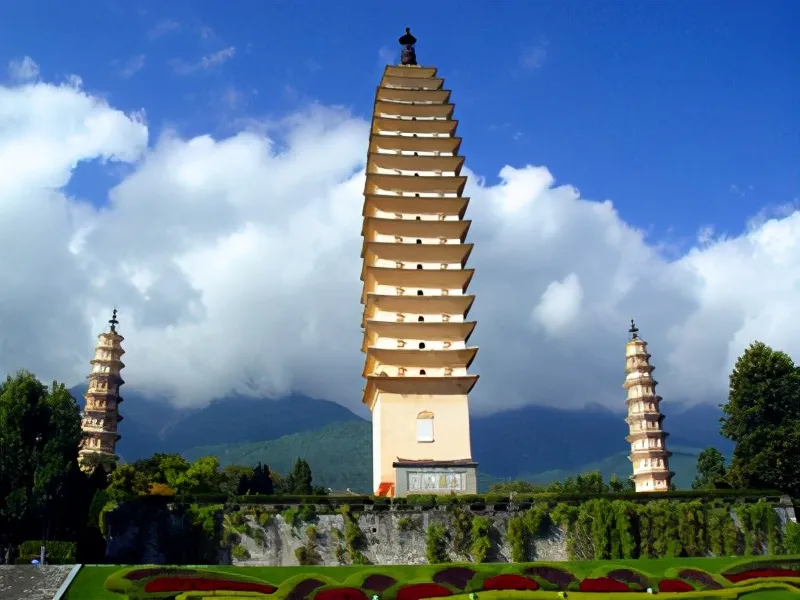
The Three Pagodas of Dali (Photo by Feng Ganyong)
Dali is located in the central-western part of Yunnan Province, 396 kilometers from Kunming, with a total area of 29,459 square kilometers. It has vast territory, rich resources, beautiful mountains and rivers, and a spring-like climate year-round, making it a treasure land yet to be developed in Southwest China. The prefecture governs one city and eleven counties, inhabited by 26 ethnic groups including Han, Bai, Yi, Hui, Lisu, Tibetan, and Naxi. By the end of 1999, the total population was 3.2609 million, with ethnic minorities accounting for about 50%, of which the Bai population was 1.0853 million. It is an autonomous prefecture with the Bai as the main ethnic group.
Close-up of the Three Pagodas of Dali (Photo by Feng Ganyong)
As the seat of the prefecture government, Dali City is also the convergence point of the Yunnan-Myanmar and Yunnan-Tibet highways, serving as the transportation hub of western Yunnan. It was historically an important gateway for cultural exchange and trade between China and Southeast Asian countries. It was the capital of the Nanzhao Kingdom in the Tang Dynasty and the Dali Kingdom in the Song Dynasty for five hundred years, known as the 'Famous City of Literature'.
Reflection of the Three Pagodas of Dali (Photo by Feng Ganyong)
Famous for its 'Wind, Flower, Snow, and Moon', Dali is now an open city to the outside world, one of the first 24 national historical and cultural cities and 44 scenic spots announced by the State Council, a national advanced cultural city, and an excellent tourist city in China. Within Dali Bai Autonomous Prefecture, the Three Pagodas of the Chongsheng Temple of Nanzhao, the Shibao Mountain Grottoes in Jianchuan, the sacred Buddhist site Jizu Mountain in Binchuan, the majestic Cangshan Mountain, the clear and bright Erhai Lake, and the lake and mountain scenery of Butterfly Spring form a beautiful and magical picture.
Nanzhao Jianji Bell Tower (Photo by Feng Ganyong)
As the bus traveled through Dali, the rolling Cangshan Mountains in the distance were clearly visible. The first scenic spot the tour group visited in Dali was the Three Pagodas of Dali, also known as the Three Pagodas of Chongsheng Temple.
View of Erhai Lake from the Three Pagodas (Photo by Feng Ganyong)
The Three Pagodas of Dali are located about one kilometer north of Dali City. Behind them stands the snow-capped, silver-streaked Cangshan Mountain, and in front lies the vast, sapphire-blue Erhai Lake. The three pagodas stand tall, supporting the sky and earth, like jade pillars piercing the sky, majestic and magnificent, one of the scenic wonders between Cangshan and Erhai.
Distant View of the Three Pagodas of Dali (Photo by Feng Ganyong)
According to records, the main pagoda is called Qianxun Pagoda, 69.13 meters high, a 16-story square dense-eave pagoda, typical Tang Dynasty architecture like the Big and Small Wild Goose Pagodas in Xi'an. Looking up from the base, the pagoda seems to pierce the clouds; as clouds move, the pagoda appears to tilt. The base is square, divided into two levels. The lower level has a side length of 33.5 meters, surrounded by stone railings with stone lions carved on the pillar tops at the four corners. The upper level has a side length of 21 meters; on its east side is a stone screen wall with the inscription 'Eternal Peace for Mountains and Rivers' by Mu Shijie, a descendant of Mu Ying, Duke of Qian. Behind the screen wall is 'Record of the Reconstruction of the Three Pagodas' erected by the provincial government.
Chongsheng Temple Complex (Photo by Feng Ganyong)
The first level of the pagoda body is 13.45 meters high, the highest among all levels. The east gate is 2 meters above the base, while the west gate is at nearly 6 meters. The wall thickness is 3.3 meters. Levels 2 to 15 are similar in structure and size. Level 16 is the top. Taking the second level as an example, it is about 2 meters high and 10 meters wide, with a corbeled eave built above, made of 17 layers of bricks, each protruding 0.05 to 0.07 meters, with the four corners upturned. On the east and west sides of the pagoda body, there are niches each containing a Buddha statue; on either side of the niches are smaller pavilion-style niches with lotus seats and hip roofs, embedded with Sanskrit scriptures. On the north and south sides, there is an arched window opening leading to the pagoda's core. On the third level, the north and south have niches, while the east and west have windows. This pattern alternates in the upper levels. The pagoda body tapers upward.
Cangshan Mountain in the Clouds (Photo by Feng Ganyong)
The pagoda top is 8 meters high, about one-seventh of the body. The tall and straight spire gives a feeling of transcending the world and piercing the sky. At the top is a copper-cast gourd-shaped vase, below which is an octagonal canopy with four spreading wings equipped with wind chimes; below that is a steel-boned copper rung; the lowest part is an inverted bowl supported by a lotus throne. At the four corners of the pagoda top, there were originally golden rocs. Legend has it that 'dragons revere the pagoda but fear the roc; Dali was once a dragon's lair, so this was used to suppress them.'
At Butterfly Spring (Photo by Feng Ganyong)
About 70 meters west of Qianxun Pagoda, there are two smaller pagodas, octagonal 10-level dense-eave brick pagodas, each 42.19 meters high. Their bodies have various reliefs of Buddha, lotus, and vases, different on each level. Levels 1 to 8 are hollow with straight walls and internal cross supports. The base is also octagonal. The two small pagodas are 97 meters apart, forming a tripod with the main pagoda, unified in layout, harmonious in shape, and integrated as a whole.
Butterfly Spring Under Renovation (Photo by Feng Ganyong)
Beside the Three Pagodas, there was once a large Chongsheng Temple. According to historical records such as 'Nanzhao Yeshi' and 'Zigu Tongji', the temple base covered 7 li, built by sage monk Li Chengmei. It had 890 rooms, 11,400 Buddha statues, and used 40,590 jin of copper. It was built during the reign of the tenth Nanzhao ruler Fengyou, from the 10th year of Baohé to the 1st year of Tianqi (AD 834-840), using 70,800 labor units and consuming gold, silver, cloth, silk, and brocade worth 43,514 jin of gold. Due to the long passage of time, most of the treasures and the temple itself have been destroyed.
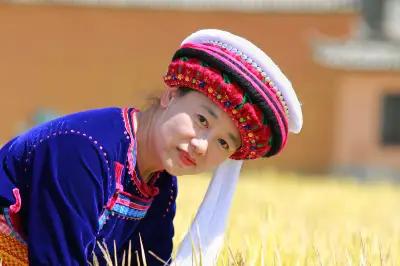
Bai People at the Scenic Area (Photo by Feng Ganyong)
I remember in April 1994, when I came to Dali to scout locations for the TV series 'Soul of the Fishing City', I visited the Three Pagodas. Returning after eleven years gave me a different feeling. Particularly gratifying was that the Dali Scenic Area had taken on a new look. With the completion of the restoration of Chongsheng Temple in April 2005, the Three Pagodas ended their nearly century-long history of having pagodas without a temple, creating a beautiful scene of pagodas and temple complementing each other.
By Erhai Lake (Photo by Feng Ganyong)
After leaving the Three Pagodas, our group drove to the Butterfly Spring Scenic Area. Butterfly Spring is located at the foot of Shenmo Mountain, the first peak of Cangshan, 27 kilometers south of Dali Ancient City. The spring is over 50 square meters, a square pool. The water is clear as a mirror, bubbling up from the bottom. Thick shade covers the pool, with a tall ancient tree lying across it—the 'Butterfly Tree'.
Boat Tour on Erhai Lake (Photo by Feng Ganyong)
According to the guide, every spring and early summer, especially on April 15, the Butterfly Tree emits fragrance attracting butterflies. Large numbers of butterflies gather by the spring, dancing in the air. Most amazingly, thousands of colorful butterflies couple tail to mouth, hanging in long chains from the Butterfly Tree, reaching down to the water surface—a spectacular sight. The marvel of Butterfly Spring has existed since ancient times, vividly recorded by Xu Xiake in the Ming Dynasty.
Ethnic Dance Performance (Photo by Feng Ganyong)
When Guo Moruo visited in 1961, he inscribed the three characters 'Butterfly Spring' (Hudie Quan), which were carved on a stone tablet by the spring. Unfortunately, the spring was under renovation, so tourists could not take photos there.
Guests Served Three-Course Tea (Photo by Feng Ganyong)
There are many legends about the origin of Butterfly Spring among the locals. One story says that long ago, a ferocious python lived by the spring, devouring people and livestock. One day, two Bai girls were caught by the python and cried out in pain. A local hunter, Du Chaoxuan, heard them and killed the python. To repay him for saving their lives, the two girls insisted on marrying him. Du Chaoxuan politely declined, saying he couldn't take advantage of the situation. In despair, the two girls jumped into the spring and drowned. Du Chaoxuan, full of remorse, also jumped in. The three turned into three colorful butterflies, dancing by the spring. Butterflies from all directions came to gather, and people called it the 'Butterfly Gathering'.
Misty Erhai Lake (Photo by Feng Ganyong)
In recent years, Butterfly Spring Park has been renovated and expanded, adding Butterfly Pavilion, Hexagonal Pavilion, Big Crescent Pool, Butterfly Specimen Hall, Wanghai Tower, and Xu Xiake statue, giving this legendary park a new radiance.
Nanzhao Customs Island (Photo by Feng Ganyong)
A boat tour on Erhai Lake was the last activity of the first day in Dali. The tour group boarded the Dayun cruise ship. On April 23, 1994, as a member of the location scouting team for the TV series 'Soul of the Fishing City', I toured Erhai Lake the day after arriving in Dali. That first tour felt short, but it included the same activities: wonderful ethnic dance performances on board and experiencing the Bai girls' 'Three-Course Tea' ceremony.
Group Photo on First Erhai Tour (Photo by Kuang Yuming)
This time, the entire cruise lasted as long as three hours. Apart from a 40-minute stop at Nanzhao Customs Island to enjoy its beautiful scenery, we spent the rest of the time sailing on the vast Erhai Lake.
Film Crew Group Photo on Erhai (Photo by Kuang Yuming)
Erhai Lake was anciently called Yeyu Marsh or Kunming Lake. Its shape resembles a human ear, hence the name Erhai (Ear Sea). Erhai is a plateau freshwater lake at an altitude of 1,972 meters. It stretches 42 kilometers from Dengchuan in Eryuan to Xiaguan in the north, about 8 kilometers wide from east to west, with a shoreline of 116 kilometers, an area of 250 square kilometers, an average depth of about 11 meters, and a storage capacity of 2.9 billion cubic meters, making it the second largest lake in Yunnan.
Statue of Guanyin (Photo by Feng Ganyong)
Erhai has abundant water sources. To the north, the Miju River and Mici River flow into it; to the east, the Bolo River; and to the west, streams from Cangshan Mountain. The Xi'er River to the south is its outlet, flowing through the Yangbi River into the Lancang River.
Group Photo on Second Erhai Tour (Photo by Liu Jie)
On the Dayun cruise ship, tourists enjoyed spectacular ethnic dance performances by young Bai men and women while sightseeing on Erhai, and tasted the unique Bai 'Three-Course Tea'. When the ship docked, the young Bai people played cheerful folk music to see everyone off. It was nearly evening, and the first day in Dali ended perfectly.
Ancient City's New Look (Photo by Feng Ganyong)
Visiting Dali Ancient City was the last activity of the Dali trip. Early on October 30, on the way to Lijiang, the convoy stopped here for breakfast, after which we toured Dali Ancient City. This was my second visit after April 22, 1994.
Group Photo on First Dali Visit (Photo by Kuang Yuming)
I remember my first visit here with the location scouting team of 'Soul of the Fishing City'. I took a photo in front of the Dali city gate tower with Mr. Huang Jianzhong, a famous director from Beijing Film Studio. Now, eleven years have passed in a flash. Returning to Dali Ancient City, I felt great changes. Not only had the stone roads been repaved and streets widened, but new cultural attractions like Wuhua Tower had been built.
Wuhua Tower (Photo by Feng Ganyong)
Dali Ancient City has a long history, abbreviated as Yeyu, also called Zicheng. Its history can be traced back to the Tianbao period of the Tang Dynasty when Nanzhao King Geluofeng built Yangjumie City (near the Three Pagodas west of the present city) as his new capital. The current ancient city was first built in the 15th year of Hongwu in the Ming Dynasty (AD 1382).
Walkway on the City Wall (Photo by Feng Ganyong)
According to documents, Dali Ancient City was 'magnificent in scale', with a circumference of 12 li, city walls 2.5 zhang high and 2 zhang thick. There were gates on the east, west, south, and north, each with a gate tower, named Tonghai, Cangshan, Cheng'en, and Anyuan respectively. At the four corners of the city were corner towers, also named: Yingchuan, Xiping, Kongming, and Changqing. The outer wall was brick, with battlements on top and a moat below. The city proper was orderly, laid out like a chessboard, with five streets from south to north and eight lanes from east to west.
A Corner of Dali Ancient City (Photo by Feng Ganyong)
Of course, most of these structures no longer exist, though some are faintly visible. What remain are parts of the north and south city walls. In 1982, the south gate was rebuilt, with the characters 'Dali' on the gatehead collected from Guo Moruo's calligraphy.
Entering Dali Ancient City (Photo by Feng Ganyong)
Today's Dali Ancient City is particularly rustic and tranquil. Streams flow within the city, making people feel refreshed. The gardens and tea houses hidden in the alleyways are excellent resting spots for tourists. The newly opened 'Foreigner Street' has become a gathering place for international visitors. The snacks with Bai characteristics and the famous 'Three-Course Tea' all offer a unique flavor. (Text and photos by Feng Ganyong)