Three Cable Cars in Dali: Gantong, Ximatan, and Zhonghe — Touring Cangshan in Full, Appreciating All the Cangshan Scenery
Yunnan is situated on the Yunnan-Guizhou Plateau, with crisscrossing rivers and sprawling mountain ranges, boasting numerous mountains and rivers. However, looking at the mountains and rivers across Yunnan's prefectures and cities, it seems that no city can compare to Dali's Cangshan.
Why do I say that? Let me explain in detail.
Lijiang's Jade Dragon Snow Mountain has 13 peaks, Shangri-La's Meili Snow Mountain also has 13 peaks, while Dali's Cangshan has 19 peaks—six more than the former two. You can imagine how few mountains in Yunnan can rival Cangshan in its majestic grandeur.
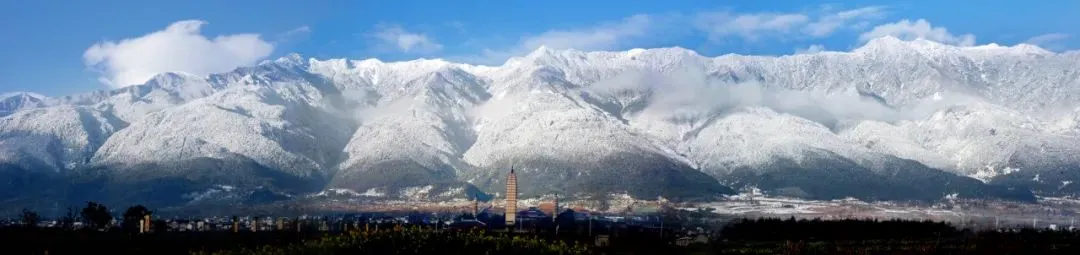
Jade Dragon Snow Mountain and Meili Snow Mountain are snowy landscapes, with snow on their peaks never melting all year round; the scenery you see is all snow. Cangshan, on the other hand, has distinct seasons, with green mountains all year round, misty clouds in summer, and snow covering the peaks and mid-slopes in winter. The phrase "Silver Cang and Jade Er" describes Cangshan and Erhai Lake at this time.
The maximum elevation difference on Cangshan is nearly 2,000 meters. The terrain is steep, and temperatures are low in the mountains. Climbing Cangshan by foot is too dangerous, so three cable cars have been built on Cangshan to facilitate tourists' visits.
In late November, Cangshan has already begun to put away its summer clouds and mist, welcoming the arrival of heavy snow!
Three cable cars on Cangshan take you on a comprehensive tour, allowing you to fully appreciate Cangshan's scenery!
The three cable cars on Cangshan, from south to north, are: Gantong Cable Car, Ximatan Grand Cable Car, and Zhonghe Cable Car.
The Cangshan Ximatan Grand Cable Car is the longest, with a one-way length of 5,555 meters, followed by the Gantong Cable Car at 2,630 meters one-way, and the shortest is the Zhonghe Cable Car at 1,668 meters one-way.
Although all three cable cars travel through Cangshan, they offer completely different experiences. The Gantong Cable Car allows you to feel the endless forest sea of Cangshan and the tranquil depth of Qingbi Stream. The Ximatan Grand Cable Car lets you experience the crisscrossing valleys of Cangshan, the undulating terrain, and the pristine purity of Ximatan. The Zhonghe Cable Car gives you insight into the long history of Zhonghe Temple.
These three cable cars are connected by a 11.5-kilometer-long blue stone path running from south to north—the Jade Belt Cloud Touring Path. This is a hiking trail that winds through Cangshan, offering views of the magnificent peaks, outstanding mountain scenery, and perilous summits.
The Gantong Cable Car backs onto Cangshan and faces Erhai Lake, adjacent to the ancient temple Gantong Temple and the internet-famous temple Jizhao Nunnery. Riding the cable car, you can overlook the hundred-mile Erhai Lake, Dali Old Town, the Three Pagodas of Chongsheng Temple, and the rolling Cangshan mountains.
The main attractions of the Gantong Cable Car are the Zhenlong Chess Game, Cangshan Canyon, and Qingbi Stream. Qingbi Stream is one of Cangshan's eighteen streams and a classic sight of the Gantong Cable Car. A single stream connects three pools, each with a different scenery, making it very unique. The Gantong Cable Car is also the starting point of the Jade Belt Path.
The scenery inside Cangshan is completely different from what you see from the cable car. In the mountains, a single leaf can block your view, and your gaze can only wander within a hundred meters. But the tranquility of the surroundings and the freshness of the air are unmatched elsewhere.
Especially in summer, when the city is unbearably hot, Cangshan is cool and pleasant. The air is filled with abundant moisture, which not only nourishes the trees but also makes the air exceptionally good.
This is the best time to visit Qingbi Stream, because you can experience another artistic conception of a winding path leading to a secluded spot.
At the Gantong Cable Car, whether you are traversing through narrow valleys or riding in a suspended cabin high in the air, you can feel its most prominent characteristic—tranquility.
The Ximatan Grand Cable Car is located next to the Tianlong Babu Film Studio. It is currently the tourist cable car with the largest elevation difference in the world and the longest climbing slope in China.
Riding this cable car, you can also overlook Erhai Lake and Dali Old Town, and enjoy the ultimate views of Cangshan's summit, because this cable car connects the Tianlong Babu Film Studio, the Qilongnu Pool, and Ximatan into one line.
This cable car allows you to enjoy snow in winter and see flowers and water in summer. The majestic and magnificent beauty of Cangshan is fully displayed during this cable car journey.
The Ximatan Grand Cable Car passes through three scenic spots: the Tianlong Babu Film Studio at the foot of the mountain, the Qilongnu Pool on the mountainside, and Ximatan at the summit.
This is the richest and most special cable car among the three in terms of scenery. However, due to the high altitude, visiting Ximatan at the upper station is affected by weather conditions.
The scenery along the Ximatan Grand Cable Car varies greatly between seasons, and even in the same season, the scenery at different altitudes differs significantly.
In spring and winter, the forest at the foot of the mountain is lush, while snow gradually appears from the mountainside upward. At the summit near Ximatan, it is completely covered with heavy snow.
In summer, the summit of Cangshan is often shrouded in thick fog, while the foot of the mountain is bathed in bright sunshine. When the rhododendrons bloom, varieties bloom one after another from the foot to the summit according to the season.
In autumn, rainfall decreases, but the trees on Cangshan remain verdant, and Ximatan does not dry up; there is no hint of autumn.
The Zhonghe Cable Car ends at Zhonghe Temple, hence its name.
This cable car is different from the Gantong and Ximatan Grand Cable Cars because the cabins of the Zhonghe Cable Car are not fully enclosed but are two-person open-air chairs. This allows you to directly feel the coolness of the air and the sensation of being suspended in mid-air.
Since it is an open-air hanging basket cable car, you can clearly see the layout of the area between Dali Erhai Lake and Cangshan from the cable car. With a short route, this cable car can offer an unobstructed experience of Cangshan's beauty regardless of wind or rain.
Apart from the beautiful scenery from the cable car itself, at the end of the Zhonghe Cable Car stands a famous temple in Dali—Zhonghe Temple, located on the central peak among Cangshan's nineteen peaks.
Zhonghe Temple may seem inconspicuous, but it has a very long history and culture. It was first built during the Nanzhao period of the Tang Dynasty, and during the Kangxi Emperor's reign of the Qing Dynasty, it was granted a plaque inscribed "Dian Yun Gong Qiao" (Yunnan Arch Bridge). Through continuous repairs, it has been preserved to this day.
All three cable cars—Gantong, Ximatan Grand, and Zhonghe—can take you to Cangshan. The Gantong and Zhonghe cable cars reach the mountainside, while the Ximatan Grand Cable Car reaches the summit. The scenery differs among the three, with the Ximatan Grand Cable Car offering the best views.
No matter which season or which cable car you choose, you can see Dali's unique scenery!
If you don't know how to choose, follow this advice:
In spring, summer, autumn, and winter, you can choose the Cangshan Ximatan Grand Cable Car. In spring and winter, you can see Cangshan and Ximatan covered in silver; in summer, you can see the misty clouds of Cangshan and a sea of rhododendrons.
In summer and autumn, choose the Gantong Cable Car or Zhonghe Cable Car. In summer, you can see Qingbi Stream at its most beautiful time and also feel the coolness of the Jade Belt Cloud Touring Path. In autumn, whether you choose the Gantong or Zhonghe Cable Car, you can feel the vast sky and wide vistas of Cangshan and see the golden fields of Dali.
After learning about the three cable cars, let's get to know Cangshan's eighteen streams and the legends associated with them.
From south to north, between every two of Cangshan's nineteen peaks, a small stream forms in the valley, making exactly eighteen streams, hence they are called "Cangshan Eighteen Streams."
From north to south, they are: Xiayi Stream, Wanhua Stream, Yang Stream, Mangyong Stream, Jin Stream, Lingquan Stream, Baishi Stream, Shuangyuan Stream, Yinxian Stream, Mei Stream, Tao Stream, Zhong Stream, Lüyu Stream, Long Stream, Qingbi Stream, Mocan Stream, Tingming Stream, and Yangnan Stream.
The water of Cangshan's eighteen streams originates on Cangshan and eventually flows into Erhai Lake. They embellish Cangshan's scenery, nourish the land in the basin at the foot of Cangshan, and nurture the people of Dali.
The scenery formed by each of Cangshan's eighteen streams has its own merits. Some are elegant and graceful, some are grand and majestic, and some are small and delicate.
Apart from their beautiful scenery, the legends associated with Cangshan's eighteen streams are also very interesting!
In ancient mythology, Cangshan was transformed from a green dragon, and the formation of the eighteen streams is related to this legend.
The legend goes that the Jade Emperor ordered the green dragon to control the wind and rain of Dali. But the dragon was playful and neglected its duties, causing droughts when rain was needed and devastating floods when rain was not needed, submerging villages and destroying farmland.
Despite repeated warnings from the Jade Emperor, the green dragon ignored them. So the Jade Emperor punished the dragon by sending it down to earth, where its body transformed into Cangshan, its ribs into the nineteen peaks, and the spaces between its ribs became the eighteen streams.
It is said that in Cangshan's eighteen streams live eighteen giant dragons, each governing one stream. The Great Black Dragon of Long Stream is the leader of all dragons.
But the Great Black Dragon was capricious and cruel. Every year when the crops ripened, it used the Dragon Seal to command the dragons to cause floods, inundating farmlands and villages.
The Little White Dragon governing Mocan Stream was very kind. Seeing the Great Black Dragon wreaking havoc among the people, it used a clever trick to seize the Dragon Seal from the Great Black Dragon and suppressed it in Long Stream. From then on, the basin enjoyed favorable weather and abundant harvests.
In addition, the names of many of Cangshan's eighteen streams are also closely related to legends.
For example, "Yinxian Stream" (Hidden Immortal Stream). It is said that in a rocky cave in the upper reaches of the stream, there is a huge rock that looks very much like a human figure. The locals call it the "Hidden Immortal" and believe that an immortal resides there in seclusion, hence the stream is named "Yinxian Stream."
[Editor] Yunnan Yijing
[Note] Please indicate the source when reprinting this article. Images are not allowed for commercial use without permission. Some images are provided by the scenic area. If there is any infringement, please contact to delete.