Meeting You in Dali and Lijiang, Recalling Our Beautiful Youth
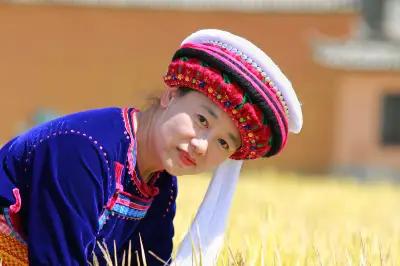
You once stood under a bright blue sky, joyful yet wistful,
and once roamed freely through emerald fields, yet with a trace of sorrow,
running toward the distance, then turning back to gaze.
At the road’s end, I stood,
silently guarding that pure, unadulterated time.
Colorful clouds drifted overhead,
I saw distant indigo mountains and white villages.
The wind lifted your hair and the hem of your dress,
carrying your fragrance through the country breeze.
In that moment, my world
held only you, a girl like a poem.
The lifelong dream
is a distant place never reached, a hometown never returned.
But once you arrive at that distant place, it becomes home.
You’ve found your faraway land, your home—
please remember those
gradually fading lush days,
and the look of your younger self.
Sending you a letter from afar.
Seeing this letter is like seeing you. I hope you’ve been well lately.
Do you still remember the intersection in front of Lijiang Old Town? We parted in a hurry there over a month ago. That day, watching you get into the car and leave, a sudden sadness welled up inside me. It felt like there were still so many words unspoken, so many sights unseen. We had only just met, yet we had to say goodbye. I imagine you still miss those days in Yunnan—you’d looked forward to the journey from Dali to Lugu Lake for so long, and finally we made it all the way. And I’m no different. Sitting on the return flight, I almost burst into tears. I suppose I simply couldn’t bear to leave. That entire journey was like a dream—or perhaps, even more beautiful than a dream.
In some quiet, late night, as I leaned over my desk, I thought again of Dali’s sky, sunlight piercing the clouds to fall on emerald wheat fields, clear and warm; I thought of Erhai Lake’s breeze gently brushing your hair, your silhouette standing against the wind by the shoreline trees; I thought of Shaxi’s streets, the ancient Tea Horse Road’s worn flagstones, where I wandered as if witnessing a thousand years of prosperity; I thought of Lugu Lake’s night, the wind scattering the clouds at the horizon, shrouding us beneath a sky full of stars. I fear that years from now, all of this might fade like the night sky did that evening. So I wanted to write you a letter, to capture the beauty along the way and our story.
When I walked through Dali’s bustling crowds and met you under the city’s dazzling sunlight, you stood beneath a cherry blossom tree, quiet and still as ever. You said, “I knew we’d meet again, in the warm sunlight of the old town, under the cherry blossoms.” I smiled. Truly, the most wonderful thing in life is anticipation. I anticipated Dali Old Town’s sunshine just as I anticipated you and this journey.
Dali, I anticipate you like the old town’s gentle light.
In the days that followed, I didn’t travel again; life remained plain as before. But I still thought of that agreement between us—the one without any promise. Before time, any promise is pale. Yet sometimes, time also brings hope.
When the sun set, those were our laziest, most leisurely hours. Sometimes travel needs no map, no destination. That kind of aimless wandering, stumbling upon an unmentioned corner and discovering a unique beauty, is the most delightful surprise. Later, we passed by the Wen Temple and then Yu’er Garden—places not quite tourist spots, simple and clean. That day, Yu’er Garden had very few visitors, creating a special tranquility. The garden is planted not only with cherry blossoms but also Dali’s famous camellias, and even more unnamed wildflowers by the path. In early spring, the whole garden was fragrant. Knowing you loved the peace here, I sat for a long time, bathed in the fading sunlight.
My favorite thing at the guesthouse was the big round table. The moment I saw it, I thought of Werewolf. That night, we played Werewolf in the dim courtyard until late. You could never convincingly state your role, and were voted out every time, while I, as the werewolf, kept bluffing and leading the game. Later, when we talked about it, I said your reasoning wasn’t logical—and you complained that you couldn’t speak Cantonese so you couldn’t explain clearly, but if you used Cantonese nobody would understand anyway. So frustrating. Those people in our memories came full of hope and left with reluctance, adding sparkle to each other’s journeys, leaving beautiful reflections in one another’s travels. But after all, they were just hurried passers-by in a happy time. Looking back, we were passers-by too.
That night, you went to bed early, and I stood on the hostel rooftop gazing at the distant night. The lights in the distance were still bright, and I could see the famous Three Pagodas of Chongsheng Temple. My original plan was to sit there leisurely, stargazing from the spacious rooftop, but the surrounding brightness left only scattered stars in the sky. No wonder—when the moon is bright, the stars are few. Fortunately, I had a bright, clear moon and a soft evening breeze for company. I thought of the song “Evening Breeze” by the band Good Sister. They sing: “Gentle evening breeze, blowing softly into a lover’s dream; gentle evening breeze, blowing softly across the homeland sky; gentle evening breeze, blowing softly over city lights; tonight’s evening breeze, where are you going, please tell me.”
When it comes to food, I’d better defer to your expertise. Yunnan cuisine isn’t particularly elaborate—nothing like Guangzhou or Chengdu, those food capitals. But I recall those days when you led me around searching for all kinds of local bites: a roll of rich, grilled dairy fan; a pot of fragrant rice noodles; a fresh bowl of steam pot chicken—I miss them now. The most memorable was probably that grilled fish. I know Cantonese people like mild flavors, so I told the shopkeeper we wanted it just slightly spicy. To my surprise, the people of the Yunnan-Guizhou Plateau are just like those in Sichuan—they love their heat. Even “slightly spicy” was too much for us. You were so overcome by the spice you couldn’t speak, yet you refused to stop eating. Thinking about it now is pretty funny. And of course, Dali’s most famous snack: flower cakes. Freshly baked flower cakes with a layer of cheese on top are crisp, sweet, and fragrant. Oh, and my beloved Dali yogurt. From Dali all the way to Lugu Lake, I drank a bottle every day—it almost became an article of faith.
One day later, you said we hadn’t taken a single photo together during those days. So we found a random street corner, set up a tripod, and took this picture. The truth is, my feelings for you weren’t some complicated, vulgar crush, nor a heart-stirring spark. We were simply fellow travelers on the road, not mentioning the past or asking about the future. I often envied you—your carefree, easy way of traveling, your courage to venture far without fear. And I also sympathized with the solitude and fragility of traveling alone. You’re passionate about sampling local cuisine everywhere you go, so traveling with you meant a feast every step of the way—a great blessing indeed.
I didn’t take many photos of all that food. Later, I searched and only found these two bowls of shredded pork rice noodle soup. I suppose all the food pictures are on your phone—remember to send them to me when you can.
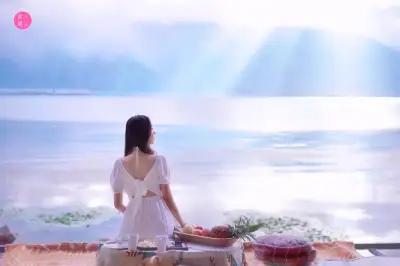
When we rode an electric scooter along the field paths by Erhai Lake, that was exactly what we’d been longing for. March weather was already warm as spring, and though there was still snow on Cangshan’s peak, it wasn’t as vast and continuous as in winter. You said the large white expanse was Cangshan snow. I said, no, those are just distant clouds gathered atop the mountain, as white as snow. We took a long detour, missing the seagulls at Majiuyi, missing the transparent hanging ball and the white bench, only to come upon a patch of blooming flowers here. The sea and sky merged in the distance, framing the deep and light red along the shore—this was the Erhai Lake I had always dreamed of.
At that moment, trying to look cool, you insisted on driving the scooter. So I stopped and switched to the back seat. But I was too heavy, wobbling unsteadily, and after a short ride, we switched back. You blamed my weight, and I teased you: a girl trying so hard to be tough. Along this stretch of West Ring Road, there were slanting trees in the lake, each shaped differently, some even fallen straight into the water—very interesting. That toppled tree could be considered a sacred tree; people waiting to climb it for photos formed a constant stream. Some couples even used it as a backdrop for wedding photos, so you really had to queue for a long time. Then you carelessly dropped your sunglasses into the water—luckily it wasn’t deep. Erhai’s water is crystal clear; you waded in to retrieve them and exclaimed how cold it was.
Haishe Park was, you said, your favorite spot by Erhai. The West Ring Road was under construction, and I don’t know how many detours we took, passing through countless field paths and clouds of dust. By the time we arrived, it was already afternoon. But the timing was fine—we weren’t in a rush. Isn’t life meant to slow down and walk softly? We passed through a shady bamboo grove all the way to the end of the shore. Haishe Park, as its name suggests, is a peninsula jutting out like a tongue. Standing at its tip, surrounded by water on three sides, you quietly felt the breeze from the lake’s surface, losing yourself in that sun-drenched moment.
Dali’s clouds are intoxicating. It’s because of the clouds that Erhai doesn’t seem monotonous or lonely. Look, the clouds embedded at the horizon constantly change shape, drifting with the wind, sometimes adorning the azure sky, sometimes veiling the blazing sun. Sunlight pierces the clouds, casting mesmerizing crepuscular rays that illuminate the distant rolling hills and lush fields, now visible, now hidden. That must be the most beautiful moment of Cangshan and Erhai.
I still remember when an old woman approached us. I thought she was telling us not to trample the crops, so I apologized profusely. But she didn’t leave; she said something to us. It must have been the local dialect—I couldn’t understand a word even after a few tries, and it got a bit awkward. Finally, you understood: she wanted us to help her lift the carrying basket onto her back. I did as she asked and then noticed she used her forehead to support the strap—it didn’t look easy at all. Living in the city for so long, seeing so many cold high-rises and so much human indifference, we seem to have grown accustomed to that kind of formatted life. The old woman was no longer young, and like all locals, she lived in the most primitive, simple way. In this contended, peaceful countryside, even with tourists passing through, they never forget their original heart and remain so pure and clean. I recall as we drove away, we waved goodbye. She shouted back enthusiastically. I don’t have a photo of the old woman, but I miss that story deeply.
Jizhao Nunnery is built halfway up Cangshan Mountain, and we hiked for a long time to reach it. You said you hated climbing more than anything in life, yet both times with me, you’d been tricked into it. I knew you meant the previous trip to Maolan, when we trekked mountain paths in high summer for most of the day—truly exhausting. But this time was nothing compared to that. We passed Gantong Temple and kept going, taking photos along the way, and after about half an hour, the nunnery’s gate came into view. That day, the four of us traveling together sat down for a group photo. Then, at dinner, we ordered braised chicken with mushrooms and added an egg, so you nicknamed our little squad “Egg-added Braised Chicken.” But I’d gotten used to it—I already knew from last time that you named every group chat after food…
As the sun was about to set, we passed a few cozy, slightly bohemian cafés, bumping into softly singing, artsy youths. Such leisurely days were rare along the way. Perhaps because we were both looking forward to the upcoming Lugu Lake trip, we were in that easygoing, go-with-the-flow mood in Shuhe, not deliberately seeking out sights but treating every place we passed as a view. You said many people here eat little pot rice. So we chose a busy restaurant, ordered the dish, and sat by the window on the second floor, watching the sky outside slowly dim until only bright lights and scattered songs remained.
Little pot rice is quite famous in Lijiang, a specialty food. Many celebrities visiting Lijiang choose this long-established restaurant in Shuhe Ancient Town to taste authentic little pot rice. This time I finally got to try it, and it was delicious, very satisfying. I highly recommend everyone go try it!
Speaking of Lugu Lake, it’s where the dream began. The original reason I wanted to come to Yunnan was that someone once mentioned Lugu Lake as a place far from worldly clamor, with few tourists and breathtaking scenery. If you wanted to calm your mind, just go sit by Lugu Lake—it would never disappoint. At the Lige observation deck, I saw four different faces of Lugu Lake: from heavy clouds to clear, boundless skies; from colorful clouds filling the heavens to a canopy of dazzling stars. It was like life, like the four seasons. In that cycle, I saw through its changes and vicissitudes.
That day, setting off from Shuhe, the weather wasn’t good. It was already gloomily overcast when we left. Soon, a drizzly rain began to fall, and we ran into an accident on the road, forcing a long detour. By the time we arrived at Lige, it was already afternoon. The sky still hadn’t cleared, and the light rain kept falling. On an overcast day, Lugu Lake is indeed not beautiful—even Xiaoying said so. Under the thick layers of cloud, the lake’s surface turned gray, as if the surrounding air were saturated with a dull atmosphere. But I was determined to find a distinctive flavor even in such weather. That day, Lugu Lake was like early spring among the seasons: though everything still seemed withered, it was slowly reviving. Through the occasional gaps in the clouds blown open by the wind, I caught glimpses of a deep blue sky—that was our hope for tomorrow.
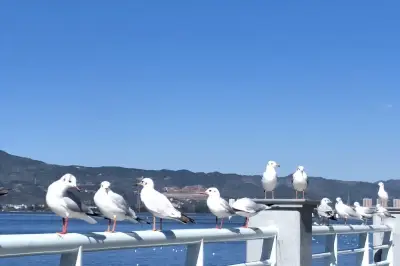
At Lige’s dock, we saw many seabirds. Those spirits of Lugu Lake sometimes floated quietly on the water, sometimes called out and rose in flocks. They could be a little greedy too, following small boats heading out into the distance, chasing the food people threw far across the lake. You said missing the seagulls in Dali was a regret, but you didn’t expect to see them here at Lugu Lake. Yet our encounter was brief; after that day, on the sunny days that followed, they were nowhere to be seen. I think of them as a gift from Lugu Lake’s overcast weather, adding a touch of color to the gray sky.
Lige Bay is the liveliest spot around Lugu Lake. The observation deck there is truly the best vantage point, just a ten-minute walk up. But you ran out of steam halfway and didn’t go any further, so you missed the view from the top and probably don’t understand the four different Liges I mentioned. As for those lakefront guesthouses on the peninsula—their prices were outrageously high. We simply couldn’t afford such luxury.
When we reached Nisai Village, we finally made it to the lakeside. Nisai has few households; compared to Lige and Daluoshui, it felt much quieter. Yet the scenery was no less stunning. The sun was blazing that day, but you said, “The sunlight is just right.” They say Nisai has two Lover Trees, but we didn’t find them. Oddly enough, both Dali and Lugu Lake are supposed to have Lover Trees, yet we never saw either. Perhaps those legendary trees were never meant for us.
“If someone on the Walking Marriage Bridge grabs your hand, you must remember to grab back!” That day we joked like that, fooling around. The Mosuo custom is said to still be practiced, and this bridge has witnessed countless loves. I imagine those shy Azhu and Aixa, gazing at the same green hills, blue sky, and Grass Sea, turning from green to yellow and yellow to green, in the blink of an eye, year after year of growth and decay. How many stories those years must hold, stories we can never know, and need not dwell on.
Past Nisai Village, past Xiaoluoshui, a few simple clouds drifted across the horizon. And it was these simple clouds, reflected in the lake’s water, that added color to the monotonous blue. But all that color paled next to your radiance. With you by the lake, it seemed the scenery itself brightened, more vibrant and alive.
In life, all meetings must end in parting. After this journey, with us so far apart, we may have little chance to meet again. But the world is not set in stone—just as I once thought before, yet our reunion came so unexpectedly and perfectly. Life is just like that, isn’t it? Who knows what the days ahead hold? Maybe we’ll see each other again very soon, won’t we?
—— A person’s good mood needs your own care; life is short, don’t neglect yourself.
Travelogue Contents 1. Dali 2. Shuhe Ancient Town 3. Lugu Lake Travel Information Hotel Index Guide Index Flight Index Website Navigation Travel Index Cruise Index Corporate Travel Index Join Cooperation Distribution Alliance Friendship Links Corporate Gift Card Procurement Insurance Agent Agent Cooperation Hotel Partnership Destination & Scenic Area Cooperation More Cooperation About Ctrip About Ctrip Ctrip Hot Topics Contact Us Careers User Agreement Privacy Policy Business License Security Center Ctrip Content Center Intellectual Property Trip.com Group Algorithm Disclosure