Late Autumn, I Await You in Western Yunnan
A classmate sent a photo of the golden ginkgo leaves in Tengchong on WeChat. After nearly a year of staying at home, I could no longer suppress my longing, and together with a few companions, we embarked on an impromptu trip! On December 10th at 4 PM, our first stop was flying from Nanning to Tengchong with a transfer in Kunming. We arrived in Tengchong at 8 PM. Tengchong is a small border town in western Yunnan, adjacent to Myanmar. Back then, the Expeditionary Force set out from here, opening up a crucial southwest supply route—a city of great merit. The four of us took a bus from the airport, 20 yuan per person. The driver enthusiastically told us about the bus routes, dropped us off at the tourist bus station, and informed us about the nearby hotels. After thanking the driver, we checked into Fengyuan Theme Hotel, a hotel with excellent value for money. The young lady at the lobby told us the bus fare and private car fare to Ginkgo Village. The next morning, we four slept in, had a nice breakfast, and took a taxi to Ginkgo Village at ten o'clock.
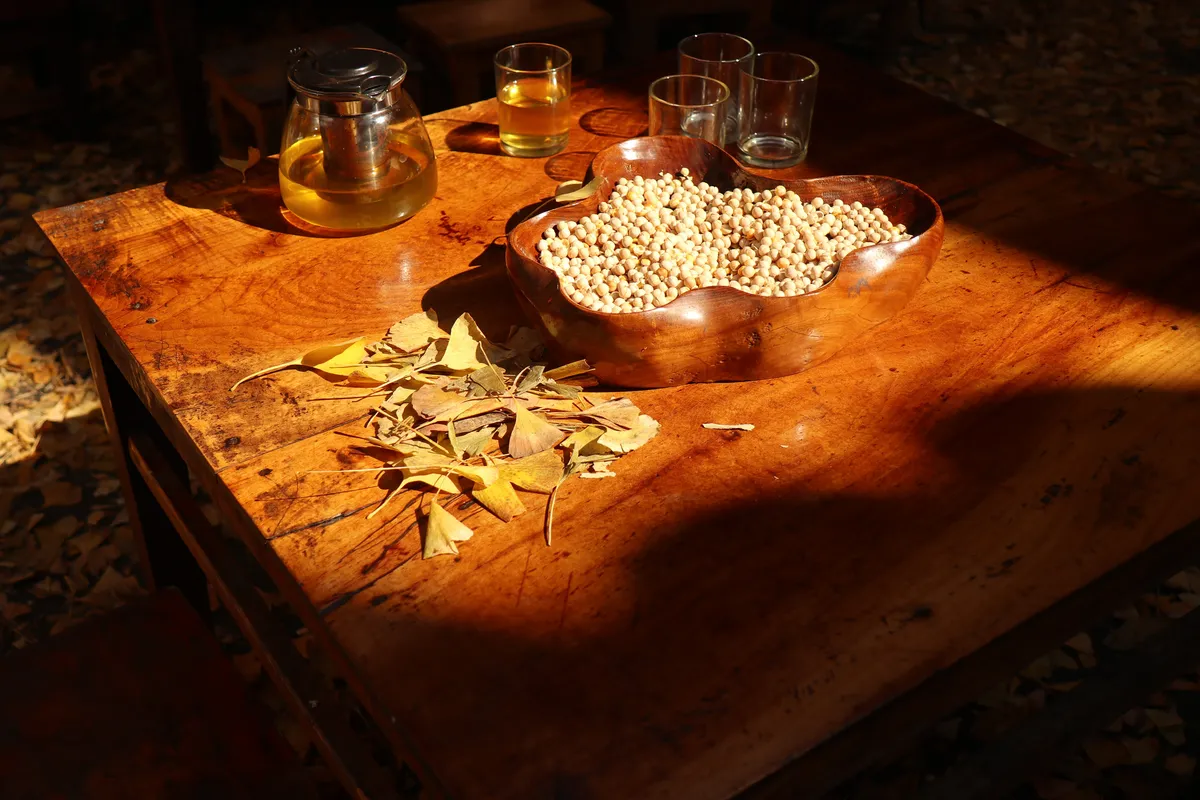
On the way to Ginkgo Village, the yellow leaves on both sides were mostly gone. It must have been beautiful if we had come in early December. Around noon, we arrived at Ginkgo Village under bright sunshine. After getting off, the innkeeper was waiting in her car to pick up guests. She took us to her home, a wonderful little courtyard. In the yard stood a century-old ginkgo tree, with only a carpet of yellow leaves left on the ground. In the center of the courtyard were a table, tea, and fragrant roasted beans. The wooden cabins around exuded a fresh woody scent. Sunlight filtered through the leaves, shining on the small table in the yard—romantic and cozy.
We put down our simple luggage and went out with our cameras to take photos. We told the innkeeper we'd be back at two o'clock for rice noodles.
The entire Ginkgo Village was a yellow world paved with golden leaves. Under the gentle breeze, the paths, low walls, courtyards—everywhere were golden fallen leaves. It was like a fairy-tale village.
Climbing onto the wall, we showed off our slim waists, carefree, savoring the last days of youth.
The villagers were simple and honest. Every courtyard gate was open; whether you were a guest or not, you could go in, look around, take photos, and enjoy the tea and beans. They were very enthusiastic when asked for directions.
The small courtyard in the afternoon, radiant like gold under the sun.
This was exactly the kind of route I liked—pure and off the beaten path. The snacks and local specialties sold by villagers by the roadside were not expensive compared to outside. Since it was the first stop, I couldn't bring much, so I bought half a kilo of dried sweet potatoes, 10 yuan per jin (500g), to eat on the way. They were very tasty. My classmates also bought peach gum, ginkgo nuts, etc., all reasonably priced.
For dinner, the innkeeper made us ginkgo chicken soup, cured pork, and sausages. They were very delicious.
On the third morning, we wandered around the village for most of the day. The morning sunlight slanted through the ginkgo trees, giving a warm and lazy feeling.
Street vendors enthusiastically recommended farm specialties to us.
Fruits hanging on trees in farm courtyards looked fresh and tempting. We asked, and the owner warmly invited us to pick and eat.
This is the handsome Teddy dog we encountered in Ginkgo Village.
Far from the noise and glamour, enjoying this moment of leisure.
After lunch, we reluctantly left Ginkgo Village, an ancient village yet to become commercialized. There have been too many negative news about tourism in Yunnan, and I always had lingering fears about traveling there. This rustic village overturned my perception of Yunnan tourism.
In the afternoon, we took a bus to Beihai Wetland. The sun was bright, and the natural environment was well preserved!
On the fourth morning, we again slept in, then took a bus to the Hot Spring Park. It was crowded on the weekend. We took an electric cart to the Rehai Big Boiling Pot! Water at 97 degrees Celsius was boiling and steaming in the pot. Next to it, eggs, peanuts, yams, and other snacks were being cooked. This is one of Yunnan's Eighteen Oddities: eggs sold on skewers.
The air in the mountains was very good. From Rehai Big Boiling Pot, we took a car to Meinv Spring. Meinv Spring had few people; tour groups didn't come here. The hot spring experience there was excellent—almost every pool was just the four of us. There were Chinese herbal pools and ginger juice pools. Free herbal tea was available. After soaking, I felt sleepy. We washed up and went upstairs to have some snacks. After resting, we took a car to the restaurant for rice noodles (included in the ticket). After dark, we took a Didi back to the hotel to organize the day's photos and videos and post on WeChat Moments.
On the fifth day, we said goodbye to Tengchong and took a shuttle bus to Ruili. A special reminder here: For those not used to carrying cash, shuttle bus tickets are cash only. Fortunately, one of our classmates had 500 yuan in cash, and we caught the 9:30 bus. For lunch, we ate the milk and cake given by Fengyuan Hotel. In Ruili, it was another sunny day. Ruili is not big, surrounded by Myanmar on all sides. The main ethnic groups are Dai and Jingpo. The economy relies heavily on tourism. After the pandemic broke out, the China-Myanmar border was closed, and the city became much more desolate. The duty-free area had very few people. I used to like a fashion magazine called 'Ruili', and I thought this city would be full of fashion and romance, but I was a bit disappointed when I arrived. We visited Dushu Chenglin (a single tree forming a forest), with an inscription 'Ruili' by Mr. Guo Moruo.
In the afternoon, we went to One Village Two Countries. The ticket price was not halved, and there were quite a few people. This was originally a single village inhabited by villagers from both China and Myanmar. Because of the pandemic, a barbed wire fence separated the two sides. Since it's close to China, the living standards of villagers in this village have become much better than those in Myanmar in recent years. Children go to Chinese schools, enjoying the same benefits as us—free tuition and free lunch. The children speak Chinese very well. Many of the attractions there are now man-made. The long-neck performance we hoped to see was gone; I heard they ran back to Myanmar.
In the evening, we had a Dai feast. It wasn't as tasty as imagined—the flavors were too strong. At night, we went to the night market to watch jade gambling (betting on raw stones). There were many people, but the vendors said there used to be even more. We walked around completely clueless. In Ruili, due to the pandemic, you could stay in a three-star hotel for just over 100 yuan, and the breakfast was also ample.
On the sixth day, our hired driver took us to Mangshi. Mangshi is the capital of Dehong Prefecture. The main attractions are the Menghuan Big Gold Pagoda and the Big Silver Pagoda. These belong to Theravada Buddhism. The Buddhist culture of Mangshi benefits the surrounding area. I've heard that people who don't understand Buddhist teachings shouldn't take photos in front of the Buddha. So I just quietly visited and took a photo from a distance.
At one in the afternoon, we took an express bus to Dali. Along the way, the checks were very strict—every vehicle was thoroughly inspected. At 6:30 PM, we arrived in Dali, and the B&B owner we booked through Ctrip sent a car to pick us up. We booked a B&B near the old town, and the accommodation cost was significantly higher than in western Yunnan. In the evening, we wandered around the old town. The old town had lost its usual hustle and bustle. Dali's rose fruit wine was delicious, but unfortunately we couldn't take it with us. We ate some local snacks in the old town and bought some small handicrafts as gifts for friends, then returned to the B&B. The B&B was nice, but it was clearly stated that breakfast was not provided, saying it was unsafe during the pandemic. On the first day in Dali, this romantic place gave us a bad experience!
Our original plan was to stay in Dali for three nights and tour for two days: one day touring Haidong (east side of Erhai) and one day touring Haixi (west side). I was in such a hurry that I forgot my driver's license, so renting a car was impossible. Hiring a private car was 350 yuan per day, which we found not cost-effective, so we changed to just one day of touring. The subsequent itinerary proved this decision was wrong.
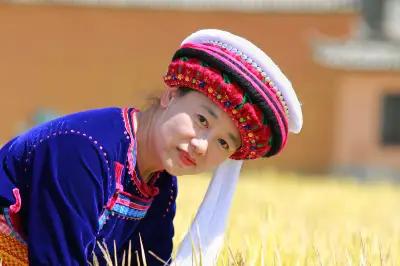
On the seventh morning, we went to a Bai ethnic food street next to the B&B and had dumplings, then set off. Dali Bai Autonomous Prefecture is famous for Bai-style houses: white walls, black tiles, neatly arranged, with exquisite patterns painted on the walls.
The car drove through a very distinctive city with rows of white houses. By the roadside, cherry blossoms were fading. Beside it was the beautiful Erhai Lake. Along the Erhai shore, there were Beetle cars and sports cars in various colors, and fashionably dressed young people. The romantic and fashionable vibe of Dali came rushing over us.
Beautiful Butterfly Spring
On the eighth morning at 11 AM, we took a bullet train to Kunming. At 3 PM, we went to Haigang Dam to feed the black-headed gulls! The scene was spectacular.
We played until sunset, then took a bus and transferred to the subway to Kunming Old Street. It was also quiet with few people—more shops than tourists. For dinner, we had the never-tiring Crossing-the-bridge noodles. The rice noodles in Yunnan taste great everywhere!
On the ninth day, we said goodbye to Kunming and took a bullet train home. This ten-day independent trip was simple and spontaneous, covering half of Yunnan. We mainly focused on niche attractions and didn't go to popular spots. For those who like taking photos, it's better to travel independently. That way, you won't be stuck in a shopping store during the best lighting hours of the day.