Wandering in Dali, Enjoying Peaceful Moments
When I think of Dali, I’m filled with daydreams—it’s a haven for artistic souls, a place of poetry and distant dreams for so many. If you’re looking for somewhere to spend the rest of your days, far from the noise, Dali truly fits the bill.
Cangshan’s snow, Erhai’s moon, Xiaguan’s wind, Shangguan’s flowers—head to Dali for a taste of romance and beauty. It’s not just steeped in artistic vibes, but also brimming with the charm of an ancient town. By Erhai Lake, time slows to a crawl; you can pause anywhere, gaze at mountains and waters, soak in old-town life, and admire blossoms galore. No matter how many times I’ve visited, Dali always leaves me utterly enchanted.
When I think of Dali, the Ancient City comes to mind first. Its streets are paved with stone slabs, and walking these bluestone paths while humming a tune just melts the stress away.
In Dali Ancient City, I’m always drawn to blue-and-white patterned cloths—this is Dali tie-dye. The main colors are white and indigo; white symbolizes good fortune for the Bai people, and together they create simple yet beautiful patterns.
Gray tiles and white walls define traditional Bai architecture. Wandering the old town, you can sense Bai history and culture everywhere.
Occasionally, you spot time-worn houses along the lanes—carefully restored yet still bearing the marks of age.
Inside the ancient city, four main streets stretch in each direction, crisscrossed by countless alleys. Strolling leisurely, ducking into whichever lane catches your fancy, you’ll find shops with uniquely decorated entrances.
There’s also Foreigner Street in Dali Ancient City, which comes alive at night. By day it’s a quiet, artsy lane; after dark, it transforms into a bar strip, with trendy facades. Some spots even have flowers and cascading water over stacked clay pots, forming mini waterfalls that draw crowds for photos.
Street stalls pop up here and there, selling fruit and local snacks. If you visit Dali, you must try the grilled rushan—a quick treat made from milk, rolled with rose jam, sweet and delicately milky.
Ducking into a quiet alley, I stumbled upon rare peace, rich with everyday life. Distant music drifted in—a singer in a low-key bar crooning folk tunes with a husky voice.
Dogs lazing on the roadside greet passersby with innocent smiles, a warm hello. Dali Ancient City holds too many historic relics; whatever changes it has undergone, the traces of time will never fade. That’s the soul of this old town.
At night, we stayed at a garden guesthouse in Dali Ancient City. Stepping inside felt like entering Alice’s Wonderland, with courtyards bursting with blooms.
The garden blended nature and living beautifully; flowers and grass thrived under the sun, everything in perfect harmony. Props and cozy nooks dotted the space—a giant teddy bear in one corner, a wooden horse on the lawn—adding a playful touch to the romance.
Our room had a cave theme, accented with ethnic-style decor in a blue-and-white palette. The mix of Mediterranean and ethnic vibes felt unique, almost like a Santorini illusion. Floor-to-ceiling windows flooded the space with light.
Gray-toned walls, irregular arch lines, and curved contours softened the otherwise stark space.
Tinghua Tang, a place where you can hear flowers bloom, see their delicate beauty, and also feel the loneliness of petals falling. Here we could always find warm serenity, a calm mindset, in laze and quiet days.
The next morning, we set off along Erhai to Shuanglang Ancient Town. Shuanglang still preserves intact Ming-Qing historic streets and traditional Bai courtyard homes—a quintessential Bai village.
The weather in Dali is truly glorious: endless blue skies, white clouds, and the captivating Erhai. It has a magic that lifts you above worldly cares and brings peace. Shuanglang fascinated me because it’s the only Dali village where guesthouses can be built right by the water. Sleeping there feels like facing the sea.
The whole town was incredibly quiet. Treading on bluestone paths down a long lane, you could hear birdsong, not a trace of crowd noise.
I’d been to Shuanglang a few years back, when it was bustling. Now, with only a handful of people, I cherish this quiet even more.
In the town, I found several huge old trees. In their shade, vendors sold local snacks.
Crossing an arch bridge near a cultural courtyard shop, I reached Yuji Island, where the Sun Palace and Moon Palace sit.
Through hushed alleys, I emerged onto a street by the shore, built right along Erhai’s edge.
Unlike the cultural lane, this street was lined with specialty eateries. Melodious singing drifted from one doorway. The whole street brimmed with ethnic character, many shops run by Bai people.
Gazing at Erhai, for a moment sky and water seemed to merge into one. Tour boats shuttled back and forth, rippling the surface.
Along the waterfront, tall tables and chairs offered spots to rest and pose. A small boat floated alone on the lake, silent and still. Pausing to feel the sea breeze and watch Erhai, my heart grew as calm as the water.
At sunset, the lake was dyed gold by the dying light, as if bathed in a blood-red glow. Quickly, the sun slipped behind the hills—the sunset was fleeting, vanishing in an instant.
Through a secluded lane, by the azure Erhai, hid a new guesthouse in Shuanglang: Tinghua Island Seaview Inn. Built on the water, it felt like a secluded island retreat.
Modern luxury met subtle Zen—seen in the front desk’s tea set, furnishings, and every thoughtful detail.
The room opened straight to Erhai views, in a chic style with voice controls, two huge floor-to-ceiling windows, and 270-degree sea views.
Drawing the curtains let sunshine flood in, warming and expanding the space.
I adored the balcony—just standing there in the breeze, Erhai right before me. Spending a night here eases the soul; opening a window to the sea is a dream come true.
The bathroom had everything: a great LED mirror, Dyson hairdryer, smart toilet, elevating the stay.
The oversized tub was perfect for photos and relaxing baths with a view of Erhai—life felt wonderful.
I also loved the courtyard terrace, with whitewashed branch canopies, a Hawaiian-style thatched roof, and white gauze billowing in the breeze—romantic and cozy.
There were photo spots galore: swings, a seaside bar, soft sofas. Time slowed there; a cup of tea and a book could while away a whole afternoon.
On a Bohemian-style tatami sat a guzheng and djembe, creating a music corner where you could play freely—simple joy.
An infinity pool held an Instagram-worthy bed; lying on it felt like drifting on Erhai, breathing with nature, merged with the landscape.
Xizhou is one of Dali’s ancient towns. It may not be the most famous or rustic, but it has unique allure. I first heard of it as Lao She’s “Oriental Cambridge,” which sparked my curiosity.
Surrounded by fields, Xizhou boasts serene, elegant Bai architecture. For me, it’s a quiet haven for daydreaming. I’d heard it might be the best spot by Erhai for aimless wandering.
While other towns buzz, Xizhou stays hushed. Mottled walls, ornate roof patterns, and long lanes invite slow appreciation.
Here, colorful tie-dye cloths hang everywhere, and elderly ladies sit focused on embroidery—tie-dye is the city’s cultural thread, part of Dali’s charm.
When tired, find a café, soak in the sun, and absorb Xizhou’s deep-seated tranquility.
Walking straight, you’ll see an orange-yellow wall that draws photo-seekers—Xizhou’s landmark, the Linden Centre. It was once the private residence of a renowned merchant, Yang Pinxiang, later transformed by American Brian Linden into a hotel and cultural center. A must-visit.
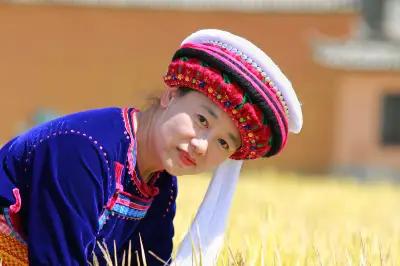
Down the street, elderly Bai women in traditional dress chatted as they walked—their simple, happy backs the most radiant sight.
By chance, I discovered a vast, peaceful field nearby, where women were harvesting wheat. Neat sheaves stacked behind them exuded rural life.
Paths crisscrossed the fields, straight roads stretching into the picture-perfect landscape. Golden fields shimmered with harvest joy under the sun.
Xizhou’s most captivating autumn feature is its rice paddies, beautiful in every season. Though I arrived late, after harvesting, there was still a stark beauty.
Wase, more low-key than other Dali villages, brims with everyday life. For photo lovers, it’s a must-visit. In winter, seagulls often pass by, wintering on the warm Erhai.
Wase’s iconic spot is a small forest, like a mini wetland park, with red iron boats lined up by the shore—popular for wedding shoots.
The blue lake, dotted with green algae, witnessed a slow boat leave a solitary trail that faded with the ripples.
Nearby Luyuo Mountain, a lesser-known photo spot, offers Erhai’s most stunning vantage point. It extends to a cliff with wild caves and dramatic sea views.
Pause from busy life and come to Dali. Though not my first visit, Dali’s romantic allure always captivates. With Cangshan behind and Erhai before, living leisurely and contentedly—this is the life many dream of.
Travelogue Contents: 1. Preface 2. Dali Ancient City, Seeking Romance and Beauty 3. Tinghua Tang, Alice’s Garden under Cangshan 4. Shuanglang, a Romantic Town Beloved by Artists 5. Tinghua Island, Sleeping by Water, Waking to the Sea 6. Xizhou, Autumn Fairy Tale in the Fields 7. Wase, Earthy Delights that Soothe the Soul 8. Epilogue Travel Info: Hotel Index, Guide Index, Flight Ticket Index, Website Navigation, Travel Guide Index, Cruise Index, Corporate Travel Index, Partnership, Affiliate Program, Friendly Links, Corporate Gift Card Purchasing, Insurance Agency, Agency Cooperation, Hotel Partnership, Destination & Scenic Spot Cooperation, More Cooperation, About Ctrip, About Ctrip, Ctrip News, Contact Us, Job Postings, User Agreement, Privacy Policy, Business License (ICP), Security Center, Ctrip Content Center, Intellectual Property, Trip.com Group, Algorithm Disclosure