Set Off, and Poetry Awaits | Yunnan Cloud-Watching Notes
In December 1940, Mr. Shen Congwen published an essay called 'Watching Clouds' in Hong Kong's Ta Kung Pao. His delightful description of Yunnan’s clouds has rekindled my longing for the Land South of the Colorful Clouds.
In ordinary days, you need a little courage to just up and go. So I drove the all-new digital Golf to storied western Yunnan!
Dali – known poetically for its wind, flowers, snow, and moon
“Wind at Xiaguan, flowers at Shangguan; the wind from Xiaguan blows Shangguan’s flowers.
Snow on Cangshan Mountain, moonlight on Erhai Lake; the moon over Erhai Lake illuminates the snow of Cangshan.”
Even if you’ve never been to Dali, the very phrase 'wind, flowers, snow, moon' brings it to mind. More simply, you might know Dali from its marble (also called Dali rock; originally the term referred to the white limestone with black veins produced in Dali, Yunnan). Or perhaps through fictional characters like Duan Yu and Zhao Ling’er…
But none of that really matters, because we know Dali is a place blessed by the Creator. Here, the mountain is called Cangshan and the lake is called Sea.
In Dali, the spring scenery never fades, and spring’s glow is never wasted.
In Dali, everywhere you look is a view.
Xizhou – a place of pure delight, where beauty is beyond words
“Travel isn't just sightseeing; it's about deeply understanding local customs.” Xizhou is exactly that kind of place.
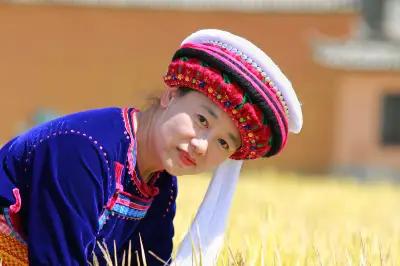
Xizhou is the most beautiful Bai town around Erhai Lake and one of the cradles of Dali culture. Nearly a hundred Bai-style houses from the Ming, Qing, and Republic eras remain well-preserved here. It’s a paradise for lovers of historical architecture, and also the 'hometown of Bai tie-dye,' the largest Bai village in China, and the location of Zhoucheng, Yunnan’s largest ethnic natural village.
Bai tie-dye uses pure cotton or cotton-linen blend white fabric, and natural dyes from plants growing on Cangshan—indigo, banlangen (Isatis root), mugwort, and others. The process is complex: designing, tracing, stitching, dyeing, removing stitches, rinsing, and final inspection.
Bai tie-dye craft was inscribed on China’s first national intangible cultural heritage list in 2006.
Tengchong – a frontier land, beautiful in every season
Driving southwest from Dali for about 300 kilometers and roughly five hours brings you to Tengchong. Here, not only are there stunning views but also an unforgettable history. The 'Teng merchants’ reverence for culture and the sacrifices every Tengchong native made during the war are deeply admirable.
In Tengchong, you can experience all four seasons—cherry blossoms, hot springs, volcanoes, ginkgo trees, and dreamlike seas of clouds.
The Longjiang Bridge is a key project on the Baoshan–Tengchong Expressway, spanning the Longchuan River valley. At 2,470.58 meters, it’s Asia’s largest highway suspension bridge and Yunnan’s first extra-large-span suspension bridge with a steel box stiffening girder. This 'bridge in the sky' used numerous pioneering technologies in China, garnered over 20 patents, and was featured in the CCTV documentary Mega Projects. Driving across it feels like walking among clouds far above the mountains.
In December, the Ginkgo Village is awash in golden leaves.
The Jiangdong Ginkgo Village lies in Gudong Town, Tengchong. It’s called Ginkgo Village because of the over 1,000 mu of ancient ginkgo trees clustered here.
The village nestles in the forest; homes and trees guard one another, creating a serene, timeless atmosphere.
Heshun – harmonious yet distinctive, where all beauties coexist
Visiting ancient towns was one of our goals on this journey.
Heshun lies southwest of Tengchong and is a well-known hometown of overseas Chinese in Yunnan. The entire town climbs the hillside, rising and falling in a pleasing, orderly arrangement.
I never expected to find, in this border region of our country, exquisite buildings from the late Qing and early Republic periods that blend Chinese and Western styles, displaying a beauty of fusion and creativity.
When we were young and naïve, we thought the ideal life lay somewhere else. In truth, whether life is good depends entirely on how you spend your everyday. And a better everyday is simply life as it was meant to be.
“Savor the hues of worldly life at a leisurely pace, and quietly observe the long passage of time.”
The flavor of the mortal world is, in essence, the scent of everyday life—a bowl of bean noodles in Tengchong, or a baba baking on the stove…
In tranquil times, squatting by the door and puffing a hand-rolled cigarette is the coziest thing.
With trees, mountains, the earth, and the passing of time all around, each day in Heshun feels ordinary yet poetic.
“Hello, Volkswagen”
– a steadfast thought: beauty is perfected over time
On this trip to Yunnan, after landing in Dali by plane, I drove the all-new Volkswagen Digital Golf the entire way.
“If the mountain won’t come to me, I’ll go to it.” We journeyed westward, from Cangshan to the Gaoligong Mountains.
The Golf is a classic Volkswagen model. Since its debut in 1974, it has been one of the brand’s best-sellers. The Golf 8 carries on this legacy while innovating significantly—for example, it’s the first Volkswagen to feature the CNS 3.0 HMI design, and the fully digital controls brought a fresh driving experience to this journey.
Yunnan is mountainous, with steep roads and many curves. From Dali to Tengchong, the distance isn’t great on paper, but even on the highway it’s a solid five-hour drive. Fortunately, I was driving the Golf, so I didn’t have to worry about power.
While on the highway, simply saying “Hello, Volkswagen” wakes the smart system, freeing your hands and making driving safer and easier. The new Digital Golf’s EA211 engine series, combined with versatile driving modes, easily handles complex road conditions. The Travel Assist system and the all-new digital cockpit also reduced fatigue on this long drive. L2-level autonomous driving, with pre-collision protection and multi-collision prevention systems, added peace of mind.
Western Yunnan is a land of towering mountains and deep gorges, and even the highway often has speed limits of just 40–50 km/h. Luckily, the car’s front-view camera and vehicle-to-everything connectivity, supported by navigation and vehicle data, recognize traffic signs and display them on the instrument panel. If your speed exceeds the limit, the system gives audible and visual warnings. This was my most thoughtful companion, guiding me safely through unfamiliar roads to my destination.
A Porsche-style electronic gear shifter replaced the mechanical stick, freeing up space in the center console and enabling wireless phone charging. The 10.25-inch digital instrument cluster and 8.25-inch touchscreen supported CarPlay and CarLife, making the drive far from boring. The first-ever Harman Kardon sound system filled the journey with music, and with the new touch experience, a swipe of a finger opened the panoramic sunroof, bathing the cabin in Yunnan’s sunshine.
They say Yunnan is like spring all year round, but western Yunnan has a huge temperature difference between day and night in winter. Especially after catching the wind in Dali’s Xiaguan at night, I wanted to dash into my car. With the mobile app’s one-touch car locator, the system always plotted the best route to my car, sparing me from the cold wind. Once inside, I switched to a warm ambient light and my favorite interface; the cabin instantly became a cozy little 'warm hut.' Turning on the seat heaters, my whole body warmed up—the car became a refuge from the chilly night.
Thanks to the all-new Volkswagen Digital Golf, this road trip through western Yunnan was a joy—spirited driving, a calm mind, and relaxed ease. I fully enjoyed Yunnan’s mountain roads, experienced the pleasure of a high-tech, digital car, and absorbed the region’s unique cultural charm.
Driving under the Yunnan sun, my shoulders and heart felt the warmth; life was reborn from fatigue. Reshaping the everyday starts with the all-digital Golf.