Let's Go to Dali for a Romantic Encounter
[Preface]
Actually, I've been quite reflective this year. I realized I had never really explored my homeland thoroughly before. Due to special circumstances this year, I started traveling around China non-stop, only to discover so much I had overlooked. Our great motherland has so many places worth visiting, not inferior to foreign destinations.
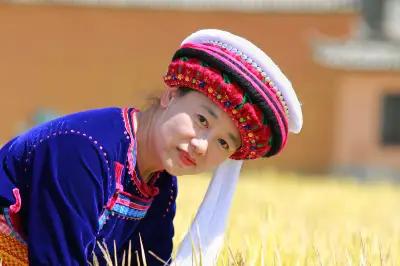
I'm ashamed to say that despite visiting Yunnan many times, this was my first trip to Dali. Located at the junction of the Yunnan-Guizhou Plateau and the Hengduan Mountains, Dali features the layered Cangshan Mountains and the vast, clear Erhai Lake, together forming a magnificent picture of lake and mountain scenery. The 25 ethnic minorities including Bai, Yi, Hui, Tibetan, Lisu, and Naxi are scattered across ancient towns like Dali Old Town, Xizhou, and Shuanglang. Folk arts like tie-dye and traditional snacks like erkuai showcase ethnic charm.
Dali is spring-like all year round, without extreme cold or heat, and the seasons are not very distinct.
Dali's "Four Wonders" — Wind, Flower, Snow, and Moon — refer to "Xiaguan Wind, Shangguan Flowers, Cangshan Snow, and Erhai Moon."
- Xiaguan Wind: Xiaguan at the southern end of Erhai, located at a pass, has constant wind.
- Shangguan Flowers: Shangguan at the northern end of Erhai was once an open grassland covered with colorful flowers.
- Cangshan Snow: The top of Cangshan is covered with snow all year round.
- Erhai Moon: Over Erhai Lake, the moonlight is gentle and charming.
DAY 1: Fly to Kunming, then take a bullet train to Dali
DAY 2: Dali Old Town, Erhai Lake, Three Pagodas Temple
DAY 3: Xizhou Ancient Town, Shuanglang Ancient Town
DAY 4: Weishan Ancient City
DAY 5: Shaxi Ancient Town
Kunming: Kunming is the capital of Yunnan province with very convenient transportation. This year, Kunming Changshui Airport has become one of the busiest airports in China, with direct flights from most domestic cities. We chose to fly directly from Fuzhou to Kunming, then took the airport bus to Kunming Railway Station for 35 RMB, which took about 35-40 minutes.
Dali: Dali also has an airport, but with fewer flight routes. You can also transfer in Kunming with flights in the morning and evening. However, we chose to take the high-speed train from Kunming to Dali, which took 2 hours and cost 145 RMB. It felt more convenient.
Local car rental is also an option in Dali.
The origin of the name "Yunnan" has been debated for a long time. But most people tend to believe this story: "During the Yuanshou reign of Emperor Wu of Han, colorful clouds appeared in the south. The emperor sent envoys to trace them, and thus the name Yunnan (south of the clouds) began." An emperor high in Chang'an City, his ethereal dream somehow resonated with the magnificent scenery seen by the people thousands of miles away. How magical and incredible! It must have been heaven's praise for the emperor's great achievements. The emperor's vanity was greatly satisfied. He happily set up a government office and appointed officials here, naming it "Yunnan." The Han Dynasty thus began to officially administer this southwestern region.
[First Impression of Dali]
There's a song called "Go to Dali" with lyrics like:
"Are you not satisfied with life?
Haven't laughed for a long time and don't know why
Since you're unhappy and don't like it here
Why not go west to Dali"
My impression of Dali is that the climate is really comfortable. Blue skies, white clouds — every cloud is so three-dimensional and beautiful.
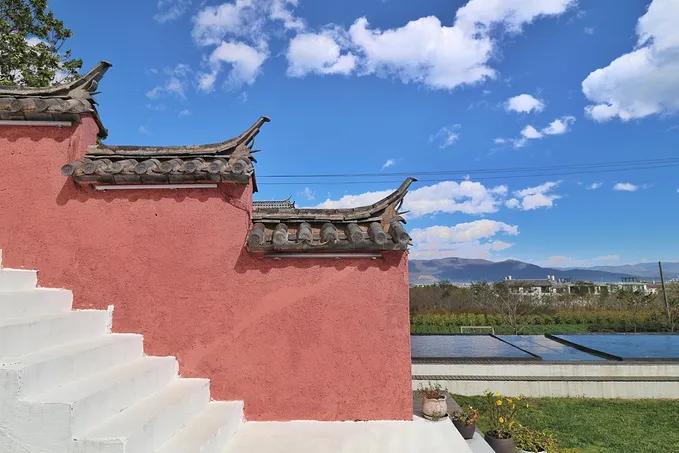
"Moonlight on Cangshan snow, Xiaguan wind blows Shangguan flowers" is a true portrayal of Dali Old Town. Dali Old Town sits between the majestic Cangshan Mountains and the charming Erhai Lake. Thick city walls, ancient wooden houses. The mountain's auspicious energy nourishes the heart, and the clouds' purity refreshes the spirit. Time flows backward here, space solidifies, and a lingering nostalgia for the past sublimates.
Our impression of Dali Old Town is that the pace of life here is really, really slow. When you come to Dali Old Town, you must experience this slow life. With Cangshan behind and Erhai in front, the square-shaped ancient city carries Dali's thousand-year history and culture.
We stayed at Fangzhou Muzhai, a guesthouse located within the old town but away from the noise, very quiet. Staying here was truly comfortable.
The guesthouse is down an alley, and you can easily walk to the main street near the Erhai Gate. The location is really great.
The guesthouse has a fresh, simple appearance — a four-story white building surrounded by various greenery.
Inside, everything is antique-style. The first floor has a Chinese-style courtyard with a very tall tree. It's clear the owner has taken great care, with decorations and various plants and flowers, giving it a very forest-like feel.
The first floor also has a restaurant and a tea room. Guests are warmly invited to drink tea, relax, read a book, and enjoy a cup of fragrant tea — truly comfortable.
On the corridors, green plants hang from the eaves. The second and third floors are guest rooms. There are sofas in the common area, and a terrace on the second floor where you can bask in the sun and lazily spend the afternoon. The plaque saying "Dali is waiting for you" here can also make for beautiful photos.
From here, you can go up to the rooftop, which is covered with plants. Inside the guesthouse, it feels like stepping into nature. Everywhere is fresh and natural. Flowers, trees, blue sky, white clouds — peaceful and leisurely. Staying here is truly wonderful.
Our room was on the third floor — a luxury king room. The room had a simple, modern design and was very spacious.
The room had not only a private bathroom but also a separate bathtub.
The room was very warm and elegant, fully equipped, and the bedding was very comfortable.
Flying a drone over the old town gives you a panoramic view. The history of the old town dates back to the Tianbao era of the Tang Dynasty, when Nanzhao King Geluofeng built Yangjumie City as his new capital.
The old town is located at the foot of the beautiful Cangshan Mountains and was the capital of the ancient Nanzhao and Dali Kingdoms. It's a place suitable for living. Locals work at sunrise and rest at sunset. In their free time, they grow flowers and bask in the sun. With bright sunshine and pleasant temperatures, it attracts countless tourists.
In the old town, during the day you can stroll along Fuxing Road, a pedestrian street lined with shops selling Dali marble carvings, ethnic costumes, local specialties, etc. You can browse among the shops and find some ethnic souvenirs. When tired and hungry, there are snack shops along the street offering local specialties.
At night, you can mingle with locals in the area around Yangren Street and Renmin Road. There are many unique bars and small cafes, some with resident singers or impromptu performances by visitors, making it lively. You can enjoy the vibrant atmosphere amidst drinks and music.
[Old Town Food]
Jinshan Bainian Guyuan Restaurant
A hundred-year-old courtyard, owned by the proprietor, very well maintained. Many flowers planted with great care, making you feel cheerful as soon as you enter. Dining here with the faint fragrance of flowers is really a special experience.
The restaurant has indoor and outdoor sections, all antique-style. It started in 1979. The restaurant's specialty homemade liquor is also worth a try.
Located inside Dali Old Town. If driving, park in the lot outside the old town and walk to the restaurant; or take a taxi.
This dish is my favorite, very fragrant. It's one of the most ordered dishes and a signature. A bit like spicy chicken but not spicy, with the aroma of herbs and lemon. Crispy and delicious, goes very well with rice.
Wild Mushroom and Chicken Soup Pot
When in Yunnan, you can't miss the special mushroom hot pot. Rich in flavor, with various mushrooms and tender chicken.
Quite unique, sweet, fragrant, and sticky. Also good as a staple.
Business hours: 10:00-23:00
I'm Waiting for You in Dali · Fangzhou Pangzi Kitchen
The restaurant has an antique architectural style. Two floors, with booth seating on the second floor giving a nice feel. You can see the old town view and the distant Cangshan Mountains.
The service is excellent. Staff frequently check on the taste, heat, and timing, and even prepare dipping sauce for you. When we left, they gave us a special tea gift box.
The restaurant is close to the Erhai Gate of the old town. Self-driving visitors can park in the lot outside Erhai Gate and walk; or take a taxi directly.
You must try the freshest and most delicious mushroom soup pot here. Mushroom hot pot is a Yunnan specialty, with ecological ingredients and delicious taste. Yunnan's complex terrain, diverse forest types, soil types, and unique three-dimensional climate have nurtured rich edible mushroom resources, with many varieties, wide distribution, and large yields. The mushroom hot pot uses old mushroom soup as the base, combining more than seven kinds of dried mushrooms with high-calcium bones, simmered for 7 hours.
Includes bamboo fungus, porcini, morel mushrooms, etc. Very nourishing, perfect for a warm winter meal.
The restaurant also serves a luxurious scrambled egg with black truffle. The black truffle is very fresh, highly recommended.
Also has specialty stir-fried meat and fried rice. The mushroom soup pot can also be used to cook tender beef and chicken, both delicious. For dessert, try the Yipin Feng Hua Xue Ye.
Business hours: 10:30-22:00
From the old town, heading toward Caicun Village, the road passes through fields where Bai aunties are farming. Follow Yuehua Road east to Caicun Dock. You can rent an electric bike to ride and enjoy the view of Erhai Lake.
Caicun was a filming location for "Heart Blossom."
Haishe Park is a long sandbank extending into the water on three sides, a small ecological park by Erhai. Willows line the shore, with different scenery on each side: waves crashing on one side, gentle ripples on the other. Scenic in all seasons, it's the best place to view Erhai. The island has pristine scenery with large trees and tall reeds. The Erhai water at the tip of the peninsula is exceptionally clear and blue, perfect for photos.
Looking down from above, Erhai has no typhoons or tornadoes. Occasionally some small waves, but Erhai is still gentle, like a crescent moon, quietly lying between the Cangshan Mountains and the Dali Basin. Waves of varying heights move orderly forward, tree shadows float on the water, small water birds rest, and thousands of sunbeams cast down, forming a beautiful landscape painting. How can one not be captivated?
Legend has it that a fairy in heaven admired human life and came down to marry a fisherman by Erhai. Seeing the fisherman's difficulty in catching fish, she placed her precious mirror at the bottom of the lake to illuminate the fish clearly, helping them catch more fish.
Later, that precious mirror turned into a golden moon at the bottom of the lake, giving rise to the "Erhai Moon." When the moon rises, approaching the shore of Erhai, looking up at the sky, a jade mirror hangs high; looking down at the lake, silver waves surge, water meets sky, vast and boundless. A bright moon floats with the waves in the sea, truly amazing.
Erhai's water is quite clear. On calm, sunny nights, approaching the shore, looking up at the sky, a jade mirror hangs high; looking down at the sea, silver waves surge from the ground, water merges with sky, vast and boundless. A full moon drifts with the waves. The moonlight over Erhai is breathtaking.
Unlike the majestic and imposing Cangshan Mountains, Erhai is more often peaceful and tranquil.
Chongsheng Temple was the royal temple of the Dali Kingdom and the first large-scale ancient temple in Dali's history. Chongsheng Temple is famous for its three pagodas (one large, two small), known as the "Three Pagodas of Dali," one of China's famous Buddhist pagodas. The three pagodas are landmarks of Dali, testimony to the flourishing of Buddhism, and one of the scenic wonders of Cangshan and Erhai. The temple seen today is rebuilt, while the three pagodas are thousand-year-old relics, the main attraction here.
Hidden in a small village, backed by Cangshan and facing Erhai, quietly listening to the Buddhist sounds from the Three Pagodas Temple.
Entering the scenic area through the main gate, you see the three pagodas on the central axis steps. The large pagoda in front is called Qianxun Pagoda, standing with the two smaller pagodas to form a tripod, quite majestic. The shape of the three pagodas resembles the Small Wild Goose Pagoda in Xi'an. The best spot to photograph the three pagodas is the "Three Pagodas Reflection Pool" in the Three Pagodas Reflection Park behind, where you can capture the pagodas and their reflections. Many tourists take photos here.
Passing the three pagodas, follow the central axis inward. Along the way, you can visit the Cultural Relics Exhibition Hall to see artifacts from the Nanzhao and Dali Kingdoms excavated during the pagoda restoration, the Bell Tower with the 16-ton Nanzhao Jianji Giant Bell, the Yutong Guanyin Hall with the Rain Copper Guanyin, and finally reach Chongsheng Temple.
Chongsheng Temple, facing Erhai to the east and backed by Cangshan to the west, is located about one kilometer north of Dali Old Town at the foot of Diancang Mountain, by Erhai Lake. Historically, nine Dali emperors became monks at Chongsheng Temple, which is called "Tianlong Temple" in Jin Yong's martial arts novel "The Demi-Gods and Semi-Devils."
[Xizhou Ancient Town]
Xizhou is a Bai ancient town that hasn't been overly developed, ideal for travelers to stroll or cycle.
Five experiences in Xizhou: visit the Sifang Street square, view Ming and Qing dynasty residences, enjoy the rural scenery, taste Xizhou crispy bread (po su ba ba), and buy Bai tie-dye products.
Zhuanjiao Lou is a landmark building in Xizhou. Yan's Mansion is a classic Bai residence. Behind it, the Huangqiang Xilin Garden has a wonderful terrace afternoon tea, popular among travelers for photos.
Xizhou Ancient Town is located in the north of Dali City, west of Cangshan and east of Erhai. During the Sui and Tang dynasties, it was called "Dalicheng" and was one of the "Ten Towns" during the Nanzhao period. It is also the hometown of the film "Five Golden Flowers" and one of Yunnan's famous historical and cultural towns and key overseas Chinese towns. It is a Bai historical and cultural town with over a thousand years of history.
Since ancient times, Xizhou has been the political, economic, and cultural center of the Bai people on the west bank of Erhai, with a long history of commerce. It is the cradle of Bai industry and commerce. During the Guangxu reign of the Qing Dynasty, the famous "Xizhou Commercial Guild" emerged, giving birth to capitalist families headed by the four major families "Yan, Dong, Yin, Yang" and eight middle families and twelve small families.
Xizhou Ancient Town's history dates back to the Nanzhao Kingdom a thousand years ago. It was an important commercial town and also produced the Xizhou Commercial Guild. It was a relay station on the Ancient Tea Horse Road, providing rest and supplies for passing horse caravans.
As a millennium-old town, Xizhou has much to offer in tourism culture — from its history to architecture, to the four major families — all are good places to revisit history and memories.
Xizhou's ancient streets are not much different from those in typical ancient towns, but they look more weathered. Compared to some commercialized ancient streets, this one was developed later and is still one of the less overdeveloped towns.
In Xizhou, you can also visit old residences. Generally, there are two types: former mansions of wealthy families, like Yan's Mansion and Dong's Mansion, and common people's courtyards. Both are open to visitors, usually for a few yuan, some free.
Wandering through the town, nearly every traditional Bai folk house has its own history and story. In ancient times, Xizhou was an important town on the Tea Horse Road, producing many wealthy merchants and scholars.
The more places you go, the more you realize that travel is not just about seeing mountains, water, and scenery. The unique mood and feelings of the moment are also unforgettable. Tourism and travel are different. Tourism just means I've been here, I've seen things. But travel is a unique inner experience, a journey of the soul. If one day you step into a thousand-year-old town, clean and free, with a gentle breeze, accompanied by grass and trees along the way, such a summer day will surely become your best memory. And Xizhou in Dali is such a place, suitable for solo travel.
[Shuanglang Ancient Town]
It is said that Dali's scenery lies in Cangshan and Erhai, and the scenery of Cangshan and Erhai lies in Shuanglang. Shuanglang has always been favored by visitors. Shuanglang Ancient Town is probably the best place to view Erhai among Dali's destinations. Here you can experience the beauty of Erhai up close, and in the distance, you can see the green Cangshan Mountains. On a good day, the scenery is indescribable.
Shuanglang has the best sea-viewing scenery in Dali, as it is close to the rippling Erhai Lake and offers a distant view of the nineteen peaks of Cangshan. Must-visit spots include: Yuji Island (the first village of Cangshan and Erhai), Yang Liping's residence Moon Palace, and Nanzhao Customs Island. The Shuanglang viewing platform and Wase Dock are very popular viewing spots on Erhai.
Shuanglang is located on the northeastern shore of Erhai, with small islands on both sides, hence the name "Shuanglang" (double corridors). Shuanglang was once a small fishing village, where most villagers fished on Erhai. It is said that Shuanglang has the best sea-viewing scenery in Dali, as it is close to the rippling Erhai and offers a distant view of the nineteen peaks of Cangshan. With the divine light of Erhai against the backdrop of the continuous Cangshan Mountains, many photography enthusiasts can capture stunning photos here.
Shuanglang Ancient Town is a beautiful small town right next to Erhai Lake in Dali. Because it is relatively quiet and has beautiful scenery, it is favored by many. It wasn't discovered recently; many years ago, it was already known for its beautiful scenery and remoteness, attracting countless tourists. Now it's also a wonderful scenic spot in Yunnan tourism, where you can experience the charm of Erhai.
That day we set off for Weishan Ancient City. On the way, we saw a ginkgo forest that looked very beautiful, so we stopped to take photos. We kept stopping along the way, doing whatever we felt like.
From Dali Old Town, it takes about an hour and a half to reach Weishan Ancient City. Weishan is located south of Dali, facing Diancang Mountain in the distance. Today's peaceful ancient city is a famous overseas Chinese town in Yunnan, with about 1,400 overseas Chinese living in Europe, America, and Asia-Pacific regions. If you have a free day, you can come here to explore nature and ancient customs.
Weishan has a long history. It is the birthplace of the Nanzhao Kingdom and the source of the Red River. Weishan is a famous literary city with a long history and culture, and numerous scenic spots. This was the first time I heard the name Weishan. When I came here, I found that Weishan Ancient City is still relatively primitive, completely different from Dali Old Town.
Weishan Ancient City still maintains the chessboard pattern from its founding over 600 years ago, making it one of the best-preserved Ming and Qing ancient architectural complexes in China. Two drum towers in the city are rare in Yunnan. Compared to Dali Old Town, Weishan Ancient City is more simple and natural, neither too bustling nor too quiet, but lazy and ancient.
Gongchen Tower, commonly known as Big Drum Tower. In the early Ming Dynasty, it was the north gate of Menghua Prefecture city. Later, as the street gradually developed northward, this tower became the central building of Weishan Ancient City.
Passing through Gongchen Tower, various shops, restaurants, and teahouses line the streets. Most residential houses still maintain Ming and Qing styles. The entire ancient city is relatively intact, with characteristic two-story ancient buildings of tiled roofs, wooden walls, and brick walls. The old city residents live a leisurely life.
Step into any teahouse, and a cup of tea costs only 3 yuan. You can sit on the street, bask in the sun, drink hot tea, and enjoy a moment of tranquility. The commercial atmosphere in Weishan Ancient City is not overwhelming. Shop owners greet neighbors passing by, chatting and laughing freely. Groups of elderly people sit around small square tables playing chess or chatting.
Time is peaceful. Weishan, this low-key historical and cultural city, quietly awaits visitors. Local residents still live their ordinary lives here. It is a bygone ancient capital, yet a living ancient city.
[Shaxi Ancient Town]
Shaxi is located in the southwest of Jianchuan County, Dali Bai Autonomous Prefecture, Yunnan Province. It is a famous historical and cultural town in China, a world endangered architecture site, and an ancient town with a long history of over a thousand years. It is known as "the only surviving market on the Ancient Tea Horse Road." Films and TV dramas such as "Princess of Dali," "Ginkgo Ginkgo," "The Moon and the Sword," and "Love or Not" were filmed here.
Walking in Shaxi Ancient Town, stepping on the uneven cobblestone streets, Bai elders in ethnic costumes shuttle through the streets. An old man sitting on the porch with eyes full of vicissitudes — at this moment, it feels like entering another world. Coming back to reality, you realize that life can be so slow. Stop and go in the alleys. Dogs in the town lean against doorways. Sunlight scatters through leaves on the ground. Tourists walk through this isolated ancient town. This is what Dali is like.
Shaxi is the Dali in my heart.
Shaxi was once an important post station on the Ancient Tea Horse Road. With the decline of the Tea Horse Road, it was gradually forgotten, which better preserved the style of the ancient Tea Horse town.
Sideng Street, anciently called Nantang, is the core ancient architecture of Shaxi Ancient Town. It is known as "the only surviving ancient market on the Tea Horse Road." The ancient stage, horse shops, and ancient temples with over 600 years of history are well preserved. There are two ancient locust trees in the center of the street. It was once listed together with the Great Wall on the "World Endangered Architectural Heritage List."
The ancient stage is the most distinctive ancient building on Sideng Sifang Street. During ethnic festivals, Bai people in Shaxi dress in festive costumes, play the dragon-headed three-stringed instrument, gather on Sifang Street, and sing and dance on the stage.
Shaxi Ancient Town is quite different. It not only retains the original memories of the Tea Horse Road but also exudes a strong atmosphere of daily life. So when going to Dali, Shaxi Ancient Town is a must-visit.
Shaxi Ancient Town is a true ancient town, antique and primitive, still maintaining its original architectural features. Ancient temples, ancient stages, ancient shops, horse shops, ancient red sandstone streets, century-old trees, ancient alleys, and ancient village gates.
It is a quiet ancient town with few tourists on ordinary days. Living here, you can enjoy a peaceful and wonderful day. Sitting on a stone bench in the center of the town, basking in the sun, life is comfortable and pleasant.
The Ancient Tea Horse Road passed through Sichuan, Yunnan, connected to Tibet and India in the north, and Southeast Asia in the south. It passed through Dali, Lijiang, Shangri-La, and other famous towns. Between these towns, there is an ancient market—Sideng Street, known as "the only surviving ancient market on the Tea Horse Road."
On Sideng Street, the Heihui River flows slowly southward. There is the Yujin Bridge, about seven to eight meters wide, with hoof prints still on the bridge. This was the necessary bridge to cross Shaxi and go to Tibet. At the bridgehead, there is a stone inscription with mottled text recording the history of building and maintaining the bridge.
Crossing Yujin Bridge and walking about 100 meters along the ancient road, a village gate made of adobe appears. Entering this gate is the market. The gate is made of adobe, looking a bit shabby and rustic, but it shows the world the appearance of the market gate on the Tea Horse Road—an adobe wall gate barely wide enough for two horses to pass through.
At the end of the narrow alley is Sideng's economic and trade center—Sifang Street. It is rectangular, completely paved with red sandstone, smooth and clean. The red sandstone has been polished smooth and glossy, with deep hoof marks on the stone slabs exclusively for horse caravans, vividly leaving traces of the flourishing commercial transportation in the past.
About a ten-minute walk from the core area of Shaxi Ancient Town, there is a village that houses the most beautiful bookstore in Yunnan, Librairie Avant-Garde Shaxi Bai Ethnic Bookstore.
The bookstore is located in a very inconspicuous village, surrounded by fields. The selection of books in the bookstore is very locally and culturally specific. The creative products developed in combination with local culture are the biggest highlight of the bookstore. Products like Jiama (a type of folk print), tile cats, and tie-dye are excellent in craftsmanship and quality.
The messy venue was restored into a landscape courtyard, and the granary was transformed into a book warehouse. There is also a tall tobacco drying house, which was ingeniously transformed by Huang Yinwu into a highly spiritual Poetry Tower. Layered fan-shaped wooden stairs spiral upward, placing poetry at the height of the soul.
[Final Words]
The world's romance and beauty converge in charming Dali—a place you must visit at least once in your life.
Our journey continues.