A Third Journey to Colorful Yunnan: Double Rainbows Over Dali and the Quest for Lugu Lake
2020 was a surreal year, but it didn't stop us from traveling. As soon as the pandemic eased a little, we took a road trip to Guangxi and Guizhou. Then just as summer began to return, we set off on a journey to Yunnan.
**The Land of Colorful Clouds**
For me, Yunnan has always carried a certain mysterious aura and halo.
Maybe that mystery comes from its status as a key frontier region in the southwest.
Maybe it comes from certain books I’d read, like *Candle in the Tomb: The Worm Valley of Yunnan*, which I re-read just before this trip.
**Third Time in Yunnan**
This was my third trip to Yunnan as a tourist.
This time, I brought my parents along – we three traveled together.
In 2014, a friend and I did a self-guided trip to Yunnan. We hit Lijiang and Dali, with Kunming just a brief transit stop before my flight to Chengdu. Back then, I hadn’t thought of writing it all down.
In 2018, my company organized a trip to Yunnan. We visited Lijiang and Shangri-La, using Lijiang as a transit hub for round-trip flights. That was more of a team-building thing.
This time, we drove from Changsha. Kunming again served as a transit point, with only a short stay before heading to the main destinations: Dali and Lugu Lake on the Yunnan-Sichuan border.
In early July, my mother fractured her right foot, so the most unique part of this trip was that she insisted on traveling “with an injury.” In the trunk, besides our regular luggage, the most important things were a wheelchair and a pair of crutches. That’s why, after weighing our options, we chose to drive from Changsha all the way to Yunnan.
Changsha – Kunming – Dali – Lugu Lake – Changsha
**Vehicle Check for a Road Trip** The most important tool for a road trip is, of course, the car. We love road trips, so before every departure we check the car carefully: tire pressure, brakes, oil, coolant, etc. We also always check the warning triangle and carry a fire extinguisher.
**Don’t Forget Sun Protection** Sun-protective clothing, sunscreen, facial masks – a must! Yunnan is a high-altitude area with intense UV rays. Even on cloudy days it can be harsh. I learned this the hard way in 2014, when I got a glaring “panda tan” on my arms.
**Bring Some Warm Clothes** Although we went in August, when many places were sweltering – Changsha was issuing heat warnings daily with temperatures around 36°C and a feels-like over 40°C – Yunnan was a cool escape. Days were warm but nights were chilly. The lowest we experienced was 11°C by Lugu Lake, and the highest 26°C in Kunming. At night, we definitely needed blankets; by Lugu Lake we even turned on electric blankets.
**Be Prepared with Footwear** Yunnan’s rainy season is generally June to August, with plentiful rain – sometimes showers, sometimes days of rain. Before we arrived, both Dali and Lugu Lake had had rain for nearly half a month. But we were incredibly lucky: during our days in Yunnan, we only encountered a brief shower in Shuanglang Ancient Town (and saw a rainbow afterwards) and half a day of rain at Lugu Lake; otherwise it was all brilliant sunshine. Because it’s the rainy season, packing enough footwear is wise.
**Bring Your Own Toiletries** You can use what the hotel or inn provides, but we always bring our own – it’s more hygienic and reduces waste.
In 2014 on my self-guided trip with a friend, Kunming was just a stopover on my flight to Chengdu – I didn’t go anywhere, just stayed one night. On this road trip, Kunming again wasn’t a major part of our plan. But my cousin’s aunt had been spending the summer there, so we made Kunming a stop to visit relatives. We stayed one night and only visited the Yunnan Provincial Museum across from her residential compound and the nearby Dianchi Haigeng Park.
Dianchi Lake, also called Kunming Lake, sits at 1,886 meters above sea level. It’s the largest freshwater lake in Yunnan and is dubbed the “Pearl of the Plateau.” Because Haigeng Park was close to my aunt’s place, that’s the part of Dianchi we visited.
Address: 1318 Dianchi Road, Xishan District, Kunming
Hours: 8:00 – 21:00
After parking, we quickly found the pedestrian walkway.
The park’s thousand willow trees bear witness to Haigeng’s 30 years of change.
A very still grey heron stood there for a long time – and I watched it for a long time.
Black-headed gulls are only seen in winter (November to March). If you come now, it’s a great time to see them. In August, there are no gulls, but there are pigeons! As long as you have food, a flock will gather. These pigeons have been fed so much they’ve lost all fear of humans – they come in droves to snatch treats.
My parents had been itching to feed gulls, but ended up happily feeding pigeons instead.
After Haigeng Park, we drove to the nearby Haihong Wetland just to catch a glimpse of the “Sleeping Beauty.”
The “Sleeping Beauty” is actually Xishan (the Western Hills), made up of Huating Hill, Taihua Hill, Luohan Hill, Guabang Hill and other peaks. From a distance, the range looks like a young maiden lying on her back beside Dianchi Lake, her dark hair trailing loosely. Unfortunately, it was cloudy that morning, so the Sleeping Beauty wasn’t very distinct, but if you looked carefully you could still make out the “head, chest, belly, and legs.”
I love visiting museums everywhere I go – they’re a fantastic way to understand local history. After watching the TV show *National Treasure*, I especially wanted to see the Yunnan Provincial Museum. The new museum is in Guandu District, Kunming, with Guangfu Road to the north and Baoxiang River to the west. Its distinctive color makes the building visible from far away.
The new Yunnan Provincial Museum has become a Kunming landmark. The main building has a square-shaped plan inspired by the traditional Yunnan “one-seal” courtyard house. The reddish-copper color reflects Yunnan’s reputation as a “kingdom of non-ferrous metals,” and the long, narrow crevices cutting through multiple floors evoke the Stone Forest.
Address: 6393 Guangfu Road, Kunming, Yunnan
Hours: Tuesday – Sunday, 09:00 – 17:00 (last entry 16:30, closed Mondays)
Admission: Free. Individual visitors can enter directly through security without a ticket.
In front of the museum square stood the float that represented Yunnan during the 2019 National Day parade. It featured a green peacock, elephants, a seven-colored garland, mountains, water, and auspicious clouds – exquisite craftsmanship.
To the east of the museum, directly across from the entrance, is the Yunnan Grand Theatre. The building looks like a woven hat – the “Crown of Yunnan” – another Kunming landmark.
You can’t bring smartphone gimbals or tripods into the museum. There’s a free storage at the entrance; after that, you can pass through security. I had booked a visit via the museum’s WeChat account, but they didn’t check my ID or reservation.
Inside the entrance is a floor map. The museum has three levels. Level 1 houses the Chinese Painting and Calligraphy Gallery, the Contemporary Art Gallery, and exhibition halls 1 & 2 (the temporary exhibition was on the Mosuo people, running until February 28, 2021). Level 2 has the Yunnan Historical Civilization exhibitions: “Ancient Yunnan,” “Light of Civilization,” and “Nanzhong Ascendancy.” Level 3 has “Splendid Buddhist Kingdom,” “Expanding Frontiers and Garrisoning Borders,” and “A Century of Changes.” Unfortunately, “A Century of Changes” was being renovated, so the exhibits weren’t complete.
We took the elevator and visited Level 2 first, then Level 3, and finally Level 1.
Entering the world of Ancient Yunnan –
This area is probably kids’ favorite. It begins with the evolution of marine life, dinosaurs, and mammals, then moves to the discovery of Yuanmou Man. I still remember the first chapter of my primary school history textbook introducing Yuanmou Man.
Passing through Ancient Yunnan, we entered the Bronze Age of Yunnan.
If you’ve seen *National Treasure*, you’ll recognize this artifact. The actor Li Guangjie’s story of passionately guarding the ancient Dian Kingdom revolves around it: the **Gilt Knight Cowrie Container**.
Nobles of the ancient Dian Kingdom used it to store cowrie shells used as currency. It was an important ritual object for displaying power, honoring ancestors, and recording social events. It has two tiger-shaped handles, and the lid is cast with four oxen. The gilt knight on top represents an aristocratic warrior of the time and is particularly eye-catching – like a “gold-armored divine being,” mighty and inviolable.
The **Bronze Table of Ox and Tiger** also held my gaze for a long time. Though not featured on *National Treasure*, it’s one of the museum’s greatest treasures. There’s a saying: “In the north, the Galloping Horse Treading on a Swallow; in the south, the Table of Ox and Tiger.” This was a ritual vessel of the ancient Dian Kingdom. The main figure is a standing ox with long, elegant horns. Its back slopes down to form a table surface; on the tail, a scaled-down tiger clamps its jaws onto the ox’s tail. The ox’s belly is hollow, with a smaller ox standing sideways inside. The large ox and small tiger were cast in one piece, while the small ox was cast separately and welded into the belly. It’s a masterpiece of Chinese bronze art and a rare treasure of ancient culture.
This **Hanging Figure Bronze Spear (Western Han)** was not displayed in a prominent spot, yet it caught my eye. It’s a ceremonial weapon used by the Dian king to flaunt military might. The most distinctive feature: near the blade, a small nude figure hangs, arms tied behind the back, hair falling down, body curved. Despite its small size, the figure is finely crafted. Historians infer that these figures represent captured Kunming tribesmen.
From the Bronze Age, we entered the Eastern Han to Early Tang era.
This was my favorite part of the entire museum – the artifacts are exquisitely beautiful.
Even the tiniest exhibits have incredibly detailed expressions and postures.
If you’ve seen *National Treasure*, you’ll remember this one. Actor Tong Dawei played Duan Yu as the guardian of the museum’s star treasure – the **Silver Gilt and Gem-Inlaid Golden-winged Bird of the Dali Kingdom**. The “Golden-winged Bird” soars, an enduring totem of the Dali people. Right at the museum entrance stands a larger version of this totem. If you visit the Three Pagodas of Chongsheng Temple in Dali, you’ll see another enlarged version in the square there.
For me, the most memorable dish was the fried grasshoppers and fried bamboo worms. Personally, I think the bamboo worms are more fragrant and tasty.
A meal of specialty Dai cuisine gave me a taste of a wide array of dishes – all quite unusual and not easy to come by – a very memorable experience.
Ever since my self-guided trip to Dali with a friend in 2014, I’ve been nostalgic about its local customs and scenery. We were short on time back then. We stayed inside Dali Old Town, climbed Cangshan Mountain, visited the Eight Departments of the Heavenly Dragon film set, saw the Three Pagodas of Chongsheng Temple and Tianjing Pavilion, and went to Erhai Lake to visit Nanzhao Customs Island. But the weather wasn’t good, so we didn’t see Dali at its best. When we decided on this Yunnan road trip, Dali was the very first place I settled on.
Dali was once the economic, political, military, and cultural center of Yunnan, a renowned cultural city. A must-visit spot in Dali is Dali Old Town.
Address: 42 Yita Road, Dali City
Parking: Several parking lots, maximum 50 yuan per day.
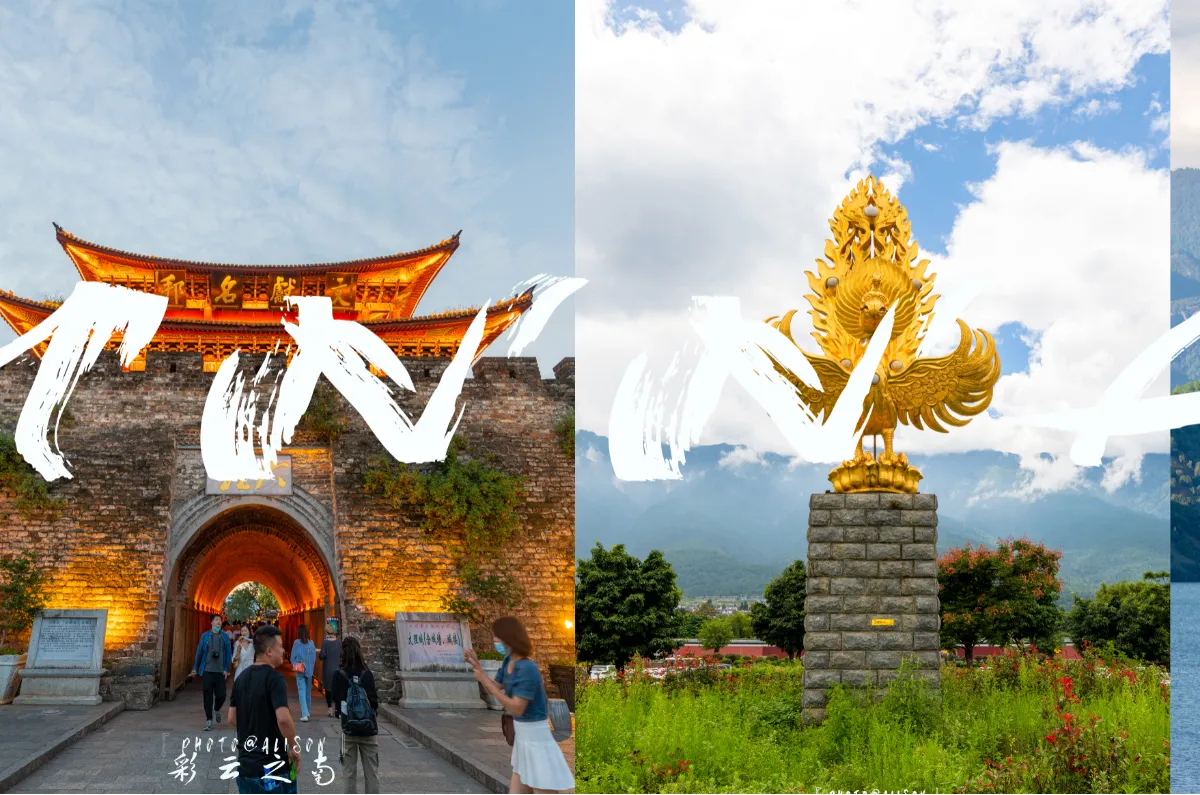
What I remember most about Dali Old Town is the southeast gate tower. In 2014, I stayed inside the old town, very close to this gate. This time, I chose a quieter inn near the Guoziguan parking lot to the east. Still, it didn’t stop me from wandering through the pedestrian street to snap a photo of that gate.
When we arrived, the tower lights weren’t on yet. I waited a bit, and just before 8 p.m., they switched on. In an instant, I was transported back to that scene in 2014.
Next to the southeast gate is Longquan Fang. Built in the style of the Shanggong Fang from the Dali Kingdom era, it follows a “hui”-shaped architectural layout. White walls and grey tiles exude a typical courtyard charm. Passing through its archway, you see spring water gushing forth, echoing Cangshan’s Longquan Peak in the distance.
Walk straight along the main road from the southeast gate and you reach Wuhua Tower.
First built during the Tang Dynasty, Wuhua Tower originally had four levels – a pedestal plus three stories. It was where the Nanzhao court hosted honored guests. After a thousand years, it was repeatedly burned and rebuilt. The last relic was the early Ming Dynasty version, which was later demolished. The Wuhua Tower we see today dates from 1998.
Foreigner Street is where Dali’s ancient charm meets Western culture. I photographed this archway back in 2014, and passing by this time, I couldn’t resist snapping it again. The old town has become much more commercialized since 2014, so I didn’t venture deep inside.
The Dali Confucius Temple served as both a prefectural and county-level temple – a landmark of the old town.
Dali Town God’s Temple seems to have been newly built in recent years. Inside, it’s essentially a hub of specialty restaurants and souvenirs. The old town is livelier than ever, with bars popping up everywhere. If you enjoy bustle and nightlife, it’s great to stay right inside and amble around.
A photo of my mother’s night stroll – crutches and all.
What you see most in the old town are flower cake shops. The most popular chains are Changyangji, Panxiangji, and Jiahua. All three offer free shipping if you buy enough, though the minimum varies. In 2018 at Shuhe Ancient Town in Lijiang, I bought Panxiangji flower cakes. This time, I tried the other two. Even at nearly 10 p.m., people were still queuing at their stores.
Besides flower cakes, there are other traditional pastries – all make nice souvenirs.
While these brands have online shops, buying in-store has perks: you get samples, and you can see the production dates. Some shops even sell “same-day fresh” flower cakes with a shorter shelf life of only 15 days.
The Three Pagodas are very close to Dali Old Town, aside from Cangshan and the Eight Departments of Heavenly Dragon site. In 2014, I visited the Chongsheng Temple Three Pagodas and Tianjing Pavilion with my friend. This time, we didn’t go inside. If you’ve never been, it’s worth the ticket.
Address: Sanwenbi Village, north gate of Dali Old Town – a 10-minute walk north from the gate.
Hours: 8:00 – 19:00
Ticket: 75 yuan
As we passed the Dapeng Golden-winged Bird Square at the scenic entrance, we parked and walked to the square to capture a distant view of the Three Pagodas and the giant golden-winged bird statue.
Behind the **Silver Gilt and Gem-Inlaid Golden-winged Bird of the Dali Kingdom** stand the Three Pagodas and Cangshan’s Yingle Peak.
Unlike the paid entry, this square is free. Besides the 6.9-meter-tall double-sided Dapeng Golden-winged Bird, there are also exquisite stone sutra pillars. From here you can see the Three Pagodas and Erhai Lake.
Under blue skies and white clouds, the carved stone sutra pillars look truly majestic.
Haizhe Park and Xizhou Ancient Town are next to each other, perfect to combine. We drove from Dali Old Town in the morning, passed through Xizhou, and reached Haizhe Park. The park entrance was under renovation, so we could only drive near the gate. Some villagers collected parking fees. The surrounding wetlands are open for photos, but you have to walk about 200 meters or take a horse cart. Since my mother had difficulty walking, we opted for the horse cart.
After getting off, each of us took a photo with the horse.
The weather was shifting from cloudy to clear, with layers of clouds mirrored on the water.
In the wetlands, little grebes – at least five of them – paddled about, occasionally chirping.
Because the park itself was closed, we only stayed around half an hour.
After Haizhe Park, on the way to Xizhou along Township Road 033, we stumbled upon a gorgeous rice paddy field. Quite a few rent-a-car travelers were posing on car roofs. This spot made headlines during the National Day holiday: tourists trampled that very field for photos.
Luckily, the sky cleared, and the sun broke through the layered clouds.
Compared to Dali Old Town’s bustle, Xizhou Ancient Town carries a quieter charm. Xizhou is an important Bai ethnic town, home to the best-preserved and largest cluster of Bai residential architecture. The layout follows the typical Bai courtyard pattern of “three houses facing a screen wall” and “four courtyards around a central well.”
Address: 18 kilometers north of Dali Old Town
Parking: Several lots; first hour 10 yuan, each additional hour 2 yuan.
The town’s central square, Sifangjie, is actually a small plaza enclosed by shops – not huge but lively.
Pass through the Hanlin Archway to reach the square.
In the middle stands a stone memorial arch called “Timing Fang,” built when several local scholars passed the imperial exams during the Ming Dynasty. Xizhou was a military stronghold of Nanzhao and culturally advanced.
On the reverse side of the arch are the huge characters “Guang Qian Li Hou” (Honor the past, inspire the future). A local saying goes: “Eighty second-rank jinshi scholars, countless juren and tribute students” – testifying to the town’s intellectual legacy.
Xizhou had four great families: Yan, Dong, Yin, and Yang. From the late Qing to the early Republic, their business along the Tea Horse Trail extended overseas, making them the economic powerhouses of Dali. The most powerful was the Yan family. The Yan Family Mansion sits right beside Sifangjie and is the largest and best-preserved Bai-style compound in town. Entry costs 18 yuan.
Around the square are small shops selling Yunnan crafts and snacks.
Compared to Dali Old Town’s modernization and commercial vibe, Xizhou is better for a leisurely, quiet wander. If you prefer tranquility, I’d suggest staying overnight here.
A long corridor at a guesthouse in town.
Yet Xizhou also has its craftspeople. The scent of roses at this shop wafted far and wide.
Here, roses aren’t for lovers – they’re for making fresh flower cakes! Make them first, then give them to your sweetheart.
Crystal-clear, freshly baked flower cakes.
Xizhou is full of creative culture. Cute cat figurines caught this cat-lover’s eye.
One shop does handmade block prints, along with coffee, desserts, and design products. Sitting upstairs with a coffee, gazing out at the ancient street – pure bliss.
You absolutely shouldn’t miss the tie-dye crafts. Many shops in the town sell tie-dye products. If you’re really into the technique, look for the **Puzhen Tie-Dye Museum** in Zhoucheng Village, Xizhou. It’s a national intangible cultural heritage protection and demonstration base for Bai tie-dye, and China’s first Bai tie-dye museum – you can even learn and try it yourself.
Now, let’s talk about another ancient town by Erhai Lake – **Shuanglang Ancient Town**.
If you’re visiting lakeside towns, after Xizhou you have to mention Shuanglang. I planned Xizhou and Shuanglang for two different days so we could take our time.
Shuanglang lies at the northeast tip of Dali City, on the northeast shore of Erhai Lake, almost directly across the lake from Xizhou. It’s called the “Number One Scenic Town by Cangshan and Erhai.” From Shuanglang, you can take a boat to Nanzhao Customs Island.
Address: 50 meters west of 078 Township Road, Dali
Admission: Free; shuttle bus inside the scenic area costs extra.
Parking: Several lots; first hour 10 yuan, each additional hour 2 yuan.
We set out from our inn in the late afternoon when the sun wasn’t so fierce, parked near the south gate, and walked in. There’s a long downhill slope – quite different from the flat lanes in Dali Old Town and Xizhou. The deeper we went, the livelier it got.
The sun was strong at first, but soon a passing cloud brought a brief shower.
Some visitors immediately opened umbrellas. We hadn’t brought any, so as the rain got heavier, we ducked under a shop awning.
Thankfully, the rain didn’t last long. The sun came right back out, and the stone-paved streets were now glistening wet.
Approaching dusk, the streets were very quiet. Shuanglang’s roads are wider than Xizhou’s, and after the rain they seemed even more spacious. I loved that calm, unhurried rhythm.
I spotted a young artist earnestly painting by the roadside.
Passing Yuji Lou Restaurant, I stopped to admire the building itself. At first glance, Bai architecture resembles Hui-style – white is the main color after all. But “powder walls with painted decorations” is a hallmark of Bai homes, and Bai buildings have more ornamentation, often with palace-style eaves that fan out, giving a bolder feel.
Along the main path we reached Kuixing Pavilion. Shuanglang’s Kuixing Pavilion has three levels. On the second floor stands the statue of Kui Xing, god of literature. Legend says Kui Xing dots the top of the exam list, so locals often come to pray for their children’s academic success.
The three-layer structure narrows from bottom to top, giving it a solid, imposing look.
Right in front of the pavilion is a lush banyan tree, full of life and grandeur.
After dinner in the town, we strolled to the Love Coast of Shuanglang. Along the shore is a row of shops and restaurants. Before sunset, this was one of the busier spots we encountered.
At the Love Coast, we were blessed with a rainbow after the rain and clear sky. At first I only saw the primary rainbow; later, looking back at my photos, I realized it was actually a double rainbow!
A double rainbow happens when light is reflected twice inside water droplets. Outside the main bow appears a fainter, secondary bow with reversed colors. The inner rainbow, the primary, is brighter, with red on the outside and blue on the inside. The outer rainbow, the secondary, has blue on the outside and red on the inside and is dimmer. Can you spot it?
As the sun was almost setting, we left Shuanglang to pick up our car and head back to our Erhai-side inn. We were greeted by a very different Erhai landscape compared to the brilliant sunshine earlier.
Dali is famous for “wind, flowers, snow, and moon” – the wind of Xiaguan, the flowers of Shangguan, the snow on Cangshan, and the moon over Erhai.
But Erhai is not just about the moon. Under blue skies and after the rain, it’s breathtaking. In the morning, we checked out of our Dali Old Town inn and drove along the lake ring road to Wase Town, across from the old town. From Zhongcun Village onward, the road hugged the water’s edge. Under those blue skies and white clouds, Erhai was especially clear and beautiful. After seeing the sunny lake, we then saw the post-rain Erhai. Sunlight pierced through clouds and spilled onto the lake’s surface with incredible intensity.
Standing on the shore, I watched stones being lapped by the lake.
The sunset left a lingering glow on the horizon, reflected in Erhai. The thickening clouds hinted at more rain that night, but also promised another surprise.
That evening, a crescent moon hung in Dali’s sky, and we could see many stars. The rain, however, waited until after we’d fallen asleep to arrive secretly.
The next morning brought another surprise. Did you spot it? Yes, a rainbow once again appeared in Dali’s sky.
Yunnan cuisine is rich. So what to eat in August? Plenty!
**Tea Oil Stir-fried Wild Mushrooms** We came during prime mushroom season, so nearly every restaurant had wild mushroom dishes. We ate this at Jiulong Restaurant in Zhoucheng Village, Xizhou. The mushrooms were crisp, and the tea oil added a fresh fragrance – delicious.
**Stir-fried Wild Sesame Greens** A simple vegetable dish, fragrant after a quick stir-fry.
**Sour and Spicy Carp** This is a traditional Dali dish. The sourness quenches thirst and cools you down; the spice dispels dampness and whets the appetite. The whole dish is fresh, aromatic, sour, and spicy. If you like Guizhou’s sour fish soup, you’ll love this!
PS: Remember the Puzhen Tie-Dye Museum in Zhoucheng Village? It’s just a five-minute walk from Jiulong Restaurant.
**Yunnan Red Three-Chop** One of Yunnan’s famous dishes: tomato, red pork, and red chili – hence “three reds.” It’s slightly sour and great with rice.
**Fire-roasted Raw Pork Skin** A Bai specialty. Every day in Dali, Bai people slaughter pigs and use straw to burn off the hair, then eat the raw skin with dipping sauce. It reminded me of Sichuan’s garlic paste pork belly. The roasted skin has a nice chew – worth a try.
**Yunnan Steam Pot Chicken** The chicken soup is purely original – incredibly flavorful.
**Cold Tree Bark and Tree Flower Salad** A unique dish, though I’m not especially used to it. You might like it.
**Bai-style Stone Grill** In Dali Old Town, the most common chain restaurant is the stone grill. Various brands abound. The stone-grilled meat is pretty good.
**Spicy Crayfish** Even in Dali, I couldn’t suppress my craving for spicy crayfish. The crayfish weren’t as big as those in Changsha, but they were still tasty – numbing and spicy.
**Wind, Flower, Snow, Moon Beer** When in Dali, don’t forget to drink a few bottles of “Wind, Flower, Snow, and Moon” beer.
I have the beer; do you have a story?
During our three days in Dali, considering it was my parents’ first visit, I booked two nights in Dali Old Town, then one night at an Erhai-side inn in Wase Town. As we were near the end of summer break and into the shoulder season, accommodation was reasonable and well-located – great value overall.
In Wase Town, our inn was right next to the lakeshore, with a balcony perfect for taking in Erhai scenery.
I stood on the balcony and easily captured the small Putuo Island nearby with my telephoto lens, as well as the faint outline of the Three Pagodas across the lake. Erhai’s waters were rippling beautifully.
Of course, besides the views, the balcony also served for… casual tea parties. Simple, but the food was still abundant.
After three days in Dali, we headed to our next stop: Lugu Lake.
The drive from Dali to Lugu Lake: Dali Expressway – Lining Highway – Ninglu Highway. About 350 kilometers, roughly six hours. Both the Lining and Ninglu highways are winding mountain roads. In good weather, the scenery is beautiful, but rain can easily trigger landslides. If you’re driving, be very careful.
On the Lining Highway, you won’t miss this scene – it’s also a filming location for Zhang Yimou’s movie *Riding Alone for Thousands of Miles*.
Driving further toward Lugu Lake, you pass several “Eighteen Bends” viewing platforms. If you want to take photos, there are places to pull over. Below the road flows the Jinsha River.
A group photo at one of the viewing platforms.
Along the way, we stopped at a service area. Many people just drive past, but inside there’s a “Mirror of the Sky” – a trendy photo spot that charges if you use their photo service, but is free if you shoot on your own.
Back in 2014, my friend and I had considered visiting Lugu Lake, but we didn’t have enough time. This time, we made the beautiful Lugu Lake the second main destination of our trip. Lugu Lake is a plateau fault-solution depression lake – the highest-altitude lake in Yunnan and the third-deepest freshwater lake in China.
Address: On the border between Yanyuan County, Sichuan, and Ninglang County, Yunnan, jointly administered by both provinces. East of the lake is Lugu Lake Town in Yanyuan County, Sichuan; west is Yongning Township in Ninglang County, Yunnan.
Admission: We entered from the Lijiang side. Standard ticket 70 yuan/person; until December 31, 2020, it was half-price – 35 yuan/person. We went in August and got the discount, a great deal.
Other: Lake surface elevation 2,685 meters; maximum depth over 90 meters.
The day we arrived at Lugu Lake was another sunny day. After ticket inspection, we drove into the scenic area. There’s a parking lot near the entrance, and a crucial tip: don’t miss the Lugu Lake Viewing Platform right there. From it, you can take in nearly the entire lake.
Pig-trough boats, called “rigu” in the Mosuo language, are essentially dugout canoes. A thick log is hollowed out and sharpened at both ends – shaped like a long pig trough, hence the name. Isolated from the outside world, Lugu Lake’s only means of transport were these unique “pig-trough boats.” They are paddled by two or three people (one in front and one behind, or one in front and two behind) using pure muscle power, causing almost no pollution.
A pig-trough boat ride is a must, but only in good weather. Our sky was blue with white clouds, and the lake was so calm it mirrored the heavens. After dropping our bags and resting briefly, we headed to the dock to board the boat I’d been dreaming about.
Lugu Lake has several docks. On the Yunnan side, the main ones are Sanjiacun, Daluoshui, and Lige docks – all have pig-trough boats. Our inn was between Daluoshui and Sanjiacun, very close to Sanjiacun Dock – less than a five-minute drive. There’s a nice photo spot at the dock where many tourists take pictures.
At Sanjiacun Dock, each boat needs 8-12 people before departing. Since we were just three, we had to share. We waited about half an hour until we had enough people.
Price: 50 yuan/person to Liwubi Island round-trip; 80 yuan/person for a full island loop.
Time: Round-trip to Liwubi Island takes about 1.5-2 hours; the loop is longer.
View from the boat: gazing into the distance on the lake.
The local boatman chatted with us the whole way.
On the return trip, the clouds parted, the sky grew bluer, and the sunlit mountains around us looked even more beautiful.
Liwubi Island, together with Xieva’e Island and Lige Island, are called the Three Penglai Islands of Lugu Lake.
Walking up the footpath, we glimpsed the far shore and boats gliding on the lake through the trees.
The island isn’t large. After disembarking, a winding path leads to the top. At the end is the Tibetan Buddhist Liwubi Temple. Before reaching it, you pass three white pagodas.
At the island’s end: the Tibetan Buddhist monastery – Liwubi Temple.
Around the temple are prayer wheels. Turn them clockwise to send up prayers.
After visiting, we took the same boat back to Sanjiacun Dock.
The next day at Lugu Lake, we started a self-drive loop tour.
The weather wasn’t great, especially in the morning: a steady drizzle fell – the real rainy weather of our trip. Because of persistent heavy rain in Sichuan and Yunnan, many roads had landslides, so we drove extra cautiously.
The loop around Lugu Lake is about 70 kilometers, all mountain roads, passing through villages and small towns. Our approximate route:
Sanjiacun – Daluoshui Village – Luoshui Lover’s Beach – Lige Viewing Platform – Lige Island – Sichuan-Yunnan Border – Dabei Hailuo Scripture Hall – Luyuan Cliff – Libai Lover’s Beach – Jishen Altar – Good Samaritan Eatery – Goddess Bay – Zha’eluo Dock – Grass Sea – Walking Marriage Bridge – Langfang – Sanjiacun
You’ll notice we didn’t visit Gemu Goddess Mountain (also called Lion Mountain), the highest peak at 3,770 meters. My mother’s foot injury made climbing impossible, and the weather was poor, so we skipped it. Though we missed the panoramic lake view from the summit, the other viewpoints offered gorgeous vistas. I’ll leave Gemu Goddess Mountain for next time!
Each year from May to October, Lugu Lake’s surface blooms with “water flowers” – and yes, I captured their beauty.
A recently cleared landslide road near Langfang Village. On the lake loop, you’ll encounter several stretches like this. Be very careful in bad weather.
When people talk about Lugu Lake’s Lover’s Beach, they often think of the Sichuan-side Libai Lover’s Beach. But there are actually two: one in Sichuan (Libai) and one in Yunnan (Luoshui). Both are pebbly waterfronts. If you have time, don’t miss either.
Leaving our inn, the first was Luoshui Lover’s Beach. We parked on an empty lot opposite (free). A light rain was falling, yet quite a few visitors were there. A stone engraved with “Lover’s Beach” made for a good photo.
Standing on the beach, facing the vast lake, I felt completely at ease.
After Luoshui Beach, we drove on to the Lige Viewing Platform.
Lige Island, together with Liwubi Island and Xieva’e Island, forms the Three Penglai Islands of Lugu Lake. This is a must-photograph spot on the loop. Near Lige Island is the viewing platform, with a few parking spots. Park and snap away. Looking down from the platform, you’ll see a “heart” shape.
To the right of the platform, a small path leads down to a white pagoda surrounded by stones.
White pagodas are Buddhist stupas, often containing relics. They embody the four elements of earth, water, fire, and air: a sturdy square base, then a water sphere, a fire cone, an air support, and the pinnacle symbolizing spirit – endless rebirth.
The local Mosuo people’s faith is influenced by Tibetan Buddhism, and **Xiao Luoshui Dabei Hailuo Scripture Hall** is the largest temple in the Lugu Lake area. Passing through a gate, you follow a path hung with prayer flags up the hill to the hall.
Because it’s on a lakeside hilltop, it’s also a fantastic photo spot.
Photography isn’t allowed inside the temple; you must remove your shoes before entering. Outside, the prayer wheels make for great photos.
Next to the hilltop scripture hall is the Yang Erche Namu Museum. She is a singer who left Lugu Lake. Entry requires a ticket.
Continuing along the loop, we reached the Sichuan-Yunnan border marker – another distinctive feature of Lugu Lake. Cross here and you officially enter Sichuan.
An introduction to the Sichuan side of Lugu Lake.
Luyuan Cliff is where the lake’s underground water emerges. It’s the deepest part of Lugu Lake, reaching over 90 meters. On the cliff stands a huge mani stone pile, and the rock face is covered in countless prayer flags.
Here at 2,722 meters, the viewing platform offers panoramic lake views, with fluttering flags all around – a truly special sight.
From Luyuan Cliff, after passing Dazu Wharf, you reach Libai Lover’s Beach. This is the main venue for the Mosuo annual mountain-and-lake pilgrimage, a place for young men and women to court. Libai Beach is larger than Luoshui and attracts more visitors.
Dotted on the water in front were the water flowers. A pig-trough boat replica stands on the beach for photos. A floating bridge extends out onto the lake.
If you go to Lugu Lake, you’ll probably visit Goddess Bay. On the way, you’ll pass Jishen Altar. This is the Mosuo sacred altar. During the “Lake Pilgrimage” and “Mountain Pilgrimage” festivals, Mosuo families come here to worship Mother Lake Lugu and Gemu Goddess Mountain.
At 2,780 meters, Jishen Altar offers a commanding view.
Before reaching the Walking Marriage Bridge, we drove to Zha’eluo Dock.
Here, a prominent pig-trough boat statue signals that you can also board boats to tour the Grass Sea.
A drizzle was falling; the plateau clouds looked puffy and dark.
With few tourists around, we sat in a beached pig-trough boat for some photos.
Leaving the dock and backtracking a bit, you reach the Walking Marriage Bridge.
This is the only bridge over the Grass Sea area of Lugu Lake. Years of silt accumulation have made the water shallow, allowing dense reeds to grow – hence “Grass Sea.” The bridge is where Mosuo lovers rendezvous. The Mosuo by Lugu Lake practice “walking marriage” – men don’t marry, women don’t wed. It’s a very famous spot; don’t miss it.
The bridge isn’t far from Lugu Lake Town – about a half-hour walk, or just minutes by car.
Traditionally, during daytime gatherings, Mosuo adults sing and dance to express interest. If a man fancies a woman, after agreeing with her during the day, he visits her “flower chamber” (a Mosuo woman’s private room) at midnight. Men call their lovers “Axia,” women call theirs “Azhu.” As night falls, the Walking Marriage Bridge fills with Azhus heading to trysts.
When it comes to Lugu Lake cuisine, the most memorable for me is a humble little eatery that draws countless backpackers: **Good Samaritan Eatery**. If you’ve seen the first season of *Dear Inn*, you’ll recognize it. In episode 8, Liu Tao and Wang Ke visited this very place.
It’s near Goddess Bay, Yanyuan County, Liangshan, Sichuan. Driving there, we passed several landslide sites and signs warning “Road collapsed, turn back” – but we found it anyway. Be extremely careful going there. The exterior is very basic, but the name stands out. You can park right in front. The day we went, there were few customers, so parking was easy.
Inside, the walls are plastered with flags and stickers from all kinds of traveler groups.
You don’t order – it’s a set meal at 40 yuan per head (used to be 30). Four dishes: sugared tomato, a seasonal green vegetable, matsutake stewed chicken, and matsutake fish soup. All dishes can be refilled and are cooked to order.
The owner, Zhao Fahao, is a whirlwind of energy. Some say he has quite a quirky personality. He has a few famous sayings:
1. “Smell this chili powder – I added matsutake. You must dip the chicken in it. Whether it’s free-range chicken, my word isn’t enough; you’ll know when you eat.” (He even showed us a matsutake mushroom to smell.)
2. “Don’t ask for rice yet; I’ll tell you when it’s time. Relax. I’ve been doing this for years and have my way to make sure you enjoy it.”
3. “Eat slowly. Soon you’ll get the best fish you’ve ever tasted – you’ll want more. Actress Liu Tao ate here for a whole week.”
4. “I’ll bring a fresh bowl for the fish soup. Taste it first and see what real flavor is. No MSG, no chicken powder, no onion or garlic. You can search the kitchen – if you find any, I’ll pay you 100,000 yuan. I make the soup with the water from soaking matsutake, so it’s naturally super fragrant. A businessman from Zhejiang offered 200,000 for the recipe; I didn’t sell. After your soup, go help yourselves to rice. Treat this as your own home – if you want more food, just say so.”
Setting aside his famous lines, the matsutake chicken and fish were genuinely delicious, leaving a fresh, savory aftertaste without making you thirsty. After the meal, beautiful Goddess Bay is just a stone’s throw away. So if you come to Lugu Lake, don’t miss this viral little spot.
If it’s your first time at Lugu Lake, I suggest staying around Daluoshui Village. It’s the liveliest part of the lake, with many hotels and inns, relatively convenient transport, plenty of restaurants, and even a pharmacy if needed. There’s also a Rural Credit Cooperative for cash.
Even though this was my third Yunnan trip, it was my first to Lugu Lake. When choosing accommodation, I considered that the long mountain drive from Dali would be tiring, so I picked a place near Daluoshui Village. That way, entering from the Lijiang-side gate, we’d reach the inn in just 10 minutes – very convenient, and equally quick when leaving. The inn, called **Lugu Lake That Year Inn**, sat between Sanjiacun and Daluoshui.
We parked right at the door. Pushing open the gate revealed a secluded courtyard. All guests become friends there, sitting around, drinking tea, sharing stories of hometowns, journeys past, and future travel plans.
The inn serves meals (extra charge) and hand-brewed coffee. There’s a small dining room facing the lake – very cozy.
The owner keeps two friendly Alaskan malamutes. The female is named Jiujiu, the male Pipi – but don’t think they’re a couple; they’re more like steel-forged buddies who actually ignore each other. When we visited, the owner had taken Pipi to Lijiang, so we only had Jiujiu to snuggle. Jiujiu was well-behaved, never barging into rooms, mostly sleeping. But wave some food, and she’d follow you instantly.
The inn has three floors. The courtyard and check-in are on the second (ground-level) floor. There aren’t many rooms. Because my mother couldn’t climb stairs, I specifically booked a ground-floor room. It was spacious; I’d asked the owner to remove the kiddie tent in advance, leaving plenty of space for two open suitcases and my camera bag.
The room had a large balcony facing Lugu Lake. Though the inn isn’t directly on the waterfront, the lake view was still very good, avoiding excessive humidity and noise. The housekeeper service was excellent – upon arrival, she gave us an overview of the lake and suggested an itinerary, and even offered free shuttles to Daluoshui Village and Sanjiacun Dock. Huge thumbs up!
That evening after the boat ride, before sunset, I set up a tripod on the balcony and captured this photo of Lugu Lake (the original file is 170MB, compressed here).
On our first clear night, I also photographed the starry sky over Lugu Lake.
Time is limited; beauty can’t be packed, only kept in memory. Looking forward to the next encounter!
As a sort of bonus from this road trip:
On the drive back to Changsha from Lugu Lake, we spent another five hours on winding mountain roads downhill, reaching altitudes over 3,200 meters. Along the way, we passed through a “sea of clouds,” as if driving above the clouds.
Descending, we passed Huaping County, Yunnan’s largest mango-producing area. Huaping mangoes are a national geographical indication product. Hills were covered in mango orchards, and local farmers had set up simple stalls along the road. Mangoes were cheap, about 2-3 yuan per jin, with discounts for bulk purchases.
If it weren’t for the road trip, we would never have passed here, never had the chance to sit under a farmer’s awning and chat for over half an hour, nor taste the superb Huaping Shenxin mangoes straight from the source. The farmer cut several for us to try – thick, juicy, and incredibly sweet. We bought some to take away. As a super mango fan, my only regret was not being able to take the whole orchard with me.
The entire road trip spanned 8.5 days and covered over 4,100 kilometers. The highest altitude we crossed was over 3,200 meters on the mountain road down from Lugu Lake. Driving allows a gradual ascent, so altitude sickness isn’t usually an issue, though individual reactions vary. If you get carsick, be extra cautious – the roads to Lugu Lake are indeed very, very winding.
If you’re also planning a trip to Yunnan, I hope this account helps!
Travelogue Contents
1. A Third Journey to Colorful Yunnan
2. Route Planning
3. Pre-trip Preparations
4. [“Spring City” Kunming – My Second Transit Stop]
5. Dianchi Lake – Pretending to Feed Seagulls, Spotting a Heron
6. Yunnan Provincial Museum – Cultural Hub Radiating to South and Southeast Asia
7. Eating in Kunming – Diverse Dai Specialties
8. [Dali – Unforgettable Echoes]
9. Dali Old Town – Inescapable Commercialization
10. Chongsheng Temple Three Pagodas – One Big, Two Small, Three Pavilions
11. Haizhe Park – Closed for Renovation
12. Xizhou Ancient Town – The No.1 Bai Town
13. Shuanglang Ancient Town – Double Rainbows After Rain
14. Erhai Lake – Driving Around, Beautiful from Every Angle
15. Eating in Dali – Steam Pot Chicken, Wild Mushrooms, Sour-Spicy Fish
16. Staying in Dali – Choose Among Old Town, Ancient Town, or Erhai Shore
17. [Dali – Lugu Lake]
18. Lining Eighteen Bends – Spectacular Jinsha River Mountain Roads
19. [Lugu Lake – Tear Drops of the Mosuo Goddess]
20. Pig-Trough Boat – The Lake’s Sole Transport, Purely Man-Powered, Pollution-Free
21. Liwubi Island – One of Lugu Lake’s Three Penglai Islands
22. Looping Lugu Lake – Self-Drive or Charter Are Best
23. Luoshui Lover’s Beach – One of Lugu Lake’s Lover’s Beaches
24. Lige Island – A Beautiful Causeway Island
25. Dabei Hailuo Scripture Hall – Lugu Lake’s Largest Temple
26. Sichuan-Yunnan Border – Vivid Statue and Lake Introduction
27. Luyuan Cliff – Source of Lugu Lake’s Waters
28. Libai Lover’s Beach – The Other Lover’s Beach
29. Jishen Altar – The Way to Goddess Bay
30. Zha’eluo Dock – A Great Place to Tour the Grass Sea by Pig-Trough Boat
31. Grass Sea Walking Marriage Bridge – Mosuo Rendezvous Spot
32. Eating at Lugu Lake – The Viral Good Samaritan Eatery from *Dear Inn*
33. Staying at Lugu Lake – A Quiet Inn with a Garden, Adorable Dogs, and Great Service
34. Bonus – Huaping Mangoes, a National Geographical Indication
35. The End
Travel Tips
Hotel Index
Guide Index
Flight Index
Website Directory
Tour Index
Cruise Index
Corporate Travel Index
Join & Partner
Distribution & Affiliate
Friendship Links
Corporate Gift Cards
Insurance Agency
Agency Cooperation
Hotel Partnership
Destination & Scenic Area Cooperation
More Partnerships
About Ctrip
About Ctrip
Ctrip News
Contact Us
Careers
User Agreement
Privacy Policy
Business License
Safety Center
Ctrip Content Center
Intellectual Property
Trip.com Group Algorithm Disclosure