Serendipitous Travel | Nothing to Do with Romance and Scenery, Just a Few Notes on Dali
Not satisfied with life? Haven't smiled in a long time and don't know why? If you're unhappy and don't like it here, why not head west to Dali? I remember my first visit to Dali in 2016, when I only stayed for one day. That whirlwind tour left no lasting impression; all I recalled was the sudden downpour by Erhai Lake and the panic of having no shelter. A friend who has lived in Dali for years told me, 'Dali is incredibly beautiful now. Why not come for a slow, quiet trip?' So, full of longing, I came to Dali again.
If you want to encounter the Dali that makes you fall in love, stay at least three days. Slow down, settle in. The meaning of travel is never about departure or arrival—it’s about savoring the present moment!
Zhemoshan | Poetry beneath the windmills, packing all the romance of Dali
The biggest surprise of this Dali trip was Zhemoshan! About an hour’s drive from Dali Ancient Town, you’ll see many travel and wedding photographers here, but it never feels crowded or noisy. Along the road, you might spot a few adorable cows calmly crossing the street.
Windmills, sunset glows, meadows, cattle and sheep… Here, you can overlook Erhai Lake and Dali Ancient Town, bundling up all the romance of Dali.
Pick a clear day, and if you’re lucky enough to catch the evening glow, this place becomes super romantic at dusk. You’ll marvel at the beauty of nature.
Xizhou | Feeling Dali’s unique tenderness
Time drifts, life flows. Xizhou showed me Dali’s gentle side. Here, I left behind hectic work and endless anxiety, finding meaning in every cup of tea and watching time pass in every cloud. The leisurely, slow pace and heartfelt conversations are the truest portrait of this authentic Yunnan town. The Round Corner Tower in Xizhou is an ancient relic left by forebears; the Bai people’s opera stage still evokes the graceful dance of costumed performers; hand-dyed fabrics bear witness to the Yunnan people’s diligence and traditional crafts from the late Ming and early Qing dynasties. The dyeing master will patiently teach you to create a one-of-a-kind piece.
Xizhou lies north of Dali Ancient Town, with Erhai Lake to the east and Cangshan Mountain to the west. It is an important Bai-inhabited town, home to the best-preserved and largest cluster of Bai residential buildings. All the architecture follows the traditional Bai style of 'three houses and one screen wall,' and the town layout adheres to the courtyard pattern of 'four courtyards and five skywells,' brimming with ethnic character. Compared to Dali Ancient Town, Xizhou is far less commercialized. There isn’t even a single bar, only a handful of restaurants and a few scattered shops, mostly run by locals.
Rice Fields | A hidden Miyazaki anime scene
Xilinyuan is a historic, quintessential Bai courtyard house. Here, you’re embraced by golden rice paddies, feeling the warm waves of wheat fragrance and kissing nature’s ancient simplicity. Every stroke of the courtyard’s stone carvings and wood engravings is exquisite, so lifelike you might imagine them speaking. Bathed in sunlight, amid this healing palette of orange walls and golden wheat, you twirl and dance—this is the essence of travel.
Yet what I loved most was Xizhou nestled among the rice fields. The red walls against the lush green roadsides, the collision of ancient architecture and modern freshness, felt perfectly harmonious, serendipitously beautiful. If you love Miyazaki’s comics, near Xilinyuan you’ll find a hidden Miyazaki fairy tale.
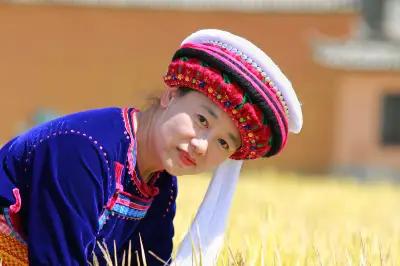
The rice fields are a must-see in Xizhou. The bright golden hues of October dazzle the eyes, brimming with vitality. With sunshine just right, it feels as if you could reach out and touch the clouds—like a tranquil, gentle painting of a storybook town.
If you come in October or November, you’ll see endless golden fields. A good friend told me that in summer, it’s a Miyazaki anime wonderland of lush green. I hope to return next summer to discover that summer beauty.
Cycling around Erhai Lake | Tell your secrets to Erhai
How can you visit Dali without cycling around Erhai Lake? Though it’s not the sea, Erhai is more beautiful than most seas in China.
Rent a car or drive yourself around Erhai, stopping wherever you fancy. Sit by the lake, gaze blankly, and whisper your secrets to Erhai.
Driving or cycling around Erhai is the quintessential Dali romance—along the way, you’ll encounter countless delights: vintage buses, flower fields, churches… Whatever style you love, you’ll find it here.
Majiuyi is a Bai village by Erhai with many trendy hotels, but what captivated me most were the dead trees standing along the lakeshore.
About 10 kilometers north of Jinsuo Island floats a solitary reef with a pavilion on it—that’s Little Putuo Island. Shaped like a seal, legend says it’s the seal left by Guanyin to calm the sea. On Erhai Lake, Little Putuo is a 'pocket-sized island.' Small as it is, it’s hugely famous, appearing in almost every Dali photo album.
Strolling through the Ancient Town | I never really understood Dali Ancient Town
The first time I rushed through Dali Ancient Town, I thought it had more charm than Lijiang Ancient Town but couldn’t describe it further—until this leisurely exploration, when I realized I’d never truly grasped it. The moment I stepped into Dali Ancient Town, it felt as if time rewound a thousand years. Even my wildest historical imagination couldn’t contain the ancient beauty of the Tang Dynasty’s Nanzhao Kingdom.
Dali Ancient Town has four gates: South, East, West, and North, with countless watchtowers and gate towers stretching as far as the eye can see. When I arrived, the crowds were moderate—luckily not peak season—which perfectly suited my desire to soak in the history. The streets radiate neatly from the ancient buildings, commercialized with a pleasing sense of restraint. The walls and tiles of the towers and various ancient structures are stunning, their interplay of black, gray, and white deeply evocative. Wandering aimlessly along the main street, Renmin Road, and ducking into nearby alleys always brought delightful surprises.
The Catholic church of Dali Ancient Town sits quietly in a hutong off Renmin Road, built in 1927. Standing in the sunlight, it’s utterly enchanting up close. Its architecture is one of a kind—a fusion of local Bai cultural traits, Han and Western styles, and other ethnic influences. Flying eaves, bracket sets, and delicate color paintings grace it. Inside, you’ll feel as if you’ve entered an ancient gallery or museum. The north wall is covered in time-honored Western paintings; the south wall is inlaid with elegant Chinese ink-wash landscapes. On the front wall hang three paintings, the central one a miniature of the church itself, recording its history and grace.
At night, the ancient town takes on a more artistic, local vibe. Warm orange light plays over old buildings, food stalls set up, and a handsome guitar player sings, his voice bouncing off the tower eaves.
The bustle masks the solemn, weathered millennia, while lively everyday life spreads at night. I have wine—do you have a story?
A Century-Old Mansion in Dali Ancient Town | A restaurant frequented by Faye Wong and other celebrities
Amid Dali Ancient Town’s growing commercialism, many old courtyards have been converted into shops. However, one place moved me deeply: hidden in the town is a beautifully preserved century-old courtyard restaurant—Jinshan Guyuan Restaurant. After a hundred years, it still retains its original architecture. Many newlyweds stop to take wedding photos at its distinctive entrance.
Dining here, you might even spot celebrities. Faye Wong and others, as well as many variety shows, have eaten here—proof of its popularity.
The whole restaurant exudes an ancient simplicity, while the courtyard, filled with flowers and plants, adds youthful vitality. Eating here feels like a hidden paradise.
What struck me most was the care put into everything. The owner and staff are all native Dali people, and their honesty and groundedness shine through: annually brewed plum wine that takes a long time to perfect, every dish cooked with heart, no frills. For just a few dozen yuan per person, you can enjoy the most natural, home-cooked flavors.
Be sure to order the signature wild mushroom and preserved rib hot pot. The broth starts with chicken stock, simmered with matsutake mushrooms, bamboo shoots, and preserved ribs, creating a collision of fresh ingredients that thrills the palate.
The signature Jinshan Bai-style tile-roasted meat is another must-try—a classic Bai dish, not greasy at all, and my companions and I fought to finish it.
In Yunnan, the 'water sprite' (a type of aquatic plant) is also a specialty; served cold, it’s incredibly refreshing. The annually brewed plum wine tastes wonderful; just by sipping it, you can tell how much care went into it.
Basically, it’s hard to go wrong here—order whatever you fancy with confidence!
Must-Try in Dali Ancient Town | Never tire of the wild mushroom hot pot
After spending several days in the ancient town, if you ask me which restaurant I couldn’t resist visiting every day, my answer is: I’ll Wait for You in Dali · Fangzhou Pangzi Kitchen.
Even a picky eater like me was won over by the food here. Every day, I craved those same few exceptional dishes, never growing tired of them. The restaurant has two floors; since it’s often full due to its great taste, I recommend a window seat on the second floor for a view of the ancient town’s beauty!
How can you miss fresh mushrooms in Yunnan? Order the signature wild mushroom soup pot—choose from ten varieties of wild mushrooms, all super fresh. A whole pot of mushroom soup is both nourishing and delicious; as it simmers, the fragrant aroma wafts irresistibly.
Personally, I adore bamboo fungus and porcini mushrooms—essentials for the mushroom pot! Who would have thought I’d return just for the mushroom fried rice? It’s incredibly tasty, blended with Sichuan flavors. As a spicy food lover, I found the combination of mushrooms and Sichuan-style cooking utterly seamless—absolutely delicious!
Their signature stir-fried meat also incorporates Sichuan flavors. Spicy food fans, don’t miss it!
In Yunnan, you can’t pass up rose yogurt. Handmade and free of unnecessary preservatives, every spoonful is filled with rose fragrance. The daily highlight was simply a cup of rose yogurt—pure bliss!
Accommodation | It awaits not passersby, but those who return
If you love Dali Ancient Town, I strongly recommend staying a few nights to experience its day and night. Hidden in an alley near Erhai Gate is a hidden gem of a guesthouse with incredible value—Fangzhou Muzhai. Here, time seems to slow down. Though located in the heart of town, it’s surprisingly secluded, without a trace of noise.
At the doorstep, I was greeted by an extremely warm housekeeper. Their sincere welcome made me feel as if I’d returned home. The owners and staff are wonderfully hospitable; you can enjoy fine local tea in the living room and share stories—funny or troubling—with new friends you’ve just met.
The four-story guesthouse boasts a courtyard on the ground floor with a winding, secluded feel—various green plants arranged in surprisingly harmonious ways. On the rooftop is a stunning garden filled with different succulents, a total delight.
The rooms are full of thoughtful details, blending local touches with a clean, elegant design.
The rooms are spacious, so when I didn’t feel like going out, I’d just lounge inside, reading, watching TV, or soaking in the big bathtub. Isn’t that the most relaxing, enjoyable part of travel?
Beyond the Town | A must-experience vegetarian meal at the most beautiful nunnery
'A winding path leads to a secluded spot, with meditation rooms hidden among flowers and trees.' That was my first impression of Jizhao Nunnery. Most temples are filled with burning incense, but Jizhao is different—simple and artistic. Here, you don’t worship with incense; instead, flowers and plants serve as offerings. With a devout heart and good intentions, your prayers will be answered, and your hopes never forgotten.
What left the deepest impression was the stunning array of succulents. Standing before any pot, you could linger for ages.
The name Jizhao comes from a phrase meaning 'sensing leads to understanding, silence illuminates.' Surrounded by pines and cypresses, the nunnery is serene, exuding freshness and elegance, a true poetic idyll. The moment you enter, you’ll marvel—there’s no temple atmosphere at all; it feels more like a literary garden bursting with spring.
Many people come here for the vegetarian meal. The vegetables, grown by the nuns themselves, are simple and organic, completely vegetarian with no meat or fish. Yet one bite makes you feel it’s the most delicious, authentic food in the world. When eating here, never waste a single grain or leaf; take small portions and return for more if needed. Waste is punished! Jizhao Nunnery sits on a mountain, so it’s cooler. Add the religious setting, so dress comfortably and warmly, and avoid anything too flashy or revealing.
If you enjoy a slow-paced life, why not head west to Dali!