Come to Dali: Escape the Hustle and Enjoy a Utterly Comfortable Stay!
During the pandemic, unable to travel abroad, when winter arrives, if you want to avoid the cold, there's really no need to go to Sanya – Yunnan's Dali has its own special charm. It may not be by the sea, but it has the relaxed vibe of a coastal town. Would you like to come and experience it?
If you want to travel to Dali, how exactly should you spend your time? The ancient town, Cangshan Mountain, Erhai Lake – every corner tempts the heart. How to explore Dali? What to eat? Where to stay? Next, I'll answer these one by one.
When you're in Dali, just like in Sanya, you have to slow down and soak it all in. The first thing is to choose a good hotel and settle in comfortably for a few days.
A lavish breakfast makes for a delightful start to the day.
This time I chose to stay at the Dali · Tinghuatang Huaqianxun Dali Erhai Water Curtain Cave Hotel. I have to say, spending three nights here was definitely the right choice.
The hotel itself is an Instagram-worthy spot; even in winter, it was bursting with blooms.
Stepping inside, every detail has been thoughtfully arranged.
There are many spaces perfect for photos, like this circular sunken sofa, just right for snapping a picture with friends.
Right next to it is a book bar; if you have time, sitting quietly with a book is also lovely.
The hotel's biggest feature is its extensive planting of flowers. In winter, they were already looking wonderful; I can only imagine what they're like in other seasons – probably a sea of blossoms.
The succulents are also fantastically well kept.
The reason it's called Water Curtain Cave is that behind the hotel, set into the cliff, there really is a karst cave. Walk inside and you'll find a little tent just perfect for photos, and behind that, the cave itself.
There's also a small pool resembling the travertine terraces of Pamukkale in Turkey – wonderfully photogenic; you'll get stunning shots in no time!
[A corner of the garden]
[A corner of the garden]
[A corner of the garden]
In the courtyard you can also spot passion fruit.
Sitting in the little yard that belongs to the guesthouse, with a breeze blowing, you'll see flowers swaying all around.
In Dali's winter, even on the coldest days, flowers bloom defiantly, giving a sense of vitality and prosperity.
Come to Dali, find a lakeside guesthouse to stay, and leisurely watch the sunrise and sunset over Cangshan Mountain and Erhai Lake – it's truly a delightful thing.
I will always love this place – the air here, fresh and liberating, the petals fallen on the courtyard, the clouds drifting across the sky, warblers and grasses, chirping insects and calling birds – everything is so beautiful.
If you stay in a top-floor room, the 270-degree sea view will absolutely win you over; Cangshan and Erhai become the backdrop of your room.
A pink room, a huge circular bathtub – everything oozes romance.
Staying here, stress naturally melts away. It's a perfect spot to let loose and recharge. Would you like to spend a night?
Near the guesthouse is Shuanglang, a secluded paradise left along the shores of Erhai Lake. Quieter than Lijiang, more soulful than Dali, those who have been there all fall in love with it. With Cangshan at its back and facing Erhai, Shuanglang is definitely worth a visit.
"The best scenery in Dali is along Cangshan and Erhai, and the best of that is in Shuanglang." In Shuanglang, your front door greets the azure waves of Erhai, while in the distance you overlook the nineteen peaks of Cangshan – it's the very essence of Cang-Er beauty.
Shuanglang was originally just a humble fishing village on the northeast shore of Erhai. Thanks to its unparalleled location, tourism has completely transformed this little village into a famous destination in Dali, drawing countless visitors every day.
In winter, you can see flocks of seagulls in Shuanglang. Bring a little bread and you can "salute" these visitors from afar.
[Seagulls on Erhai Lake]
[Seagulls on Erhai Lake]
[Seagulls on Erhai Lake]
[Seagulls on Erhai Lake]
[Seagulls on Erhai Lake]
Shuanglang is a small fishing village, but not as tiny as you might imagine. The villages along Erhai are packed with guesthouses, all kinds bewildering, each distinctive, hidden at the end of alleyways, silently telling the story of leisurely holiday life in Shuanglang.
Here you can do nothing, read a book, listen to music, face Erhai, and gaze at Cangshan.
Local Bai-style houses with their unique patterns attract many people.
Standing by the lakeside in Shuanglang, look up: Cangshan. Look down: Erhai. Glistening ripples sparkle, dazzling as a mirror. For generations, the native villagers have quietly lived by Erhai, fishing day after day, witnessing through the ages Dali's "wind, flowers, snow, and moon."
Wandering in Shuanglang, you soon come to the edge of Erhai. The brilliant blue sky and water nearly blind you with brightness – it feels radiant and vibrant. Water constantly spouts up from the lakeside, as if adding oxygen to this place.
Here, an artistic vibe comes naturally; you'll find poetry and the distant horizon right here.
As the sun sets, the afterglow casts enchanting light on the lake's surface. After snapping a quick photo in front of a landmark, I set off to drink in Shuanglang's beauty as if racing against time.
The island vibe goes without saying, but what most excites visitors is the string of beautifully decorated little shops – selling clothes, accessories, local snacks – one after another in dizzying succession.
A book and an afternoon really is so pleasant indeed.
Strolling through the lanes of Bai-style dwellings, you'll always discover some shops with special ambiance – all kinds of cafes and snack joints, or stores selling ethnic tie-dye shawls. When the spring sunshine is out on a clear day, you'll meet the most beautiful version of Shuanglang.
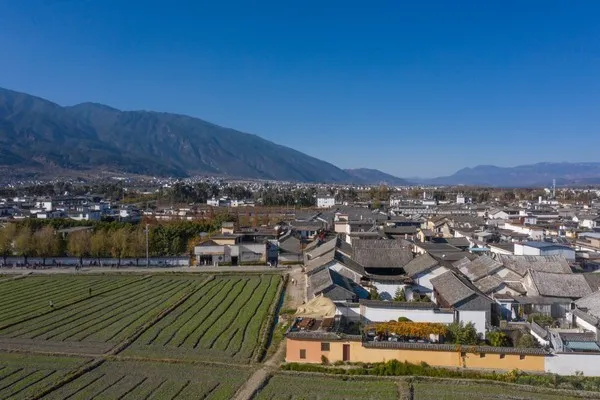
And after you've experienced romantic Shuanglang, the quiet beauty of Xizhou is bound to win your heart too. Xizhou is the largest town in the northern part of Dali in northwest Yunnan. Looking down from above, it's like an ancient, elegant city, or rather a huge open-air museum of traditional residential architecture.
Besides the leisurely slow life, exquisite guesthouses, and down-to-earth local customs – all standard old-town delights – Xizhou is the cradle of Dali culture. Even today, you can feel the farming culture, see handicrafts with ethnic character, and experience thousands of years of cultural heritage.
Xizhou old town isn't big. Although the map marks many sights, once you're here, you'll realize that every corner feels like a scenic spot.
Xizhou preserves the most and best cluster of traditional Bai-style houses, many dating from the Ming, Qing, and Republican periods. It's no exaggeration to say that Xizhou's ancient architecture is a microcosm of Bai architectural culture. For example, the Seven-Chi Study of Yang Shiyun from the Ming dynasty, the Zhao Tingjun mansion from the Qing, and during the Republican era, the mansions of Yan Zizhen and Dong Chengnong.
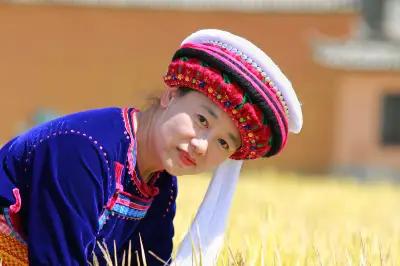
Walking in Xizhou old town, stepping on the ancient flagstone paths, watching elderly Bai locals in their traditional costumes pass by, it's as if you've entered another world where time stands still and life moves at a wonderfully slow pace.
[Historic photos along the street]
At the center of Xizhou old town is the Square Street, a small plaza enclosed by shops. Outside it, streets twist and turn in complexity.
Compared with the bustling ancient towns of Dali and Shuanglang, this is a completely different scene.
A photo spot hugely popular with visitors.
When in Dali, don't forget to come to Xizhou old town to seek out history and quiet stones, sense the town's past and present vicissitudes, and take in the rich folk customs of the Bai people. It's like admiring an ink-wash painting that embodies a thousand years of Bai history – mottled, antique, and quietly elegant.
In Xizhou old town, find a tranquil corner to calm your restless heart.
Address: Dali Bai Autonomous Prefecture, Dali City. Opening hours: the old town is open all day; Yan Family Compound 8:30-17:30, Yan Family Folk Residence 8:00-18:00. Transport: from Dali Ancient Town or Xiaguan, take a minibus heading for Xizhou along the Yunnan-Tibet Highway, flag it down anywhere; fare 5-8 yuan.
In the evening, near Xiaoputuo Island, you can see a small flock of seagulls too. Besides, this spot isn't far from the guesthouse, and you can enjoy a lovely sunset.
According to legend, when Guanyin was creating the Dali basin, she tossed a vast sea-calming seal into the eastern part of Erhai. The seal turned into an islet to subdue waves and protect fishermen. So, fishermen built a Guanyin Pavilion on the island to commemorate the goddess. They named a fishing village east of the islet Haiyin and called the islet Little Putuo Mountain and the pavilion Xiaoputuo, meaning the place of Guanyin's spiritual practice.
Xiaoputuo Island has a circumference of just over 200 meters, formed entirely of limestone, shaped much like a round seal. If Erhai is a painting, Xiaoputuo's location is precisely where the seal falls, hence it's also called Haiyin.
Probably during the Chongzhen reign of the Ming dynasty, local fishermen raised funds to build a two-storey pavilion with a hip-and-gable roof on the island, enshrining a statue of Guanyin, so people called it Guanyin Pavilion.
The next day, we drove two hours to an even more remote old town – Shaxi. Some say Shaxi is different from Dali and Lijiang: rustic and comfortable; once you arrive, you'll want to stay for a long time. At that point I didn't know Shaxi very well, but the name had already taken root in my heart.
Maybe you've passed through it on your way to Dali or Lijiang, but you haven't yet really gotten to know it.
Shaxi is a historic ancient town dating back over a thousand years, with roots reaching the Spring and Autumn and Warring States periods more than 2,400 years ago. Aofeng Mountain ancient tomb cluster and copper mine ruins east of Shaxi on Huacong Mountain show that as early as 400 BC, Shaxi was a bronze smelting base centered on the Heihui River.
Shaxi old town is known as "the only surviving ancient market on the Tea Horse Road." Located in the southeast of Jianchuan County, Dali, it sits in the southeast of the Three Parallel Rivers protected area (Jinsha, Lancang, and Nu rivers), between Dali Ancient Town and Lijiang Ancient Town, making it a strategic pass on the ancient Tea Horse Road into Tibet.
Shaxi old town is not large; strictly speaking, there are only three or five "sights," so half a day is enough if you're just here for photos. But if you want to unwind on holiday, it's worth taking your time over a few days.
Amble along Shaxi's quiet flagstone paths, lined by old-world buildings on both sides, with a murmuring stream flowing through. Climb up to the old opera stage in the center, browse the shops and horse inns on Square Street, walk onto Yujin Bridge over the Heihui River, visit Xingjiao Temple, listen to Shaxi's Dongjing ancient music and feel the charm of an ancient ethnic music, and taste Shaxi's local specialties like ginseng seeds, matsutake mushrooms, and goat milk cake. Shaxi is the place I felt most worth staying in for a slow-paced few days. A simple, tranquil little town with none of the crowds and commercial atmosphere of Dali or Lijiang – serene, quaint, and fresh. In an afternoon shower, sitting quietly in a small restaurant eating a meal, the air is filled with the scent of flowers.
[Mud-brick town gate] And Shaxi old town's gate might surprise you. The old street of Sideng in Shaxi has three gates: the east gate leading towards Dali, the south gate connecting to the salt wells of western Yunnan, and the north gate heading towards Tibet. The east gate is built of adobe, only wide enough for two horses to pass through; locals call it Jiezi Gate. Once you enter, you're in the market.
Today, by the bridge, there's even a horse for visitors to pose with.
The stone lions at the bridgehead have become blurred, as if recounting the prosperity and glory of the horse caravan days.
The ancient opera stage has three storeys: the front is the stage, behind it Kuixing Pavilion, where local Bai people venerate the God of Literature. The structure is exquisitely built, with twelve corners flaring out as if about to take flight.
[Intricate wood carvings – a specialty of Jianchuan – can be seen everywhere]
[Many shops have cured meats hanging from the eaves]
[The old town is not large, quietly nestled among the hills]
After that, why not visit the shore of Jianhu Lake? It's like a mini Erhai.
Jianhu Lake isn't big, but it's beautiful year-round. The reflections on the lake are breathtaking, as if you've stepped into a painting.
And the pastoral scenery around Jianhu is so stunning you'll find it hard to tear yourself away! This place is simply wonderful!
After spending a few days in Dali, when I left I felt I hadn't had enough. After reading this guide, are you tempted to come and see for yourself?