A Medium Well Witch's Private Collection of Medieval Recipes: 10—In Dali's 12 Hours of Eating, There's Always One Dish That Makes You Forget What Day It Is
The video of the show was in yesterday's post
'Home Cooking'
Starting work, I was only thinking about disappearing. As soon as I saw the holiday balance is running low—usually I can't wait to polish the days to a shine, now I can't wait to forget what day of the week it is.
Like escaping to Yunnan, telling my friends: 'If you're looking for me, don't wait downstairs; I'll be waiting under that cloud that looks just like a fat pony. Be there or be square.' I even started imagining a group photo where they're all smiling, but I'm dead serious.
I've come to really appreciate Yunnan people's way of eating. Their style is a bit like America, or rural France—they refuse takeout, demand good ingredients, and keep the cooking quick. Because of the hot climate, there are many cold dishes.
But that doesn't mean I'm used to it all. This time I'm in Dali again. As soon as I thought of Heqing Blown Liver, I couldn't help bringing some dry rations—sour 100% Criollo dark chocolate. Yet the real Bai people eat with great sophistication; the essence lies in the sourness of the sour-spicy flavor.
Pig liver paste (zhugan zuo) is a very traditional hot sauce here. The sourness doesn't come from vinegar—Bai grandmothers insist on using papaya to bring out the sourness, adding a fruity aroma. For BBQ dipping dishes, the Bai traditionally use plum vinegar made from Zhaoshui plums to balance all the spices, so even extreme spiciness won't cause internal heat. That's wisdom.
All set to go!
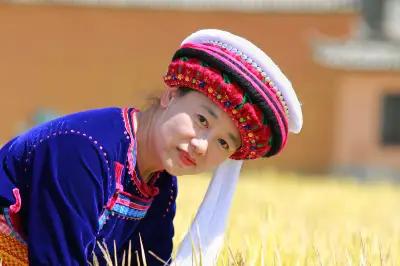
Bright sun—me, a female farmer, wearing the Japanese spring outing hat I bought at the Milky Deer Planet. Dali locals taught me to face away from the sun when it's bright; because of the high altitude, as long as you're in the shade, it's cool and comfortable—direct exposure can easily burn the skin. For once, I finished a whole meal of rose-sugar roasted milk fan and roasted erkuai.
⏰10:30
A stroll through Dali Old Town, then an early lunch at a Bai grandmother's house.
Yang Ningge and Xiaowen took me to this 40-year-old halal restaurant. It's extremely hard to find on a first visit—the door number is vague. Following the slender alley of the Yi Lan Courtyard, we heard a black mynah clearing its throat. To listen to its 'court performance', we sat at a table that had been wiped down by sunlight.
I thought a bowl of cold chicken rice noodles in that sour-spicy thick sauce would be the 'ultimate' of this trip to Dali.
Then I ate the chestnut beef—the whole person melted into the navel of 'brisket satisfaction'.
Frozen fish, full of fresh spicy jelly fragrance. Bitter greens stir-fried with taro and fermented bean paste—refreshing yet satisfying.
A bowl of chicken and beef broth, clear yet rich.
When paying, the landlady used an abacus: 170 yuan. Her mother, already 75, smiled while mixing the sauce for the rice noodles—her teeth so white.
⏰13:30
I steeled myself to go work in the fields, and also check out the vegetables, cows, horses, sheep, fish, and rabbits (actually, to lose weight). Drove to Shuanglang, two hours. In the end, I went to the artist Baxun and Moon's home to see paintings—the moving kind. I just collapsed; not moving felt so good.
Moon said this place is great for writing. I think Hemingway would agree. On their hillside is Baxun's Huoshan Art Museum—that's the eye of Huoshan.
⏰14:00
My eyes were full. On the winding mountain road back, I passed by Teacher Shen Jianhua's Chicken's Nest Coffee and stopped for a rest.
Photographer Qiqi introduced that he had taught many Bai mothers to paint, and their works are as brilliant as sunshine.
I thought, perfect for a cup of coffee and to admire the sparse shadows of plum blossoms. But seeing so many little tadpoles in the restroom did give me a bit of inexplicable excitement.
Spend an afternoon here, and even the most silent mood will start to crow.
⏰15:00
Late lunch—I chose Xishang's Extra Bistro.
Good food from nearby nurtures people from all directions. All the ingredients here are sourced from within a hundred meters.
Fried ribs with mint turned into crispy chicken wings—delicious, but not as intoxicating as the spicy sea snails from Erhai when paired with alcohol.
That's what I thought in my heart, but I obediently ordered Iberian pork ribs with sour plum sweet sauce and tree tomatoes, paired with coffee.
Shuanglang Town has such good water and soil that I couldn't help falling in love with the water-coriander pesto. My own basil pesto couldn't match the grilled tilapia and pumpkin.
Stuffed tofu was topped with chicken fir mushroom oil, every hole in the tofu full of umami.
⏰16:30
Afternoon tea time—I sat for a while at Baxun's Muxi Dali. By Erhai Lake, I finally understood what 'the scenery is so beautiful it's edible' means.
⏰18:40
Seeing the sunset glow already spreading, for dinner I returned from Shuanglang to Dali Old Town to have hotpot.
What does 'FROM FARM TO TABLE' mean? From the farm to the table is just a few hundred meters.
⏰21:30
Milky Deer Planet, Agan Town, No. 404—it's actually an antique music bar with a 'sheriff'. When I arrived, it was just time for Yunnan's late-night snacks and music.
In Eric Clapton's 'Hey Hey', I estimated eight people could finish half a lamb's worth of hotpot 'hey hey' around a Tibetan fireplace.
The side dishes were premium takeout: 'Xiadui Halal Canteen'—the king of Dali beef—beef stew, minced beef with green peppers…
We can do nothing about time; it's short, but better to have it than to miss it. I finally couldn't help saying, 'We haven't even eaten any wild mushrooms yet!'
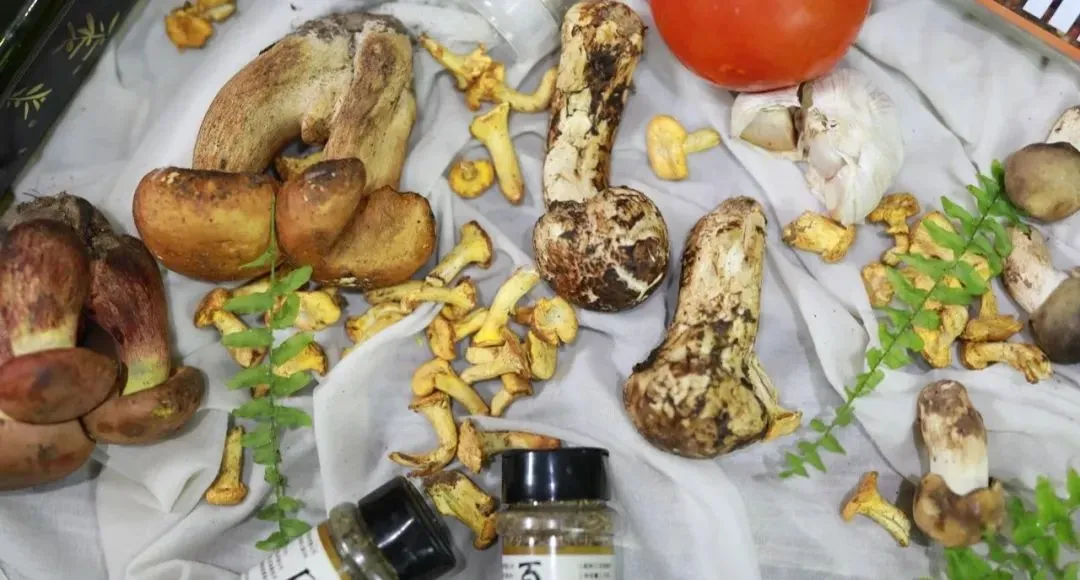
To heal a longing, you shouldn't mention the absence—you need to actually eat them to truly fill the gap. During winter and spring in Yunnan, when mountain delicacies are scarce, locals don't eat dried ones; they prefer frozen mushrooms, which are fresher.
They are little girls picking mushrooms; I am an old lady eating mushrooms. Every summer is a great season for Yunnan mushrooms: precious matsutake, easily poisonous jianshouqing, smooth porcini, tender qingtou, crunchy ganba… those with names and those without. In the Ming Dynasty, Pan Zhiheng compiled 'Guang Jun Pu' (Expanded Mushroom Manual), recording 119 edible mushrooms.
But given how much the Central Plains knew about Yunnan during the Ming Dynasty, this number is a very conservative estimate. According to statistics, Yunnan now has about 250 species of wild mushrooms, accounting for more than half of the world's edible fungi.
On the other side of the ocean, the French also love eating mushrooms. In France, only Paris mushrooms (button mushrooms) and phoenix mushrooms are cultivated; other common wild mushrooms include: morels (Morilles) in spring, porcini (Cèpes) in summer, chanterelles (Girolles), pied de mouton, yellow chanterelles (Chanterelle), black trumpets (Trompette) in autumn, and Coprin mushrooms in winter (though, a quick aside: in the minds of Yunnan people, only wild mushrooms qualify as 'junzi'; everything else is just 'mogu'. However, this distinction will be adjusted in translation.) The French usually cook mushrooms with butter or heavy cream, slowly stewed, which significantly enhances the rich, original flavor.
This time, I borrowed the recipe for Hunter-style Mushroom Stew with Fried Bread from the book 'Home Cooking', originally published in the American Gourmet Society magazine. But all the mushrooms were replaced with precious ones air-shipped from Yunnan.
Now, let's follow Granny and make this stewed mixed mushrooms.
Jianshouqing must be thoroughly cooked, or you might see little people after eating it.
Any quick recipes to recommend?
'Don't say I like you,
say the moonlight on this summer night is so beautiful.'
—Natsume Sōseki
Food Bless You!
Consultant for the China International Food Expo
Producer of 'The Divine Dining Table'