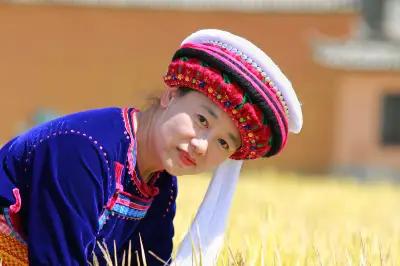
Off to Jade Dragon Snow Mountain – A Family Trip to Yunnan
June 18-22, 2012. A five-day group tour for three: Kunming, Dali, Lijiang in Yunnan. Our son was 11 years old, innocent and carefree!
Day 1: Dali Ancient City – Lijiang Guanyin Gorge – Lijiang Ancient City
1. Dali Ancient City – One of China's first 24 historical and cultural cities.
Dali Ancient City is located in the west of Yunnan Province, at the foot of the picturesque Cangshan Mountain, also known as Yeyu City or Zicheng. Its history dates back to the Tianbao era of the Tang Dynasty. It was the capital of the ancient Nanzhao Kingdom (Tang Dynasty) and Dali Kingdom (Song Dynasty). For over 500 years during the Tang and Song dynasties, Dali was the political, economic, and cultural center of Yunnan. Within the ancient city, there are 14 cultural relic protection sites at the municipal level or above, carrying Dali's history, religious culture, and ethnic culture, making it the core area of Dali tourism.
In the first year of the Baoyou era of the Southern Song (1253), the Yuan Dynasty destroyed the Dali Kingdom, and the city was ruined. In the fifteenth year of the Hongwu era of the Ming Dynasty (1382), Ming forces captured Dali and built a new prefectural city, which is today's Dali Ancient City.
South Gate Tower of Dali Ancient City
The South Gate Tower is called Shuanghe Tower, also known as Cheng'en Tower. The South Gate is the foremost of the four gates, built in the fifteenth year of the Hongwu era (1382). It is the oldest and most majestic building in the ancient city, a symbol and landmark of Dali. The two characters 'Dali' on the gate were personally inscribed by Guo Moruo during his visit to Dali in 1961. 'Dali' is the name of the kingdom, meaning 'great governance of Dali, enriching the country and prospering the state.'
Entering the ancient city from the South Gate
This is a place suitable for living, with a very slow local pace of life, bright sunshine, and a pleasant temperature. Strolling through the shops in the ancient city and admiring the old buildings is very relaxing.
Presidential Military Governor's Mansion
Walking about a hundred meters north from the South Gate of Dali Ancient City, on the west side of the street, there is a courtyard distinctly different from the neighboring residences. The blue-background golden-character plaque reading 'Presidential Military Governor's Mansion' looks especially solemn against the blue sky and Cangshan Mountain. This complex faithfully records a heroic and moving historical event in which the people of western Yunnan, led by the Hui people's Du Wenxiu, bravely fought against the Qing Dynasty.
Wuhua Tower was originally the state guesthouse of the Nanzhao king. When Kublai Khan, the founder of the Yuan Dynasty, conquered Dali, he once stationed troops in front of the tower. In the early Ming Dynasty, Wuhua Tower was burned down during the war. During the Hongwu era, Dali Ancient City was rebuilt. The modern Wuhua Tower was rebuilt in 1998. It is a four-story building over twenty meters high, with the first floor as a base and the upper three floors as the tower. Wuhua Tower is one of the landmark buildings of Dali Ancient City.
Honglong Well: Located in the southwestern part of Dali Ancient City, starting from the west city wall in the west and connecting to Fuxing Road in the east, it is only a few hundred meters long. The well gives the block its name.
In recent years, Honglong Well has become particularly popular among tourists and has become a hot spot in Dali Ancient City. The reason for its popularity is the clear stream that flows year-round, creating a beautiful scene of 'clear spring flowing over stones.'
Xingxing Gate: Derived from Confucianism, it means that celestial literary stars gather at this threshold.
Taking a photo with a peacock
Wucheng Gate: Wucheng Temple, commonly known as 'Wu Temple,' formerly called 'Taigong Temple,' dedicated to Jiang Taigong and sixty-four famous generals from past dynasties. The Wu Temple in Dali was built in the seventeenth year of the Hongwu era of the Ming Dynasty. Also known as Guandi Temple, it symbolizes military culture and wealth in Dali.
Foreigner Street, originally named 'Huguo Road,' commemorates the early Republic of China when Yunnan people opposed Yuan Shikai's monarchy and rose up to protect the nation. Huguo Road runs east-west, 1200 meters long, 7 meters wide, paved with bluestone slabs. The most prosperous section is the middle, 185.6 meters long, and it is one of the earliest and most famous Foreigner Streets in China.
After the reform and opening up, the Hongshancha Hotel on Huguo Road was designated as a hotel for foreigners, making Huguo Road a gathering place for foreign tourists in Dali. As tourism developed, the number of visitors increased, with foreigners gathering for leisure, tasting local delicacies, working, or finding girlfriends – each enjoying their own pursuits in a lively and harmonious atmosphere. Chinese and Western food shops, tea houses, jewelry stores, antique shops, tie-dye shops, and galleries sprang up, lining both sides of the street with a dazzling array of goods, making it the famous Dali Foreigner Street both at home and abroad.
Dali has been a gathering place for the Bai people since ancient times.
2. Guanyin Gorge – First Scenery of Lijiang
Guanyin Gorge Scenic Area is the entrance to Yulong Pass, one of the six major passes of Lijiang Basin, located at the 'Yulong Pass' checkpoint, known as the 'First Scenery of Lijiang.' Lijiang Guanyin Gorge is a scenic area integrating natural landscapes such as mountains, canyons, forests, and lakes, with cultural landscapes like Tea Horse Ancient Street, Naxi villages, folk customs, and religious sentiments. 'The long pass of Qiutang Road, the ancient love of the Yunnan-Tibet Tea Horse Road' is a portrayal of Lijiang Guanyin Gorge, which can be described as the first dangerous pass on the Yunnan-Tibet Tea Horse Road. Xu Xiake entered Lijiang through this pass, describing Qiutang Pass as 'the key to Lijiang Prefecture.' Entering this key means entering the gate of Lijiang, and only through this gate can one truly come to Lijiang.
Here, it is 2578 km from Beijing, with an altitude of 2230 m.
First, reaching the entrance of the 'Tea Horse Road,' which was a folk international trade channel in southwestern China mainly using horse caravans. It originated from the tea-horse trade in the ancient southwestern border, flourished in the Tang and Song dynasties, and peaked in the Ming and Qing dynasties. It can be divided into the Sichuan-Tibet and Yunnan-Tibet routes. Historically, Guanyin Gorge was the only entrance and military fortress for the Yunnan-Tibet Tea Horse Road from Lijiang into Tibet.
Liangma Bridge: Built by local people for the convenience of horse caravans on the Tea Horse Road. After passing the Tea Horse Road and crossing Mujia Bridge, one reaches Mujia Villa, which was the tax inspection post set up by the Mu Chieftain.
Mujia Villa: Located within Lijiang Guanyin Gorge Scenic Area, it was the tax inspection post set up by the local 'emperor' Mu Chieftain. Simple and unique, the building is a typical Naxi courtyard with two patios. The intricately carved six-panel doors, the beautifully laid out courtyard, and the symbolic hanging fish all reflect the wisdom and aesthetic sense of the Naxi people.
Playing a game of officers catching thieves
This should be Naxi script.
Xiake Pavilion: This is a place visited by Xu Xiake. In 1639, at the invitation of Mu Zeng Chieftain, Xu Xiake traveled from Dali to Lijiang and stayed in Lijiang for 15 days. This was the only entrance for Xu Xiake to enter Lijiang Basin from Dali and Heqing. It is said that Xu Xiake entered Lijiang through here, and the Xiake Pavilion was where he once stayed. Later, in his memory, the 'Xiake Pavilion' was built. He also made detailed records in his 'Travel Notes of Xu Xiake,' writing the magnificent chapter 'This mountain is truly the key to Lijiang.' This is the best spot for a close view of Guanyin Gorge.
Passing through the bustling market street, the greenery becomes more intense, with a mix of emerald and dark green, wildflowers fragrant; weeping willows reflect in the tranquil lake, with sky and water blending into a vast expanse of green.
Through a dense bamboo forest, there is a 385-meter-long mountain tunnel, traversed by an electric minitrain. 'Where hills bend, streams wind, and the pathway seems to end; past dark willows and flowers in bloom, lies another village.' 'The pool moon does not flow away with the water; the gorge wind comes with the crowd.'
After the tunnel, about a hundred meters ahead is the mouth of Guanyin Gorge, with a stone tablet reading 'Lijiang Guanyin Gorge.'
Lijiang Guanyin Waterfall: The gorge is quiet, with towering peaks. Gradually, the sound of water is heard. Turning around the peak, a waterfall cascades down, swift as an arrow, truly with the force of a 'silver river falling from the ninth heaven.' This is Guanyin Waterfall. At the end of the waterfall, following the surging current and the shimmering light, we climb back along the stone steps up the mountain. The branches intertwine overhead, even in daylight it is dim; sparse branches interlace, sometimes revealing the sun. Exotic flowers and rare plants compete in beauty, and the mountain breeze is fresh and refreshing.
Passing through Yulong Pass Tea Horse Ancient Street
After exchanging the customs clearance documents here, one can go to Lijiang Ancient City.
3. Evening, entering Lijiang Ancient City
Stayed at Xiya Hotel
Day 2: Jade Dragon Snow Mountain – Lijiang Ancient City
1. Jade Dragon Snow Mountain, Blue Moon Valley Scenic Area
Blue Moon Valley: Located at the eastern foot of Jade Dragon Snow Mountain in Yulong Naxi Autonomous County, Lijiang City, Yunnan Province, commonly known as 'White Water River.' It is famous worldwide for its majestic snow-capped mountains, azure jade-like lakes, and spectacular gorge scenery. Named for its blue lake water and crescent-shaped valley, it is said to be the prototype of the Blue Moon Valley in British writer James Hilton's novel 'The Lost Horizon.'
Yuye Lake: The water of Yuye Lake is extremely clear, revealing a pure white bottom at a glance. The blue lake reflects the nearby Jade Dragon Snow Mountain, like a beautiful landscape painting, reminiscent of the poetic scene: 'A half-mu square pond opens like a mirror; shadows of sky and clouds wander together.'
Jingtan Lake: Jingtan Lake is a small scenic spot in Blue Moon Valley, appearing delicate but very tranquil. The lake water is also exceptionally clear, with a flavor of 'Jiuzhaigou Mirror Sea,' evoking the poetic sentiment: 'The lake and autumn moon blend in harmony; the pool surface is calm, a mirror unpolished.'
Tingtao Lake: The water of Tingtao Lake has a large drop, with streams cascading like waterfalls, making a 'ding-dong' sound like a musical instrument. Standing by the lake, one can hear the sound of water mixed with the rustling of pine trees, like the beautiful scene described in 'The sound of the stream under the pine tree, and the sound of the waves on the pine tree.'
2. Impression Lijiang Show – The highest live performance in the world at 3050 meters above sea level
'Impression Lijiang' is a large-scale original ecological live performance, directed by China's most influential director Zhang Yimou together with Wang Chaoge and Fan Yue. It took over a year of work and hundreds of revisions to complete. The performance theater is located at 3050 meters above sea level, the highest live performance venue in the world – Ganhaizi in Jade Dragon Snow Mountain Scenic Area. It is currently the only live performance held during the day.
'Impression Snow Mountain' uses the snow mountain as a backdrop, drawing on the spirit of heaven and earth, taking from nature's grandeur, with folk culture as the carrier, using bold freehand brushwork. At the highest performance venue in the world at 3100 meters above sea level, it brings the truth and shock of life close to everyone.
Performers come into the audience to interact
Galloping horses come to the back of the audience
Jade Dragon Snow Mountain is still shrouded in clouds and mist
Standing in the large performance venue at the foot of Jade Dragon Snow Mountain, as the show begins, one is unconsciously drawn in, truly feeling a cleansing of the soul, a transcendence of the spirit, visual beauty, and an unprecedented sense of unity between heaven and man – truly wonderful!
3. Yushui Village – The Dongba Holy Land in the central region of the Naxi people
Yushui Village is the Dongba Holy Land in the central region of the Naxi people and the source of Lijiang Ancient City. The Nature Conservancy designated Yushui Village as a base for inheriting Dongba culture, Baisha fine music, and Leba dance, carrying out the excavation, sorting, inheritance, research, and display of Naxi ancient culture.
The Divine Spring is actually meltwater from the top of Jade Dragon Snow Mountain, which gushes out after seeping through 2400 meters of rock.
Divine Dragon Three-tiered Water: A large spring flows down the hillside, folding into three tiers. The Naxi people's worship of the Divine Dragon Three-tiered Water is integrated into their lives. They build their domestic water into three-tiered divine springs; they arrange their family feasts into three tiers with high and low plates, bowls, and hotpots; they build their courtyards in the style of three-tiered water; Naxi women even wear the 'three-tiered water' on their bodies.
Black Dragon Pond: Also known as Jade Spring Park, formerly called Jade Spring Dragon King Temple. Built in the second year of the Qianlong era (1737), with records of renovations in the 60th year of Qianlong and the 18th year of Guangxu. It was named after receiving imperial titles of 'Dragon God' from the Jiaqing and Guangxu emperors of the Qing Dynasty. Later, it was renamed Black Dragon Pond.
Black Dragon Pond is located at the foot of Xiangshan Mountain in the north of the city. Following the Jade River from Sifang Street in Lijiang Ancient City upstream for about one kilometer, there is a clear spring pool – the famous Black Dragon Pond.
Ancient buildings include the Dragon God Shrine, Deyue Tower, Suocui Bridge, Yuhuang Pavilion, and later relocated buildings such as the Jietuo Forest Gate Tower of Fuguosi Temple from the Ming Dynasty on Zhishan, Wufeng Tower, the Ming Dynasty Guangbi Tower from the prefectural yamen, and Qing Dynasty buildings like Tinglyi Pavilion, Yiwen Pavilion, Wenming Archway, etc.
5. Lijiang Ancient City
Lijiang Ancient City, also known as Dayan Town, is located in Gucheng District, Lijiang City, Yunnan Province, situated in the middle of Lijiang Basin. It was built in the late Song and early Yuan dynasties (late 13th century AD), at an altitude of the Yunnan-Guizhou Plateau, covering an area of 7.279 square kilometers. Lijiang is one of the second batch of approved Chinese historical and cultural cities and is one of the two ancient cities that successfully applied for World Cultural Heritage as a whole. Lijiang Ancient City embodies the achievements of ancient Chinese urban construction and is one of the types of Chinese residential architecture with distinctive features and styles.
Sifang Street: A small food street in the ancient city, with dozens of small restaurants on both sides, each offering Yunnan's special rice noodles in various varieties. Therefore, this street is also called 'Lijiang Rice Noodle Street.' Sifang Street is the center of Lijiang Ancient City, said to have been built in the shape of the Mu Chieftain's seal during the Ming Dynasty. It was the most important hub on the Tea Horse Road, where merchants from all directions gathered since the Ming and Qing dynasties, and various cultures intermingled, making it the economic and cultural exchange center of Lijiang.
This sculpture is called 'Climbing Mountains and Crossing Rivers.'
6. Lijiang Eternal Love – The large-scale song and dance performance 'Lijiang Eternal Love' is the soul of Lijiang culture. Using IMAX 3D visual effects, it recreates 'Naxi Genesis,' 'Lugu Daughter's Kingdom,' 'Horse Caravan Legend,' 'Ancient Road Modern Breeze,' 'Jade Dragon Third Kingdom' and other histories and legends of Lijiang over a thousand years.
It leads audiences to cross snow-capped mountains, in the vast primitive wilderness, by the Mosuo flower towers on Lugu Lake, on the stormy Tea Horse Road, in the ancient town of the ancient road with dancing and singing, in the romantic and tragic Jade Dragon Third Kingdom, and in the paradise-like Shangri-La, to meet a romantic encounter and feel a beautiful moment.
The entire performance integrates elements of dance, acrobatics, martial arts, stage machinery, panoramic stunts, and installation art. Through high-altitude anti-gravity walking on the moon, the Great Peng bird saving the ancestor, high-altitude door smashing, water mines, floods, waterfalls, rain curtain plank roads, large-scale snow mountain mechanical models, and tens of thousands of sets of high-tech machinery combined with original ecological art, it outlines a cultural legend full of spirit and flesh, blood and tears, life and death, love and passion.
7. Return to Lijiang Ancient City
Day 3: Dali Xizhou Yan Family Mansion – Chongsheng Temple
1. Visit a silverware shop in Dali
2. Yan Family Mansion
Located in Xizhou Town, Dali, Yunnan, it is a grand mansion consisting of multiple courtyards connected together. Entering the tall, intricately carved gate with upturned eaves, there is a courtyard of 'three rooms with a screen wall,' decorated with calligraphy and paintings, flowers and trees swaying, pleasing to the eye.
Passing through the hallway, there is a large courtyard of 'four compounds with five patios,' with corner rooms and patios, leading in all directions like a maze.
Following the winding path to a secluded spot, there is another 'four compounds with five patios' courtyard, and at the deepest part, there stands quietly a Western-style villa with modern architectural forms, complete with a basement, balcony, corridors, French windows, surrounded by flowers and bonsai, in an elegant and unique environment.
Despite the passage of time, the red lacquered doors and windows and the white marble carved railings still retain their former glory.
This fully demonstrates the superb architectural art of the Bai people.
Bai Three-Course Tea, called 'Shaodaozhao' by the Bai people. It is a way of drinking tea that allows hosts and guests to express feelings, wish for goodness, and is full of dramatic color. Initially, it was used by the Bai people as a blessing from elders to younger generations for education, apprenticeship, business, and marriage. The 'Three-Course Tea' song and dance performance has become a staple of Dali tourism.
The 'Three-Course Tea' symbolizes the philosophy of life: 'first bitter, second sweet, third aftertaste.' It has become a tea ritual for Bai folk weddings, festivals, and hospitality.
3. Dali Chongsheng Temple
Chongsheng Temple faces Erhai Lake to the east and leans against Cangshan Mountain to the west, located about one kilometer north of Dali Ancient City in Yunnan Province, at the foot of Diancang Mountain, by the shores of Erhai Lake. Historically, nine Dali emperors became monks at Chongsheng Temple, which is referred to as 'Tianlong Temple' in Jin Yong's martial arts novel 'The Demi-Gods and the Semidevils.'
Chongsheng Temple was burned down during the Xianfeng era of the Qing Dynasty, leaving only the three pagodas intact.
In 2004, the Dali Cultural Bureau spent 182 million yuan to rebuild Chongsheng Temple. The reconstruction project focused on protecting the three pagodas, maintaining the existing bell tower, Rain Bronze Guanyin Hall, and the front area layout, with the building complex arranged in three main axes, eight platforms, nine entrances, and eleven layers.
Main buildings include the Golden Winged Bird Square, Mountain Gate, Dharma Protection Hall, Maitreya Hall, Eleven-Faced Guanyin Hall, Grand Buddha Hall, Acya Guanyin Pavilion, Wanghai Tower, Arhat Hall, Patriarch Hall, Thousand Buddha Corridor, etc. The Buddha statues in each hall are based on 'Zhang Shengwen's Scroll' (also known as 'Dali Kingdom Buddha Scroll') and the 'Five Hundred Arhats' from Qiongzhu Temple by Li Guangxiu of the Ming Dynasty, as well as artifacts found in the three pagodas, arranged according to Dali's diverse culture and the eclectic features of Zen and Esoteric Buddhism. 617 Buddha statues and ritual implements were cast in bronze, 599 of which are gilded and painted.
The entire antique building complex covers 600 mu (about 40 hectares), with a construction area of 20,080 square meters, belonging to a Han Chinese Buddhist temple. On April 22, 2005, the reconstruction of Chongsheng Temple was completed.
Chongsheng Temple Three Pagodas consist of one large and two small pagodas. The large pagoda is called Qianxun Pagoda, built during the reign of Nanzhao King Quanfengyou (824-859 AD). The distance between Qianxun Pagoda and each of the small pagodas is 70 meters, forming a tripod. Qianxun Pagoda currently stands 69.13 meters high, with a base width of 9.9 meters, a square hollow brick pagoda with dense eaves, 16 stories in total, and is one of the tallest existing pagodas in China. It shares similar architecture with the Big Wild Goose Pagoda and Small Wild Goose Pagoda in Xi'an, both typical Tang Dynasty structures, and its form is similar to the Small Wild Goose Pagoda, making it one of the typical pagoda styles of the Tang Dynasty.
Day 4: Kunming – Stone Forest – Colorful Yunnan
1. A jewelry shop in Kunming
2. Stone Forest Scenic Area
Located in Shilin Yi Autonomous County, Kunming, 78 kilometers from the provincial capital. The area covers 350 square kilometers. The Stone Forest Scenic Area has been designated by UNESCO as a 'World Geopark' and 'World Natural Heritage Landscape.' In 1982, it was approved by the State Council as one of the first batch of national key scenic spots, a national 5A tourist attraction, and a national civilized scenic tourist area.
About 300 million years ago, the Kunming Stone Forest Scenic Area was a vast ocean. After a long geological evolution, it formed extremely precious geological relics, covering many types of karst landforms on Earth.
Long Lake is a karst lake, supplied by groundwater, with a circumference of 5 kilometers, a width of 300 meters, an average depth of 24 meters, and clear, pollution-free water. Surrounded by green mountains, vegetation coverage exceeds 95%. The air is fresh and clean with good transparency.
There is an island in the lake, and the lakeshore is mainly forested with Yunnan pine, with gentle terrain, divided into many small lakes, in a quiet and beautiful environment. It sits at an altitude of 1907 meters, surrounded by mountains. The lake surface is shaped like a slender maiden, and it is the hometown of Ashima in folklore. Because the lake is hidden among green hills and forests, with few tourist footprints in the past, it is also called 'Hidden Lake.'
The Large Stone Forest consists of dense stone peaks, like a stone basin.
The stone forests here stand upright and abrupt, with smooth lines and a pale bluish-gray color. The tallest independent rock pillar exceeds 40 meters in height.
There are typical scenic spots such as 'Lotus Peak,' 'Sword Peak Pool,' 'Hanging by a Thread,' 'Extreme Narrowness Leading to People,' 'Elephant Sitting on Stone Platform,' 'Deep Orchid Valley,' 'Phoenix Combing Feathers,' etc.
The most famous is the 'Stone Forest Scenic Spot' where Long Yun inscribed the word 'Stone Forest.' 'Wangfeng Pavilion' is the best place to appreciate the 'forest of stones.'
The Small Stone Forest (Ashima Scenic Area) has thick, solid stone walls like screens, dividing the Small Stone Forest into several gardens. The most famous attraction in the Small Stone Forest is 'Ashima.'
3. A jade shop
Tea Horse Road statues
4. Colorful Yunnan
Colorful Yunnan performance
5. Stay at Xishuangbanna Hotel (not in Xishuangbanna)
Opposite is the Wyndham Hotel
Day 5: Kunming
1. Kunming Golden Temple Scenic Area
Located at the foot of Mingfeng Mountain, 7 kilometers northeast of Kunming city center. The main hall is made of brass, shining brightly under the sun, casting a golden glow on the green valley, hence the name, also known as Copper Tile Temple. The famous Golden Temple is part of the Taihe Palace, a Taoist temple, built in 1602 during the Ming Dynasty. It is one of China's four major copper halls and the best preserved. In the tenth year of the Kangxi era (1671), Wu Sangui, the Prince of Pingxi, renovated it, giving it a long history. The Golden Temple has beautiful natural scenery, with paths winding through the forest, dense green trees blocking out the sky, occasional bird songs, deeply embodying the essence of Taoist culture.
Passing through Yingxian Bridge, entering the 'Scenery of Mingfeng' archway.
Walking from the foot of the mountain, passing through 'First Heavenly Gate,' 'Second Heavenly Gate,' and 'Third Heavenly Gate.'
Climbing to the Heavenly Gate, one sees the simple and solemn gate of 'Taihe Palace.' The couplet reads: 'Painted beams connect with clouds, occupying only three acres of green hill; Vermilion towers reflect the sun, opening a new layer of green fields.'
Entering the temple gate, passing through Lingxing Gate.
Climbing the steps into the 'city,' facing a high staircase is the central building of Taihe Palace, the famous Golden Temple.
Is this Chen Yuanyuan?
The park is full of copper objects.
From the bell tower, one can see Kunming city.
2. Kunming Cuihu Park: Located at the foot of Luofeng Mountain in the northern part of Kunming city, opposite the main gate of Yunnan University (the lower image shows the right side of Qinglai Hall on the Donglu Campus of Yunnan University), it is one of the most beautiful parks in the city. Although not large, it has unique characteristics. Originally a bay of Dianchi Lake, it became a clear lake as the water level dropped. Since the Ming Dynasty, successive Yunnan administrative officials have built pavilions and towers here. Because of the weeping willows and clear water, it was officially named Cuihu (Green Lake) at the beginning of this century.
It is famous for its 'Green Embankment Spring Dawn.' People call it 'a green gem set in Kunming city.'
Driving through Kunming city, we happened upon a talent show scene.
Conclusion: The five-day trip was packed full, with countless natural landscapes, historical buildings, and several performances. Among them, the most beautiful natural scenery was Jade Dragon Snow Mountain; the most exquisite ancient architecture was the Xizhou residences (although Chongsheng Temple is magnificent, it is a replica); the most exciting performance was Impression Lijiang; and the happiest thing was the strong parent-child bond!!!