Yunnan Travel: Unforgettable Notes from Four Dali Visits (Photo)
Dali in Yunnan is a beautiful place that uniquely captures all four characters of the idiom "Wind, Flower, Snow, and Moon." I have traveled to Dali four times, and the fourth visit, which ended just over a month ago, left me with vivid, lingering memories that I still can't get enough of.
Soaring in the Blue Sky (Photo: Feng Ganyong)
Time back to March 19, 2021. I set off early at 5 a.m. for Terminal 2 of Beijing Capital Airport, kicking off my first trip out of the city that year. We would take Air China flight CA8328 to Dali Huangcaoba Airport. Invited by Mr. Shen Hui from Ctrip Travel, I was joining an on-site inspection of Dali’s residential cultural life organized by Sunac Southwest Cultural Tourism Group—a magical journey of wind, flower, snow, and moon was about to begin.
Dali Airport (Photo: Feng Ganyong)
Air China flight CA8323 took off at 07:17 and after a four-hour flight landed smoothly at Dali Huangcaoba Airport at 11:20. I first visited Dali back in April 1994, when I came with director Huang Jianzhong from the Beijing Film Studio to scout locations for the TV drama 'Soul Broken at Fishing City.' Later, in November 1998, I returned for filming a documentary on Chinese ethnic sports and for tourism. As we exited the airport, our Dali guide Tang Jia greeted us with a warm smile at the arrival gate.
Heading to Downtown Dali (Photo: Feng Ganyong)
As our car headed downtown, the lovely scenery of Erhai Lake soon came into view. Tang Jia told us about Dali in detail. Dali is famous for the four poetic features: the wind of Xiaguan, flowers of Shangguan, snow on Cangshan Mountain, and the moon over Erhai Lake, a complete embodiment of 'Wind, Flower, Snow, and Moon.' Not only in China but throughout the world, it stands out uniquely. Today, it is a national open city, one of the first 24 historical and cultural cities, one of the 44 national scenic areas, a national cultural model city, and an excellent tourist city in China.
Street View of Downtown Dali (Photo: Feng Ganyong)
Our group drove to the Dali Yiqingyuan farmhouse to enjoy our first lunch of Bai ethnic cuisine after arriving. The distinctive flavors left a deep impression on me, a first-time visitor to Dali. I was especially intrigued by a final dish that looked much like northern Chinese fried dough. When I asked, I learned it was called 'roasted rushan' (a local cheese wrap).
Dali Tourist Map (Photo: Wang Jue)
After lunch, Tang Jia took us by car to first visit the Ancient City of Dali. This was already my third visit there. She explained that Dali Ancient City is located in the northwestern part of Yunnan Province, at the southern end of the Hengduan Mountains, nestled at the foot of Cangshan Mountain and by the shores of Erhai Lake, covering an area of 3 square kilometers.
Ancient City Wall of Dali (Photo: Feng Ganyong)
Dali Ancient City has a long history. Also known as Yeyu or Purple City, its history can be traced back to the Tang Tianbao era, when Nanzhao King Geluofeng built Yangjuxu City (near today's Three Pagodas west of the city) as his new capital. The current ancient city was initially constructed in the 15th year of the Hongwu reign of the Ming Dynasty (1382 AD).
Group Photo in Dali (Photo: Feng Ganyong)
Standing before the grand gate tower of Dali Ancient City, inscribed with the two characters 'Dali' in the handwriting of the renowned calligrapher and writer Guo Moruo during his 1961 visit, I felt a rush of fond memories from my previous photos taken here. Likewise, our group captured an unforgettable group photo at this spot.
A Photo Inside Dali Ancient City (Photo: Tang Jia)
Our group entered through the North Gate and strolled through Dali Ancient City, once again encountering those familiar lively scenes. The city stretches about 1,000 meters from east to west and over 2,000 meters from north to south, with three main north-south avenues and five or six east-west lanes. All houses are traditional wood-and-earth structures with tiled roofs, and most streets are paved with blue stone slabs.
Wuhua Pavilion in the Ancient City (Photo: Feng Ganyong)
Along this main street running north-south, shops specializing in marble crafts, tie-dye, straw weaving, and other local specialties, and Bai ethnic eateries brimming with authentic flavors are lined up one after another. Notably, most streets are accompanied by clear streams channeled from Cangshan Mountain, and everywhere you see elegant traditional Bai dwellings. Locals, rich or poor, have a tradition of cultivating flowers and plants in their courtyards.
A Bird's-Eye View of the Ancient City (Photo: Wang Jue)
The layout of Dali Ancient City follows a chessboard pattern, with the north and south gates symmetrically aligned, forming the main road framework. The city center leans westward, and the north-south axis is not centrally located, resulting in a heavier west and lighter east layout. The east and west gates are offset from each other, following the Bai architectural principle of 'not aligning the four cardinal directions strictly on center.'
Strolling Through Dali Ancient City (Photo: Feng Ganyong)
The ancient city covers about twelve li in circumference, with four gate towers and four corner towers. The walls have four gates: the East Gate, Erhai Gate (also called Tonghai Gate); the South Gate, Shuanghe Gate (also called Cheng'en Gate); the West Gate, Cangshan Gate; and the North Gate, Santa Gate (also called Anyuan Gate). A moat lies outside the walls. The city was repeatedly renovated during the Qing Dynasty and retains a typical chessboard layout with symmetrical north-south gates and a crisscrossing network of streets and lanes, known as the 'Nine Streets and Eighteen Alleys.'
Photo in Front of the Gate (Photo: Yang Yang)
Walking inside the ancient city, one is struck by the unified architectural style, harmonious proportions, and quaint streetscape. In the old alleys, flowers and greenery abound, giving rise to the saying 'a well for every three households, and a few potted plants in every home.' The city preserves many buildings from the Ming, Qing, and Republic of China eras, with temples, academies, churches, and other historic sites dotted around, such as the Jianggong Ancestral Hall, the ruins of Du Wenxiu's Command Post, and the Catholic Church.
The Gateway of Foreigner Street (Photo: Feng Ganyong)
Returning to Dali Ancient City, I noticed many changes—some attractions that I didn't recall from over a decade ago, like the Foreigner Street inside the city. After asking, I learned that Foreigner Street was originally called 'Huguo Road' (Protect the Nation Road), named to commemorate the Yunnan people's uprising against Yuan Shikai's imperial ambitions in the early Republic of China. Huguo Road runs east-west, is 1,200 meters long and 7 meters wide, paved with blue stone. Its most bustling section is a 185.6-meter stretch, one of China's earliest and most famous foreigner streets.
Scenery on Foreigner Street (Photo: Wang Jue)
After the Ancient City tour, I visited Erhai Lake for the third time. On previous trips, I always toured the lake by boat, sailing on its waters.
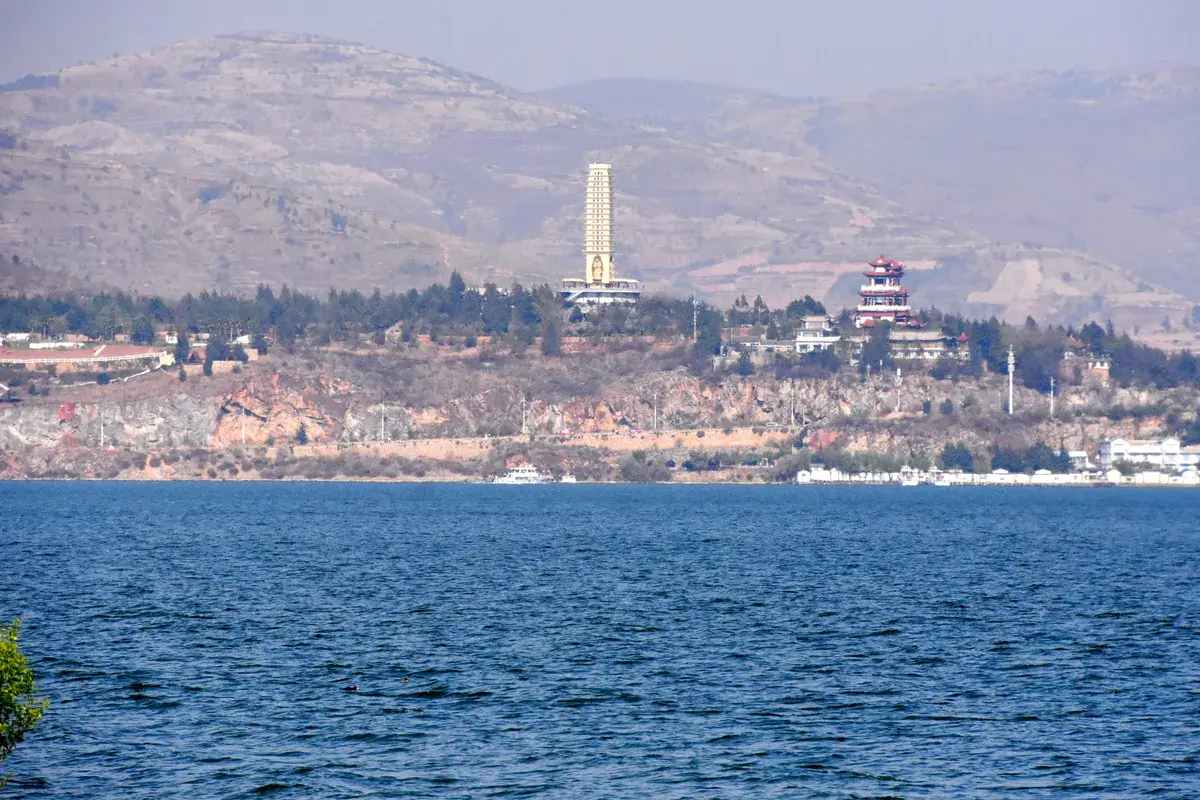
Erhai Lake Scenery (Photo: Feng Ganyong)
This time, I strolled along the Erhai Ecological Corridor and arrived at Wind-Flower-Snow-Moon Square, the site of the old Longkan Ancient Ferry. The scenery was enchanting, with clear blue water, azure skies, and seagulls soaring, attracting many newlyweds taking wedding photos.
A Photo by Erhai Lake (Photo: Yang Yang)
The Erhai Ecological Corridor is a boundary between people and the lake, stretching over 50 kilometers around the shore. Visitors can ride sightseeing electric carts to enjoy lakeside views, rent a bicycle to cycle, or simply walk and soak in the beauty of Erhai.
Wind-Flower-Snow-Moon Square (Photo: Feng Ganyong)
It is said that the ecological corridor creates a physical buffer to let Erhai Lake 'breathe a little.' It links the lakeside villages, turning the distinctive Bai traditional communities into 'a string of pearls around Erhai.' Strolling along this corridor, a nostalgic rural scroll slowly unfolds before your eyes.
Wedding Photos by the Lake (Photo: Feng Ganyong)
With the completion of the Erhai Ecological Corridor, the lakeside once dominated by vast farmland and buildings has transformed into well-equipped walking and cycling paths. Today, it has become a beautiful scenic line where the city and water merge, attracting countless people from all directions daily to cycle, stroll, and relax.
Longkan Ancient Ferry Dock (Photo: Feng Ganyong)
That night, I stayed at the Dali Shili Hilton Hotel, which not only offered top-notch facilities but also a superb environment. From the balcony of my room, I could see the undulating Cangshan Mountain range, and from the other side of the hotel, the boundless Erhai Lake stretched out. The views all around were simply breathtaking.
Black Fried Dough Stick (Photo: Feng Ganyong)
The breakfast at the Hilton was nothing short of sumptuous, but that wasn't the point. The big highlight was a black fried dough stick. According to the chef, it was made with cuttlefish ink. It looked scary, but after a bite, it tasted surprisingly good. This was another pleasant culinary surprise during the trip, following the fried rice with ba jun mushrooms I had at Aishan Mushroom Hotpot restaurant, making both dishes especially memorable.
View of Cangshan Mountain from the Hotel Balcony (Photo: Feng Ganyong)
Speaking of Cangshan Mountain, I was filled with emotion. On my previous drives around Dali, I could always see the spectacular, rolling silhouette of Cangshan, but I had never actually climbed it. This fourth visit finally fulfilled my dream of ascending Cangshan.
Group Photo at the Foot of Cangshan Mountain (Photo: Feng Ganyong)
Early on March 20, we left the hotel and soon reached the Cangshan Scenic Area by car. I realized how close it was to where we stayed. For my very first Cangshan visit in four Dali trips, I took the Gantong Cable Car from Ximatan (Xima Pool) to the halfway point and began exploring the mountain.
Cangshan Mountain Cableway (Photo: Wang Jue)
Cangshan Mountain is the main peak at the southern end of the Yunling mountain range, composed of nineteen peaks stretching from north to south, starting from Eryuan Dengchuan in the north to Xiaguan Tianshengqiao in the south. These nineteen peaks are majestic and imposing, offering a stark contrast to the gentle beauty of Erhai Lake. From north to south, they are named: Yunnong, Canglang, Wutai, Lianhua, Baiyun, Heyun, Sanyang, Lanfeng, Xueren, Yingle, Guanyin, Zhonghe, Longquan, Yuju, Malong, Shengying, Foding, Ma'er, and Xieyang.
Cangshan Mountain Scenery (Photo: Feng Ganyong)
Each peak of Cangshan exceeds 3,500 meters in elevation, with the highest, Malong Peak, reaching 4,122 meters. Due to the high altitude, the summits are extremely cold and capped with snow year-round. Under sunlight, the snowscape appears exceptionally crystalline, pure, and spectacular.
A Check-in Spot on Cangshan Mountain (Photo: Feng Ganyong)
It is said that the ever-present snow on Cangshan, which never melts even in summer, is the most famous of Dali's 'Wind, Flower, Snow, Moon' quartet. A legend recounts that one year, a plague swept the foot of Cangshan. A brother and sister, using magic they had learned, drove the plague god to the mountaintop and buried him in the snow to freeze to death. To ensure the plague god would never revive, the sister turned into the Snow Goddess of Snowman Peak, forever guarding the mountain. Dali's magnificent landscape owes much to the snowy scene of Cangshan.
Photo on the Observation Deck (Photo: Tang Jia)
Literary figures ancient and modern have left splendid poems and prose about it. Ming Dynasty scholar Yang Sheng'an wrote: 'The peak is capped with snow, the hillside wreathed in white clouds, a divine craftsmanship where each reveals its skill.' The Yuan Dynasty poet Huanghua Elder inscribed on a stone tablet: 'A jade dragon hangs over the mirrored terrace, mid-mountain flying snow in heavenly wind.' And Ming Dynasty Hanlin Academician Zhang Laiyi, sending off Master Wuji back to Dali, described it: 'Shaded cliffs still hold the primordial snow, white stones transformed over three thousand autumns.' The grandeur of Cangshan's snow scene is comparable to the Alps in Europe.
A Hanging Cave on Cangshan Mountain (Photo: Feng Ganyong)
On this visit to Cangshan, although I couldn't climb all nineteen peaks, I felt quite content ascending to the Cangshan Grand Canyon observation platform at an elevation of 2,660.74 meters.
Cangshan Grand Canyon (Photo: Feng Ganyong)
Cangshan boasts beautiful natural scenery and a wealth of scenic spots. Ancient people summarized its diverse landscapes into the 'Eight Views of Cangshan.' The Grand Canyon nestled between Malong Peak and Shengying Peak is particularly spectacular, with jagged rocks, towering cliffs, hanging vines, and ancient trees—exuding a strong, primeval wilderness.
Photo at a Cangshan Check-in Spot
In the afternoon after the wonderful Cangshan excursion, the on-site inspection of Dali’s residential cultural life organized by Sunac Southwest Cultural Tourism Group officially began. I saw the 'Dali Little Courtyard' project, set against the backdrop of Qingbi Stream from Cangshan Mountain. With its location advantage and a theme of eco-health, it is a new benchmark for Chinese family eco-living and stands out as a charming highlight in the Dali Ancient City area.
A Scene at the Foot of Cangshan Mountain (Photo: Wang Jue)
Accompanied by Mr. Wang Yongfu, manager of Sunac Southwest Cultural Tourism Group, we personally experienced a series of modern cultural tourism living scenes under the theme 'Dali Little Courtyard,' which was a delight for the eyes and a feast for the senses.
Inspecting the Residential Experience (Photo: Feng Ganyong)
The last stop of my four Dali visits was Xizhou Ancient Town. Xizhou is one of the cradles of Dali culture. As early as the coexistence of the Six Zhao and Heman tribes, it was a Bai ethnic settlement. Originally a Heman city of Dali, it was garrisoned by Sui Dynasty general Shi Wansui, earning the name 'Shicheng' or 'Shidan.' During the Tang Dynasty, the former capital of Nanzhao was also built here, then called Da Li City, already 'densely inhabited,' and it was one of the 'Ten Districts' of the Nanzhao period.
Photo with Yang Yang and His Wife (Photo: Wang Yongfu)
On the morning of March 21, I toured Xizhou with Pu Hongbing and the Yang couple on a small sightseeing cart within the ancient town. Xizhou Town lies in the northern part of Dali City, backed by Cangshan Mountain to the west and facing Erhai Lake to the east.
A Stall Corner in Xizhou Town (Photo: Wang Jue)
Xizhou is also the hometown of the famous movie 'Five Golden Flowers,' a renowned historical and cultural town in Yunnan Province and one of the key hometowns of overseas Chinese. It is a Bai ethnic historical and cultural town with over a thousand years of history.
Zhengyi Gate in Xizhou (Photo: Feng Ganyong)
At the same time, this was my third visit to Xizhou in Dali. Walking its small streets, my old impressions had completely vanished. Xizhou boasts over a hundred courtyard residences of Bai ethnic architecture from various periods—Ming, Qing, Republic of China, and contemporary—each with its own distinctive features.
Entering Xizhou Town (Photo: Feng Ganyong)
From a distance, Xizhou looks like an ancient, elegant town, or more like a huge museum of residential architecture. Its unique forms and near-perfect structures exude a sense of dignified solidity yet lightness, ancient elegance yet free and unrestrained quality and beauty.
A Bird's-Eye View of a Corner of Yan Family Compound (Photo: Feng Ganyong)
Centered around Sifang Street, Xizhou extends north to Tianzhuang Hotel, south to Fuchun Lane, Caiyun Street, and Ranyi Alley, west to the middle section of Shishang Street, and east to the protected residences on the east side of the town's eastern road. Within an area of about 17.32 hectares, it gathers most key protected and protected residences, including the Yan, Dong, and Yang family compounds, which are listed as national key cultural relics protection units.
Visiting an Old Bai Residence (Photo: Feng Ganyong)
Due to time constraints, our group focused on visiting the Yan Family Compound and its museum. Passing through the grand, intricately carved gate with upturned eaves, we entered a 'sanfang yizhaobi' (three wings and a screen wall) courtyard, with calligraphy and paintings on the screen wall and swaying flowers and trees that filled the eyes with radiance. Beyond the hall was a 'sihe wu tianjing' (four-sided compound with five courtyards) mansion, with corner rooms and open-air yards, interconnected like a maze.
Old Architecture in Xizhou (Photo: Feng Ganyong)
After winding through secluded paths, another 'sihe wu tianjing' courtyard with a hidden world awaited. In the deepest backyard stood a Western-style villa, wholly modern in design, with a basement, balconies, corridors, and floor-to-ceiling windows, surrounded by potted plants and flowers. Despite the passage of time, the red painted doors and windows and the white marble-carved railings still retained their former splendor.
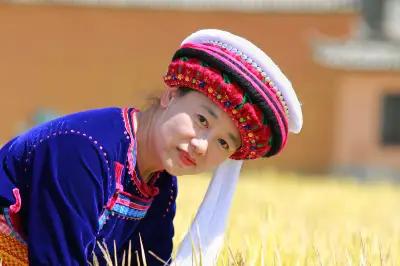
A Photo in the Xizhou Countryside (Photo: Pu Hongbing)
With the Xizhou visit concluded, my fourth trip to Dali came to a perfect close. Although the trip lasted only three short days, merely a fleeting glimpse of Dali, it was immensely rewarding. Dali's Bai ethnic culinary culture with its unique flavors and the colorful Bai song and dance performances left me with unforgettable, delightful memories. Farewell, Dali! I'll come back again when I have the chance. (Text and photos: Feng Ganyong)