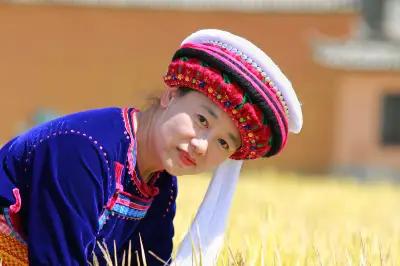
Explore an Ideal State, Dream Back to Nanzhao Kingdom, Be a Time Thief in Dali (Shaxi, Xizhou, Weishan, Dali Ancient Town)
I sit in my room, flipping through your photos, and it reminds me of Dali.
Sunshine always so bright, sky so azure, forever green Cangshan. I love the blue Erhai Lake, dotted with white sails, my heart beats slow with the wind. Under the golden sunset, in the green fairy grass, your smile is so warm. —— "Warmth" by Xu Wei
This is my fifth time in Dali, and only now do I realize that Dali is far more than just Dali.
After my fifth visit, I wondered why I always missed this before. In my memory, Dali only meant that small area around Erhai Lake. My obsession used to be watching clouds roll by the lake, so I missed the "ideal states" away from Erhai like Shaxi and Weishan. Now that I've explored every corner by Erhai, I finally ventured north and south. Along with beloved Xizhou and the iconic Dali Ancient Town, these four old towns and ancient cities are the true treasures of Dali, making life worthwhile! In my youth, how many dreamed of Dali in Yunnan? I've entered the dream and don't want to wake. Let the mountain songs accompany my journey.
『 One · Dali Ancient Town 』—— Find a city by Erhai Lake
"If you can't find someone you like, why not find a city by Erhai Lake?" My heart fluttered the first time I heard that. This is already my fifth visit to Dali Ancient Town, and it still feels the same—so comfortable, perhaps because of Dali's radiant sunshine, perhaps because of its gentle breezes and light clouds.
Although it's a popular spot, the artistic vibe here is unique to an ancient town. Within the high walls, you can stroll and daydream, enjoy flowers and wine, or pause anywhere to listen to music. You're no longer just a passing traveler.
Those scattered handcraft shops, snack stalls, bars, or unassuming little stores in every corner are all scenery.
At the foot of Cangshan, facing Erhai Lake, spring warmth brings flowers to bloom.
Soon you'll notice cherry blossoms blooming along the streets. Walking on the uneven flagstones, your heart lightens. If you're unhappy with life, why not head west to Dali.
Millennium Ancient Tower | Wuhua Tower
When you think of Dali Ancient Town, what building first comes to mind? As long as you walk its main streets, you can't miss this striking pavilion—it's a landmark of both the old town and Dali itself.
The architecture in Dali Ancient Town features uniform grey-tiled roofs, exuding simplicity. At the heart of this 1,200-year-old city stands Wuhua Tower, a grand and exquisite structure with four pavilions supporting it and clear streams surrounding. Once famous during the Nanzhao and Dali kingdoms.
Located in the middle section of Fuxing Road, it's one of Dali Ancient Town's iconic buildings, magnificent and captivating. In ancient times, Wuhua Tower served as an official banquet venue for distinguished guests; it was five stories high and could hold ten thousand people.
Historically, Wuhua Tower was burned and rebuilt several times, enduring a millennium of change. The current tower was reconstructed in 1998, a twenty-plus-meter four-story building: the bottom one is a platform, the upper three the tower itself.
Wuhua Tower is one of the more imposing structures in the old town, offering views of Cangshan from above and a panoramic overview of the ancient town area. Especially at night when the lanterns first glow, it's exceptionally beautiful.
When Bai Architecture Meets Jesus | Catholic Church
I bet 90% of visitors to Dali Ancient Town don't know it hides a church—truly the most worthwhile religious building to see. When traditional Bai dwellings meet Jesus, Dali Ancient Town seems to gain a new layer of mystery.
Tucked away in a lane off Renmin Road is the most distinctive building in the old town: the Catholic Church. If you're tired of the crowds, come with me to this rare quiet spot, standing silently among the crisscrossing streets.
Without the words "Catholic Church" above, you'd never guess there was one here. It's not the conventional European-style church you'd imagine. Built by European missionaries in the 20th century during a wave of "sinicization," they crafted it in a Chinese—or more precisely, Bai—style.
This strikingly Bai-style church is called the Holy Trinity Church, with upturned Chinese eaves resembling a pair of unfolding wings. Beneath the flying eaves are exquisite stone carvings and vivid color paintings. Crimson pillars and red doors are classic Chinese red, and the layered dougong brackets above the entrance are living fossils of ancient Chinese architecture. The couplets on the doors blend Catholic elements with traditional Chinese parallel verse, a harmonious fusion of East and West.
This is a place the French should most visit, for over a century ago, their ancestors brought Catholicism to Yunnan and created this Chinese-Western hybrid Holy Trinity Church. More than a hundred years later, French tourists marvel in front of this Chinese-style Catholic church. Dali's diverse and inclusive culture seems unchanged, standing tall like this wonderful church.
Warming a City with a Bookstore | Dafang Bookstore
This was a chance discovery while strolling the old town after dinner—a bookstore I never knew could be so large.
Stepping inside, I was surprised by how spacious it was; from outside, it looked tiny.
Dafang Bookstore traces its roots to Zhonghua Book House, founded in 1993, and was officially established in 2014. The name "Dafang" comes from Zhuangzi's "Autumn Floods": "I have long been laughed at by the great masters," referring originally to those who understand profound truths, later to well-informed or learned individuals.
Inside are many delicate trinkets and stationery, all warmly arranged. Stepping in feels heartwarming.
I enjoy Dali's slow pace, holding a warm coffee, the quiet of being alone.
The bookstore's central area is the most photogenic, especially the staircase from the first to the second floor—a must-stop. Upstairs, several large characters declare, "This is Dali," letting you feel its welcome.
Amid the greenery and whispers of books, I wait for you in Dali; Dafang waits for you here.
Encounter an Academy Deep in the Alley | Wutong Academy
Besides Dafang Bookstore, there's another quiet, little-known bookstore hidden in the old town, very low-profile.
A vertical sign by the roadside points into an alley, about twenty to thirty steps in.
This alley is incredibly peaceful, with few tourists venturing here, evoking a hint of Xizhou.
Inside, there's a small courtyard. On the ground floor, they sell drinks. I grabbed a lemonade and headed into the reading room. To my surprise, no one was there; it felt like I had the whole place to myself.
Poetic windows, wooden desks, bright lighting—a lovely atmosphere. Even a brief rest stop is great: drink, chat, and best of all, no crowds, so you can enjoy the quiet alone.
Knowing Only Wind, Flower, Snow, Moon, Not the Town of Literature | Confucian Temple
Walking along Fuxing Road, the main street of Dali Ancient Town, you'll see a building with flying eaves and dougong brackets: it's Dali Confucian Temple.
Though located in a bustling area, not many tourists visit, making it a perfect spot for peace amidst noise. Especially in the morning, it's serene and cool, offering a moment of tranquility.
Dali Confucian Temple faces east, with symmetrical axis layout and courtyard terraces stepping upward. The architecture is predominantly wooden in antique style, reflecting Bai architectural tradition. It once served both prefectural and county exam sites and is a landmark of Dali Ancient Town.
Entering the gate, you see a bridge called "Zhuangyuan Bridge" (Top Scholar Bridge). Legend says only those who passed the highest imperial exam could cross it; others had to go around. The pond beneath is "Panchi," signifying scholarly success in ancient academies.
The temple is also called Confucius Temple. The restored version you see today carries profound traditional Chinese culture, deeply influencing Dali and bearing witness to its title "Town of Literature." Every corner exudes an ancient fragrance.
In front of the main hall, many prayer plaques hang; each year, parents come to pray for their children's success.
Walking through the temple, a few scattered visitors, the simple walls retain traces of the past, silently telling of bygone glory.
Both Former Governor's Mansion and Mini Forbidden City | Dali Museum
99% of people don't know Dali Museum is right inside Dali Ancient Town!
I stumbled upon this place while passing by. The site was once the Qing Dynasty Yunnan Governor's Office, Du Wenxiu's Marshal Mansion, the headquarters of the Seventh Detachment of the Yunnan-Guizhou-Guangxi Border Region, and the office of the West Yunnan Working Committee. Hence, the sign didn't directly say Dali Museum.
Even on non-holidays and non-weekends, quite a few visitors come. The well-ordered buildings and lush greenery make you feel like entering a grand courtyard.
Leveraging its ancient town core, the museum preserves the original Qing architectural style while seamlessly blending rich exhibitions with garden ancient structures—like a miniature Forbidden City.
The collection spans precious artifacts from Dali's Neolithic era to modern times, nearly 10,000 pieces. It houses six permanent exhibitions: Historical Relics, Ming Dynasty Pottery Figurines, Buddhist Art, Ancient Calligraphy and Painting, History of the Yunnan Governor, and Du Wenxiu's Uprising, plus an expanded Stele Forest section—making it a unique resource for studying Dali's history and culture.
The museum's vermilion walls exude antiquity, known as "Forbidden City Red." When sunlight filters through, tree shadows dance, full of poetry. Unlike typical solemn museums, its garden-style design is distinctly Dali.
Dali Ancient Town Food
Every time I come to Dali, I can't resist hunting for tasty treats. I've compiled some for you!
Milk Fan is a fan-shaped dairy product from Dali, a local specialty. A thin slice with low moisture, milky white or yellow, shaped like a water-chestnut fan with small ears. It can be eaten raw, fried, grilled, or in a salad. One of Yunnan's "Eighteen Oddities" says, "Milk is fried and eaten"—that's Milk Fan. The picture shows grilled Milk Fan bought on the street.
Yunlong Rice Noodle Rolls are a snack from Yunlong in Dali. I bought mine on Fuxing Road. The rolls are chewy and springy, ten yuan each—a good price. Tangy, sweet, salty, spicy, with crushed peanuts, the texture is rich.
Yangbi Rice Noodle Rolls are a specialty from Yangbi, Dali. Looking a bit like rice noodle rolls, they're made from premium rice, with a delicate texture. Flavored sour, spicy, sweet, plus the richness of walnut paste, they're uniquely delicious.
Flower Cake is Yunnan's most representative delicacy—a crisp pastry filled with edible roses unique to Yunnan. Many travelers buy it as a souvenir. My mom especially loves it.
② Restaurant Recommendation For Dali Ancient Town, I'll recommend just one favorite restaurant, a traditional-style inn where you can try many Yunnan specialties. I love both the ambiance and the food—already my second visit!
It's in a side alley off Renmin Road. After a day exploring, I returned to the old town as the lanterns first glowed. Passing by, I spotted this little gem.
The restaurant oozes ancient charm: cherry blossom decorations at the entrance, calligraphy menus, wooden lofts, paper lanterns, guzheng and drums. It's so classical that wearing Hanfu would make it even more photogenic—instantly teleporting you to ancient times.
The restaurant has two floors. From outside it seems small, but inside it's spacious. At the entrance, large wine jars greet you, and the aroma of wine fills the air.
I didn't expect the dishes to be as stunning as the setting, shrouded in drifting fairy mist.
Emerald Rouge Snowflake Fish is a perfect ten in presentation. A signature dish, generous portion, the fish meat tender and smooth, mouthwatering just to look at. There are even cobblestones inside.
Dali Erkuai Spicy Chicken is not as heavy as Sichuan-style; the spice level is moderate, suitable for all tastes.
Wind, Flower, Snow, Moon is a must-order!!! The name is so Yunnan. At night in Dali, of course I'd sip a few cups. This is their house-brewed drink with two flavors: one peach blossom wine, one plum wine. A perfect slight tipsiness.
The special Paoluda blew me away—just order it! My friends all loved it. If you don't like it, come find me.
When we left, they gave each of us a hand-drawn map of Dali Ancient Town they made. I loved it so much, I still keep it.
『 Two · Xizhou Ancient Town 』—— Love, Delight, Joy, Xizhou
I love this quote praising Xizhou by Fangqi: "How can I tell you what Dali is? Using the sound of wind through wheat fields in Xizhou... perhaps you'll understand?" Whenever Dali comes up, beyond Erhai Lake, the first place that springs to mind isn't the old town but Xizhou Ancient Town. I never miss Xizhou on any trip—it never feels repetitive. It's less bustling than Dali Ancient Town, offering a more reserved, quiet beauty.
Xizhou's Yellow Walls and Wheat Fields, Peaceful Years | Xilinyuan
I truly adore the yellow walls of Xilinyuan. Every time I pass, I snap a few photos. Under the old grey tiles, the long outer wall is painted orange-yellow, reflecting the blue sky, white clouds, and endless rice paddies, like a natural ink-wash painting.
Any pose you strike here looks great, and group photos with funny poses are super fun.
Recording a short video is also nice; many video photographers choose this spot.
This is Xizhou in spring—the wall surrounded by rapeseed flowers. In autumn, it's waves of rice paddies.
Meet You at the Corner | Round Corner House
The Round Corner House is a must-see in Xizhou and its iconic landmark. Located at 119 Shijing Street, it was originally the old residence of Yang Ruxuan, a villager from north Xizhou, built in 1945. It's the most uniquely structured and styled historical building in Xizhou.
Its corner location, inward residence, outward commercial idea, fusion of Chinese and Western design, and curved exterior accidentally left a miraculous building for Xizhou, creating today's hugely popular photo spot.
If you want photos, I suggest going before 10 am when there are fewer tourists. I went at noon, and people were already queuing for pictures.
Blue and White Romance, Daydream Here | Lanxu Tie-Dye Shop
Only after several Xizhou trips did I finally visit this shop—highly recommended. Many come to Xizhou just for it.
It's in an ordinary lane in Xizhou; go to the end, turn right.
Free to visit, no extra charges, and the owner is very welcoming, happy to have you sit.
Here you can learn tie-dye, have a drink, or simply take photos and rest—all fine!
The shop has two floors, a small courtyard, and a balcony. The first floor is a blue tie-dye themed experience area; the second floor overlooks the little fields of Xizhou.
Glass windows, round arches, and the rooftop are great photo spots. I recommend going in the morning; afternoon draws more crowds.
Miyazaki's Wheat Fields Really Exist | Kelizhuang
Have you seen the shape of wind, heard the sound of wind through wheat? The manga-like scene of wind-swept wheat fields truly exists in Xizhou!!!
This wheat field is near Kelizhuang village by the roadside. Navigate to "Kelizhuang" along the Dali Line; it's right by the road.
Taking photos here costs a small fee—10 yuan per person, no time limit, shoot until you're exhausted!
A girl next to me dressed adorably. Remember to bring props when you come, or you might end up like me with only a few shots—things like an easel, kite, butterfly net etc.
If you're after wheat field photos, best come before April. The sight of wheat swaying in the wind is truly dreamlike—worth seeing in person.
But I must say, the wheat was already bent. Lying down in the field for photos still looks great, but please try not to trample it unnecessarily.
If you miss it, make a date for next spring!
Xizhou Food
Most of what Dali Ancient Town has, Xizhou also offers. Besides roasted milk fan and rice cakes, the star is Xizhou Baba!
Available sweet or savory, it's baked with charcoal above and below—the top fierce, the bottom gentle. After shaping the dough and brushing with lard, it's baked, repeatedly basting with oil until fragrant and crisp.
"A Bite of China" once filmed here. When in Xizhou, you must try Xizhou Baba!
It used to be very cheap, but with tourism, prices have risen.
I also recommend a few other places: Guzidi Garden Restaurant, A Maying Pea Jelly, Jiyisi Café. You'll love them.
『 Three · Weishan Ancient Town 』—— Earthly Flavor of Nanzhao's Ancient Capital
Because of Dali Ancient Town, Weishan, a hundred miles away, became a forgotten place and a rare haven for daydreaming in Yunnan. Time faded its former prosperity but preserved a rare original essence. When I set foot in this 600-year-old town, I regretted discovering this gem so late after so many Yunnan trips. Before writing, I hesitated whether to share it—I loved its unworldly aura so much, fearing future crowds would turn it into another Dali Ancient Town, losing its true charm. When I posted the video online, some said, "Don't recommend it anymore, we'll have nowhere to daydream." It's a conflicted feeling, but even if I don't share, others will. I can't protect it from commercialization, so let me show its most beautiful side as I see it, letting the world know that the old Yunnan can still exist. Apart from the worldiness and distant landscapes, there is nothing else.
Bird Song and Flower Fragrance in Mengyang | Mengyang Park
My first stop in Weishan was Mengyang Park, not originally planned—I didn't even know its name then. It was right next to the parking lot, so we stumbled in. (No need for a map in Weishan; just wander; surprises await.)
This is a favorite spot for locals, who call it "Big Park." The former "Small Park" next door has become a square, so this "Big Park" is the only park within the ancient town.
It's not a scenic spot but brims with everyday life: women watering flowers, elderly exercising, kids running... Coupled with the pleasant climate and singing birds, it's the first time I felt a park's atmosphere so vibrant.
You'll notice the trees festooned with birdcages. Weishan has many bird keepers; walking their birds in the morning is as routine as our daily meals, ingrained in their lives. The air is never without birdsong; here, mornings truly wake you with chirping.
Weishan Library is also in Mengyang Park—an ideal reading spot in such surroundings.
Mengyang Park is nearly a century old, housing well-preserved ancient structures like Yanta Arch, Chongsheng Shrine, Zunjing Pavilion, Minglun Hall, plus numerous ancient trees. Its cultural depth sets it apart from ordinary parks, and that's its charm.
You'll see a red-walled building: the "Nanzhao Chess Academy," originally the "Qin and Chess Club," founded in 1938 for chess and music activities, later renamed. Weishan hides many chess masters. The academy still retains its historical layout; when no tournaments, it's a bustling tea house.
Ancient trees, pavilions, ponds, corridors, greenery, and flowers—you'll forget your worries and savor the moment's tranquility, sipping tea, soaking in the park.
Magnificent Nanzhao, Historical Capital | Nanzhao Museum
A must in Weishan Ancient Town is the Nanzhao Museum! To uncover the mysteries of the ancient Nanzhao Kingdom, start here; it's an ideal first stop.
Located on Baoguo Street, the museum opened in 2015, blending modern exhibition halls with ancient architecture into an artistic hall.
The first building you see is the prologue hall. Like a book's preface, it summarizes the exhibition and sets the historical context—an overview of the entire museum.
The ceiling of the prologue hall features a stunning color painting of "The Nanzhao Pictorial," recording detailed Nanzhao history—Yunnan's earliest surviving painting artwork.
On the floor, the rise and fall of Nanzhao over a century are engraved.
Nearby are artifact exhibition halls: swords, pottery, jewelry—remnants of early Weishan civilization. Though not vast, the collection captures the essence of Nanzhao culture.
Here lie many answers about Nanzhao history.
During the Tang Dynasty, the Erhai region was dotted with small states, each independent. Among them, the six most powerful were Mengxi, Yuexi, Langqiong, Dengdan, Shilang, and Mengshe—known as the "Six Zhao." Mengxi was in north Weishan to Yangbi area, Dengdan in Dengchuan area, Langqiong in Eryuan area, Shilang in Qingsuo of Eryuan, Yuexi in Binchuan, and Mengshe in Weishan. Though autonomous, Mengshe was the mightiest and, located farthest south, was called "Nanzhao" (Southern Zhao). With Tang support, King Piluoge unified the six Zhao, moved the capital to Taihe City, and founded the Nanzhao Kingdom.
Beyond the exhibits, the architectural beauty of the museum is even more captivating, retaining traces of the past.
Dengjue Temple, Sun Palace, Lin Gong Shrine, Zhaozhong Shrine, and the Dengjue Twin Pagodas form key parts of the museum. Sun Palace stands out with its grand, simple, and weighty presence.
Sun Palace was built in 1418 (Ming Dynasty) by the Meng Hua native prefect and monk Wuyong, renovated in both Ming and Qing. Its massive timber structure, well-preserved and exquisitely crafted, is a vital example for studying early Ming wooden architecture, of immense heritage value. Inside, two sets of doors are displayed:
The "Hundred Longevity" Partition Doors: Six doors (two missing), each 54 cm wide, 245 cm high. The top panels of the first five each feature eighteen seal-script "longevity" characters; the last door has ten "longevity" plus the inscription "created on an auspicious day in mid-autumn, Yihai year," collectively forming the "Hundred Longevity Picture." The lower panels are carved with auspicious motifs like "magpies on plum," "phoenix through peonies," and "cormorants with lotus," exquisitely carved with profound symbolism. These doors reflect the owner's forward-thinking health philosophy. A partition door set carved with seal-script "hundred longevity" is extremely rare, forming a cultural treasure blending seal art with ancient wellness theory.
Minglun Hall Partition Doors: A complete set of six Ming dynasty woodcarvings, each 294 cm high, 70 cm wide, divided into five carved sections top to bottom. The topmost features auspicious beasts—dragon, phoenix, crane, tiger. The main panels: the outer four show spring, summer, autumn, winter landscapes; the middle two depict mountains, water, castles, and pagodas. The three lower levels are all floral patterns. Relief and openwork carving combine with vivid colors, creating distinct layers. Towering mountains, majestic waterfalls, winding rivers, villages amid greenery, drifting clouds, bridges, seasonal flowers—all come alive with vitality and serene harmony.
The Dengjue Twin Pagodas south of Sun Palace I find especially beautiful. Golden sunlight halos them more mysterious and majestic, with wind chimes on the eaves sending threads of Zen—utterly enjoyable.
Endured Vicissitudes, Lofty Palace Wall | Confucian Temple
Dali Ancient Town has its Confucian Temple; Weishan has its own.
Weishan's Confucian Temple stands next to Mengyang Park, featuring Dachengmen, Dacheng Hall, Yanta Arch, Chongsheng Shrine, Minglun Hall, Zunjing Pavilion etc. Once a place for officials to worship Confucius and for scholars to take exams.
Outside the temple, a street lined with lanterns and paper umbrellas looks beautiful under the sun, as if welcoming visitors.
The temple is grand, covering about 10,000 sqm. Facing south, a sprit screen at the front bears the marble inscription "Lofty Palace Wall." The phrase from The Analects means "The Master's wall is many ren high; if one cannot find the gate and enter, one cannot see the beauty of the ancestral temple and the richness of its officials; those who find the gate are few indeed." Thus, the "Lofty Palace Wall" was built before Confucian temples to symbolize the profound wisdom, virtue, and thought of Confucius, beyond ordinary comprehension.
Past the screen, you see a small arched bridge and pond. According to ancient rites, the emperor's academy had a circular pond called Piyong; feudal lords had a semi-circular one called Panchi, or half-wall pond. Thus, enrollment was termed "entering the Pan." The Panchi is a key feature of Confucian temple architecture.
The bridge crossing it is also called "Zhuangyuan Bridge." Only top scholars could cross; others went around.
Continuing along the central axis, you encounter the "Lingxing Gate." An important ancient ritual structure, first recorded when Emperor Gaozu of Han ordered a sacrifice to the star Lingxing. Later, Lingxing was worshipped before heavenly ceremonies, believed to govern scholars' success. In the Song Dynasty, a Lingxing Gate was placed by the sacrificial platform wall, and because its shape resembled window lattice, "Ling" (spirit) was changed to "Ling" (lattice). The left path through the gate is Yi Road, the right is Li Gate.
Beyond Lingxing Gate is Dacheng Gate, also called Yi Gate or Ji Gate. Yi Gate signifies that those entering should be neatly dressed and dignified out of respect for Confucius. Ji Gate implies authority and high status, befitting prominent families. "Dacheng" is Mencius's appraised of Confucius.
Inside, it's very quiet. When I visited, there was not a single tourist, making you want to sit on the steps and savor the slow passage of time.
Every plant, brick, tile, door, railing, flower is a world.
Hub of All Directions, Tower in the City Center | Xinggong Tower
Xinggong Tower is the landmark of Weishan Ancient Town and my absolute favorite building here—a must-see!!!
At first sight, it felt familiar, a bit like Dali Ancient Town's Wuhua Tower, but with more historical weight.
Located at the very center of Weishan, it's a street-crossing tower from the Ming Dynasty Meng Hua Prefecture. First built in 1390, rebuilt in 1711, destroyed in 1857, and reconstructed in 1860 by General Ma Guozhong of Du Wenxiu's Muslim uprising. The tower stands 11 meters tall, comprising a wooden upper structure and a brick-stone base. The pavilion-style building combines beam-lifting and through-column construction, with double eaves and a hipped gable roof. The ground floor has a veranda all around, with dougong brackets inside and out.
Climb Xinggong Tower for a panoramic view of Weishan. Its perfectly proportioned upper and lower sections, well-preserved, possess an indescribable beauty.
The four sides bear plaques: "Auspicious Halo on Huafeng Peak," "Cranes Embracing Weixia," "Jade Ring and Melon Fields," and "Dragon shadows on Cangshan." They face the four main streets. In old times, official decrees were posted here to inform the public.
Apart from the vast landscapes and earthly bustle, there is nothing else.
Commanding Six Zhao, Overlooking Ten Thousand Li | Gongchen Tower
From Xinggong Tower, you can see Gongchen Tower not far away—truly magnificent.
Originally the north gate tower of Meng Hua Guard City, built in 1390. It was originally three stories, then reduced to two during renovations in 1648. Standing on a brick wall 47.1m long, 26.6m wide, 8.1m high, climbing up offers a view of countless twinkling lights of the city.
Under the south eaves hangs the plaque "Commanding Six Zhao" written in 1771 by Meng Hua Deputy Prefect Kang Xu. Under the north eaves, "Overlooking Ten Thousand Li" was written in 1785 by Deputy Prefect Huang Dahe. Both plaques exhibit powerful, vigorous calligraphy, adding immense charm to Gongchen Tower and all of Weishan.
Gongchen Tower and Xinggong Tower stand like dazzling twin stars over the ancient city.
Weishan Food
The saying "Play in Dali, eat in Weishan" is spot on.
For instance, the "Single Strand Noodle" featured on "A Bite of China." I recommend Zhuji Single Strand Noodle or Su Laosan Yigu Noodle—mostly patronized by locals, and they stop selling after noon. Guojiang rice noodles (bridged rice cakes) are unique, but locals prefer braised pork rice noodles; try Laowang Guojiang Rice Noodles. Also, grab a traditional Weishan popsicle—strolling the streets while licking one is the epitome of leisure. Add rice noodle rolls, grilled rice cakes, fried stinky tofu, all cheap and delicious. It's not an overstatement to call it a low-key foodie paradise.
『 Four · Shaxi Ancient Town 』—— This Is the Ideal Life
This is a place I've wanted to visit many times but kept missing due to various reasons. This time, I finally didn't miss it.
The ideal of life is to live an ideal life, and this idyllic haven between Dali and Lijiang makes it possible. Shaxi—my current favorite ancient town.
I can no longer revisit the Dali and Lijiang of 20 years ago, but Shaxi still offers a chance to time travel.
The town is small yet exquisite. The Jiangnan-style "small bridge, flowing water, households" feels different on this southwestern land—rustic, pure, authentic.
How to describe the feeling? "Stunning" to capture "tranquility"? Though it sounds odd, that's exactly it—isolated from the world, untainted. The air carries the scent of earth and walls; footsteps and horse hooves echo clearly, inspiring deep affection and lingering thoughts.
If you have ample time in Yunnan, this place you must visit!
A Hidden Paradise on the Ancient Tea-Horse Road | Yujin Bridge
In ancient times, Shaxi was a key post on the Tea-Horse Road, and anyone passing through would cross this bridge—Yujin Bridge.
Originally an iron-chain bridge, "Iron Chain Over the River" was one of Shaxi's four scenic views. It was destroyed during the Xianfeng era's wars when the chains were melted into weapons. The current semicircular single-arch stone bridge was built from 1921 to 1935, funded by donations. The name "Yujin" derives from a couplet by Shi Lifei in 1792: "Stone can form a bridge, henceforth no need to sing 'Gong Wudu'; the ford is truly jade, only here do we know water has a source."
An extant inscription by Bai scholar Zhao Fan and commander Yang Yiqian, "Appeal for Repairing Yujin Bridge," attests to its importance on the Tea-Horse Road.
Surrounding Shaxi is a river called Heihui, over 20 meters wide at its broadest, flowing around the town.
In the past, the riverbanks on both sides of Yujin Bridge were ideal resting spots for horse caravans, where countless travelers and pack horses watched the rising sun and moon.
Yujin Bridge is also a favorite sketching location for art students and professionals; painters come here daily.
With the decline of the Tea-Horse Road, this place was gradually forgotten, but precisely because of that, it has better preserved the look of an old horse caravan town.
A Gate Through Time | Nanzhai Gate
Nanzhai Gate is, in my opinion, the most distinctive gate in Shaxi Ancient Town. The first time I saw it, I had an illusion: what hidden world lies beyond?
On this side is an open space; peering through the gate reveals a deep, quiet alley, sparking curiosity.
In the past, the old Beizhai Gate was destroyed by war and weather, leaving only Beiguzong Alley leading to it. Nanzhai Gate connected to various salt wells south of Shaxi.
Approaching Nanzhai Gate, you first step onto a blue flagstone lane—Nanguzong Alley, full of old-world charm, lined with many shops.
Shaxi Food
Compared to Weishan, Shaxi has far fewer local snacks—quite scarce, really. Try the sweet wine here. "Si Yue Kitchen" next to Nanzhai Gate is good. The most famous restaurant, "Chujian Shaxi Private Kitchen," I haven't tried, but many recommend it. As for afternoon tea, it feels even more worthwhile, fitting Shaxi's daydreaming vibe. "Universe Bread," "Match Coffee," "Half Mountain Coffee," "Raven Café," "Yezi's Shop" are all worth visiting.
Appendix 1 · Travel Tips
— Map distribution of the two ancient cities and two old towns
— About Car Rental
Renting a car in Dali is very convenient, especially for circling Erhai Lake—the best choice! Don't rent from random roadside vendors; the risk includes high deposits and substandard vehicles. Inspect the car carefully for damage before renting; take photos or video to avoid disputes. Use third-party platforms whenever possible for better assurance; with a Zhima credit score above 600, you can waive the deposit. Return the car with the same fuel level as when picked up; check the gauge. Scratch insurance is usually 50 yuan/day; get the necessary coverage, safety first. Renting an electric scooter is suitable for Dali Ancient Town and nearby, typically 60 yuan/day.
— 20 Things You Must Do in Dali
? Visit Dali University in spring for cherry blossoms.
? Go to Tianlong Babu Film City to soak in martial arts atmosphere.
? Experience tie-dye in Zhoucheng and make a canvas bag.
? Take a photo with the Three Pagodas of Chongsheng Temple.
? Spend two days lazing in Xizhou Ancient Town to truly know what peaceful years feel like.
? Must-try: roasted milk fan and Xizhou baba.
? Rent a car or cycle around Erhai Lake.
? Visit Jizhao Nunnery for vegetarian meals and forest seclusion.
? Climb Cangshan to see azaleas.
? Go to Shaxi Ancient Town to feel authentic Dali charm.
? Drop into any bar at night for folk music.
? When tired, find a bookstore in Dali Ancient Town to read and sip coffee.
? Eat street barbecue at night; the night is just as enchanting.
? Watch a sunrise and sunset by Erhai Lake.
? Rent an electric scooter and wander aimlessly through streets and alleys.
? Go to Butterfly Spring and hum "Beyond the Colorful Clouds."
? Have a beautiful solo photoshoot.
? Find a guesthouse you like and sunbathe, daydream on the terrace.
? Head to quiet spots to see seagulls flown in from Siberia.
? Don't follow a tight schedule; sleep in naturally!
— Notes
1. Sun protection! Sun protection! Sun protection! Can't stress this enough.
2. Dali has a big temperature difference, so pack not just summer clothes but also a jacket.
3. If driving to Shaxi, slow down on curves near cliffs; there are many trucks.
4. Always carry an umbrella; Dali rains often.
5. Wear comfortable shoes—never high heels.
— Dali Travel Seasons
January: winter cherry blossoms
March: spring cherry blossoms
March–April: rapeseed flower fields
May–June: sunflowers in full bloom
July–October: rainy season; more rain, take an umbrella
September–October: rice paddies turn golden
November–March: seagulls migrate from Siberia
Appendix 2 · About the Author
A Leo boy born in '98, based in Chengdu. Over four years of university, I've traveled to 7 countries and 60 cities. Ctrip signed traveler. Partial to lesser-known spots in cities and natural scenery. Hoping for wonderful, kind encounters. The journey is long—see you on the road.