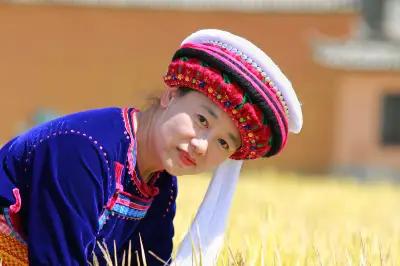
Summer Dali Travel Guide: Playing in Erhai, Admiring Flowers at Xima Pond, Listening to Rain at Gantong, Watching Clouds at the Three Pagodas of Chongsheng Temple
HAPPY SUMMER
Playing in Erhai, Admiring Flowers at Xima Pond
Listening to Rain at Gantong, Watching Clouds at Chongsheng Temple
Travel is one of the best ways for modern people to relax.
During holidays, the number of tourists nationwide often reaches hundreds of millions, or at least tens of millions, causing a surge in visitors at popular scenic spots across the country. Therefore, many people choose to travel during off-peak times.
Yunnan, as the most popular tourist destination in Southwest China, attracts a huge number of visitors all year round.
Yunnan is a magical place, especially the route from Kunming to Dali, Lijiang, and Shangri-La. Taking Kunming as the center and heading west, you can see different seasonal landscapes in the same season.
Spring flower seas, summer clouds and mist, autumn fields, winter snow mountains. From Kunming to Shangri-La, only about 700 kilometers apart, yet along this 700-kilometer road, you can witness strikingly diverse scenery, which feels incredible.
Dali and Lijiang, as the two most important cities on the western route of Yunnan tourism, both have unique ethnic minority cultures and a particularly famous mountain. However, those who have visited know that the two cities give completely different feelings.
As the scorching summer arrives, here is a summer travel guide to Dali, allowing you to get to know the most outstanding summer scenery in Dali in advance and prepare for your trip!
As a tourist city, Dali has very developed tourism transportation. There are tourist shuttle buses from the high-speed rail station, airport, and bus station, as well as bus routes between various attractions, making it very convenient.
Dali is a very special place, with mountains, water, and flowers that bloom all year round.
In addition, Dali was the capital of the mysterious "Nanzhao Kingdom". Another legendary family, the Duan family, produced rulers who "preferred monastic life to the throne". The legends of Erhai and Cangshan are deeply rooted in people's hearts. With mountains, water, and people, everything about Dali appears perfectly reasonable.
People have lived at the foot of the mountain and by the water for generations. Everything in Dali revolves around life and development. During this time, history changed, culture accumulated, life flourished, and buildings rose. After years of development and renewal, it has finally become what we love today.
Under the blue sky and white clouds between Cangshan and Erhai, various flowers can be seen everywhere. Alleys, roads, farmlands, and houses crisscross. The prosperity of the city and the simplicity of the countryside blend perfectly here. Life is slow, and the sense of happiness is extremely high!
In such an environment, the beauty of every scene and object is magnified infinitely. Rain and mist on Cangshan, water and moonlight on Erhai, and ancient architecture are all worthy of appreciation.
As summer and the summer vacation arrive together, there is a new reason to go to Dali.
At this time, Dali has clear water, green mountains, and vibrant flowers, making it the best time to explore the summer scenery and border town life of Dali. When visiting Dali in summer, these sights and activities should not be missed!
Water is not rare, but it is rare in Dali. Along the shore of Erhai, a small road is built around it, forming a loop for tourists to cycle around the lake.
Erhai is not a sea but a plateau lake. It is the "mother lake" that sustains the life and reproduction of the Dali people, and it is also the most unforgettable impression for everyone who goes to Dali.
Whether locals or outsiders, everyone has their own way of visiting Erhai.
Locals never consider Erhai a scenic spot; they have long regarded it as part of the city. For those living by the lake, Erhai is a place for an after-dinner stroll.
A gentle lake breeze blows, causing branches on the shore to sway gently, as people walk along the lake... Day after day, year after year, this is the life of the Dali people. Visiting Erhai has become integrated into their daily life.
Outsiders visit Erhai differently from locals. Locals observe from a distance, while most outsiders combine "close-up" and "distant views".
Outsiders tour Erhai by cycling around the lake and taking a boat to sail on it. The difference is that cycling is a loop tour around Erhai, while taking a boat offers close contact with the lake.
Whether children or young people, everyone has an indescribable attachment to water, especially a plateau lake as clear as Erhai, with gentle ripples, which is particularly attractive.
Several small islands and peninsulas in Erhai, such as Luoquan Peninsula and Nanzhao Customs Island, have become "popular check-in spots" in Dali.
The islands vary in size. Some are far from the shore, away from the crowds, extremely quiet, and many people like to spend leisurely days there.
A loop tour around the lake allows you to see all the islands, while taking a boat allows you to see the most famous Nanzhao Customs Island and even go ashore to explore.
The boat departs from Dali Port Wharf in Xiaguan City, gradually moving away from the city, passing villages, as if traveling through a painting, taking all passengers to view Dali's mountains and waters from the best angle.
During the voyage, dance performers on board present the Bai ethnic songs and dances characteristic of Dali in batches, allowing you to enjoy the melodious and cheerful Bai tunes.
The boat tour is a "self-guided tour" throughout. Cangshan and Erhai are the basic scenery. The boat makes a stop at Nanzhao Customs Island during the journey, where you can go ashore to explore the island on your own.
On Nanzhao Customs Island, you can see the sky and water merging. The mountains, trees, and rocks on the island create a beautiful scenery with brilliant clouds and mist. The stone paths and pavilions wind and twist, and ancient tree shadows sway, letting you feel the gentle touch of the breeze.
Finally, the boat docks at Shuanglang Town’s Shuanglang Pier, ending the boat trip and beginning a leisurely tour of the ancient town...
Cangshan Xima Pond is the "ultimate beauty" of summer in Dali. The azaleas covering the mountains are the most beautiful sight of this season. The bright azaleas and the verdant forest complement each other, creating the most stunning summer scenery.
The azalea sea at Cangshan Xima Pond is not as dense as artificially planted flower seas, but its sparse and orderly natural distribution adds a sense of freedom and casual elegance.
Although there are a large number of azaleas on Cangshan, the temperature difference caused by altitude affects the blooming time of azaleas at different elevations. Therefore, it is likely that the foot and waist of the mountain are in bloom while the top still has buds.
When Xima Pond is clear and rainless with high visibility, the number of azaleas is at its peak, and the Xima Pond cable car is operating normally, it is the best time to admire flowers at Xima Pond.
At this moment, the scene you see takes full advantage of the right time, place, and people!
In addition to flower viewing, the 5,555-meter one-way cable car ride and the scenery outside the cable car line at Cangshan Xima Pond are also unforgettable.
The Cangshan Xima Pond cable car, as the passenger cable car with the greatest altitude difference in the world and the longest climbing distance in China, leaves a memorable impression. It is 5,555 meters long with an altitude difference of over 1,600 meters.
With such a huge altitude difference and the scenery along the cable car line, this cable car is definitely a top-tier experience.
Taking the cable car, you look up at the mountains and forests from the foot, then overlook Erhai and Dali from the mid-mountain. Above the mid-mountain, you travel through clouds and mist, searching for ridges and gullies. At the top, you experience breaking through the clouds and suddenly seeing the sky clear.
The experience of taking the Xima Pond cable car can be summarized as: surprises appear unexpectedly!
The word "Gantong" is both the name of a tea and an ancient temple, as well as the name of a cable car.
In this article, "Gantong" refers to both a cable car and a mountain scenery.
The Gantong cable car is named after its proximity to Gantong Temple. It produces Gantong tea. The most artistic Jizhao Nunnery in Dali is also located here, and the most beautiful "Qingbi Creek" among the eighteen streams of Cangshan is hidden in the deep mountains nearby.
Gantong Temple, Jizhao Nunnery, Gantong cable car, and Qingbi Creek form another classic tourist route at the foot of Cangshan.
Because the Gantong cable car is located in the core area of Cangshan National Geopark, with lush vegetation, the feeling here is different from other places.
The sound of Qingbi Creek flowing, birds singing in the mountains, and raindrops pattering on leaves are all very clear. Although untouched, they still bring joy to the heart.
Taking the Gantong cable car to listen to the rain in the mountains is the most comfortable, healing, and addictive thing to do in summer!
The mountains at this season have the most comfortable temperature and humidity, and the most pleasant natural sounds.
Once you enter the mountains, you don't want to leave or move; you just want to sit quietly and soak in the comfort and tranquility.
Qingbi Creek, the Zhenlong Chess Game, mountain tea houses, and mountain pavilions—the combination of architecture and natural scenery creates a sense of elegance, revealing the Zen that ancient literati pursued.
Just like Qingbi Creek, people know it is a three-pool stream, but some can see something different.
Just like a mountain rain, some people think it delays their journey, while others feel it is a concert of nature in the mountains, nourishing everything.
Just like people watching the scenery in the mountains, who knows if they themselves are part of the scenery in someone else's eyes?
Although it is about viewing scenery, what people see varies widely—different people have different views.
In summary, the experience along the Gantong cable car line can be described as "different people, different feelings"!
The Three Pagodas of Chongsheng Temple Cultural Tourism Area is a Buddhist cultural site in Dali, a concentrated display of Dali's architecture and culture from the Tang and Song dynasties.
The most prominent buildings in the Three Pagodas area are the "Three Pagodas," which are also the most historically significant structures.
The architecture of the Three Pagodas is distinctive, but without understanding the cultural connotation behind the scenery, you might only see them as ordinary buildings.
Therefore, most people first notice the natural scenery when they come here.
The Three Pagodas are built with Cangshan behind them and facing Erhai. As soon as you enter the area and look up, you can see Cangshan—snowy white on the top in winter, and surrounded by clouds and fog in summer.
During this season, the most obvious view of Cangshan at the Three Pagodas is: clouds and fog cover the mountain from the top to the waist, making Cangshan disappear from sight.
The background of the Three Pagodas turns from green to white, and the mountains are no longer visible. However, driven by the sun and wind, a small part of the clouds dissipates, revealing a corner. It is this corner that makes you feel the charm of Cangshan and the clouds.
Choose a spot at the Three Pagodas to quietly watch the clouds. Above Cangshan, clouds surge, wind and clouds rise, thick fog quickly gathers and disperses, like a sped-up "Chronicle of Cangshan Clouds."
The architecture of the Three Pagodas becomes more solemn, more mysterious, and even more unique amidst the surging clouds!
Traveling to Dali in summer—watching flowers, playing in water, listening to rain, and observing clouds—brings a sense of ease and comfort. You can also briefly experience Dali's slow and interesting life during your journey.
Let the natural scenery between Cangshan and Erhai, as mellow as fine wine, intoxicate your heart. Your body and mind will be soothed here. Such a trip is worth having!
Text & Layout: Yunnan Yijing
Images: Some images provided by Dali Tourism Group. If there is any infringement, please contact for deletion.
Note: Please indicate the source for reprinting articles.