Yunnan: A Journey on a Whim
Since last Spring Festival, special circumstances have kept me cooped up at home. The past two years have been unbearably stifling—without venturing out to wander, life feels bland and flavorless. But there was nothing to be done. I could only look through my travel archives at home and share them with you, to soothe my restless soul.
A few years ago, I traveled to Yunnan. As winter neared, the Yunnan-Guizhou Plateau's temperature swings were huge, shaped by the plateau monsoon climate under the influence of the South Bengal high-pressure system. Most of Yunnan enjoys warm winters and cool summers, feeling spring-like all year round.
Yunnan's tourism resources can be roughly divided into four major areas. The northwest—Dali, Lijiang, Shangri-La, Lugu Lake—is not only ringed by majestic alpine scenery, but also draws countless visitors each year seeking a taste of romantic, tranquil living. The provincial capital, Kunming, serves as a hub, with the Stone Forest, Fuxian Lake, and Luoping's rapeseed flower fields all worth a visit. The south includes Xishuangbanna, the Yuanyang Rice Terraces, Puzhehei, and Bamei. In the west, there's Baoshan, Dehong, and Nujiang, but the truly unmissable highlights are Tengchong, Heshun, Ginkgo Village, the Three Parallel Rivers, and the border town Ruili.
I've traveled widely across China. If I were to sum it up: Yangzhou in flowery March; Xining, the perfect summer escape; Kunming, delightful in all seasons; Chongqing, the gourmet capital; Xi'an for its profound history; Tibet, for cleansing the soul; and Jiangnan, for ancient town charm. Yet, colorful Yunnan miraculously combines all of these, blending their finest qualities while balancing their shortcomings.
Perhaps everyone who dreams of traveling to Lijiang fantasizes about a beautiful romantic encounter. They imagine something might happen—a chance meeting under the rain eaves, in a bar, at a guesthouse, around a corner. But only when you get to Lijiang do you realize it's nothing more than wishful thinking.
Jade Dragon Snow Mountain is undoubtedly Yunnan's star attraction, famed for its 'precipitousness, wonder, beauty, and grace.' From base to peak, it showcases a progression from subtropical to temperate to alpine landscapes. At the foot lies Ganhaizi, a sprawling meadow where you can gaze up at the Jade Dragon peaks towering between blue sky and white clouds.
Yunshanping (Spruce Meadow) is a sacred place in the hearts of young Naxi lovers—a tranquil grassy expanse, with ancient trees towering toward the clouds and thick vines creating a secluded, elegant atmosphere. From a distance, the Jade Dragon peaks gleam like a hanging waterfall, silver in the sunlight.
The Impression Lijiang performance, with its Naxi music and the imposing Jade Dragon Snow Mountain as a backdrop, presents a striking visual tableau: a crimson stage, snow-white peaks, and a deep azure sky. The performers' masterful acting and poetic lines leave a lasting impression. Galloping horse caravans, Naxi women carrying baskets over rocky mountain paths, scenes of hard labor, and Naxi men drinking and dancing to welcome faraway guests—all come vividly to life.
Blue Moon Valley is a rather mediocre scenic spot, overly artificial in its design.
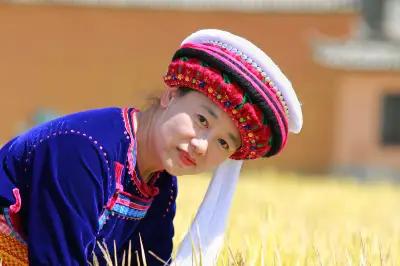
Fifty-six ethnic groups, fifty-six blossoms. The women of each group, adorned in vibrant reds and greens, are elegant, poised, and charming.
Of China's 56 ethnic minorities, Yunnan is home to 51. Among them, 25 have populations exceeding 5,000 and relatively concentrated communities. It's said that 15 of these—including the Bai, Hani, Dai, and Lisu—are unique to Yunnan and found nowhere else. Their vibrant traditions and customs add a unique dimension to traveling in Yunnan.
Yunnan is a highland region, and attractions are far apart. After a long drive, we reached Shuhe Ancient Town.
Shuhe Ancient Town's main appeal lies in its snow mountain views and hotels. Gazing up at the snow peaks, watching lovely people pass by, looking down at the cobblestones, listening to the murmur of water, and savoring local bites—this captures the authentic experience of Shuhe.
Compared to Dayan Ancient Town's quaint courtyards, bustling alleys, and noisy bars, Shuhe Ancient Town is even more vibrant.
Before I knew it, I had entered Lijiang, the mystical ancient Naxi kingdom. The pure meltwater from the snow peaks, borne on a cool breeze, seemed to sweep away the dust of the mundane world, calming my restless heart.
Lijiang is a must-visit destination—a classic check-in spot. What goes around comes around, as they say.
Lijiang's nightscape is not to be missed. As dusk falls and neon lights sway, you absolutely have to hit a bar and party.
Every city in Yunnan is spotlessly clean and well-kept. Life moves at a leisurely pace, making it an ideal place to retire.
Chongsheng Temple is another must-see. With Erhai Lake to its east and Cangshan Mountain to its west, it sits at the foot of the mountain right by the lake. The temple's Three Pagodas are especially renowned—often called the 'Dali Three Pagodas'—and rank among China's most famous pagodas. They have long symbolized Dali and have served as a filming location for Jin Yong's martial arts epics. On a clear afternoon, it's the perfect time to capture their reflection in the water.
As evening falls, bars begin to open. It's only when you pause that you get to see the most beautiful views.
But I still love the waterwheels, steadfast in my belief that fortune is ever-turning.
After taking in Lijiang's night scenes, the next day calls for a spectacular audio-visual feast—the grand ethnic performance 'Lishui Jinsha' (Golden Sands of Lijiang).
Through song and dance, the ethnic minorities present themes of family, friendship, and love as a gala for travelers like us who have never truly known Lijiang. This is more than a showcase of ethnic traditions; it’s a clash of civilization and raw nature. Leaving the hustle behind to feel that primal rhythm—what could be more meaningful?
The show features group dances, a Hani women's drum dance, Tibetan songs and dances, Yi dances, a De'ang women's dance, and a showcase of traditional costumes from across China’s ethnic mosaic. The scale is immense, leaving the audience spellbound.
In the dance of Dai maidens, they move with an unhurried, water-like grace—like the sweetest nectar of the earth, like a flowing moon stirring tender emotions.
The most emblematic part is the marriage culture—showcasing the world’s last surviving matriarchal society, the 'Axia' walking marriage tradition by Lugu Lake. With its entwined emotions and elegant choreography, it vividly conveys the boundless charm and depth of Lijiang's courtship customs.
Love and hate, life and death—these are humanity’s eternal themes. The marriage customs of ancient matriarchal clans, part of a five-thousand-year civilization, represent a sublime intertwining of soul and body, intellect and emotion. We humans cry out for civilization, yearn for happiness, and pray for immortality.
'Lishui Jinsha' is not just a tourist show—it’s modern art. Through graceful dance, enchanting music, vibrant costumes, spectacular staging, and flickering lights, it pioneers a new form of ethnic performance, worthy of being called China’s answer to Broadway.
Throughout the entire show, applause never ceased. Truly a feast for the senses, leaving you with endless afterglow.
The show came to a close with a grand finale celebrating ethnic unity.
The Chinese nation, a people that have endured so many trials, has stood unshaken in the East, thanks to the unity and solidarity among its ethnic groups.
A divided family may see loved ones become estranged; a divided workplace breeds scheming; a divided ethnic group scatters like sand; a divided country invites humiliation.
Over millennia of migration, trade, intermarriage, and cultural fusion, China’s ethnic groups have formed a tapestry of mutual integration, living side by side and complementing one another, giving rise to a cherished tradition of unity and love.
A key reason the Chinese nation has been able to rise from the ashes and march toward glory is that all ethnic groups have shared joys and sorrows, stood together in pride and shame, and united against foreign foes. In the process, our treasured tradition of ethnic solidarity has not only flourished but also launched us onto a new journey toward great rejuvenation.