A Legendary Journey: 2021 Golden Autumn in Henan Travelogue (6 5A Scenic Spots, 2 People, All Expenses 2100 Yuan)
Today (2021-12-21), as I was preparing to supplement my travelogue and photos, I suddenly discovered that the latter half of the text and images were missing, which was quite frightening! I decided to write a few spin-off posts to share with everyone the most impressive scenic spots.
2021-12-14: Newly uploaded a few compressed photos—first, let's take a look at Laojun Mountain.
2021-12-1: Most recently added 'Henan Cuisine Chapter'.
During this eight-day trip in Henan, we had over ten main meals plus daily breakfasts, and the most impressive were the various soups for breakfast. Throughout the journey, especially when staying at Laojun Mountain, self-heating rice and self-heating hot pot meals proved to be extremely handy. Speaking of soup dishes, whether it's the beef soup on the streets of Luoyang or the flat noodle dish (bian fen cai) by the roadside in Anyang, they were all delicious. However, the famous 'Luoyang Water Banquet' we tried at a restaurant didn't feel particularly outstanding, and my wife especially didn't like it.
It's said that a Luoyang local's breakfast always starts with a bowl of soup. Beef soup, beef offal soup, creamy and sweet lamb soup, tofu soup, meatball soup... the choices are endless. Luoyang people have their own kind of dedication when it comes to food. As the saying goes, 'The morning is the golden time of the day,' so Luoyang people never compromise on breakfast! 'In Luoyang, there are 100 kinds of breakfast to wake you up with 100 different cravings'—this is no exaggeration.
Luoyang's old town feels very much like a fourth-tier old county town, with historical depth and great simplicity, and the food is delicious and cheap. This is unequivocally a compliment—I really love this feeling when traveling. It's far better than man-made 'historical sites'; it's authentic. A bowl of rich, fragrant soup paired with golden, crispy fried meatballs is the meatball soup that Luoyang people yearn for. My wife is particularly fond of these crispy meatballs, which are said to be made from deep-fried vermicelli. (Some say it's tofu.)
In Luoyang, we specifically went to an old shop on the old street to try the 'Luoyang Water Banquet' using a group-buy package from a certain review website. Here's a professional introduction borrowed from online:
The Luoyang Water Banquet is a calling card of Luoyang. Over 100 years ago, it was enjoyed by nobles and officials in the imperial court, but now it has long become a common home-style meal for ordinary people. If we ask how much a Luoyang Water Banquet costs, should we go for an expensive one or a cheap one? Should we have a full table, or just sample a few dishes? If going for an expensive one, the century-old famous brand Luoyang Water Banquet is a renowned Chinese feast and a time-honored brand. If you want to try all the dishes in the banquet, generally there are 8 cold appetizers, then 16 main courses, and 8 pastries. The 16 main courses are: Peony Swallow Dish, Luoyang Stewed Assorted, Luoyang Sliced Meat, Steamed Pork Strips, Spicy Fish Fillet, Milk Soup Braised Offal, Braised Four Treasures, Luoyang Crispy Pork, Seasoned Phoenix Wings, Sour Soup Crispy Fried Balls, Quick-boiled Meatballs, Luoyang Sea Cucumber, Oil-fried Eight-treasure Rice, Honeyed Ginseng Fruit, Rice Wine Red All Over the River, and Fulfilling Wish Soup. Together with the cold dishes and pastries, a full table generally costs at least 500 yuan.
Throughout the streets and alleys of Luoyang, there are many small and medium-sized restaurants serving the Water Banquet, such as Yan Tianxia, Luoyang Noodle House, Luoyang Restaurant, etc. There are also many small eateries like Yaoyao Water Banquet and Xinghua Village on West Street in Luoyang's old town. Behind the old market in the old city, on Xian Guo Shi Street, there's a Guanji Water Banquet that is very popular, often requiring a queue. This shop offers small portions, allowing you to sample the essence of the Luoyang Water Banquet with 10 to 8 dishes for no more than 200 yuan. The folk-style Water Banquet in Luoyang still retains traditional flavors, with those in the old town being more authentic.
This time, we specifically went to a Water Banquet place on the old street near Lijing Gate, but it was unexpectedly closed, so we went to a nearby one called 'Xinxin Water Banquet.' We arrived at 5 p.m., and there weren't many customers. The boss introduced that only one steamed bun remained as the staple food for the day, which indicated that business had been good during the day. So we sat down. After we sat down, waves of 5 to 6 groups of customers trickled in, filling the small shop to capacity. In the end, an elderly couple who had arrived earlier had to share a table with other guests so everyone could sit. The dishes everyone ordered were pretty much the same; several groups used the same group-buy voucher. Later, the boss lady went out specially to buy two bags of steamed buns, and it seemed they were quickly consumed as well.
We ordered a double set meal online, which was really cheap: 4 dishes for 57 yuan, including the long-awaited Peony Swallow Dish, Boiled Meat Slices, Sour Soup Crispy Fried Balls, and a hawthorn soup (we took a sip at the shop, and it was okay—warm, sweet and sour; we packed it to take back to our accommodation for a late-night snack, but ended up dumping it the next morning). The only regret was too much pepper, and also all the soups were sour, making several dishes taste almost the same. The only thing my wife liked was the crispy fried balls, especially in their hot, un-soaked original state. Later, we asked the boss lady and found out they are made from vermicelli.
After finishing the Water Banquet, our stomachs were full but we didn't feel satiated. We returned the packed hawthorn soup to our accommodation (just a 5-minute walk away), then wandered around the snack street again. I ate half a serving of potstickers, and my wife had a handful of tripe skewers. We felt that it was no different from other snack streets, except there were a huge number of stalls (probably several hundred) and the prices were relatively cheap.
I have been a registered member of Ctrip for 21 years, but I haven't written a travelogue for over 6 years—I've become lazy. Most of the 42 travelogues still on Ctrip now lack visible images, losing much of their charm. The hundreds of thousands of views and over a hundred comments are all fond memories of the past.
This October, we went on an impromptu trip. Looking back now, it was an extremely lucky journey—we had a great time, spent little, and most importantly, perfectly avoided the pandemic. The trip took place between October 16-24, 2021. During that period, a new wave of COVID erupted in Inner Mongolia and other places, which later spread to Henan and Shanxi. Shortly after we returned to Dalian, a local outbreak started on November 4 and hasn't ended yet. Thinking back, this trip was truly fortunate. Because of this special stroke of luck, I decided to pick up the pen again, first to draft an outline and recount the itinerary in a journal style. If people are interested, I'll slowly put up my experiences and photos from the trip.
This nine-day journey passed through three provinces: Henan, Shanxi, and Shandong, with a self-driving distance of 2,100 kilometers. For two people, the total expense was 6,347 yuan. Excluding transportation, we spent 2,086 yuan on food, accommodation, and entertainment. Detailed breakdown will be provided later. We visited a total of 9 scenic spots, including 6 5A-level attractions. Besides sightseeing, we also visited 4 clients and 2 relatives along the way.
The schedule and itinerary were as follows:
Oct 16: 7:50 a.m. flight Dalian—Zhengzhou
Luoyang Lijing Gate,
Oct 17: Longtan Grand Canyon (Separate post, welcome to browse: Spin-off: A Joyful Tour of Longtan Grand Canyon https://you.ctrip.com/travels/luoyang198/4045435.html)
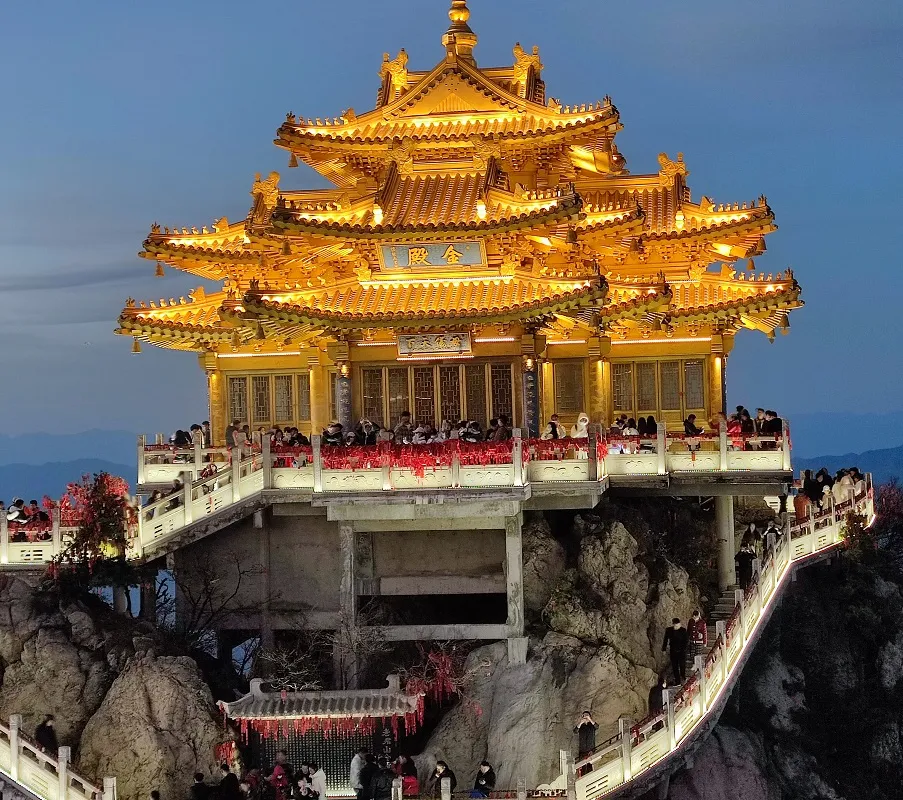
Oct 18: Laojun Mountain (Spin-off: Food, Clothing, Accommodation, and Travel at Laojun Mountain The absolute highlight of this trip to Henan was undoubtedly Laojun Mountain. https://you.ctrip.com/travels/2098808/4045020.html)
Oct 19: Longmen Grottoes
Oct 20: Red Flag Canal (Already compiled a spin-off: The Surprise and Inspiration of the Red Flag Canal https://you.ctrip.com/travels/linzhou1890/4046110.html?isAuthor=true)
Oct 21: Yinxu Museum, Chinese Character Museum
Oct 24: Flight back to Dalian
Expenses:
Round-trip airfare: 1,220 yuan
Car rental, fuel, parking: 3,041 yuan
Accommodation: 911 yuan
Scenic spot tickets, cable cars, shuttle buses, coat rental: 600 yuan (Among these, only Shaolin Temple tickets cost 140 yuan; all others were free.)
Food and shopping: 575 yuan
We owe this trip to the 'Encounter Golden Autumn, Enjoy Hometown Travel' tourism promotion held by Henan Province from October 10 to November 10, 2021. It was this free-ticket event that sparked the idea for my wife and me to travel to Henan. During this event, a total of 432 A-level scenic spots in Henan actively participated, offering free admission to visitors nationwide, accounting for 74.48% of all A-level attractions in the province. Of the 19 5A-level scenic spots in the province, 16 participated in the free-ticket event, including: Luoyang's Longmen Grottoes, Longtan Grand Canyon, Baiyun Mountain, and Laojun Mountain–Jiguan Cave; Pingdingshan's Yaoshan; Anyang's Yinxu, Red Flag Canal, and Taihang Grand Canyon; Jiaozuo's Yuntaishan, Qingtianhe, and Shennongshan; Xinxiang's Baligou; Nanyang's Dinosaur Relics Park and Laojieling; Shangqiu's Mangdang Mountain Tourist Area; and Zhumadian's Chayashan.
From the initial idea to the actual trip, it took only one week. Even when I requested annual leave from my boss before departure, he was a bit bewildered—why was I suddenly rushing to take leave? On October 12, I booked the flights on Ctrip: the outbound flight was a 71% discount economy class; later, the return flight was a 75% discount HUIXUAN economy class. The round-trip airfare per person was just 610 yuan, which was really cheap. After booking the flights, I started researching the itinerary and scenic spots. For the first time, I arrogantly set a rule of only visiting 5A-level attractions, but later I discovered that Henan's tourism resources are so rich that I simply couldn't cover all its 5A spots in the time I had!
Here's a little anecdote. I'm embarrassed to admit that a week before departure, I, a self-proclaimed travel expert, didn't even know about Laojun Mountain. It wasn't until I was doing my pre-trip homework and saw videos online of its fairyland-like scenery—especially those aerial shots overlooking the Golden Peak and sea of clouds—that I was instantly stunned. 'A peerless holy land under heaven, the world's number one immortal mountain.' I immediately decided that, no matter what, I had to stay overnight on Laojun Mountain to watch the sunrise and sea of clouds in the morning.
Finally, after reading descriptions and visitor reviews on Ctrip for each scenic spot, I initially selected 5 of the 5A attractions participating in the free-ticket event, plus the long-famous Shaolin Temple, which did not offer free admission. Once the destinations were set, I planned the route and decided to rent a car at Zhengzhou Airport for a self-driving tour. Before departure, I only booked the first night's accommodation in Luoyang, deciding to find lodging wherever we ended up. Since it wasn't peak tourist season, accommodation shouldn't be a problem, not to mention we had a car. I did pay special attention to the accommodation on Laojun Mountain; according to the introduction, it seemed that during peak season, getting a bed was extremely difficult. So I communicated with the mountain lodge owner via WeChat in advance and orally booked a small wooden hut for one night.
Since free tickets for each scenic spot could only be reserved three days in advance and required downloading the 'Henan Cultural Tourism' mini-program on the phone, I decided to delegate this task to my wife. As it turned out, this was a very wise choice; she perfectly completed the job, timely reserving all our planned tickets as well as some later unplanned ones. Kudos! I only bought the Shaolin Temple tickets on Ctrip for our first stop. At 70 yuan each, it wasn't expensive, but I was a bit puzzled why visitor reviews on Ctrip and the internet were generally low, so I appropriately lowered my expectations.
In that week from deciding to go to Henan until departure, whenever I got home, I would read the introductions and visitor reviews of various scenic spots on Ctrip. Later, I found that Baidu Video could search for introductions and various 'live-stream' type videos of each area. The images of each attraction quickly came to life, and my heart grew increasingly restless—it turned out that Henan is so beautiful, with such profound history, and so much delicious food. Full of anticipation, early on October 16, we embarked on this exceptionally worthwhile Encounter Golden Autumn trip to Henan.
Day 1: Shaolin Temple + Luoyang Lijing Gate + Luoyi Ancient City
The first day of a trip is often when one is in the best physical condition and most eager to explore. But the extensive homework I did before this trip meant my expectations for the first day weren't too high. As the saying goes, the higher the expectation, the greater the disappointment; lowering expectations is often a good thing.
We arrived at Xinzheng Airport at 9:40 a.m. With no checked luggage, we went straight to the parking lot to pick up the car—a white sedan, with a base price of 58 yuan per day. Adding insurance and other miscellaneous fees, the total rental cost for 9 days was 1,780 yuan, and we drove 2,100 kilometers. It was well worth it. After picking up the car, we headed straight for Shaolin Temple in Dengfeng—a childhood dream destination and the setting for countless films and TV shows.
A brief introduction to Shaolin Temple: In AD 495, the Northern Wei Emperor Xiaowen moved the capital to Luoyang and, to settle the eminent monk Batuo who came with him, selected a site and built a temple. Because the temple faces Shaoshi Mountain, backs onto Wuru Peak, and is located deep in the forest at the foot of the mountain, it was named Shaolin Temple. Ascending the steps before the temple gate, passing through the entrance hall, and following the central axis, you come successively to the Hall of Heavenly Kings, the Great Buddha Hall, the Sutra Library (Dharma Hall), the Abbot's Courtyard, the Snow-Incense Pavilion, and the Thousand Buddha Hall (Western Saint Hall)—a total of seven courtyards. Shaolin Temple has suffered several calamities in its history. The most recent was in 1928, during warlord conflicts, when the warlord Shi Yousan set fire to Shaolin Temple, burning down the Hall of Heavenly Kings, Great Buddha Hall, Sutra Library, and other main buildings to ashes; many precious scriptures, temple records, and martial arts manuals were reduced to cinders. The remaining structures today include the temple gate, Snow-Incense Pavilion, Thousand Buddha Hall, etc., while the others were rebuilt later. Shi Yousan got his comeuppance for his many misdeeds, eventually being buried alive.
As we neared Shaolin Temple around noon, it was time to eat. I kept thinking about Henan's stewed noodles, especially the lamb stewed noodles. In my recent business trips to Henan, I hadn't had a chance to eat authentic stewed noodles—the huge bowl, fragrant broth, lamb hidden at the bottom, mixed with daylily, wood ear mushrooms, bean sprouts, vermicelli... Just thinking about it made my mouth water. From experience, restaurants near tourist spots are often expensive and not tasty, so I decided to turn off at a place 7-8 kilometers from the Shaolin Temple entrance where people were more concentrated, and find a local, authentic stewed noodle joint to fill up and power up for an afternoon of sightseeing. Turning off the main road, I searched on my phone for local delicacies and found that options were either nearby fast food or delivery, or too far away. So we found a place convenient for parking and went looking for a restaurant. Eventually, we found a small corner eatery on the street called 'Jinjiang Restaurant'. It had six or seven small tables, serving various noodles as well as stir-fried dishes and 'rice' (locals call cooked rice 'da mi', which I hadn't noticed before). When we entered, there were no other customers. But looking at the servers, all honest-looking middle-aged folks over 50, and a bowl of lamb stewed noodles for just 10 yuan was indeed not expensive, so we decided to eat there.
I ordered a bowl of stewed noodles for 10 yuan, my wife had braised beef noodles for 16 yuan, and I also ordered a dish of sophora flower scrambled eggs for 19 yuan from the menu. A sumptuous lunch for just 45 yuan. The broth of the stewed noodles was excellent, although the side ingredients lacked the daylily and wood ear mushrooms I remembered, and there wasn't much lamb, but for 10 yuan a bowl, you can't expect a bicycle! My wife, however, was a bit unhappy with the braised beef noodles—she couldn't see any beef when the bowl arrived. I said the meat was hidden at the bottom; she probed accordingly and indeed found traces of a few diced beef pieces at the bottom—I guess beef has been extremely expensive this year. The sophora flower scrambled egg portion was huge, at least four eggs' worth by eye, and I immediately had the urge to pack it to go. My wife complained I'd ordered too much, but I insisted it wasn't much; in reality, I ate like a horse and was stuffed. Later, nearly every group of customers who came in ordered stewed noodles, proving my choice was brilliant.
Well-fed, we bought some drinks and water from a nearby shop. With our stomachs full, we felt invigorated and ready to explore Shaolin Temple thoroughly in the afternoon.
A brief introduction to Shaolin Temple: In AD 495, the Northern Wei Emperor Xiaowen moved the capital to Luoyang and, to settle the eminent monk Batuo who came with him, selected a site and built a temple. Because the temple faces Shaoshi Mountain, backs onto Wuru Peak, and is located deep in the forest at the foot of the mountain, it was named Shaolin Temple. Ascending the steps before the temple gate, passing through the entrance hall, and following the central axis, you come successively to the Hall of Heavenly Kings, the Great Buddha Hall, the Sutra Library (Dharma Hall), the Abbot's Courtyard, the Snow-Incense Pavilion, and the Thousand Buddha Hall (Western Saint Hall)—a total of seven courtyards. Shaolin Temple has suffered several calamities in its history. The most recent was in 1928, during warlord conflicts, when the warlord Shi Yousan set fire to Shaolin Temple, burning down the Hall of Heavenly Kings, Great Buddha Hall, Sutra Library, and other main buildings to ashes; many precious scriptures, temple records, and martial arts manuals were reduced to cinders. The remaining structures today include the temple gate, Snow-Incense Pavilion, Thousand Buddha Hall, etc., while the others were rebuilt later. Shi Yousan got his comeuppance for his many misdeeds, eventually being buried alive.
To be honest, if it weren't on the way, I wouldn't have made a special trip to Shaolin Temple, not wanting to shatter the lofty image of this holy place in my mind. From afar, you could already sense the Shaolin vibe; near where we had lunch, there were several Shaolin martial arts schools. As we approached Shaolin Temple, the various signs along the road further reinforced that unmistakable flavor. The parking lot at the entrance was huge, with at least several hundred cars parked. It seemed that even without the free ticket campaign, the place was bustling with visitors. There were shuttle carts at the gate, but I had done my homework and knew the walk inside wasn't long, so we didn't take one going in, planning to take it back if we got tired. However, on the return, we needed to stop midway for a martial arts performance, so we didn't take the shuttle back either.
Several archways and the temple gate at Shaolin Temple are good photo spots. Also, the stone steles and ancient cypresses inside are quite nice. As for the buildings, except for the Western Saint Hall, which survived the warlord's fire, the rest were rebuilt in recent years and not much different from elsewhere. However, the guardian figures at the entrance left a deep impression on me—their expressions were truly striking. Inside the Western Saint Hall, the footprints left by warrior monks practicing their skills are clearly visible, and some cypress trees have finger holes—all marks left by Shaolin martial arts. Also, finding the imperial handwriting of the two characters 'Shi Min' on a stone stele left by Li Shimin was a gain from this visit.
The commercial atmosphere inside the temple wasn't as heavily criticized online; there were a few donation spots for the temple's upkeep, but it wasn't too bothersome. The most speechless part was the Pagoda Forest—the resting place of eminent monks through the ages, yet some pagodas were carved with reliefs of airplanes, high-speed trains, and laptops. Isn't that a bit too up-to-date? After two hours of visiting, there wasn't much else to see at Shaolin Temple. The hour-based Shaolin martial arts performance was canceled for no apparent reason, and there was no sign or staff member at the performance hall to explain, which left visitors feeling quite uncomfortable. Although it's a free performance, we had still paid for admission. Fortunately, I had read some guides beforehand that mentioned an auction of calligraphy and paintings before each show, which I already disliked, so it wasn't a big loss. We decided to head back to Luoyang city early to rest, and in the evening, we planned to see the night view of Luoyi Ancient City!
Two things about Shaolin Temple are most commendable: first, there was no disorderly expansion of the temple buildings; second, there was no annoying music like 'Shaolin, Shaolin' or 'Shepherd Song' playing around the scenic area, disturbing the Buddha's tranquility. We left Shaolin Temple at just 3:30 in the afternoon. On a whim, I asked my wife to look for any other nearby free-entry scenic spots we could stop by, but we didn't find anything suitable, so we decided to go back to our accommodation in Luoyang to rest before heading out again.
I'd done my homework; the parking lot for our accommodation was right next to Lijing Gate, and navigating there would take about an hour and a half. Rationally, it was time to head home. Tonight's accommodation in Luoyang—Luohua Xianshe (the name itself is so artistic, I love it!)—had an absolutely amazing location, right on the old town pedestrian street next to Lijing Gate. After looking at the photos on Ctrip, each room had different decor. We finally chose a romantic love-themed king-bed room, originally priced at 214 yuan, but after applying various discounts, it was less than 118 yuan:
1 room x 1 night ¥214.00
Room and other charges ¥214.00
Premium member discount -¥33.00
Flight passenger discount -¥45.00
Billion-dollar subsidy -¥13.00
Full-reduction coupon -¥5.00
Total payable ¥117.95
For this trip, we only booked this one night's accommodation in advance, planning to check out the room after arriving and decide whether to stay here the next day as well. The room facilities were no less than a standard three-star hotel: the bathroom was separated into wet and dry areas, and the shampoo and body wash were large bottles of good quality. The decoration was artistic and cozy. It was the cleanest homestay I've ever stayed at. The room on the second floor had a small landing that felt like a private living room. I bought breakfast back and ate it in our room, which was exceptionally pleasant and comfortable. My wife could take her time getting ready while I was out buying breakfast—really nice. The host recommended the nearby peony cakes and Bufan soup, both very tasty. The shops on the pedestrian street all had distinct character. This directional sign was interesting, so I took a photo of it: The food from the first evening, and photos of the night scenes at Lijing Gate and Luoyi Ancient City will be edited and uploaded later. We were especially lucky with the accommodation choice—so close to specialty snacks, unique products, and scenic spots. It was fantastic!
For breakfast on the second day, I got up early, walked 20 minutes, and discovered a place called 'Old Sun Family Beef Soup' on my own. The taste was exceptional. Here are a few pictures to give you an idea:
2021-12-26 Update: Link to the spin-off on Laojun Mountain, to be continued...
2021-12-31 Added Red Flag Canal photos
2022-1-1 Added videos of Laojun Mountain and Longtan Grand Canyon (unfortunately, due to the 30M limit, only very short videos can be uploaded)