Early Winter Yunnan Journey 2021 Part 2: Dali and Shaxi Ancient Town
Leaving Wuliang Mountain in Nanjian County, we headed north. Today's destination was the only well-preserved major town on the ancient Tea Horse Road: Shaxi Town in Jianchuan County.
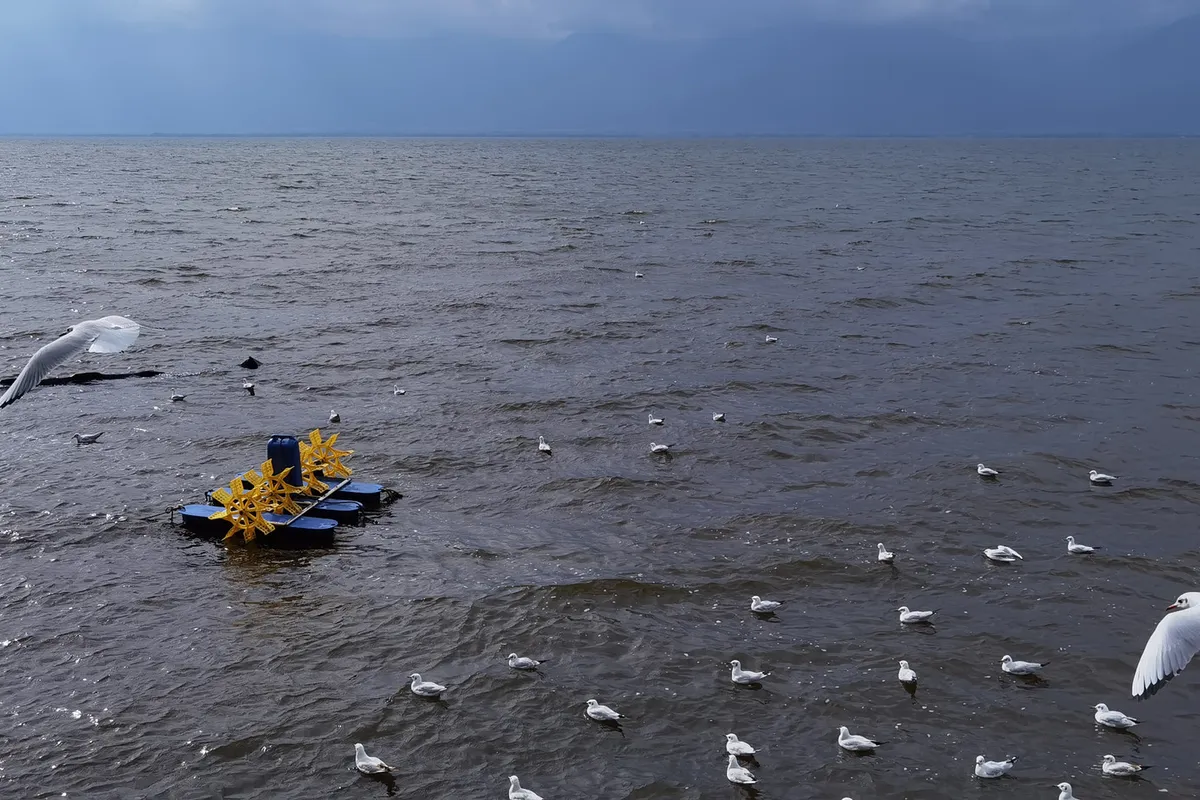
Passing through Dali, we originally planned only a short stop for lunch. Before coming, many people had criticized Dali Ancient Town for being overly commercialized. But just while we were eating, the thick, gloomy clouds that had persisted since morning suddenly parted, letting a few rays of Buddha's light shine through. We immediately decided to explore Cangshan and Erhai Lake. Erhai is the second-largest lake in Yunnan Province, with a total area of 246 square kilometers, elongated from north to south. Cangshan lies to the west of Erhai, stretching continuously along the lake. Dali has built a lakeside road along Erhai, about 120 kilometers long. We avoided Dali Ancient Town, the Three Pagodas Temple, and Butterfly Spring on the west bank. Instead, we drove leisurely from south to north along Hai Dong Road, stopping at Wase Town, Little Putuo Island, and the Shuanglang Viewing Platform to enjoy the lake and mountain scenery. Dali is truly a romantic place. On the ring road, brightly decorated luxury cars (all modified second- or third-hand cars) carried young men and women cruising along. Rental points dotted the roadside; when we asked, renting a Porsche convertible like that cost only 160 yuan per day. The owner said, 'No tourists this year, business is hard.' Shuanglang Town was originally a small fishing village. Now, celebrity mansions, shops, and inns are packed closely together. Among them, the famous dancer Yang Liping's grand mansion, Sun Palace, sits right on the waterfront. To protect the clean waters of Erhai, the government has drawn a red line requiring all buildings to retreat 30 meters from the shore. I wonder if this ban can be effectively enforced.
Shaxi Town is over 100 kilometers south of Dali Ancient Town and more than 30 kilometers north of Jianchuan County, nestled in a mountain hollow surrounded by peaks on all sides. A rushing river, the Heihui River, a major tributary of the Lancang River, flows through the town, dividing Shaxi into east and west parts. The ancient town where horse caravans once gathered is on the west side, while on the east bank, across a stretch of farmland, is a farming village. Two bridges span the river; one is a historic stone arch bridge used by the caravans. The stone slabs on its surface are pitted and scarred from the horses' hooves. Back then (during the Qianlong reign of the Qing Dynasty), villagers raised funds to build this bridge. The great Bai ethnic poet and literary scholar Shi Fan (courtesy name Lifan) wrote a couplet for the event: 'With stones we form a bridge, henceforth no more lament of "no crossing for you,"' and the second line: 'The crossing truly is jade; here one knows the water has its source.' The stone bridge was then named Yujin Bridge (Jade Ford Bridge). Today, this ancient bridge has become one of the town's four famous sights, a must-visit spot for photography enthusiasts. Whether it's the morning mist rising over the river and the cooking smoke curling up from the opposite village, or the sunset sky ablaze with crimson clouds, both sides of Yujin Bridge offer the best photo opportunities.
Shaxi Ancient Town was founded in the late Southern Song Dynasty and reached its heyday in the late Qing and early Republic period. Most of the surviving ancient buildings date from the Ming and Qing dynasties. In the 1990s, the town was listed by the World Monuments Fund. Many ancient towns and old cities in Yunnan have a central square where locals gather and markets are held, called Sifang Street. Shaxi's Sifang Street is particularly distinctive. On the west side of the square stands a temple called Xingjiao Temple. The area is predominantly Bai, so the temple follows Bai Buddhism. I took a look inside; the most striking feature of a Bai Buddhist temple is that the main hall has no clay statues but is covered with murals teaching people to do good. Opposite the temple is an ancient stage, about two meters high, with a triple-tiered roof, nearly as grand as the big stage in the Summer Palace. Both structures were built during the Yongle period of the Ming Dynasty, the same era as Beijing's Forbidden City, and are national-level protected cultural relics. The old town has two main streets: Sideng Street, running east-west, and Guzong Alley, running southwest-northeast. They meet at Sifang Street, and many lanes and alleys branch off from them. Bai homes are distinctive, featuring 'three rooms and a screen wall'—meaning a typical house forms a courtyard with a large screen wall by the main gate. Grander homes have 'four rooms and five courtyards,' with several rows of buildings and at least five internal courtyards. On every screen wall is written a four-character motto, such as 'Purple Air from the East' or 'Accumulated Goodness Brings Joy.' These are not just auspicious phrases; they also hint at the owner's surname. The entire old town has no city walls but has three gate towers: south, north, and east. Each gate is set at the end of a street or alley, essentially functioning as a watchtower, manned day and night to prevent bandits from robbing the caravan goods. The west side faces mountains with no road, so there is no west gate.
The town also has many old trees, each three to five hundred years old. Beside the stage stands an ancient locust tree, its gnarled branches highlighting the rustic charm of the stage. Near the former caravan trading hall, there is another old tree, its leaves resembling willow leaves, with a beautiful shape. In early winter, its leaves turn golden. Only after asking a local did I learn it was a Chinese cork tree (huanglian). Good heavens, cork trees grow very slowly; how many years must it have taken to grow so large? Chatting with elderly locals by the street, I learned a few things about the caravans. Why did this place become a staging point for caravans on the Tea Horse Road and thus flourish into an ancient town? The starting point of the Tea Horse Road is in Xiangyun County, Dali. From there to here is exactly a day's journey (they call it a 'leg'), so caravans would rest here overnight before continuing. Why is Pu'er tea pressed into round cakes? To make it easier for caravans to carry. Nowadays, with mechanized transport, there are naturally no more caravans, and the town has quieted down. Horses are now amusement rides for tourists. Shops in town are labeled with traditional names: 'Blacksmith' was where horseshoes were forged; 'Barber' is for haircuts. Especially interesting, on an old house at Sifang Street, slogans from that era remain: 'For the nation to be prosperous, the nation must be strong; for the nation to thrive, population must be controlled.' We laughed at that. Now, should we control for more or for less? It shows the slogan writer had foresight—written this way, it stays relevant in any era. Now the town sees few tourists, making it exceptionally tranquil. A persimmon tree laden with fruit leans over a wall, attracting many birds pecking at the fruit. Along both sides of the streets and alleys run water channels, with mountain spring water babbling through. In the past, these streams provided water for every household and served as a firefighting resource.
At night, listening to the gurgling water outside the window, I felt an urge to just lie down and relax. Many outsiders now rent old houses here, renovate them, and settle down for retirement. We met Taiwanese and even Americans renting here. We stayed at an inn near Sifang Street called Jing Ping She. The inn is small, with only six rooms, run by a Chongqing native. I asked him, 'Why open an inn here?' He said the climate is much better than Chongqing—not cold in winter, not hot in summer. The owner runs the inn alone, keeps two rare cats: a British Shorthair Fold and a large American Maine Coon, bigger than a teddy bear dog. He also keeps a huge Doberman pinscher as the household security guard. Shaxi Ancient Town is truly different from the water towns of Jiangsu and Zhejiang or the ancient villages of southern Anhui that I've visited. It is a wonderful place to stay longer, to relax and rejuvenate. We originally planned to stay one night but ended up staying three. (Some of the photos are the innkeeper's works.)