Picture-Perfect Scenery: All the Way West to Dali
“Seven Star Hill is haunted, eight horses run, you must down the wine...” In the late-night karaoke bar, drinking games and rowdy shouts filled the air, buzzing with energy. Old Wang sipped his cold beer and soaked in the clamor around him. It was his birthday. Normally he preferred peace and quiet, but so many friends said they hadn't seen each other in ages and insisted on a gathering, so he used the occasion to organize a dinner and drinks. Watching everyone laughing and cheerful, Old Wang felt a certain ease—after all, the recent slump in his industry and work had brought immense pressure and confusion. Amid the laughter, when he looked around, Old Wang noticed something off: his good pal Fatty, normally a chatterbox when drinking, looked completely preoccupied and out of sorts. As a loyal friend and big brother figure, Old Wang pulled him aside and asked with concern, “Brother, what’s wrong today? Is my wine not to your taste, or the girls not attentive enough?”
“Ah, Brother Qiang, the company is laying people off next month...”
“Oh, so that’s what’s worrying you.” Old Wang spoke lightly, but his mind spun like wheels on a highway. Fifteen-point-six-seven-eight seconds later, a story he was sure would move and persuade took form. He took a sip of draft beer, cleared his throat, and began to tell Fatty leisurely:
On Mount Cang I searched for the Six Meridian Sword; I didn’t find Prince Duan, only wind, flowers, snow, and moon.
By Erhai Lake I sought the Mantuo Villa; instead I met Xiyuan, truly a world apart.
Six years ago, my friend’s guesthouse in Dali—Xiyuan—opened. A thousand miles away, with no gift to send, I could only offer a doggerel poem to show my heart. More than two thousand days have passed since then, but I still had no clear idea where exactly the guesthouse was or what it looked like. Yet when Dali is mentioned, two moments instantly come to mind. One is Huang Bo singing in the movie *Heart Flower Road Trip*: “If you’re not happy with life, then keep heading west to Dali.” The other is from Jin Yong’s novel *Demi-Gods and Semi-Devils*, when the monk Jiumozhi goes alone to Dali’s Tianlong Temple to seize the ultimate martial art—the Six Meridian Sword. He uses everything he’s learned, fights six masters at once, battling them all—the plot twists are thrilling. Imagine: Jiumozhi, a royal dharma protector of Tubo, thoroughly versed in Buddhist scriptures, possessing supreme martial skill, with power, insight, and status reaching the peak. If even he was dissatisfied with life, how are ordinary people supposed to live? He went to Dali purely out of “greed.” He wanted every ultimate skill under heaven, which made him practice to the point of derangement, burst into madness, and lose all his martial arts. After that tribulation, he instead achieved great enlightenment, returned to Tubo to study Buddhism deeply, became an eminent monk, and was remembered through the ages. The master’s experience feels quite similar to the industry and work we’re in: already a pillar of the nation, yet the original aspiration couldn’t resist the temptation of expansion, blindly chasing scale and completeness. As they say, when things reach an extreme, they reverse—and events since last September have confirmed this.
After this long, impassioned speech, Fatty’s look shifted from dejection to bewilderment. I seized the moment to pour on more chicken-soup wisdom: “Life and work are the same—nothing is ever completely satisfying. It’s like walking in Chongqing: the roads go up and down, full of ups and downs. How about we head west... not to watch that movie you like, *Journey to the West* (the saucy one), but take some time to go west to Dali and experience the state of mind of Huang Bo and Master Jiumozhi?” Upon hearing this, Fatty lifted a full glass of beer and downed it in one gulp, then grasped my hand, tears streaming, and said, “Good big brother, I’ll follow your advice!”
Honestly, this kind of spontaneous, last-minute decision isn’t like a pre-planned, well-prepared trip where you’re full of anticipation and excitement early on. Even sitting on the speeding high-speed train, watching the floating clouds pass the window, I felt no thrill of travel. Then I glanced at the weather info on my phone: Dali, overcast, for a whole week straight...
The forecast was as accurate as ever. Arriving at Xiaguan, I didn’t see the crystalline blue skies typical of the Yunnan-Guizhou Plateau I remembered. There was only weak, intermittent sunshine, layers of dull grey clouds that shifted between dark and light, and a soporific cool breeze...
Then we entered the old town. Given the special circumstances of the time, there weren’t many tourists, and plenty of shops were closed. Inside the sizable town, it wasn’t exactly deserted, but neither was it bustling. Looking at the thick city walls at the South Gate, their mottled colors whispered of a long and weathered history. Those 1,200 years of sedimentation make every first-time visitor eager to find the city’s traces of time. But to be honest, nowadays most of China’s “old towns, ancient streets, historic villages” have their busiest central streets lined with shops selling jade, snacks, cold drinks—nothing to do with history. Nanjing’s Fuzimiao is like that, Chongqing’s Ciqikou is like that, Guilin’s West Street is like that, and Dali’s old town is no exception. So only when you inadvertently step into a little alley with grey tiles and white walls, a bluestone path underfoot, can you faintly feel the tranquility an old town is meant to have, and imagine its past noise, prosperity, and glory.
Climbing up Wuhua Tower to look into the distance, the sunshine had by then been completely beaten back by dark clouds. The sombre sky half hid and half revealed Mount Cang. All these signs seemed to tell us that maybe this wasn’t the best time to visit. That was my impression of the old town on Day One. Although I’m sort of an old friend (had been here before), this time it didn’t feel so welcoming.
But no matter how the weather or other objective conditions ahead presented themselves, the set itinerary had to go on. Just like life and work—you can’t give up because of temporary difficulties. Our plan for Day Two was a self-drive tour around Erhai Lake. After a night’s rest, we were physically recharged, plus a road trip is inherently fun, especially beside beautiful Erhai. So as soon as we got in the car, our mood was different from the day before. A few friends agreed: even if it’s cloudy, as long as it doesn’t rain, the trip is still worth it. But we were clearly too optimistic, because Heaven had other ideas. When you think an overcast sky is your bottom line, that’s just what you think.
When we reached Pantou Village, a tiny village that went viral online because of a curved road hugging Erhai Lake. The whole village is built along the shore, arranged tier by tier, human culture and nature reflecting each other. But the weather that day was truly uncooperative. On the Erhai ecological boardwalk, picturesque scenery lay on one side, while on the other, a piercing cold wind made us shiver. All pleasant sensations were blown away, leaving nothing. And by the time we got to Xizhou Old Town, heaven even sent rain—from a few scattered drops to a drizzle, then a steady pour. Faced with this, we had to quickly change plans, extend our stay in Xizhou, and wait it out. It never rains but it pours, and a delayed boat meets a headwind. This again reminded me of work: when you think the industry has bottomed out, when you think your own career has bottomed out, that’s just what you think. It all felt increasingly bleak and dispiriting.
But luckily, Heaven is fair enough—with enough patience and perseverance, when it closes a door, it will surely open a window. During our forced lingering in Xizhou, we hung out in a coffee shop, sipping drinks, people-watching, spacing out... Before we knew it, in the early afternoon, the rain stopped, the wind died, and the mist lifted. The many difficulties and discomforts, which arrived silently, also departed quietly. You could say the whole trip (the scenery and our mood) completely turned around right here.
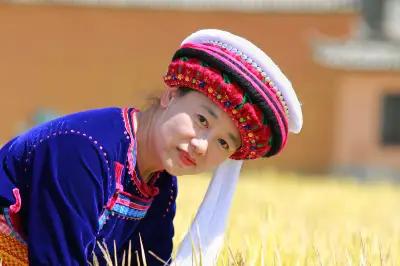
Xizhou after the rain lifted its bridal veil for us like a shy new wife. First to catch the eye were vast wheat fields. It wasn’t the ripening season; half-grown wheat swayed in the breeze, rustling softly—utterly enchanting. Walking around the fields, you could imagine the busy scene at harvest time and the joy of reaping. Today, the wheat fields not only provide food for the villagers but have also become a must-stop spot for countless visitors taking photos, creating greater value for the town. The perfect blend of people and nature was on full display.
Though occasional raindrops still spattered our faces, the morning’s soaking misery was gone. The temperature rose; a clear breeze brought supreme comfort. Everything was turning for the better. Beyond that, Xizhou boasts plenty of remarkable natural and cultural sights. Ancient, tranquil alleys; a bustling corner; a wide, open park; even an ordinary coffee shop—all were worth savoring with time and exploring on foot. Everything felt so down-to-earth and warm, as if we were back in our childhood hometown streets. We lingered, not wanting to leave. Time truly slowed down here.
We bid Xizhou goodbye and carried on.
As the sky gradually cleared, our mood lifted accordingly. Especially when we drove to Shangguan and gazed across at Xiaguan on the other shore, a few shafts of sunlight spread over the land, and the grey sky grudgingly revealed a few hints of blue—immensely gratifying. Would tomorrow really get better?
It turns out tomorrow not only got better but exceeded all expectations. When we stood in Shuanglang the next morning, looking toward Mount Cang and Nanzhao Folk Island, the longed-for blue sky and white clouds were right before our eyes. The sky was clean as a mirror; the clouds steamed and glowed, soft as cotton. With such a sky, how far behind could the sunshine be? Yes, the joy brought by that clear, sunny weather pervaded the whole final day. By then we’d already forgotten all the earlier gloom, downturn, and negativity. All the holding on and persistence over those three days proved completely worthwhile. Especially when we reached the last site, Longkan Wharf—it was the absolute highlight of the trip.
On the sunny, calm wharf, crowds surged and buzzed with life. This is the prime spot for sunrise and Erhai views, a witness to lovers pledging to grow old together, a big stage for wandering guitarists singing of the faraway. Standing there felt like being inside a painting—no binoculars needed; every corner offered a view or a surprise. In the distance, the snow-capped Mount Cang shone clear; up close, Erhai sparkled with rippling light; above, white clouds endlessly rolled; below, every face showed a happy smile. Here, Dali revealed her most beautiful side to us in full.
Joyful times pass quickly, and the 130-plus-kilometer journey around the lake ended before we knew it. But the road of life hasn’t stopped; new tracks and new journeys lie in wait! Just like our experience on this Dali trip—as long as we focus, persist, dig deep, and add a bit of luck, we’ll definitely get what we wish for.
Like an awards ceremony, as we were about to leave Dali, I couldn’t help but feel a wave of emotion:
I don’t know whether I counseled him along the way, or he comforted me, but I’m grateful for my good brother’s companionship.
Though there was still a mountain of unfinished work, thanks to my boss for granting me four days off.
Focus, persistence, deep cultivation; after long patience comes bright moonlight—this is actually the constant precept of my old leader. Though I’m unsure if we’ll meet again, I’m grateful for their guidance and tolerance at work.
Special thanks go to my brother Xu Xuexian for your strong support on this itinerary. The moment we met, you gave me a big bear hug plus a very Western-style cheek kiss, instantly making that familiar feel of stubble roaming across my face hit home, and startling everyone present. Even though you’d already downed a jin of baijiu that day, your singing was still remarkably lucid. A line from the song, “Don’t bring up the past again,” seemed to hint something to me... But whether you were sober in the real world or lost in a dream, I finally managed to get the car key from you and achieved my goal, safeguarding our Erhai ring road trip under these special circumstances.
If Erhai could hear, if Mount Cang could see, I really want to say: Thank you!
Detailed travel tips:
Dali is a tourist city with a pleasant climate, beautiful scenery, comfortable accommodation and food, mid-range spending, and overall a very nice experience. It’s well worth visiting—a must-recommend!
You must do a self-drive tour around Erhai Lake. The scenery along the way is stunning, the experience strong, and it makes you feel truly immersed, at little cost. Highly recommended! There are many rental shops locally; consider renting a car. Parking fees at scenic spots are usually 10 yuan per visit.
Xizhou, Shuanglang, and Longkan Wharf are all wonderful stops. This time we didn’t set foot on Little Putuo or Nanzhao Folk Island—viewing them from afar felt even better. Spend more time on the roadside “non-sightseeing spots”—they’re absolutely worth it.
At the South Gate of Dali Old Town, there’s a warehouse-style vinegar rice noodle shop that serves the best rice noodles I’ve had in Yunnan. The lard + sesame oil combo makes every bite fragrantly irresistible! I especially recommend Wase Town—not a traditional tourist spot, but definitely a genuine place where locals gather. Eat in the town and experience real local flavors.
Itinerary suggestion:
Day 1: Depart Chongqing at 7 a.m., arrive Xiaguan at 2 p.m. Direct buses outside the train station to the old town. Then leisurely explore the town; it’s liveliest between 9 and 10 at night.
Day 2: Depart the old town by car at 8 a.m., reach Pantou Village by 9 a.m., Xizhou by noon (worth an extended stop). In the afternoon, drive to Shuanglang, where the sunset glow is gorgeous. Stay overnight in Shuanglang.
Day 3: Depart Shuanglang in the morning and collect the remaining sights along the way. Return to the old town around 3-4 p.m. The distance isn’t long; no need to rush. Meander as you like, stopping longer wherever feels fun. Truly go with the person, the scene, and your mood. Overnight in Dali Old Town.
Day 4: Continue wandering the old town in the morning; head back to Chongqing in the afternoon.
Budget: Around 1,300 yuan per person for four days, including round-trip high-speed train tickets (Chongqing–Dali).
Note: The first 1,000 characters of this article are purely fictional; any resemblance is purely coincidental.